
传媒

Search documents
定期报告:节后春季行情进行中聚焦成长
Huajin Securities· 2026-01-04 02:01
1. Report Industry Investment Rating No relevant content provided. 2. Core Viewpoints of the Report - This year after the New Year's Day, the A - share spring market is underway and may be volatile and bullish, affected by factors such as policy implementation, liquidity, and the performance of the Hong Kong stock market [1][4][7]. - After the holiday, technology growth and some cyclical industries may be relatively dominant, with continuous upward industrial trends and policy support [1][26]. - After the holiday, it is recommended to continue to allocate industries such as technology, some cyclical and consumer sectors on dips [1][38][46]. 3. Summary by Relevant Catalogs 3.1 Post - holiday Spring Market is Underway 3.1.1 Factors Affecting Post - holiday A - share Movement - Since 2010, in 11 out of 16 years, the Shanghai Composite Index showed the same upward or downward trend in the 10 trading days before and after the holiday. The post - holiday short - term market performance is affected by policies, external events, liquidity, and the performance of the Hong Kong stock market [1][4]. - Positive policies and external events may lead to a short - term rise in the post - holiday A - shares, while tight policies or negative external events may result in weak performance. Liquidity also plays a key role, and the performance of the Hong Kong stock market during the holiday has a certain impact on the post - holiday A - shares [4]. 3.1.2 This Year's A - share Spring Market is Underway and May be Volatile and Bullish - Positive policies may continue to be implemented after the holiday, and external risks may be limited. The "two new" policies are accelerating implementation, local two - sessions may be held intensively, and consumption - stimulating policies may be introduced. Externally, the Fed may cut interest rates in January, Sino - US relations may remain stable, and geopolitical conflicts may ease [7][8]. - Post - holiday short - term liquidity may be further relaxed. Overseas, the Fed is likely to cut interest rates, and the RMB exchange rate may be strong. Domestically, the central bank may cut interest rates and reserve requirements. Also, stock market funds may accelerate inflow [9]. - The Hong Kong stock market performed strongly during the New Year's Day holiday, which may boost the post - holiday A - shares. The correlation coefficient between the Hong Kong stock market's rise and fall during the New Year's Day holiday and the Shanghai Composite Index's rise and fall in the 10 trading days after the holiday is about 0.5 [18][19]. - The post - holiday economy and corporate profits are still in weak recovery. The economy is in a weak recovery state, and corporate profits may continue to recover, although the industrial enterprise profits in November continued to decline [21]. 3.2 Industry Allocation: Focus on Growth after the Holiday 3.2.1 Technology Growth and Some Cyclical Industries May be Relatively Dominant after New Year's Day - Historically, policy and industrial trends drive pre - holiday strong industries to maintain their strength after the holiday. Pre - holiday leading industries may switch due to high sentiment or market adjustments. Industries with continuous strength around the New Year's Day usually have a relatively low historical quantile of trading volume [26]. - This year, the industrial trends of technology growth and some cyclical industries may continue to rise after the holiday. The pre - holiday leading cyclical industries have neutral - low sentiment, while the technology growth industries have high sentiment [26]. 3.2.2 Currently, the PEG of Electric Power, Media, and Automobile is Low - Among the primary growth industries, the predicted PEG of electric power equipment, media, and automobile is relatively low, at 0.64, 0.86, and 1.13 respectively. The historical quantiles of trading volume of medicine, computer, media, and automobile are low [40]. - Among the secondary growth industries, the sentiment of traditional Chinese medicine, biological products, automobile services, and chemical pharmaceuticals is low. The predicted PEG of nautical equipment, games, commercial vehicles, and wind power equipment is relatively low [44]. 3.2.3 After the Holiday, it is Recommended to Continue to Allocate Industries such as Technology, Some Cyclical and Consumer Sectors on Dips - It is recommended to allocate industries with upward policy and industrial trends, such as machinery (robotics), military (commercial aerospace), electric power (nuclear fusion, energy storage), media (AI applications, games), computer (AI applications, satellite Internet), electronics (semiconductors, AI hardware), communication (AI hardware), and medicine (innovative drugs) on dips [46]. - In the short term, it is recommended to allocate sectors that may make up for lost ground and have potentially improved fundamentals, such as securities and consumer sectors (food, retail, social services) on dips [56].
A股市场运行周报第74期:看多马年春节,短线两手准备-20260103
ZHESHANG SECURITIES· 2026-01-03 13:44
Core Viewpoints - The report is optimistic about the A-share market post-New Year, anticipating a "good start" after the holiday due to the rise in Hong Kong stocks and the A50 index [1][2][50] - There is uncertainty regarding the sustainability of the three driving factors behind the recent A-share rally: the A500 ETF's volume and price increase, the strength of optical modules, and the booming commercial aerospace sector [1][2][50] - The mid-term outlook suggests that the market may continue to rise before March, with a general recommendation to be bullish and proactive in investments [1][2][50] Market Overview - The market experienced narrow fluctuations before the New Year, with most broad indices slightly declining; the Shanghai Composite Index rose by 0.13%, while the CSI 300 and SSE 50 fell by 0.59% and 0.47% respectively [10][48] - The A500 ETF's share increased by only 1.58 billion shares in the last three days before the holiday, a significant drop from the previous week [10][48] - The overall market sentiment indicated a tendency to "rest and prepare for the next battle," as reflected in the low volatility before the holiday [10][48] Sector Observations - The report highlights strong performance in the petrochemical and commercial aerospace sectors, with the oil and petrochemical sector rising by 3.92% and the commercial aerospace sector increasing by 3.05% [13][49] - The report notes a resurgence in interest in robotics and AI applications, with automotive and machinery sectors rising by 1.44% and 1.32% respectively, while consumer sectors like food and beverage saw declines [13][49] Fund Flow Analysis - The latest margin trading balance reached 2.54 trillion yuan, an increase of 0.47% from the previous week, indicating a positive trend in fund inflow [26][48] - The report indicates that the securities ETF saw the highest net inflow of 13.1 billion yuan, while the electronic ETF experienced the largest outflow of 8.9 billion yuan [26][48] Valuation Insights - The dynamic valuation model shows that the current market indices have seen an increase in valuation levels, with the Shanghai Composite Index's PE-TTM at 16.59, placing it in the 91.99 percentile [40][42] - The Shenzhen Component Index's PE-TTM is at 31.24, in the 77.52 percentile, indicating a generally elevated valuation across major indices [40][42]
港股市场速览:开年整体上涨,风格概念分化
Guoxin Securities· 2026-01-03 13:08
Market Overview - The Hong Kong stock market has shown an overall increase at the beginning of the year, with the Hang Seng Index rising by 2.0% and the Hang Seng Composite Index increasing by 1.7% [1] - Performance differentiation is noted among market capitalization segments, with large-cap stocks (Hang Seng Large Cap +2.0%) outperforming mid-cap (Hang Seng Mid Cap +0.8%) and small-cap stocks (Hang Seng Small Cap -0.3%) [1] - Among major concept indices, the Hang Seng Automotive Index saw a significant rise of 4.8%, while the Hang Seng Biotechnology Index declined by 1.4% [1] Valuation Levels - The valuation of the Hang Seng Index increased by 1.4% to 11.7x, with the Hang Seng Composite Index also rising by 2.2% to 11.7x [2] - The Hang Seng Automotive Index experienced a notable valuation increase of 5.1% to 14.3x, while the Hang Seng Biotechnology Index saw a significant drop of 5.0% to 25.9x [2] - A total of 14 industries saw valuation increases, with real estate (+28.1%) and oil & petrochemicals (+4.8%) leading the gains, while basic chemicals (-5.8%) and pharmaceuticals (-4.9%) faced the largest declines [2] Earnings Expectations - The earnings per share (EPS) for the Hang Seng Index increased by 0.8% compared to the previous week, while the Hang Seng Composite Index's EPS decreased by 0.5% [3] - The Hang Seng Biotechnology Index's EPS expectations were revised upward by 3.7%, indicating positive sentiment in that sector [3] - A total of 26 industries experienced upward EPS revisions, with defense and military (+11.8%) and construction materials (+6.2%) among the top gainers, while real estate saw a significant downward revision of 22.0% [3]
掘金10倍股:低价低估值+高景气度,15只绩优潜力“黑马”揭晓
Zheng Quan Shi Bao· 2026-01-03 08:06
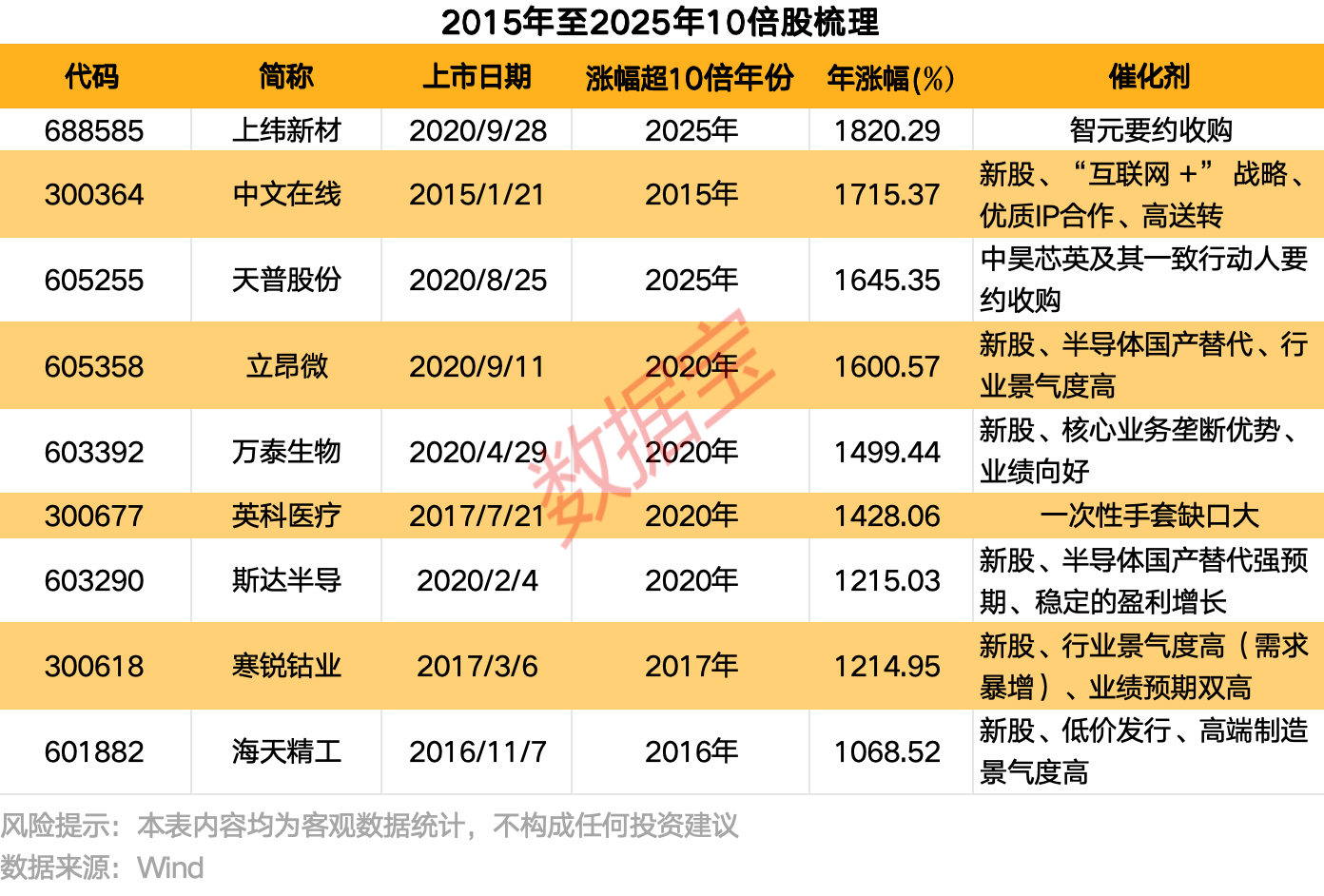
Core Insights - The A-share market has seen a resurgence of "10-bagger" stocks, with 2025 marking the return of stocks that have increased over 10 times in value, a phenomenon that has been rare since 2015 [1] - A total of 9 stocks achieved this milestone from 2015 to 2025, with significant annual increases noted in 2025, particularly for companies like Shangwei New Materials and Tianpu Co., which saw increases of 1820.29% and 1645.35% respectively [1][2] Group 1: Characteristics of 10-Bagger Stocks - Three main catalysts contribute to the emergence of 10-bagger stocks: 1. New stock attributes, as seen with companies like Zhongwen Online and Wantai Biological Pharmacy, which had substantial price increases in their debut years [1][2] 2. High-quality fundamentals, such as core technological barriers and stable profit growth, which support stock price increases [1][2] 3. External catalysts, including high industry demand and favorable acquisition news, which have historically driven stock prices up [2] Group 2: Characteristics of 5-Bagger Stocks - From 2015 to 2025, 56 stocks achieved annual increases of over 5 times, with a notable concentration in the TMT (Technology, Media, and Telecommunications) sector, particularly in electronics and computer industries [5][8] - These 5-bagger stocks generally exhibit lower price characteristics, with average closing prices below the overall A-share market, indicating potential for growth [8] - The profitability and growth potential of these stocks are also strong, with many showing higher compound annual growth rates in net profit compared to the overall A-share market [8][9] Group 3: Potential Stocks for 2026 - A selection of 15 potential stocks has been identified based on criteria such as being in high-demand industries, having low closing prices, and strong expected performance in terms of net profit growth [12][13] - Notable companies include Maijie Technology and Tuobang Co., which have low price-to-earnings ratios compared to their industry averages, indicating potential undervaluation [12][13] - The selected stocks also show strong trading activity, with several having daily turnover rates exceeding 5%, suggesting investor interest and liquidity [12][13]

吉视传媒与中农阳光明确在智慧农业服务体系建设等关键方向合作意向
Zheng Quan Shi Bao Wang· 2026-01-02 12:52
Core Viewpoint - The collaboration between Jishi Media and Zhongnong Sunshine focuses on the development of smart agriculture and digital collaboration in agricultural services [1] Group 1: Company Collaboration - Zhongnong Sunshine's chairman Zhao Ming and his core team visited Jishi Media to discuss deep cooperation in smart agriculture [1] - Both companies have established intentions to collaborate on building a smart agriculture service system and a digital agricultural service network [1]

A股突发双利好!春季攻势提前打响,近10年数据揭示关键布局窗口
Sou Hu Cai Jing· 2026-01-02 04:31
Group 1 - The A-share market is expected to experience an early "spring rally" starting in mid-December 2025, potentially leading to a rare overlap of "cross-year" and "spring" trends due to late Chinese New Year and intensified institutional competition [1][3] - Historical data shows that the average spring rally over the past decade has yielded a 6.5% increase, but the 2026 rally may differ as structural opportunities emerge despite a generally flat index performance in four out of the last seven years [1][3] - The China Securities Regulatory Commission has introduced significant reforms, including a public fund fee reduction that benefits investors by 51 billion yuan annually, and a push for long-term capital inflow, which aims to reshape the market ecosystem [3] Group 2 - The consensus among brokerages for 2026 investment strategies highlights technology and domestic consumption as key themes, with specific focus on AI applications, commercial aerospace, and humanoid robots benefiting from policy support [5] - The domestic consumption sector is targeted for investment due to stagnant valuations and rising policy expectations, with sectors like liquor, duty-free, and tourism identified as core holdings [5] - External factors are favorable, with the Federal Reserve's interest rate cuts expected to enhance liquidity globally, benefiting emerging market assets, particularly in sectors like aviation and paper manufacturing that have foreign currency liabilities [5] Group 3 - Recent market performance indicates strong potential in specific sectors, such as AI applications in media and gaming, driven by cost reduction and efficiency improvements [7] - Industrial metals like copper and aluminum are positioned to benefit from global manufacturing recovery and domestic supply adjustments, making them attractive for both growth and defensive strategies [7] - Despite high expectations for the spring rally, there is a cautionary note regarding structural differentiation in the market, with potential corrections in overvalued tech sectors if earnings do not meet high expectations [7]

“慢牛”领跑!估值驱动转向盈利驱动
Sou Hu Cai Jing· 2026-01-01 23:12
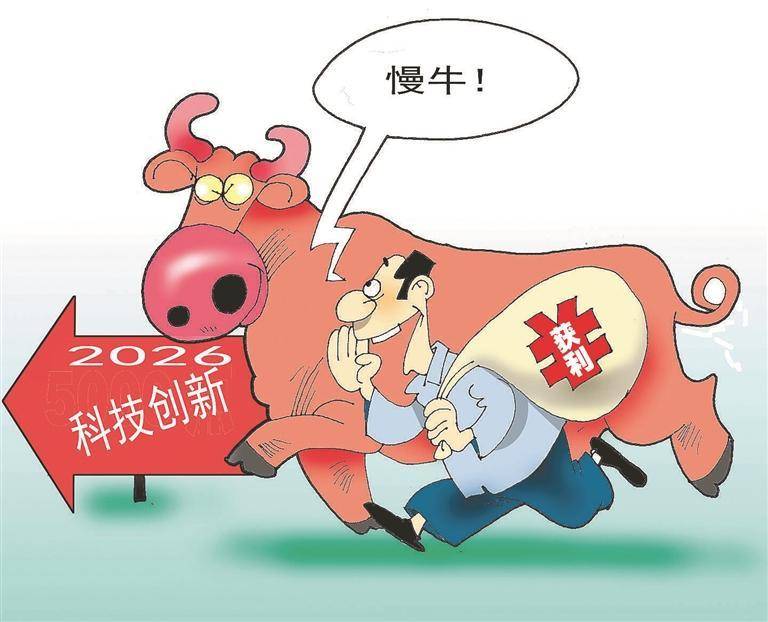
Group 1 - The A-share market is expected to shift from valuation-driven to profit-driven, exhibiting a "slow bull" characteristic in 2026 [2][3] - Investors are advised to focus on four major directions: technology innovation, advanced manufacturing, upstream cycles, and domestic consumption [2][8] - Technology investment difficulty in 2026 will be greater than in 2025, requiring precise grasp of industry rhythms and deep stock selection for excess returns [11] Group 2 - The macroeconomic policy is expected to support resilient growth and structural upgrades, with a GDP growth target of around 5% for 2026 [5][6] - Manufacturing investment is anticipated to receive support from strong export resilience and continued policy backing for advanced manufacturing [5][6] - The focus on expanding domestic demand is crucial for stabilizing growth, with measures including increased consumption subsidies and support for service industries [5][6] Group 3 - A-share earnings are expected to enter a new phase of slow recovery in 2026, driven by technology manufacturing, inventory replenishment, and profit margin recovery [7][9] - The investment strategy should focus on cyclical recovery and technological self-reliance, with an emphasis on sectors like non-ferrous metals, machinery, and social services [7][8] Group 4 - The market is likely to see a convergence of technology and value styles, with structural opportunities emerging in value sectors as the economy stabilizes [12] - The focus on "outbound + technology" is expected to dominate market trends, particularly in the AI industry chain and resource sectors [13] Group 5 - The overall market is anticipated to be balanced between growth and value, with significant opportunities in both large-cap and small-cap stocks [14][16] - The recovery in earnings and return on equity (ROE) levels is expected to support stock market performance, with long-term funds increasingly entering the market [16]
长城基金汪立:把握科技与内需主题轮动机会
Xin Lang Cai Jing· 2026-01-01 03:52
Core Viewpoint - The A-share market is expected to take a significant step forward in 2026, supported by a systemic decline in risk-free interest rates, a peak in time deposit maturities, government encouragement for long-term capital entry, capital market reforms enhancing investment attractiveness, and a transformation in China's industrial structure [1][4]. Group 1: Market Outlook - The market may enter a boom period for asset management demand as the peak of time deposit maturities approaches in 2026, alongside government initiatives to encourage long-term capital inflow [1][4]. - Capital market reforms are expected to enhance the investability of Chinese assets and improve market resilience against risks, potentially leading the stock market from a volatile phase to a more stable and positive trend [1][4]. - The acceleration of China's industrial structure transformation is shifting from traditional industries to new technology sectors, which are entering an innovation expansion cycle, while Chinese manufacturing is expanding globally, reducing economic uncertainties [1][4]. Group 2: Investment Directions - The company is optimistic about sectors such as technology, brokerage, and consumer goods, indicating a potential cross-year investment strategy [2][5]. - In the technology sector, there is a focus on internet, media, computing, and power equipment manufacturing, particularly those with global competitive advantages, due to the rapid advancement of AI models and applications [2][5]. - The financial sector, including brokerages and insurance, is expected to benefit from deepening capital market reforms, which may revive market risk appetite [2][5]. - Consumer sectors are showing signs of improvement, with a focus on low-priced, low-inventory stocks in food and beverage, agriculture, and tourism services, as well as cyclical stocks in non-ferrous metals and chemicals [2][5]. - Domestic demand is anticipated to become a key theme, with a focus on emerging consumption, sports economy, and winter tourism as the government aims to build a strong domestic market [2][5].
月之暗面完成5亿美元新融资,持有现金超100亿元;巴菲特正式退休;公众号一键排版内测上线;ModelY连续三年成全球最畅销车丨邦早报
创业邦· 2026-01-01 01:12
Financing and Valuation - Moonlight Dark Side completed a $500 million Series C financing, achieving a post-investment valuation of $4.3 billion, with over 10 billion RMB in cash reserves [2] - Weijing Medical Robotics announced the completion of a financing round of over 100 million RMB [18] - Lizheng Technology completed a C+ round financing exceeding 300 million RMB [18] - Kunyou Optoelectronics announced a new round of C financing, led by state-owned capital investment [18] - Black Play, a trendy toy brand, completed over 100 million RMB in Series A financing [18] Corporate Developments - Warren Buffett officially retired as CEO of Berkshire Hathaway, concluding a 60-year leadership tenure [3] - Xiaopeng Motors outlined plans for significant product adjustments, focusing on enhancing product strength and reducing internal inefficiencies [10] - Evergrande Auto announced continued suspension of trading, exploring cash resource management methods [9] - Qunar Travel's CEO announced new employee benefits, including an additional three days of child companionship leave and a 50,000 RMB childbirth bonus [11] Market Trends and Innovations - Tesla's Model Y has been recognized as the best-selling car globally for three consecutive years [14] - The release of the first personal robot, Qiyuan Q1, marks a new entry into the personal robotics market by Shangwei New Materials [19] - The launch of the "One-Click Formatting" feature on WeChat public accounts aims to enhance content presentation efficiency [24] - Suzhou government announced incentives for promoting AI application scenarios, with rewards up to 10 million RMB for qualifying projects [25] Technology and AI Developments - Qwen-Image-2512 was released, showcasing significant improvements in image generation capabilities [21] - Tesla's recruitment for a low-voltage electrical engineer for its Robotaxi project has sparked speculation about its entry into the Chinese market [17]



TMT|2026年度科技投资展望
2025-12-31 16:02
TMT|2026 年度科技投资展望 20251230 2025 年科技领域的发展可以分为几个关键阶段。1 月至 3 月,我们提出了春 季科技进攻的思路,并在 1 月建议进行科技抄底。3 月时,我们对科技年报和 一季报进行了展望。在 4 月市场低迷期间,我们再次明确了科技方向作为进攻 方向的重要性。到 9 月份,我们对 AI 产业动态进行了分析,并展望了四季度行 情,坚定了对 AI 投资的信心。 对于 2026 年的科技投资,您有哪些核心观点和判断? 展望 2026 年,我们认为通信、电子、计算机和传媒四个行业将位于涨幅榜的 前 1/3,甚至有可能进入前 10 名。特别是通信板块,有望位于涨幅榜的前五名。 这一判断基于全球 AI PC 产业变革带来的基础设施建设高潮,以及国内外算力 需求持续增长。 具体来说,海外算力板块在 2026 年的业绩增速预计为 AI 领域 2026 年预计出现大模型大战,各大厂商争夺流量。流量分配方 式可能变化,生成式引擎优化(GEO)兴起,多模态 AI 应用带来娱乐方 式变革。 商业航天及太空算力发展超预期,通过部署在晨昏轨道上的卫星,可以 24 小时不间断地接收太阳能,从而显著提高 ...