保险业

Search documents
重拳出击!香港保监局新规上线,打击无牌销售、违规返佣
2 1 Shi Ji Jing Ji Bao Dao· 2025-09-22 12:26
Core Viewpoint - The Hong Kong Insurance Authority announced new regulations to address the issue of excessive commission payments to referral agents, implementing a baseline referral fee of 50% starting October 1, 2025, in response to market irregularities and increasing demand from mainland Chinese customers [1][2]. Group 1: Regulatory Changes - The Insurance Authority will set a "red line" for referral fees, limiting them to 50% of the commission starting from October 1, 2025 [1]. - The new commission structure for participating insurance agents will restrict the first-year commission for participating insurance products to 70%, requiring the remaining commission to be distributed over at least five years [4]. Group 2: Market Context - In 2024, new insurance premiums from mainland visitors reached HKD 62.8 billion, a 6.5% increase from 2023, accounting for 28.6% of total new premiums in personal business [1]. - The rise in demand for Hong Kong insurance products from mainland clients has led to an increase in unlicensed sales activities in cross-border transactions [1]. Group 3: Enforcement Actions - The Insurance Authority, in collaboration with the Independent Commission Against Corruption, has taken joint actions to combat unlicensed sales to mainland clients, including undercover operations to monitor sales practices [2]. - From January to August 2025, the Insurance Authority has undertaken 32 disciplinary actions, totaling 116 since 2021 [5]. Group 4: Future Developments - Starting January 1, 2026, the background check program for intermediaries will expand to include life insurance brokers, with ongoing discussions to extend this to bank insurance personnel [3]. - The Insurance Authority will continue to maintain communication with mainland regulatory bodies to ensure regulatory coordination and address potential conflicts of interest [4].
高质量完成“十四五”规划丨我国金融服务实体经济质效大幅提升
Xin Hua Wang· 2025-09-22 11:55
Core Viewpoint - During the "14th Five-Year Plan" period, China's financial services have significantly improved in quality and efficiency, effectively supporting the economy's recovery and high-quality development [3]. Financial Support to the Real Economy - Over the past five years, the banking and insurance sectors have provided an additional 170 trillion yuan to the real economy through various means such as credit, bonds, and equity [3]. - The total financing from the exchange market for stocks and bonds reached 57.5 trillion yuan, with the proportion of direct financing increasing by 2.8 percentage points to 31.6% compared to the end of the "13th Five-Year Plan" [3]. Monetary Policy and Economic Goals - The People's Bank of China has maintained a supportive monetary policy stance, contributing to the successful achievement of the main goals of economic and social development during the "14th Five-Year Plan" [4]. Financial Regulation and Support for Key Sectors - The Financial Regulatory Administration has focused on increasing supply, optimizing structure, and addressing weaknesses, supporting the completion of economic and social development goals [5]. - Loans to technology-based small and medium-sized enterprises, inclusive small and micro loans, and green loans have all seen annual growth rates exceeding 20% [5]. - Research and technology loans, medium to long-term loans for manufacturing, and infrastructure loans have experienced average annual growth rates of 27.2%, 21.7%, and 10.1%, respectively [5]. Capital Market Developments - More than 90% of newly listed companies in recent years are technology enterprises or have high technological content [5]. - The market capitalization of the technology sector in A-shares now accounts for over one-fourth of the total market, with the number of technology companies in the top 50 by market capitalization increasing from 18 at the end of the "13th Five-Year Plan" to 24 currently [5]. Foreign Exchange and High-Quality Development - The State Administration of Foreign Exchange has advanced deep reforms and high-level opening in the foreign exchange sector, enhancing the efficiency of trade foreign exchange receipts and payments, as well as the convenience of cross-border investment and financing [5].

发布会纪要丨高风险机构数量、高风险资产规模大幅压降,李云泽最新发声
Di Yi Cai Jing· 2025-09-22 11:49
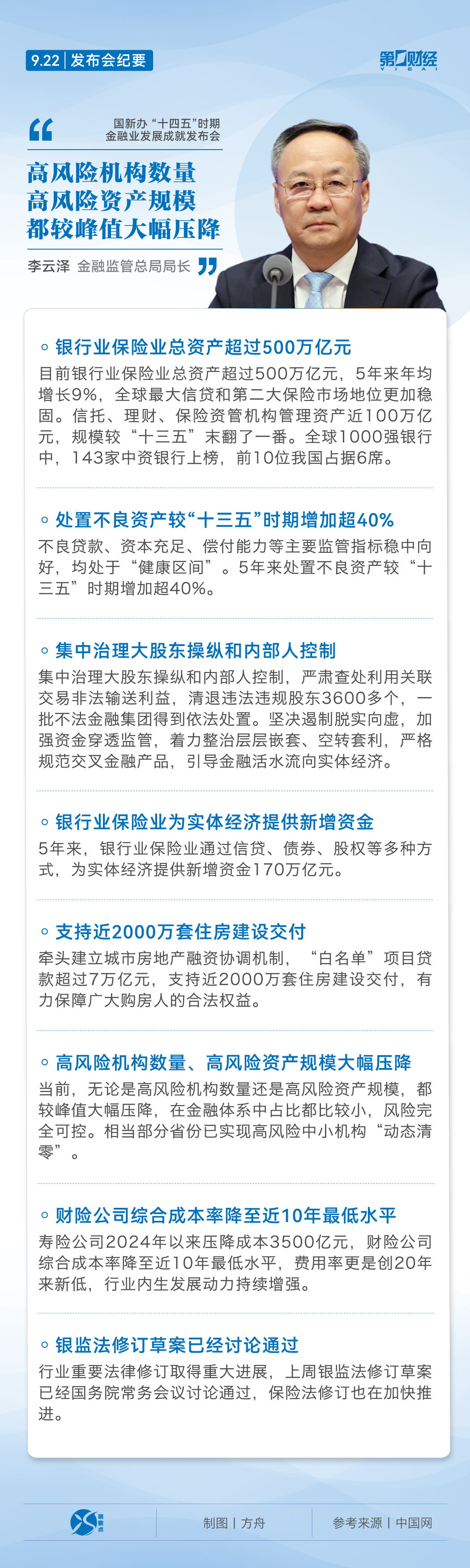
Core Insights - The financial industry has achieved significant growth, with total assets of the banking and insurance sectors exceeding 500 trillion yuan, reflecting an average annual growth of 9% over the past five years [2] - The number of high-risk institutions and the scale of high-risk assets have been significantly reduced from their peak levels, indicating a more stable financial environment [8] Group 1: Financial Industry Growth - The banking and insurance sectors have total assets exceeding 500 trillion yuan, solidifying their position as the largest credit market and the second-largest insurance market globally [2] - The management assets of trust, wealth management, and insurance asset management institutions have nearly doubled compared to the end of the 13th Five-Year Plan, reaching approximately 100 trillion yuan [2] Group 2: Asset Management and Risk Control - The disposal of non-performing assets has increased by over 40% compared to the 13th Five-Year Plan period, with key regulatory indicators such as non-performing loans and capital adequacy remaining stable and within a healthy range [3] - The number of illegal shareholders has been reduced by over 3,600 through strict governance against major shareholder manipulation and insider control [5] Group 3: Support for the Real Economy - The banking and insurance sectors have provided an additional 170 trillion yuan in funding to the real economy through various means such as credit, bonds, and equity over the past five years [6] - A financing coordination mechanism for urban real estate has been established, with over 7 trillion yuan in loans supporting the construction and delivery of nearly 20 million housing units [7] Group 4: Regulatory Developments - The comprehensive cost ratio of property insurance companies has dropped to its lowest level in nearly a decade, while life insurance companies have reduced costs by 350 billion yuan since 2024 [9] - Significant progress has been made in the revision of important industry laws, with the draft of the banking regulatory law having been discussed and approved by the State Council [10]
潘功胜:今日发布会不涉及短期政策调整,下一步金融改革内容将在中央统一部署后做进一步沟通
Sou Hu Cai Jing· 2025-09-22 11:15
Group 1 - The core theme of the press conference was to introduce the achievements of the financial industry during the "14th Five-Year Plan" period, focusing on medium to long-term perspectives without discussing short-term policy adjustments [19] - The overall financial system in China is stable, with healthy financial institutions and smooth market operations [4][18] - The banking and insurance sectors have seen total assets exceed 500 trillion yuan, with an annual growth rate of 9% over the past five years [21] Group 2 - The A-share market has shown significant resilience and risk resistance, with the proportion of technology companies in the top 50 by market capitalization increasing from 18 to 24 during the "14th Five-Year Plan" [2][26] - A total of 10.6 trillion yuan has been distributed to shareholders through dividends and buybacks, representing an increase of over 80% compared to the "13th Five-Year Plan" [2][26] - The annualized volatility of the Shanghai Composite Index decreased by 2.8 percentage points to 15.9% during the "14th Five-Year Plan" [2][27] Group 3 - The financial regulatory authority has taken strict measures against financial irregularities, including the dismissal of over 3,600 illegal shareholders and the resolution of several illegal financial groups [3][36] - The regulatory framework has been significantly restructured, with over 60 supporting rules introduced following the new "National Nine Articles" [2][25] - The financial regulatory authority has imposed penalties on 20,000 institutions and 36,000 individuals, with fines totaling 21 billion yuan [23][28] Group 4 - The stock issuance registration system has transitioned from a pilot program to full implementation, with various measures introduced to optimize the listing and financing processes [5][42] - The total market capitalization of the A-share market surpassed 100 trillion yuan for the first time in August [26] - The proportion of direct financing in the capital market has increased by 2.8 percentage points to 31.6% compared to the end of the "13th Five-Year Plan" [26] Group 5 - The foreign capital holding in A-shares is currently 3.4 trillion yuan, with 269 companies listed overseas [6] - The central bank's monetary policy stance is supportive, implementing moderately loose monetary policies to stabilize the economy [7][8] - The modern monetary policy framework in China has been initially formed and continuously improved, effectively promoting reasonable growth in financial totals and optimizing credit structures [9][33]
潘功胜、李云泽、吴清、朱鹤新今日重磅发声 ! | 宏观经济
清华金融评论· 2025-09-22 11:08
Core Viewpoint - The article discusses the significant achievements of China's financial sector during the "14th Five-Year Plan" period, highlighting reforms, risk management, and the enhancement of financial services to support the real economy. Group 1: Financial Sector Achievements - China's financial sector has made substantial progress, with total banking assets reaching nearly 470 trillion yuan, ranking first globally, and stock and bond market sizes ranking second worldwide [4] - The financial system has seen a comprehensive deepening of reforms, with improved governance and a more robust financial service framework, leading to enhanced quality, efficiency, and inclusiveness of financial services [4][5] - The average annual growth rate of loans to technology-based small and medium-sized enterprises, inclusive micro-enterprises, and green loans exceeded 20% during the "14th Five-Year Plan" [5] Group 2: Financial Risk Management - Significant progress has been made in preventing and resolving financial risks, with a focus on orderly handling of key risk areas and maintaining the stability of the financial system [6][14] - The financial system remains generally stable, with financial institutions in good health and the market operating smoothly [6][14] - The article emphasizes the importance of a unified leadership from the central government in managing financial risks effectively [15] Group 3: Financial Market Development - The capital market has seen a notable increase in the proportion of technology sector market capitalization, now exceeding 25%, which is significantly higher than the combined market capitalization of banking, non-banking financial, and real estate sectors [26][27] - The regulatory framework for capital markets has been strengthened, with the implementation of new securities laws and the establishment of a more comprehensive market system [26][28] - The article highlights the improvement in market transparency and fairness, with increased enforcement against financial misconduct [27] Group 4: Future Directions - The People's Bank of China plans to continue deepening reforms and enhancing the central bank's macro-prudential and financial stability functions to support high-quality economic development [10][16] - There is a commitment to maintaining a balance between growth and risk prevention, ensuring the stability of the financial market and the renminbi exchange rate [11][17] - The focus will be on further enhancing the openness of the financial sector and improving the regulatory framework to support a higher level of financial security [22][33]

新华社权威速览·非凡“十四五”丨从三个“新”,看金融强国建设迈出坚实步伐
Xin Hua Wang· 2025-09-22 10:49
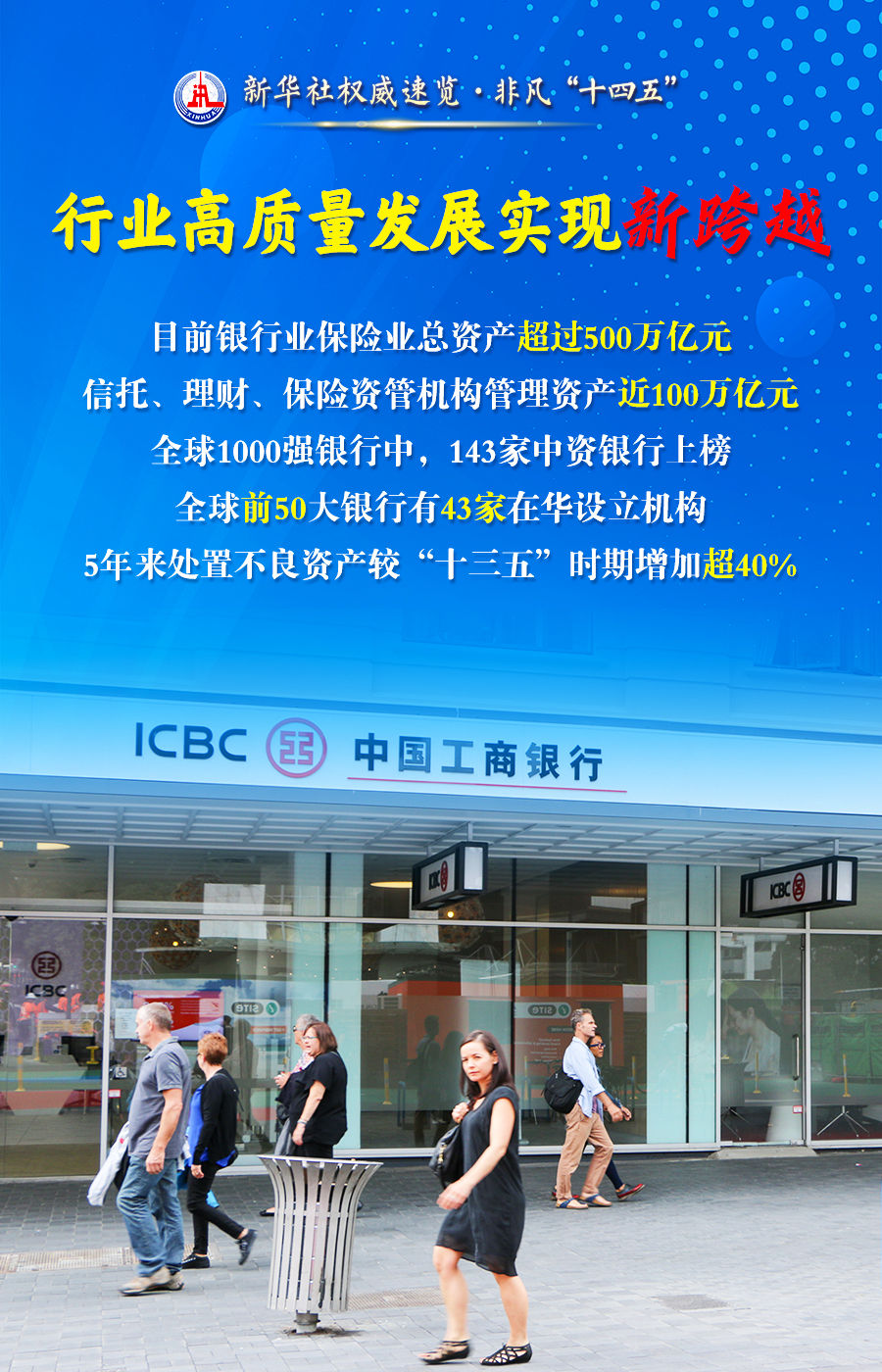
22日举行的"高质量完成'十四五'规划"发布会上,金融监管总局局长李云泽说,金融监管总局深入践行金融工作的政治性、 人民性,全面完成"十四五"规划的目标任务,助力金融强国建设迈出坚实步伐。 新华社权威速览 · 非风· 金融服务再上新台 银行业保险业通过信贷、债券、股权等多种方 为实体经济提供新增资金170万亿元 普惠型小微企业贷款余额36万亿元 保险业累计赔付9万亿元 较"十三五"时期增长61.7% 农业保险为8亿户次农户提供风险保障 商业养老、健康保险积累准备金11万亿元 新华社权威速览 · 非风 · " 融监管开创新 省市县三级防非打非机制全面覆盖 监管法制"四梁八柱"加快搭建 数字化智能化水平不断提高 累计处罚机构2万家次、责任人3.6万人次 罚没金额210亿元 中国工商银行 策划:令伟家 统筹:于卫亚 文案:李依伦、冯松龄 设计:卓越 【纠错】 【责任编辑:刘阳】 ...

新华保险、苏州高新相关公司新增一项700.00万元的招标项目
Xin Lang Cai Jing· 2025-09-22 10:15
Group 1 - The core announcement involves a tender for the procurement of security monitoring system construction suppliers for Hangzhou Bank from 2025 to 2028, with a budget of 7 million yuan [1] - The tender was published on September 22, 2025, indicating a strategic move by Hangzhou Bank to enhance its security infrastructure [1] - Xinhua Insurance and Suzhou High-tech hold shares in Hangzhou Bank, with ownership stakes of 4.55% and 1.63% respectively [1]




宏观点评:广义财政盼增量-20250922
CAITONG SECURITIES· 2025-09-22 10:15
Revenue and Expenditure Overview - From January to August 2025, general public budget revenue totaled CNY 14.82 trillion, a year-on-year increase of 0.3%[2] - General public budget expenditure for the same period reached CNY 17.93 trillion, with a year-on-year growth of 3.1%[2] - In August 2025, general public budget revenue was CNY 1.24 trillion, up 2.0% year-on-year, while expenditure was CNY 1.86 trillion, reflecting a 0.8% increase[4] Tax Revenue Insights - Tax revenue continues to outperform non-tax revenue, with August tax revenue growing by 3.4% year-on-year, marking five consecutive months of positive growth[5] - Manufacturing accounted for over 30% of total tax revenue, with a growth rate exceeding 5% in the first eight months of 2025[5] - Securities transaction stamp duty surged by 226% in August, driven by increased market activity, contributing significantly to tax revenue growth[8] Fiscal Pressure and Challenges - The fiscal data for August indicates mounting pressure, with weakened consumption impacting tax revenue and a declining real estate sector exacerbating fiscal income challenges[23] - Government fund revenue fell by 5.7% year-on-year in August, primarily due to a 5.8% drop in land transfer income[18] - Infrastructure spending remains weak, with related expenditures showing a significant decline of 13.2% when combined[13] Future Outlook and Policy Implications - The necessity for incremental policy measures is rising due to anticipated economic pressures and the nearing end of government bond issuance in the fourth quarter[23] - The potential for early utilization of next year's debt quota and the timing of policy financial tools will be critical in supporting economic stability[23]
信号巨大!潘功胜、李云泽、吴清、朱鹤新同日发声
FOFWEEKLY· 2025-09-22 10:01
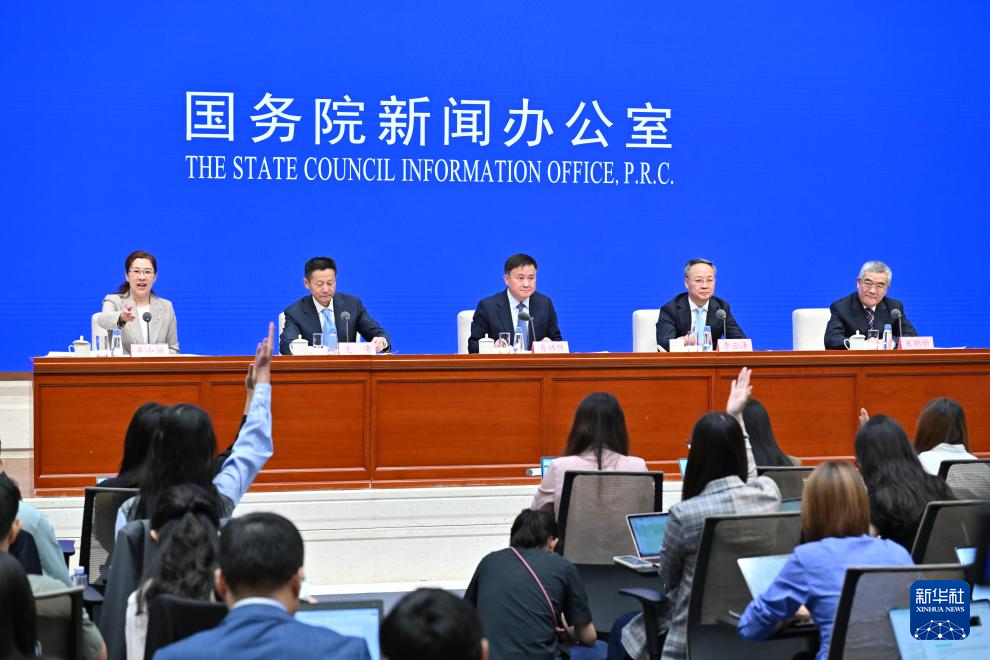
时隔近一年,金融管理部门"一把手"再次出席同场新闻发布会。 9月22日下午3时,国务院新闻办公室举行"高质量完成'十四五'规划"系列主题新闻发布会,中国人民银行行长潘功胜,金融监管总局局长李云泽,中 国证监会主席吴清,中国人民银行副行长、国家外汇局局长朱鹤新介绍"十四五"时期金融业发展成就,并答记者问。 发布会上,金融管理部门"一把手"在答记者问中释放了不少重磅信息,发布会要点梳理如下。 央行行长潘功胜: 今日发布会不涉及短期政策调整 我国银行业总资产位居世界第一 潘功胜介绍,"十四五"期间,我国金融事业取得新的重大成就。 截至今年6月末,我国银行业总资产近470万亿元,位居世界第一;股票、债券市场规模位居世界第二;外汇储备规模连续20年位居世界第一。同 时,我国在绿色金融、普惠金融、数字金融等方面走在世界前列,基本建成多渠道、广覆盖、安全高效的人民币跨境支付清算网络,移动支付处于国 际领先水平。 "十四五"期间科技型中小企业贷款年均增速超20% 潘功胜介绍,"十四五"期间,我国金融服务实体经济质效大幅提升,科技型中小企业贷款、普惠小微贷款、绿色贷款年均增速均超过20%。 今日发布会主要介绍"十四五"时期金融 ...

中国资产大爆发,背后藏着这三个城市
盐财经· 2025-09-22 09:23
Group 1 - The year 2025 is expected to be filled with both turmoil and anticipation in the global financial markets, with the Shanghai Composite Index rising while US stock indices reach new highs [2] - The recent decline in the US dollar exchange rate contrasts with the rising US stock market, indicating underlying tensions in global financial dynamics [3][6] - The Euro has been recovering against the dollar, with the exchange rate approaching 1.2 since September, reflecting geopolitical influences on financial markets [4][6] Group 2 - The Guangdong-Hong Kong-Macao Greater Bay Area is positioned as a crucial player in the global financial landscape, benefiting from Hong Kong's status as an international financial center [7][8] - In the first half of 2025, Hong Kong's IPO market saw a significant recovery, with new stock financing reaching $14.1 billion, a 695% increase compared to the same period in 2024 [10] - The rise in Hong Kong's market activity is attributed to global investors seeking Chinese assets amid expectations of US dollar interest rate cuts [10][12] Group 3 - The introduction of the "Science and Technology Enterprise Special Line" in Hong Kong has made it easier for innovative companies to go public, enhancing the market's appeal for tech investments [14][16] - Recent regulatory changes have reduced the initial public offering (IPO) public shareholding requirement from 15% to 10%, facilitating easier access to capital for companies [16] Group 4 - The emergence of stablecoins is seen as a significant opportunity, bridging the gap between on-chain crypto assets and off-chain real-world assets, thus enhancing the usability of crypto in payments and settlements [20][23] - Hong Kong's proactive approach to stablecoin regulation, with the introduction of the "Stablecoin Regulation" in August 2025, positions it as a leader in the crypto asset space [20][23] Group 5 - The distinction between digital currencies is highlighted, with three categories: cryptocurrencies, central bank digital currencies (CBDCs), and stablecoins, each serving different purposes in the financial ecosystem [25][28] - CBDCs, such as the digital yuan, offer advantages like instant settlement and direct access without the need for a commercial bank account, promoting financial inclusion [30][32] Group 6 - The Guangdong-Hong Kong-Macao Greater Bay Area is recognized as a financial hub, with Hong Kong as an international center, Shenzhen as a model of financial and technological integration, and Guangzhou focusing on green finance [34][36] - Shenzhen's financial innovation and market-oriented approach are expected to continue driving growth, particularly in creating a multi-layered capital system [37] - Guangzhou's role in financial resource aggregation and its potential in green finance highlight the ongoing opportunities for innovation in the region [39]