
玩具

Search documents
周周芝道 模型跟踪:关税对美国通胀影响
2025-07-21 00:32
Summary of Key Points from Conference Call Industry and Company Involved - The analysis focuses on the impact of tariffs on inflation in the United States, particularly in relation to various industries and consumer behavior. Core Insights and Arguments - **Tariff Rate Increase**: The effective tariff rate in the U.S. rose significantly from 2.5% at the beginning of 2025 to 8.8% by mid-year, with tariffs on imports from China increasing from 10% to nearly 40% [1][5] - **Impact on Different Industries**: The metal industry saw a 50% increase in tariffs, while small appliances, furniture, and toys experienced a 20% increase [1][5] - **Cost Burden Distribution**: Tariff costs are primarily borne by exporters, U.S. companies, and consumers, with historical data indicating that consumers ultimately shoulder most of the burden [1][3][11] - **Inflation Transmission**: As of June 2025, approximately 40% of tariff costs have been passed on to the Consumer Price Index (CPI), with the remaining 60% potentially absorbed by businesses [1][9][11] - **Correlation Between Actual and Theoretical Inflation**: There is a positive correlation between actual inflation and theoretical predictions, with a correlation coefficient of about 0.4 [1][9] - **Modeling Approach**: A comprehensive panel regression model was developed to track the impact of tariffs across 212 industries, allowing for detailed analysis of long-term effects on inflation [2][5] Additional Important Content - **Consumer Price Index (CPI) and Federal Reserve Policy**: The CPI is crucial for determining the Federal Reserve's interest rate decisions, with expectations of potential rate cuts in late 2025 [3][12] - **Differential Impact on Product Categories**: Certain product categories, such as small appliances and audio equipment, are experiencing significant inflation, while the automotive sector shows no notable price increases [10] - **Weak Dollar Effects**: A weaker dollar limits exporters' ability to absorb tariff costs, leading to increased pressure on importers [13][14] - **Future Economic Indicators**: The future path of interest rate cuts by the Federal Reserve will depend on economic data and the observed effects of tariffs on inflation [7][12] - **Monitoring Future Trends**: Continuous tracking of CPI data from July to September will help assess the transmission of tariff costs between businesses and consumers [16]
美国内部阵营分裂?向中国露出笑脸,背后三重压力曝光
Sou Hu Cai Jing· 2025-07-19 04:25
Group 1: Domestic Crisis - President Trump's recent comments at the Pennsylvania Energy Summit indicate a surprising shift towards a more cooperative stance with China, contrasting sharply with his previous hardline rhetoric [2] - Tensions with the Federal Reserve escalated when Trump nearly attempted to fire Chairman Powell over a $600 million renovation cost, leading to significant market turmoil before he reversed his decision [3] - The Epstein case has created a political storm, with public skepticism surrounding the official narrative of his death, further isolating Trump as he faces backlash from both supporters and opponents [3] Group 2: Trade War Consequences - The U.S. is experiencing the negative impacts of the trade war, with prices for Chinese products, such as toys and clothing, increasing significantly, indicating inflationary pressures on consumers [5] - China's restrictions on rare earth exports pose risks to critical U.S. industries, including defense and electric vehicle manufacturing, highlighting vulnerabilities in supply chains [5] Group 3: Failed Containment Strategy - Trump's strategy to unite allies against China has faced rejection, with key allies like Germany and Japan opposing decoupling efforts, and Australia resuming coal trade with China [7] - The New York Times has characterized Trump's containment strategy as ineffective, suggesting a lack of international support [7] Group 4: Compromises and Diplomatic Postures - The U.S. government has allowed companies like NVIDIA and AMD to sell modified AI chips to China, reflecting a contradiction to its stated goal of preventing technology leaks [8] - Diplomatic efforts are being made, with U.S. officials seeking dialogue with China, indicating a shift towards a more conciliatory approach [8] Group 5: China's Response - China continues to review rare earth export licenses and is advancing its own chip self-sufficiency, demonstrating a strategic focus on maintaining its technological independence [9] - The Chinese government perceives Trump's recent friendly rhetoric as a tactical response to domestic challenges rather than a genuine shift in policy [9]


“十四五”数字彰显中国优势
Sou Hu Cai Jing· 2025-07-19 02:32
Group 1 - China's consumer market remains the second largest globally, with a projected retail sales total of over 50 trillion RMB in 2023, reflecting an average annual growth of 5.5% over the past four years [3][4] - The contribution of consumption to China's economic growth has reached approximately 60%, highlighting the shift towards a domestic demand-driven growth model [3][4] - China's foreign trade has shown resilience, with goods trade expected to reach 6.16 trillion USD by 2024, marking a 32.4% increase from the end of the 13th Five-Year Plan in 2020 [4][5] Group 2 - The structure of China's exports has shifted, with high-tech products accounting for 18.2% of total goods trade by 2024, indicating an upgrade in technological capabilities [5] - The trade relationship with the US remains stable despite challenges, with bilateral trade expected to reach 688.3 billion USD in goods and 155.8 billion USD in services by 2024, reflecting growth since 2017 [6] - China's trade partnerships have diversified, with ASEAN remaining the largest trading partner for five consecutive years, and trade with Belt and Road Initiative countries exceeding 50% [5][6] Group 3 - The recent approval of NVIDIA's H20 chip sales to China marks a shift in US export control strategy, indicating a potential thaw in technology-related tensions [7] - Chinese officials emphasize the importance of foreign investment and the attractiveness of the Chinese market for multinational companies, particularly in the AI sector [7] - The resilience of China's economy against tariffs has exceeded many analysts' expectations, although challenges in imports and domestic demand persist [8][9]


广东外贸连续8个季度正增长,“新三样”产品出口增28.8%
第一财经· 2025-07-18 15:32
Core Viewpoint - Guangdong's foreign trade has achieved record growth in the first half of 2025, with a notable increase in the export of "new three samples" products by 28.8% [1][2]. Group 1: Trade Performance - In the first half of 2025, Guangdong's total goods trade import and export reached 4.55 trillion RMB, a year-on-year increase of 4%, surpassing the national growth rate by 1.1% [1]. - The export value was 2.89 trillion RMB, growing by 1.1%, while imports reached 1.66 trillion RMB, increasing by 9.5% [1]. - Guangdong's foreign trade accounted for 20.9% of the national total, contributing 28% to the national foreign trade growth [1]. Group 2: Role of Enterprises - There are 130,000 foreign trade enterprises in Guangdong, an increase of 7.6%, with private enterprises making up 110,000 of these, growing by 8.6% [2]. - The total import and export value of private enterprises reached 2.92 trillion RMB, accounting for 64.2% of the province's total foreign trade [2]. Group 3: Export Product Composition - The export of electromechanical products was 1.96 trillion RMB, a growth of 7.2%, representing 67.8% of the total export value [2]. - High-tech product exports reached 505.43 billion RMB, increasing by 13.3%, with significant growth in machine tools and drones at 18.7% and 29.2%, respectively [2]. Group 4: Import Trends - Guangdong's imports of electromechanical products surged by 19.3% to 1.16 trillion RMB, making up 70.1% of total imports [5][6]. - Key components such as central processing units, aircraft parts, and integrated circuits saw increases of 322.5%, 27.5%, and 14.3%, respectively [5]. Group 5: Industrial Upgrades - The province is focusing on industrial transformation, with significant demand for high-end manufacturing equipment reflected in the import statistics [5][6]. - Imports of aerospace equipment and semiconductor manufacturing equipment grew by 63.8% and 47%, respectively, indicating a shift towards advanced manufacturing capabilities [6].

智通港股通活跃成交|7月18日
智通财经网· 2025-07-18 11:05
Group 1 - On July 18, 2025, Alibaba-W (09988), Guotai Junan International (01788), and Haotian International Investment (01341) were the top three companies by trading volume in the Southbound Stock Connect, with trading amounts of 32.15 billion, 29.95 billion, and 28.56 billion respectively [1] - In the Southbound Stock Connect for the Shenzhen-Hong Kong Stock Connect, Alibaba-W (09988), Tencent Holdings (00700), and Kingsoft Cloud (03896) were the top three companies by trading volume, with trading amounts of 23.60 billion, 14.31 billion, and 12.46 billion respectively [1] Group 2 - The top ten active companies in the Southbound Stock Connect (Shanghai-Hong Kong) included Alibaba-W (09988) with a trading amount of 32.15 billion and a net buy amount of -2.94 billion, Guotai Junan International (01788) with 29.95 billion and -2.20 billion, and Haotian International Investment (01341) with 28.56 billion and +0.8955 million [2] - In the Southbound Stock Connect (Shenzhen-Hong Kong), the top ten active companies included Alibaba-W (09988) with a trading amount of 23.60 billion and a net buy amount of +6.82 billion, Tencent Holdings (00700) with 14.31 billion and -2.47 billion, and Kingsoft Cloud (03896) with 12.46 billion and +2.34 billion [2]





生产假冒泡泡玛特,主犯被判4年、罚金60万元!
证券时报· 2025-07-17 15:04
Core Viewpoint - The article discusses a court ruling in Beijing regarding a copyright infringement case involving counterfeit toys from the brand Bubble Mart, highlighting the legal consequences faced by the perpetrators and the scale of the illegal operation [1]. Summary by Sections Case Details - On July 16, the Chaoyang District People's Court in Beijing sentenced the main perpetrator, Zhu, to 4 years in prison and a fine of 600,000 yuan for commissioning the production of counterfeit Bubble Mart toys [1]. - From July 2023 to January 2024, Zhu illegally produced counterfeit "Temperature" and "Night City" series toys, paying over 600,000 yuan to accomplices for production [1]. - Over 80,000 counterfeit toys were seized by law enforcement, with a total value exceeding 400,000 yuan [1]. Legal Findings - The court found that Zhu's group illegally reproduced and distributed copyrighted artistic works without permission, with illegal business revenue exceeding 1 million yuan, constituting "particularly serious circumstances" of copyright infringement [1]. - Zhu received a lighter sentence due to his confession, lack of prior criminal record, and the return of 120,000 yuan in illegal gains [1]. - Other accomplices, including Ning and Peng, were sentenced separately for copyright infringement, while three individuals involved in selling the counterfeit products faced criminal charges for selling infringing copies [1].


南向资金今日成交活跃股名单(7月17日)
Zheng Quan Shi Bao Wang· 2025-07-17 12:09
Group 1 - The Hang Seng Index fell by 0.08% on July 17, with southbound trading totaling HKD 134.72 billion, including HKD 68.29 billion in buying and HKD 66.43 billion in selling, resulting in a net inflow of HKD 1.85 billion [1] - The southbound trading through Stock Connect (Shenzhen) had a total turnover of HKD 49.60 billion, with net buying of HKD 0.19 billion, while Stock Connect (Shanghai) had a turnover of HKD 85.12 billion, with net buying of HKD 1.67 billion [1] - The most actively traded stock by southbound funds was Xiaomi Group-W, with a total turnover of HKD 64.88 billion, followed by Alibaba-W and Guotai Junan International with turnovers of HKD 52.03 billion and HKD 50.25 billion respectively [1] Group 2 - Among the stocks with net buying, Meituan-W led with a net inflow of HKD 6.06 billion, while China Construction Bank and Xiaomi Group-W followed with net inflows of HKD 5.91 billion and HKD 3.15 billion respectively [1][2] - The stock with the highest net selling was Pop Mart, with a net outflow of HKD 8.44 billion, and Tencent Holdings and Kangfang Biotech also experienced significant net selling of HKD 3.79 billion and HKD 0.76 billion respectively [1][2] - Meituan-W has seen continuous net buying for 9 days, with a total net inflow of HKD 72.14 billion during this period [2]

从1.0到3.0:国际消费品牌的中国进化论
3 6 Ke· 2025-07-17 10:53
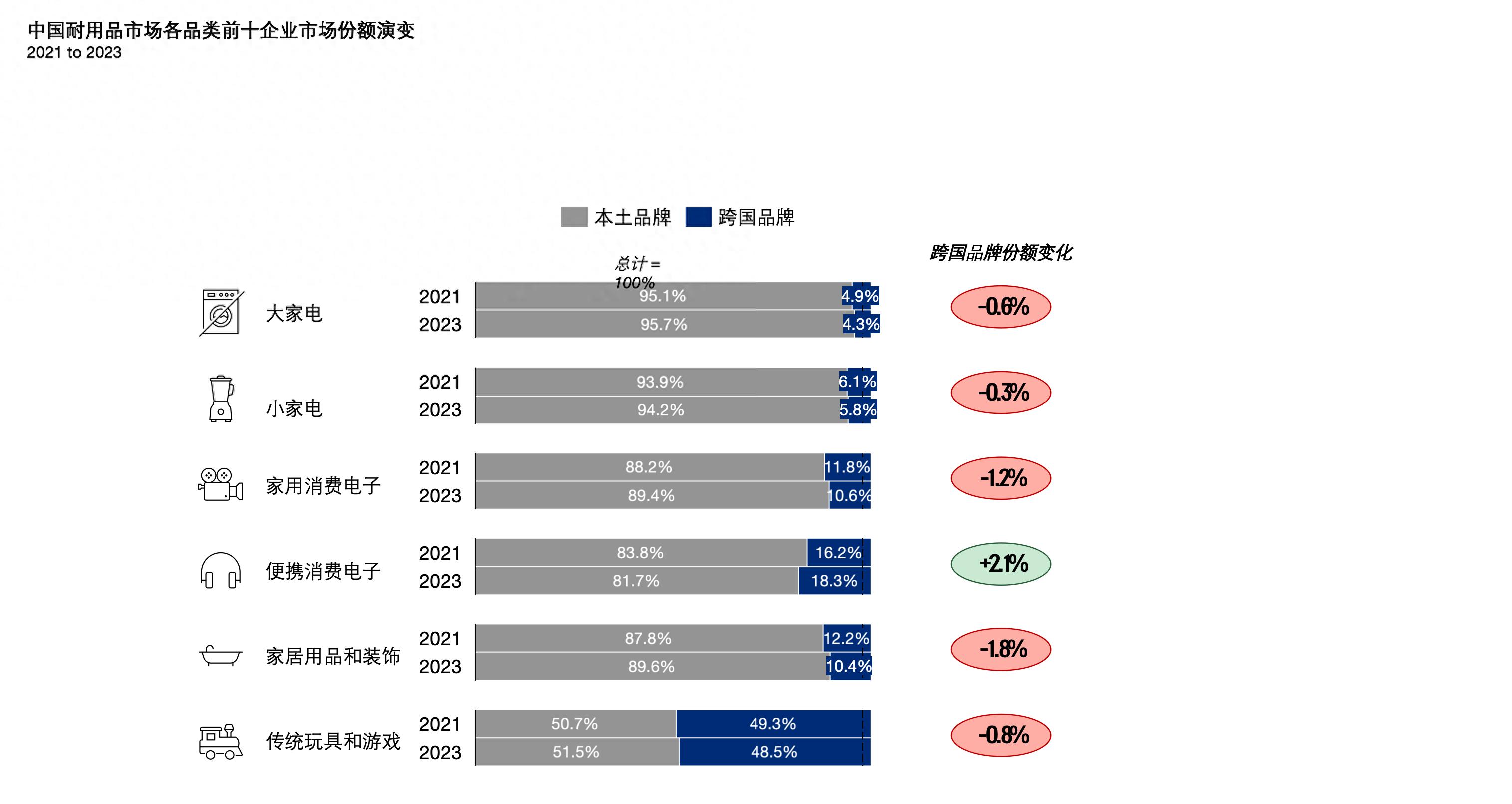
Core Insights - The article discusses the significant shift in the competitive landscape for multinational brands in China, moving from a growth phase to a market share battle against local brands [2][3][25] - It highlights the changing consumer preferences, where local brands are increasingly favored for their value and innovation, leading to a decline in market share for international brands [3][7][23] Group 1: Market Dynamics - Multinational brands are facing unprecedented challenges in China, with local brands capturing 80-95% market share in various categories such as home appliances and consumer electronics [3][4] - The consumer confidence index has dropped from 123 in 2018 to 89 in 2024, indicating a significant decline in consumer sentiment [3] - The shift in consumer purchasing logic has moved from brand loyalty to a focus on product value, with 62% of consumers prioritizing "advanced technology" and 48% valuing "cost performance" [7][8] Group 2: Competitive Challenges - Multinational brands are experiencing a cost disadvantage, with net profit margins around 4%, significantly lower than the approximately 9% margin for local brands [8] - The article notes a "vicious cycle" for international brands, where declining sales hinder necessary investments for transformation, leading to further sales declines [8][22] - The transition from a growth phase (1.0) to a competitive phase (2.0) is marked by a need for structural transformation to maintain competitiveness [3][25] Group 3: Successful Strategies - Some multinational brands are successfully navigating the challenges by leveraging global resources while building local capabilities, creating a competitive moat [9][10] - Successful brands are focusing on local innovation, with leading brands launching new products every month and achieving 5-8% of revenue from new products [13][22] - The article emphasizes the importance of a consumer-driven approach, moving from a "push model" to a "pull model" based on consumer insights [21][22] Group 4: Transformation Initiatives - Five key transformation initiatives are identified for multinational brands to regain market growth: local innovation, optimizing product mix, enhancing internal capabilities, strengthening product communication, and setting realistic financial goals [11][22] - Brands need to establish agile market insight mechanisms to quickly respond to consumer demand changes [14] - The importance of content marketing and social media engagement is highlighted, as brands must create relatable product narratives that resonate with consumers [19][20] Group 5: Future Outlook - The article projects that China will play a crucial role in driving global growth for multinational brands, with a rapidly growing middle class and a unique consumer market [23][24] - By 2030, China's middle class is expected to reach 400 million, providing a significant opportunity for product innovation [23] - The evolving e-commerce landscape in China is redefining global retail, with platforms like Douyin and Xiaohongshu leading the way in consumer engagement [23][24]
中文在线:《罗小黑战记2》联名手办盲盒即将上市丨消费早参
Mei Ri Jing Ji Xin Wen· 2025-07-16 23:56
Group 1 - Xiaohongshu announced the launch of the world's first open-world adventure island event "RED LAND" in Shanghai from August 8 to August 10, targeting gaming and ACG (Anime, Comic, and Games) enthusiasts [1] - In the past year, the number of posts related to ACG and gaming on Xiaohongshu ranked third and fourth among all categories, with year-on-year growth of 175% and 168% respectively [1] - The event marks Xiaohongshu's first foray into large-scale offline IP activities, indicating a shift from an online content platform to an offline cultural ecosystem [1] Group 2 - Chinese Online announced that the collaboration between the brand "GONG" under Pop Mart and the upcoming animated film "The King's Avatar 2" will soon launch a series of collectible blind boxes [2] - Multiple brands are planning collaborations with "The King's Avatar 2," enhancing the IP's commercial value and driving secondary consumption [2] - This initiative represents a dual-driven exploration of content and consumption for Chinese Online, potentially providing new insights into the commercialization of original domestic animation [2] Group 3 - Anta Sports reported positive growth across all product lines in the second quarter of 2025, with the Anta brand experiencing low single-digit growth and FILA achieving mid single-digit growth [3] - Other brands under Anta, excluding those added after April 1, 2025, saw retail sales growth of 50% to 55% [3] - The performance highlights the structural growth resilience under Anta's multi-brand strategy, although the main brand's growth slowdown may reflect ongoing adjustments in the mainstream sports consumption market [3] Group 4 - The consumption market in China showed significant improvement in the first half of 2025, with holiday consumption playing a crucial role [4] - The number of people traveling during the "Spring Festival," "May Day," and "Dragon Boat Festival" reached record highs, contributing to double-digit growth in related leisure and travel services [4] - New consumption patterns and diverse consumer behaviors are emerging, indicating strong consumer vitality and providing robust support for economic growth [4]

“世界超市”磁力四射 一场预料中的“抢铺大战”
Zheng Quan Shi Bao· 2025-07-16 23:35
Core Insights - The Yiwu Global Digital Trade Center, representing the sixth generation of Yiwu's market, is attracting significant interest from businesses, with over 19,000 qualified merchants registering for 900 available commercial spaces in the infant and beauty products sector [1][2] - Despite global trade challenges, Yiwu's market continues to thrive, with an average daily foot traffic of 219,000 and a 4.87% year-on-year increase in foreign visitors [1][9] - The bidding process for commercial spaces involves rigorous qualification checks, ensuring that only serious and capable businesses can participate, which has led to a competitive "space grabbing" environment [2][3] Market Dynamics - The bidding for the infant and beauty products sector saw a starting price of approximately 5 million yuan per square meter, with final bid prices ranging from 134,333 to 136,666 yuan per square meter [3][4] - The value of commercial spaces in Yiwu is closely linked to market maturity, industry type, location, and size, with some spaces listed for transfer at prices exceeding 10 million yuan [6][9] - Yiwu's market has become a critical hub for over 210,000 small and medium-sized enterprises, attracting more than 20,000 foreign merchants and nearly 9,000 foreign-funded entities [9][10] Strategic Initiatives - Yiwu is implementing a "vertical layout" strategy to enhance industry clustering, allowing related products to be grouped together for more efficient procurement [7][8] - The Yiwu Global Digital Trade Center is positioned as a key node for Chinese manufacturing to reach global consumers, integrating market and digital trade services [10][11] - Yiwu's brand overseas expansion plan aims to establish 46 brand projects in 20 countries by 2024, facilitating over 70,000 products for international buyers [11]
