
金融科技

Search documents
国证国际港股晨报-20251118
Guosen International· 2025-11-18 02:51
Market Overview - The overall market is experiencing a pullback, with a strong atmosphere of profit-taking [2] - The Hang Seng Index fell by 0.71%, the Hang Seng China Enterprises Index dropped by 0.74%, and the Hang Seng Tech Index decreased by 0.96%, indicating rising risk aversion [2] - The total trading volume in the market was approximately 217.6 billion HKD, with short selling amounting to about 44.5 billion HKD, representing 23.22% of the total trading volume [2] Sector Performance - The film and entertainment sector continues to see outflows, while the pharmaceutical sector is under pressure, particularly in areas like brain-machine interfaces and innovative drugs [3] - Commodity-related sectors are also showing weakness, with gold prices dropping approximately 180 USD from their highs, leading to declines in gold and non-ferrous metal stocks [3] - The electric power and new energy sectors are experiencing a downturn, with expectations for policy catalysts cooling off [3] Individual Stock Highlights - Lithium battery and new energy vehicle sectors are showing resilience, with lithium carbonate futures rising over 5%, driving stocks like Ganfeng Lithium (1772.HK) higher [3] - Ganfeng Lithium's chairman predicts a 30% increase in global lithium carbonate demand by 2026, potentially reaching 1.9 million tons, with prices possibly exceeding 150,000 RMB per ton [3] - Consumer-related sectors are performing relatively well, with stocks in baby products, food, and airlines showing gains, indicating a shift of defensive capital towards domestic demand [3] Company Analysis: Tencent Holdings (700.HK) - Tencent's gaming business exceeded expectations, with domestic market revenue reaching 42.8 billion HKD (up 15% YoY) and international market revenue at 20.8 billion HKD (up 43% YoY) [6] - The advertising business generated 36.24 billion HKD, reflecting a 21% YoY increase, driven by AI-enhanced targeting technology [7] - Financial technology and enterprise services recorded a revenue of 58.2 billion HKD in Q3, marking a 10% YoY growth, supported by improved consumer trends and AI-related services [7] Ecosystem and AI Development - Tencent's WeChat and QQ platforms maintain strong user engagement, with WeChat's monthly active users at 1.414 billion (up 2% YoY) and QQ's at 517 million (down 8% YoY) [8] - The company is advancing in AI technology, with its mixed foundation model achieving industry-leading levels in image and 3D generation [8] - The integration of AI in advertising is enhancing marketing ROI, significantly improving efficiency across various sectors [8] Investment Recommendation - Tencent's Q3 2025 performance demonstrates the deep integration of AI across its business lines, showcasing strong growth resilience in gaming, advertising, and enterprise services [9] - The company is projected to maintain growth through AI-driven advertising efficiency, new game launches, and consumer recovery [9] - A target price of 788 HKD is set, corresponding to a 25.7x PE for 2025 and 23.0x for 2026, maintaining a "Buy" rating [9]
The EM Outperformance Cycle Begins
Daily Reckoning· 2025-11-17 23:00
Core Viewpoint - The article discusses the potential for emerging markets (EM) to outperform U.S. stocks in the coming years, highlighting the cyclical nature of market performance and current valuation disparities between U.S. and emerging market equities [1][6]. Market Performance Comparison - Since 2008, the S&P 500 has risen 592%, while the MSCI world index (excluding the U.S.) increased by 140%, and the MSCI emerging markets index only by 92% [1]. - Historically, from 2001 to 2010, emerging markets saw a 330% increase, contrasting with stagnant performance in the S&P 500 [3]. Valuation Insights - Current valuations indicate that U.S. stocks are expensive, with the S&P 500 trading at a P/E ratio of 29, while the Vanguard Emerging Markets ETF (VWO) has a P/E ratio of 16, and Brazil's EWZ ETF is even lower at 11 [6][7]. - The article suggests that emerging markets are at "bargain basement prices," and the last time valuations were this low, they outperformed U.S. stocks by approximately three times over the next decade [6]. Recent Performance Trends - Over the past year, emerging markets have begun to outperform U.S. markets, with VWO rising about 20% compared to a 13% increase in the S&P 500 [8]. Investment Options in Emerging Markets - The Vanguard Emerging Markets ETF (VWO) provides diversified exposure to 4,983 top EM stocks with a low expense ratio of 0.21% [9]. - For investors looking to avoid exposure to China, iShares offers a fund (EMXC) that excludes Chinese stocks [10]. Focus on Brazil - The EWZ ETF offers broad exposure to Brazil's largest companies, with attractive yields and significant exposure to natural resources [11]. - Specific investment opportunities in Brazil include Petrobras (PBR), Nubank (NU), and VALE, the largest iron ore miner [12][13]. Future Outlook - The expectation is for low returns in broad U.S. indices like the S&P 500 and Nasdaq 100, suggesting a shift towards emerging markets could be beneficial [15]. - With anticipated dollar weakness, emerging markets may present an excellent opportunity for wealth growth during potentially turbulent times [16].


中国公司全球化周报|滴滴自动驾驶出海首站落户中东阿布扎比/菜鸟与AKI集团达成合作
3 6 Ke· 2025-11-17 11:55
Company Developments - Didi Autonomous Driving has established its first overseas station in Abu Dhabi, partnering with the Abu Dhabi Investment Office to support smart mobility and sustainable transportation initiatives [5][6]. - Two Chinese companies, Loong and WeRide, received the first batch of fully autonomous commercial operation licenses in Abu Dhabi, allowing them to operate Robotaxi services without onboard safety personnel [5][6]. - Cao Cao Mobility signed a memorandum of understanding with the Abu Dhabi Investment Office to promote electric and battery-swapping vehicles in the region [5]. - Cainiao Network partnered with Al Khayyat Investments to enhance logistics efficiency in the UAE using AI technology [5]. Market Trends - Ant Group showcased its AI products at the Singapore FinTech Festival, emphasizing its global strategy and partnerships with over 13,000 enterprises across 24 countries [7]. - TikTok Shop in Southeast Asia reported a 2.3 times increase in total transaction volume during the Double Eleven shopping festival compared to the previous year, indicating strong market potential [7]. - AliExpress surpassed Amazon in app downloads in several countries during its overseas Double Eleven sales event, with over 200 brands achieving double the average daily sales of Amazon [7]. Investment and Financing - Paitena Robotics completed a multi-million A round financing to enhance its construction robotics and overseas expansion efforts [8]. - Xunming Biotechnology raised tens of millions of dollars in A round financing to advance its antibody drug development and global partnerships [8]. - Langchong Future secured a Pre-A round financing of over 100 million yuan, with 90% of its revenue coming from overseas markets [8]. - Andao Pharmaceutical completed a C round financing of over 400 million yuan to accelerate clinical research for its new drugs globally [8]. Policy and Market Insights - Global investment in data centers is projected to exceed oil spending for the first time, with an expected investment of $580 billion in data centers by 2025 [9]. - The EU plans to eliminate the tax exemption for low-value packages by 2026, accelerating the timeline for this policy change [10]. - China holds a 56.6% share of the global laser equipment market, with significant growth in exports to the Middle East, Europe, and Southeast Asia [10]. - Chinese electric motorcycle brands are rapidly expanding in Southeast Asia, with significant market shares in Thailand and Vietnam [10].


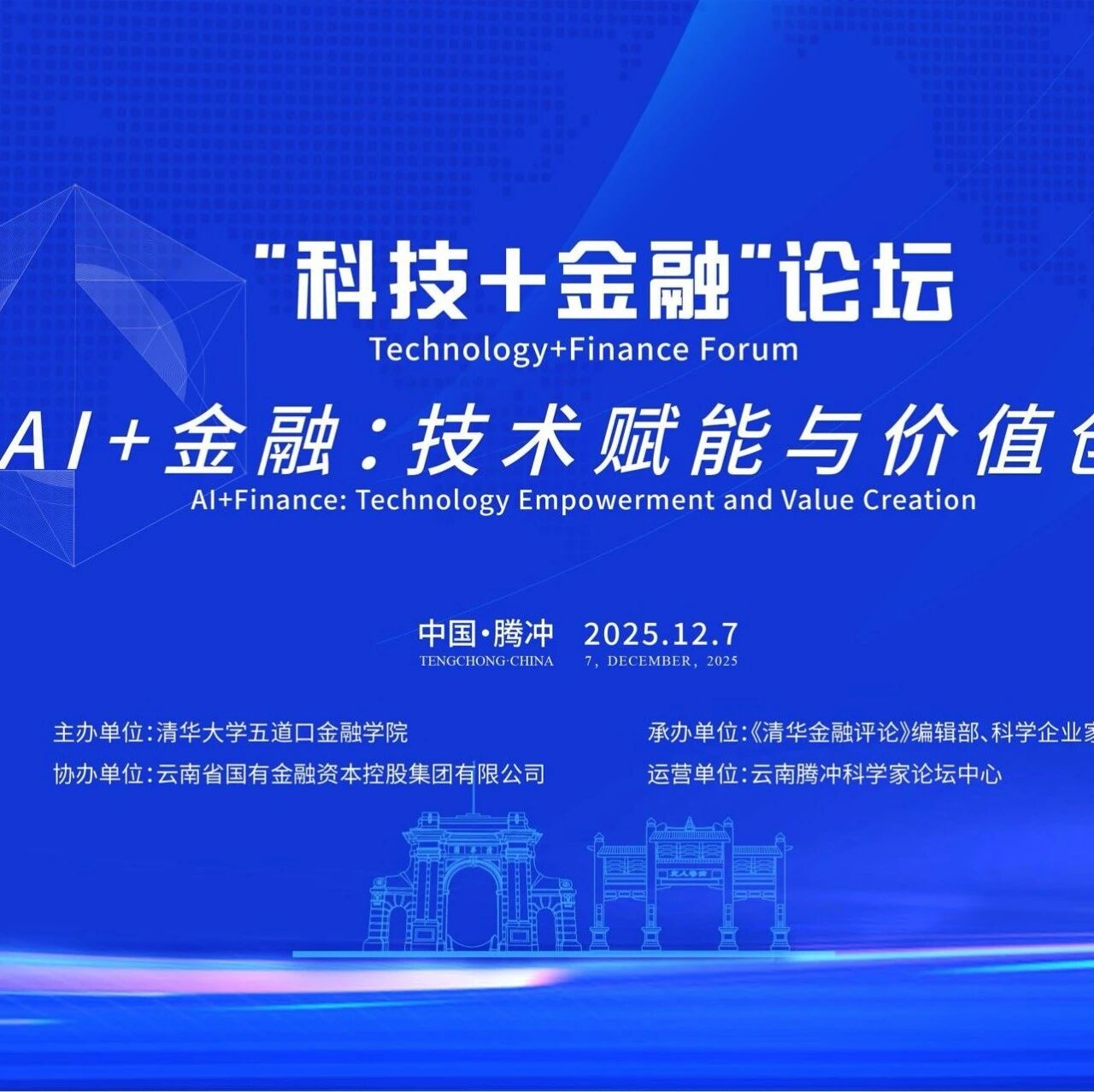
席位有限,先到先得!2025腾冲科学家论坛——“科技+金融”论坛
清华金融评论· 2025-11-17 10:38
Core Viewpoint - The article emphasizes the importance of integrating technology, industry, and finance to support high-quality economic development in China, aligning with the goals set by the 20th National Congress and the 2025 Government Work Report [1]. Group 1: Event Overview - The 2025 Tengchong Scientist Forum will be held on December 7, 2025, in Yunnan, focusing on the theme "AI + Finance: Technology Empowerment and Value Creation" [2]. - The forum is organized by Tsinghua University Wudaokou School of Finance and aims to provide a high-end communication platform for technological financial innovation [1][2]. Group 2: Agenda Highlights - The event will feature a series of activities including keynote speeches, high-level dialogues, and roundtable discussions focusing on AI's impact on the financial ecosystem [2][6]. - The agenda includes a session on exploring the dual paths of technology empowerment and value creation, as well as discussions on AI's role in reshaping financial ecosystems [6]. Group 3: Invited Guests - The forum will host leaders from policy regulatory bodies, Yunnan provincial government, and experts from Tsinghua University and other institutions [3]. - Notable attendees will include academicians from the Chinese Academy of Sciences and the Chinese Academy of Engineering, as well as financial institution experts from major banks [4]. Group 4: Forum Highlights - The forum will gather top-tier experts and industry leaders, with over 200 business leaders expected to participate [5]. - It aims to explore the reconstruction of the financial ecosystem through AI and discuss relevant hot topics such as data elements and financial innovation [6]. Group 5: Venue and Environment - The event will take place in a comfortable environment conducive to innovative thinking, characterized by a pleasant climate and unique natural scenery [8].
联易融科技-W(09959)11月17日斥资740.16万港元回购265万股
智通财经网· 2025-11-17 09:57
Group 1 - The company, Lianyi Rong Technology-W (09959), announced a share buyback plan on November 17, 2025, involving an expenditure of HKD 7.4016 million to repurchase 2.65 million shares [1]
【Fintech 周报】经营贷利率低至2.2%;常熟银行迎“85后”行长;比特币抹去今年以来全部涨幅
Tai Mei Ti A P P· 2025-11-17 09:07
Regulatory Dynamics - The China Payment and Clearing Association has issued an initiative to strengthen the security management of "no-password payment" services, advocating for the prohibition of default activation and the provision of limit management features [2] - Following the implementation of the "Assisted Loan New Regulations," licensed consumer finance institutions are required to reduce the average comprehensive financing cost of newly issued loans to 20% or below starting from Q1 next year, which may pressure the consumer finance and assisted loan sectors [2] Industry Dynamics - The commercial auto insurance for new energy vehicles in China has surpassed 100 billion yuan for the first time, reaching 108.79 billion yuan, with a year-on-year growth of 36.6% [4] - The penetration rate of new energy vehicles reached 58% in September, with the commercial insurance coverage rate at 91% for the first nine months of the year, indicating a strong growth trajectory in this sector [4] Corporate Developments - Industrial Bank has established a financial asset investment company with a registered capital of 10 billion yuan, focusing on non-bank financial services [5] - Changshu Bank has appointed a new executive team, including a notably young president born in 1986, setting a record for the youngest president of a listed bank [5] - Ma Shang Consumer Finance plans to transfer over 1.8 billion yuan in personal non-performing loans, with an average overdue period exceeding 1800 days [6] - Xinyu Consumer Finance has released six batches of non-performing loan transfers totaling over 2.6 billion yuan, indicating a significant focus on asset disposal [6] - China Bank Consumer Finance has announced changes in its senior management, with new vice presidents expected to enhance business expansion and risk management [6] - Tencent's Q3 report shows a 10% year-on-year increase in revenue from its financial technology and enterprise services segment, driven by strong growth in commercial payment activities and consumer loan services [7][8]


推动金融人才与国际金融中心建设“双向奔赴” “沪上金融家”这样说
Xin Hua Cai Jing· 2025-11-17 08:54
Core Insights - The development of a strong financial talent pool is essential for building a robust financial nation, with discussions on how to promote the dual growth of financial talent and the Shanghai International Financial Center [1] Group 1: Financial Technology and AI - Shanghai has become the preferred destination for foreign financial institutions entering the Chinese market, with cross-border RMB settlement accounting for a significant portion of the national total [2] - Experts emphasize the necessity of leveraging financial technology and artificial intelligence to enhance Shanghai's competitiveness as an international financial center [2] - DBS Bank has implemented generative AI across multiple applications, transforming traditional banking processes into parallel workflows, which is expected to have a disruptive impact on operational efficiency [2][3] - AI is being utilized for various functions, including compliance, intelligent marketing, risk control, customer service, and investment research, with a notable increase in the proportion of technical personnel in firms like Jiufang Zhitu [2] Group 2: Financial Security and Risk Management - The integration of big data and AI is crucial for improving operational efficiency and maintaining market stability and security in the financial sector [3] - AI can enhance customer profiling and enable precise marketing, while also aiding in anti-money laundering efforts by analyzing vast amounts of data for suspicious activities [3][4] - Financial institutions can achieve 100% pre-warning, real-time monitoring, and post-event tracing of compliance risks through the use of AI and big data [4] Group 3: Talent Development in Finance - The construction and cultivation of financial talent should be prioritized to establish Shanghai as a leading global financial technology center within the next 3 to 5 years [6] - The competition for talent among global financial centers is intensifying, with a shift towards a workforce that is increasingly tech-savvy, digitally capable, and knowledgeable in green finance [6][7] - Recommendations for talent development include fostering interdisciplinary talents who understand finance and technology, cultivating international financial professionals, and developing leadership skills in finance [7]
恒银科技(603106):大力调整产品服务结构,营收较为稳健
China Post Securities· 2025-11-17 08:31
Investment Rating - The report assigns a "Buy" rating for the company, with an expected increase in stock price relative to the benchmark index of over 20% within six months [7]. Core Insights - The company has adjusted its product and service structure significantly, leading to stable revenue growth. For the first three quarters of 2025, it achieved revenue of 265 million yuan, a year-on-year increase of 3.22%, and a net profit attributable to shareholders of 17.8 million yuan [5][9]. - The company is focusing on product innovation and research and development, enhancing its technological barriers. It has improved the success rate of data encryption transmission to 99.9% in financial self-service devices and optimized its cash processing speed to over 720 notes per minute [9]. - The company is actively expanding into overseas markets, successfully launching products in countries like Bangladesh and the Philippines, which is expected to contribute to revenue growth in the future [9]. Financial Performance Summary - Revenue projections for 2025-2027 are as follows: 442 million yuan in 2025, 492 million yuan in 2026, and 543 million yuan in 2027, with growth rates of 0.96%, 11.46%, and 10.27% respectively [10]. - The net profit attributable to shareholders is projected to be 59.05 million yuan in 2025, 75.26 million yuan in 2026, and 82.90 million yuan in 2027, reflecting growth rates of 47.16%, 27.47%, and 10.15% respectively [10]. - Earnings per share (EPS) are expected to be 0.11 yuan in 2025, 0.14 yuan in 2026, and 0.16 yuan in 2027, with corresponding price-to-earnings (P/E) ratios of 103, 81, and 74 [10].

粤开证券携手金证股份共拓机构理财新蓝海
Quan Jing Wang· 2025-11-17 08:16
Core Insights - The launch of the "Enterprise Treasure" platform by Guangdong Kai Securities and Jinzheng Co., Ltd. marks a significant step in providing a comprehensive institutional wealth management service solution, focusing initially on the public fund sector [1][2] - The platform aims to address pain points in institutional client services and promote the digital transformation of institutional business through a full-cycle, integrated approach [1][2] Group 1: Platform Features - The platform covers the entire investment process, including pre-investment research, transaction support, post-investment analysis, and operational management, creating a closed-loop service [1] - It offers a rich and multi-dimensional set of investment research tools to enhance brokerage firms' value-added services [2] - The platform supports various transaction types, including public and private funds, income certificates, fund advisory, on-market ETFs/LOFs, money market funds, and reverse repos, catering to diverse institutional allocation needs [2] Group 2: Technological Integration - Jinzheng Co., Ltd. emphasizes a B2B2C model, focusing on the full lifecycle service needs of professional institutional investors [1] - The project leader from Jinzheng Co., Ltd. highlighted the company's mature construction plan for the platform, which supports integration with heterogeneous systems and allows for rapid deployment [2] - The collaboration between Guangdong Kai Securities and Jinzheng Co., Ltd. explores a new model of institutional services driven by demand, technology, and ecosystem co-construction [2] Group 3: Market Context - The institutionalization of China's securities market is accelerating, making institutional business a core area for high-quality development among securities firms [1] - As the market for institutional wealth management services becomes more specialized and digitalized, Jinzheng Co., Ltd. is committed to leveraging technology, including AI models, to enhance service efficiency [2] - The company aims to build a smart, collaborative, and sustainable new ecosystem for wealth management services by integrating resources with industry partners [2]

蚂蚁健康升级,会否成为又一个极其昂贵的故事丨正经深度
Sou Hu Cai Jing· 2025-11-17 08:14
Core Insights - Ant Group is facing challenges in cultivating new growth drivers while needing to tell a new market story for valuation recovery and management [1][2] - The health strategy of Ant Group is AI-driven, continuing the platform thinking inherited from Alibaba, aiming for a transformation from a "fintech platform" to an "AI-driven livelihood service infrastructure" [2][9] Business Structure and Strategy - Ant Group has restructured its organization, with the new "Health Business Group" becoming a strategic pillar alongside other core business units [7] - The company aims to integrate health management, consultation, diagnosis, payment, and rehabilitation into a seamless service ecosystem [9][10] Market Challenges - The healthcare sector presents significant complexity and high barriers to entry, making integration difficult [3][4] - Ant Group's health strategy faces competition from established players like Tencent, JD, and Baidu, as well as numerous AI healthcare startups [21][22] Financial Performance and Valuation - Ant Group's valuation has significantly decreased from a peak of over 2.1 trillion yuan to approximately 567.1 billion yuan, a drop of over 70% [7][8] - The company’s net profit has also declined sharply, with a drop of more than 60% compared to its peak [7] User Engagement and Market Potential - Ant Health has served over 800 million users since its inception in 2014, indicating a strong user base [8][9] - The Chinese healthcare market is projected to grow from 8 trillion yuan in 2019 to 20 trillion yuan by 2025, with a compound annual growth rate of 15% [8] AI Integration and Technology - Ant Group's AI health application "AQ" is central to its health strategy, providing various AI-driven health services and connecting with over 5,000 hospitals and nearly a million doctors [14][16] - The AI model has been trained on over a trillion tokens of medical data, aiming to provide personalized and reliable health advice [16][17] Internal and External Challenges - Internal resource competition among different business units poses challenges for the implementation of the health strategy [21] - The healthcare sector's high investment and slow return model complicates the commercialization of AI healthcare solutions [22]
