
保险

Search documents
负债行为跟踪:当内外资共振,结构特征如何?
ZHONGTAI SECURITIES· 2026-03-29 10:22
1. Report Industry Investment Rating No relevant content found. 2. Core Viewpoints of the Report - This week, sentiment indicators such as the VIX index continue to indicate a decline in global risk appetite, but the decline of the A - share market has narrowed, reflecting that the negative impact of external factors on the A - share market has weakened. Leverage funds' activity has dropped to a low level, ETF funds have continued to flow in, and foreign capital is optimistic about Chinese assets, even siphoning funds from other markets [2]. 3. Summary by Directory 3.1 Two - margin trading - The proportion of two - margin trading volume to A - share trading volume has dropped from 9.2% to 9.0%, reaching the average level of the past three years, close to the end of June 2025. The two - margin balance has generally decreased from 2.63 trillion to 2.62 trillion, falling on Monday and Tuesday and then rebounding slightly [2]. - Index component two - margin trading has seen continuous net outflows; most industries have de - leveraged, with national defense and military industry, agriculture, forestry, animal husbandry and fishery, commerce and retail, media, and automobile having relatively large de - leveraging amplitudes, while industries such as coal, comprehensive, and public utilities have increased leverage [3]. - Stocks with a market value of over 3 billion have de - leveraged, and small - cap stocks have a relatively large de - leveraging amplitude [3]. - Popular stocks de - leveraged on Monday and Tuesday and increased leverage from Wednesday to Friday [3]. 3.2 ETF funds - CSI 300, SSE Composite Index, ChiNext, Science and Technology Innovation 50, and CSI 1000 ETFs have seen net inflows this week, while SSE 50 and CSI 500 ETFs have had small net outflows. Except for the CSI 500 ETF, other representative ETFs had a large amount of funds bottom - fishing when they had a large decline on Monday [4]. 3.3 Foreign capital - This week, foreign capital has continued to flow into the Chinese market, which can be cross - verified from several perspectives: the trading volume proportion of northbound funds has increased from 13.2% to 13.3% on a month - on - month basis; the median weekly increase or decrease of northbound active stocks is - 0.1%, and the average is 0.5%, outperforming the entire A - share market; from March 18th to March 25th, foreign capital has flowed out of the Japanese, South Korean, and US markets and into the Chinese market [5].
北京智驾车将有商业保险 适配L2-L4全级别
财联社· 2026-03-29 09:39
Group 1 - The article highlights that Beijing has taken the lead in the country by initiating the development and application of commercial insurance products for intelligent connected new energy vehicles [1] - The new insurance products will largely follow the existing commercial vehicle insurance system for new energy vehicles, focusing on providing risk coverage for specific intelligent driving scenarios and hardware/software losses [1] - The insurance is designed to be compatible with all levels of intelligent connected new energy vehicles, from L2 to L4, addressing gaps in current insurance definitions that primarily consider human driving scenarios [1]


普惠保险服务覆盖超2.36亿人 中国太保寿险积极构建“1+3+N”多层次医疗保障体系
和讯· 2026-03-29 09:30
Core Viewpoint - China Pacific Insurance (CPIC) is deeply integrating into the "Great Health and Elderly Care" strategy, focusing on a multi-layered medical insurance system that includes critical illness insurance, long-term care insurance, and supplementary medical insurance, aiming to cover over 236 million people by 2025 [1][2]. Group 1: Insurance Coverage and Services - By 2025, CPIC's critical illness insurance will cover over 105 million people across 39 cities, while long-term care insurance will serve over 85 million people in 44 cities across 17 provinces [1]. - The "Huhui Bao" project, a customized commercial supplementary medical insurance in Shanghai, has insured over 33 million people from 2021 to 2025, with over 6.45 million insured in 2025 alone, making it the largest project of its kind in the country [1]. - Cumulative compensation for the "Huhui Bao" project has exceeded 2.7 billion yuan, benefiting hundreds of thousands of families, with the youngest claimant being 3 months old and the oldest 104 years old [1]. Group 2: Long-term Care Insurance Initiatives - CPIC has participated in over 50% of national long-term care insurance pilot projects, establishing systematic operational capabilities in disability assessment, care coordination, and fund management [2]. - The company plans to launch the "Yihu" series of commercial long-term care insurance in 2026, aiming to mitigate the risk of family imbalance caused by a single member's disability [2]. Group 3: New Product Offerings - The "Yihu Tian Nian Protection Plan," launched on March 30, includes a combination of products that allow consumers to flexibly configure based on health status and retirement expectations, providing both value appreciation and defense against care needs [3]. - This plan also offers "Wuyou Butler" services, addressing the challenges faced by families with disabilities by providing health management, professional assessments, and care resource connections [3]. - Commercial long-term care insurance is positioned as a complement to policy-based long-term care insurance, offering higher coverage and more flexible designs to meet diverse and high-quality elderly care needs [3].

【华西非银】中国平安2025年报点评:OPAT实现双位数增长,资负两端表现稳健
Xin Lang Cai Jing· 2026-03-29 09:29
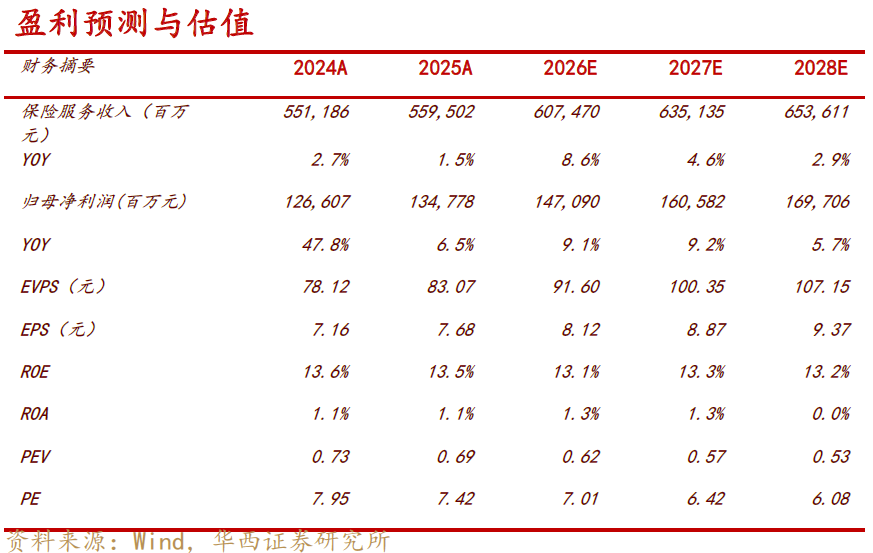
Summary of Key Points Core Viewpoint - Ping An Insurance reported a solid performance in 2025, with a notable increase in operating profit and new business value, despite challenges in the fourth quarter due to market volatility and one-time project impacts [1][2]. Financial Performance - The group achieved a parent operating profit (OPAT) of CNY 134.415 billion, up 10.3% year-on-year, with a Q4 increase of 35.3% [1]. - The net profit attributable to the parent company was CNY 134.778 billion, reflecting a year-on-year growth of 6.5%, but a significant decline of 74.1% in Q4 [1]. - The new business value (NBV) for life and health insurance reached CNY 36.897 billion, up 29.3% year-on-year [1][3]. - The combined ratio (COR) for property insurance improved to 96.8%, a 1.5 percentage point enhancement year-on-year [1][4]. Business Segments - Life and Health Insurance: - Operating profit was CNY 99.752 billion, a 2.9% increase year-on-year, driven by a 55.5% rise in investment service performance [3]. - The NBV growth was attributed to a significant increase in value rate, with the NBVM rising by 4.9 percentage points to 23.4% [3]. - The agent channel's NBV grew by 10.4%, while the bank insurance channel saw a remarkable increase of 138.0% [3]. - Property Insurance: - Operating profit reached CNY 16.923 billion, up 13.2% year-on-year, with stable growth in insurance service revenue of CNY 338.912 billion, a 3.3% increase [4]. - The overall cost ratio improved due to optimized expenses and profitability in the auto insurance segment [4]. Investment Performance - The total investment income increased by 13.5%, with a comprehensive investment return of 6.3%, up 0.5 percentage points year-on-year [5]. - The investment portfolio exceeded CNY 6.49 trillion, reflecting a 13.2% increase from the beginning of the year [5]. Dividend Distribution - The company proposed a cash dividend of CNY 1.75 per share at the end of 2025, leading to a total annual cash dividend of CNY 2.70 per share, a 5.9% increase year-on-year [1]. Future Projections - The company maintains its revenue forecasts for 2026-2027 at CNY 607.47 billion and CNY 635.135 billion, respectively, with an additional forecast for 2028 at CNY 653.611 billion [6]. - The net profit projections for 2026-2027 are set at CNY 147.09 billion and CNY 160.582 billion, with a new forecast for 2028 at CNY 169.706 billion [6].

中信股份(00267):业绩再写稳健格局,派息率持续提升
GF SECURITIES· 2026-03-29 09:28
Investment Rating - The report assigns a "Buy" rating to the company, with a current price of HKD 11.83 and a fair value of HKD 14.51 [9]. Core Insights - The company demonstrated resilient performance with total revenue of RMB 7692.64 billion in 2025, reflecting a year-on-year growth of 3.0%. The net profit attributable to ordinary shareholders was RMB 587.30 billion, a slight increase of 0.9%. The annual dividend per share was RMB 0.585, with a payout ratio of 29.0%, up by 1.5 percentage points from the previous year [9]. - The financial sector emerged as the core growth driver, achieving revenue of RMB 2908.80 billion and net profit of RMB 558.15 billion, representing year-on-year increases of 6.2% and 6.0%, respectively. Key subsidiaries performed well, with CITIC Bank's total assets surpassing RMB 10.13 trillion and net profit reaching RMB 706.18 billion, a 2.98% increase [9]. - The industrial sector showed significant performance divergence, with revenue growth of only 1.1%. Notable contributions came from CITIC Metal's copper and niobium businesses, while CITIC Pacific Energy's green electricity generation increased by 94% [9]. - The company has consistently increased its technology investments, maintaining an investment intensity of over 3% for three consecutive years. It is enhancing its technology infrastructure and integrating AI into both financial and industrial sectors [9]. - Profit forecasts indicate a net profit of RMB 589 billion for 2026, with a year-on-year growth of 1.15%. The report maintains a reasonable valuation of 0.45x PB, translating to a fair value of HKD 14.51 per share [9]. Financial Projections - Revenue projections for the company are as follows: RMB 7472 billion in 2024, RMB 7693 billion in 2025, RMB 8006 billion in 2026, RMB 8413 billion in 2027, and RMB 8792 billion in 2028, with growth rates of 9.75%, 2.95%, 7.15%, 5.07%, and 4.51% respectively [4]. - The net profit attributable to shareholders is projected to be RMB 582 billion in 2024, RMB 587 billion in 2025, RMB 589 billion in 2026, RMB 599 billion in 2027, and RMB 606 billion in 2028, with growth rates of 1.06%, 0.91%, 1.15%, 1.74%, and 1.24% respectively [4].

再创新高!五大险企去年盈利超4000亿元,权益仓位普遍提升
证券时报· 2026-03-29 08:30
Core Viewpoint - The five major A-share listed insurance companies in China achieved a record net profit of 425.29 billion yuan in 2025, marking a year-on-year increase of over 70 billion yuan, or 22.4%, following a historical high in 2024 [1] Group 1: Profit Performance - China Life reported a net profit of 154.08 billion yuan in 2025, up 44.1% year-on-year [2] - New China Life achieved a net profit of 36.28 billion yuan, a 38.3% increase [2] - China Pacific Insurance's net profit was 53.51 billion yuan, growing by 19% [2] - China Property & Casualty Insurance reported a net profit of 46.65 billion yuan, an 8.8% rise [2] - Ping An Insurance's net profit reached 134.78 billion yuan, up 6.5% [2] - The overall increase in profits is attributed to both liability and investment sides, alongside the transition to new accounting standards [2] Group 2: Investment Performance - China Life's total investment income was 387.69 billion yuan, a 25.8% increase from 2024 [5] - The investment return rate for China Life was 6.09%, up 59 basis points year-on-year [5] - The equity investment ratio for China Life increased by nearly 5 percentage points, reaching 16.89% by the end of 2025 [5] - Ping An's investment portfolio grew to 6.49 trillion yuan, a 13.2% increase, with a comprehensive investment return rate of 6.3% [5] - China Property & Casualty Insurance's investment assets reached 1.90 trillion yuan, with total investment income of 92.32 billion yuan, a 12.4% increase [6] - New China Life's investment assets exceeded 1.84 trillion yuan, with total investment income of 104.33 billion yuan, a 30.9% increase [7] Group 3: Liability Side Transformation - The liability side of insurance companies has stabilized, contributing to the increase in net profits [8] - China Life's new business value increased by 35.7%, with significant growth in the bancassurance channel [8] - Ping An's new business value in life and health insurance reached 36.90 billion yuan, a 29.3% increase, with bancassurance channel growth of 138% [9] - China Pacific Insurance's new business value grew by 40.1%, with bancassurance channel premiums increasing by 46.4% [9]




中国平安(601318):2025年年报点评:营运利润稳健增长,股票仓位大幅提升
EBSCN· 2026-03-29 08:11
Investment Rating - The report maintains a "Buy" rating for both A-shares and H-shares of Ping An Insurance, with current prices at 56.95 RMB and 59.30 HKD respectively [1]. Core Insights - In 2025, Ping An achieved an operating revenue of 1.1 trillion RMB, a year-on-year increase of 2.1%. The net profit attributable to shareholders was 134.78 billion RMB, up 6.5% year-on-year, while the operating profit attributable to shareholders reached 134.42 billion RMB, reflecting a 10.3% increase year-on-year. The new business value (NBV) was 36.9 billion RMB, marking a significant growth of 29.3% year-on-year [4][9]. - The company’s net investment return rate was 3.7%, a slight decrease of 0.1 percentage points year-on-year, while the total investment return rate was estimated at 4.6%, an increase of 0.1 percentage points year-on-year. The comprehensive investment return rate improved by 0.5 percentage points to 6.3% [4][8]. Summary by Relevant Sections Financial Performance - In 2025, the company reported a net profit of 134.78 billion RMB, with a growth rate of 6.5%. The quarterly performance showed fluctuations, with Q4 experiencing a significant decline of 74.1% year-on-year, primarily due to investment disturbances. The operating profit for the year was 134.42 billion RMB, reflecting a 10.3% increase year-on-year [4][9]. - The new business value (NBV) for 2025 was 36.9 billion RMB, with a year-on-year growth of 29.3%. The first-year premium reached 157.92 billion RMB, up 2.5% year-on-year, driven by product structure optimization and effective cost control [5][6]. Business Segments - In the life insurance segment, the average NBV per agent increased by 17.2% to 80,000 RMB per agent annually, despite a slight decrease in the number of agents [5]. - The property insurance segment saw a 3.3% increase in insurance service revenue, totaling 338.91 billion RMB. The comprehensive cost ratio improved by 1.5 percentage points to 96.8%, positioning the company favorably compared to peers [7][8]. Investment Strategy - The company significantly increased its stock holdings, with stock assets reaching 958.1 billion RMB, a 119.1% increase from the beginning of the year, now accounting for 14.8% of total investment assets [8]. - The report anticipates that the new business value will continue to grow positively in 2026, supported by ongoing enhancements in product structure and service offerings [9].
给商业航天上保险
经济观察报· 2026-03-29 07:00
Core Viewpoint - There is a significant gap between the domestic commercial aerospace market size and the related insurance premium scale, with the market expected to reach 2.5 trillion yuan by 2025, while the current insurance premium is only about 800 million yuan [1][3]. Group 1: Market Dynamics - The private commercial aerospace company plans to double its low Earth orbit satellite production capacity to 40 satellites per year, but this still may not meet the growing demand from downstream enterprises [2]. - The rapid expansion of low Earth orbit satellites and the increasing demand for high-frequency, high-precision ground images are driving the need for enhanced risk management solutions [2][5]. - The domestic commercial aerospace insurance market is highly concentrated, with major market shares held by large insurance institutions like China Life, China Ping An, and China Taiping [5]. Group 2: Insurance Challenges - The high technology nature of commercial aerospace leads to low tolerance for errors, making insurance companies more cautious in underwriting, focusing on companies with high historical success rates [5][6]. - The insurance market faces challenges such as rapid technological iterations, lack of historical data for accurate pricing, and high liability risks, which necessitate a more cautious underwriting strategy [6][7]. - High insurance premiums deter companies from purchasing coverage, particularly for third-party liability insurance during rocket launches, which can exceed 400,000 yuan for a coverage amount of 50 million USD [8]. Group 3: Solutions and Innovations - Companies are exploring tailored insurance products that cover various risk scenarios throughout the satellite lifecycle, including research, testing, launch, and in-orbit operations [9][12]. - The development of a commercial aerospace insurance pricing model based on static data is underway, which will evolve to a dynamic model as more data becomes available [11][12]. - The establishment of a commercial aerospace insurance consortium has provided risk coverage for 17 launch projects amounting to nearly 7.7 billion yuan [12]. Group 4: Future Outlook - The future growth of the aerospace insurance market is expected to focus on satellite internet constellation construction, regular commercial rocket launches, and deep space exploration [13]. - A comprehensive financial solution combining insurance, funding, and capital support is needed to address the pain points of commercial aerospace companies [13]. - If insurance coverage can be expanded to encompass the entire satellite lifecycle, companies may seek additional funding to increase production capacity significantly [13].

再创新高!五大险企去年盈利超4000亿元,权益仓位普遍提升
券商中国· 2026-03-29 06:33
Core Viewpoint - The profitability of listed insurance companies in China has reached a new high in 2025, with a total net profit of 425.29 billion yuan, marking a 22.4% increase from 2024, following a record high in 2024 [1][2]. Group 1: Profitability Highlights - In 2025, major listed insurance companies reported significant net profit growth: China Life at 154.08 billion yuan (up 44.1%), New China Life at 36.28 billion yuan (up 38.3%), China Pacific at 53.51 billion yuan (up 19%), China Property at 46.65 billion yuan (up 8.8%), and Ping An at 134.78 billion yuan (up 6.5%) [2][3]. - The total investment income for China Life reached 387.69 billion yuan, a 25.8% increase from 2024, with an investment return rate of 6.09%, up 59 basis points [5][6]. Group 2: Investment Strategies - Listed insurance companies have increased their equity asset allocations significantly compared to 2024, with China Life raising its equity investment ratio by nearly 5 percentage points [5]. - By the end of 2025, China Life's stock and fund allocation rose from 12.18% to 16.89%, with over 1.2 trillion yuan in public market equity investments [5][6]. Group 3: Liability Side Transformation - The liability side of insurance companies has stabilized, contributing to the overall profit increase, with premium income growing steadily and liability costs decreasing [8][9]. - China Life's new business value increased by 35.7% in 2025, with significant growth in the bancassurance channel, which saw total premiums exceed 110.87 billion yuan, a 45.5% increase [8][9]. Group 4: Market Conditions and Future Outlook - The insurance sector is expected to benefit from a stable long-term interest rate environment, with the ten-year government bond yield stabilizing around 1.82%, potentially easing pressure on fixed-income investment returns [9].

中国平安(601318)2025年报点评:资负协同+高股息属性 攻守兼备价值凸显
Xin Lang Cai Jing· 2026-03-29 06:24
Performance Overview - The company's net profit attributable to shareholders for 2025 is projected to be 134.8 billion yuan, representing a year-on-year increase of 6.5%. However, Q4 saw a significant decline in net profit by 74% due to losses from growth stock investments and non-recurring gains. Excluding one-time disturbances, the net profit excluding non-recurring items increased by 22.5% [1] - The operating profit attributable to shareholders increased by 10.3%, with the new business value (NBV) and embedded value (EV) for life insurance rising by 29.3% and 11.2% respectively. The combined ratio (COR) for property insurance improved by 1.5 percentage points to 96.8%, and the dividend per share (DPS) reached 2.7 yuan, up by 5.9% year-on-year [1] Life Insurance - The company optimized its channel structure and improved the quality of its workforce. The NBV from bank insurance channels increased by 138% year-on-year, accounting for 25.5% of total NBV, becoming a core growth driver. The number of individual insurance agents decreased by 3.3% to 351,000, but the per capita NBV increased by 17.2%, indicating a significant improvement in workforce quality. The annual NBV margin increased by 4.9 percentage points to 23.4%, with both individual and bank insurance channels achieving notable value rate improvements [1] Property Insurance - The underwriting profitability of property insurance continued to improve, with total premiums increasing by 6.6% year-on-year. The COR for auto insurance decreased to 95.8%, and premiums for new energy vehicles rose by 39%, achieving underwriting profitability. Most non-auto insurance products also reported underwriting profits, with only liability insurance showing a slight loss, indicating a continuous optimization of overall underwriting profitability [1] Solvency - The core solvency ratios for the group, life insurance, and property insurance are robust, standing at 160.7%, 123.3%, and 173.5% respectively. The comprehensive solvency ratios are 193.3%, 175.7%, and 217.1%, all within a reasonable industry range, providing a solid foundation for sustainable development [2] Investment - The core equity position reached a historical high, with the proportion of core equities (stocks + equity funds) increasing by 9.2 percentage points to 19.1%. The bond allocation decreased by 6.7 percentage points, and real estate investment exposure fell to 3.1%. The investment income showed stability, with net interest income (NII) at 3.7% (down 0.1 percentage points year-on-year) and comprehensive investment income (CII) at 6.3% (up 0.5 percentage points year-on-year), resulting in a total investment income increase of 13.5% year-on-year. The proportion of OCI stocks in total stocks is 57.2%, showing a significant decrease since the beginning of the year, indicating a shift towards a more balanced investment structure [2] Investment Recommendation - The company is positioned as a dual-purpose stock with synergistic asset-liability management and high dividend attributes. As of March 27, the static dividend yield is 4.7%. Projected net profits attributable to shareholders for 2026-2028 are 155.3 billion, 170.9 billion, and 178.1 billion yuan, reflecting year-on-year growth rates of 15.2%, 10.1%, and 4.2% respectively. The corresponding price-to-embedded value (PEV) ratios are 0.64, 0.59, and 0.56, maintaining a "buy" rating [2]