工业母机

Search documents
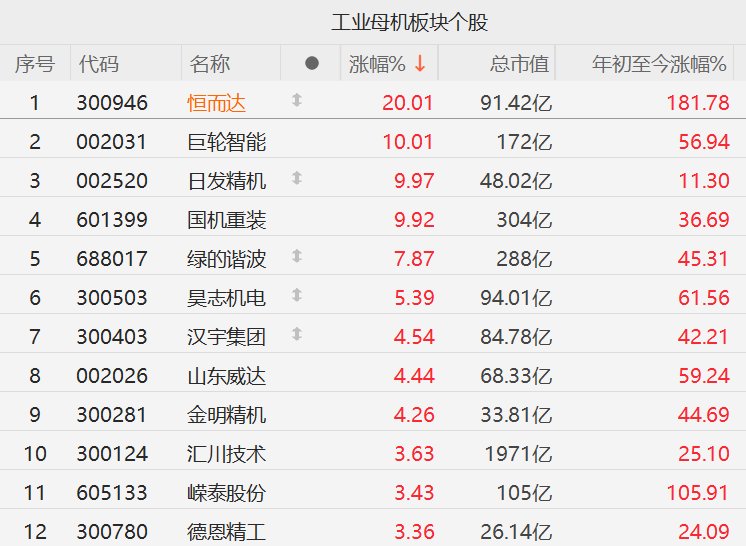
A股工业母机板块走强,巨轮智能等多股涨停
Ge Long Hui A P P· 2025-12-04 03:08
Core Viewpoint - The industrial mother machine sector in the A-share market is experiencing significant growth, with several stocks showing strong performance due to the formation of a MACD golden cross signal [1] Group 1: Stock Performance - Heng'erda has reached a 20% limit up [1] - Jilun Intelligent, Rifa Precision Machinery, and Guojiji Heavy Industry have all achieved a 10% limit up [1] - Green Harmony has increased by over 7% [1] - Haozhi Electromechanical has risen by over 5% [1] - Hanyu Group, Shandong Weida, and Jinming Precision Machinery have all seen increases of over 4% [1]




【汉中】“十四五”以来累计实施重大工程项目1029个
Shan Xi Ri Bao· 2025-12-03 22:44
11月27日,记者从汉中市举行的高质量完成"十四五"规划首场新闻发布会上获悉:"十四五"以来, 汉中市经济实现质的有效提升和量的合理增长,经济总量有望站上2000亿元台阶,经济规模稳居陕甘川 渝毗邻六市第二位,高质量发展综合绩效评价指数保持全省前列。 5年来,汉中市统筹推进深层次改革和高水平开放,发展环境不断优化,民营经济经营主体数量居 全省第二,民营经济增加值占比达58.7%,营商环境满意度位居全省前列。开放水平明显提升,中欧班 列"汉西欧"专列常态化运营,进口保税仓和出口监管仓挂牌运行,汉中经开区纳入陕西自贸试验区协同 创新区。(记者:杨露雅) 汉中市发展和改革委员会主任郝明森介绍,"十四五"以来,汉中市坚持大抓项目、抓大项目,累计 谋划实施重大工程项目1029个;全市固定资产投资年均增速稳居全省前列。全社会研发投入、规上工业 企业研发投入强度连续5年居全省第一方阵。装备制造、现代材料、绿色食药三大主导产业集中度超过 80%,创建省级中小企业特色产业集群7个,总量居全省第二。宝汉天工业母机集群获评国家先进制造 业集群,数字经济核心产业产值达54亿元。 ...
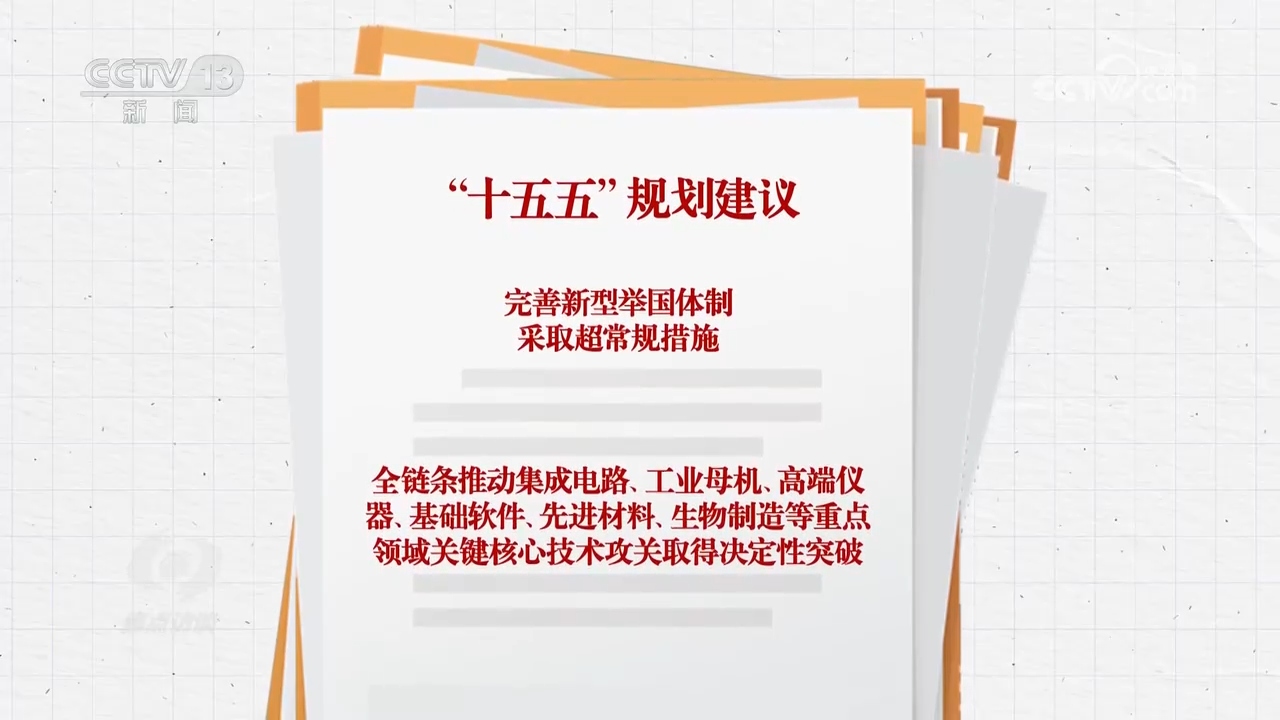
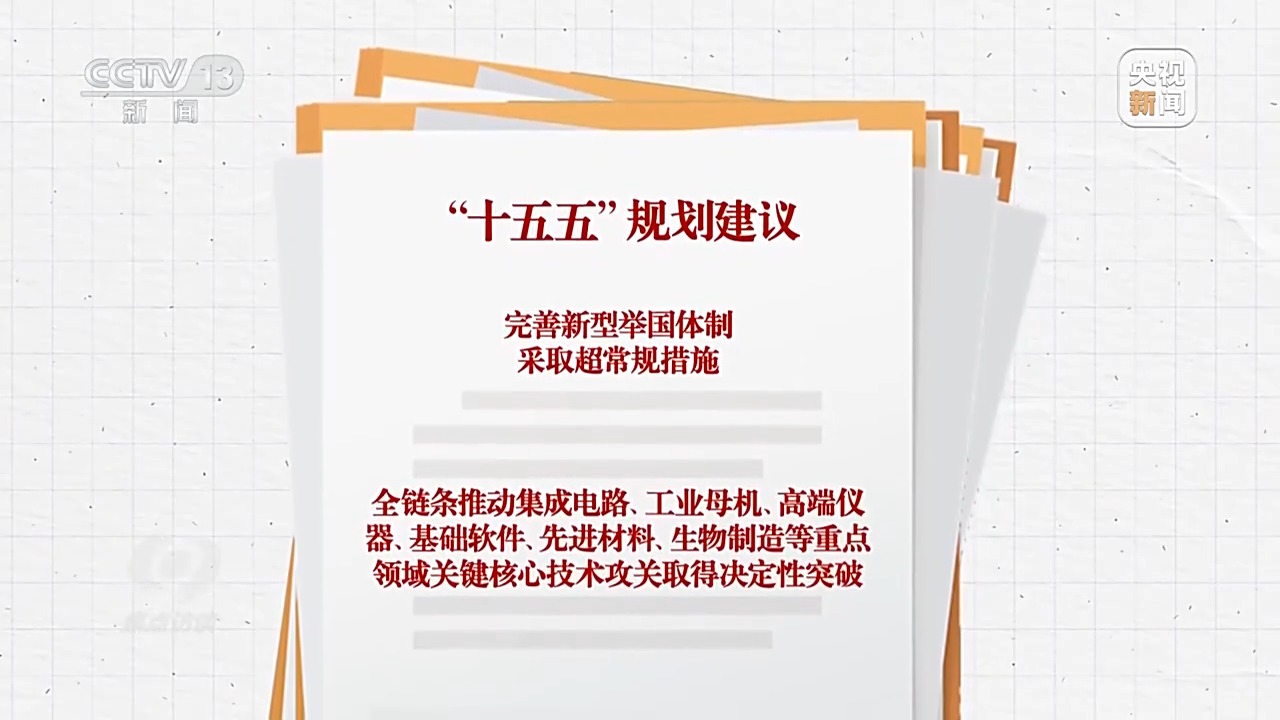
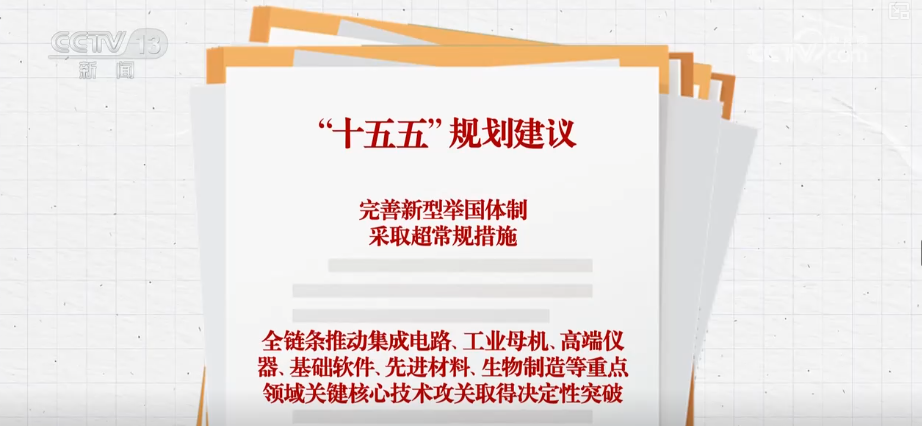
为什么要全链条推动集成电路等重点领域关键核心技术攻关取得决定性突破
Xin Lang Cai Jing· 2025-12-03 13:20
Core Viewpoint - The article emphasizes the importance of overcoming key core technology challenges in critical sectors such as integrated circuits, industrial mother machines, high-end instruments, basic software, advanced materials, and biomanufacturing to ensure national security and promote high-quality economic development [1][5]. Group 1: Importance of Key Core Technologies - Key core technologies are essential for national security and high-quality economic development, necessitating a strong focus on improving the ability to tackle these challenges [1][5]. - Recent advancements have been made in areas like 5G, Beidou navigation, high-speed rail, and nuclear power, but significant gaps remain in integrated circuits and other critical fields that require intensified efforts [1][5]. Group 2: Systematic Approach to Innovation - A systematic and comprehensive approach to deploying key core technology initiatives is crucial for accelerating breakthroughs and shortening innovation cycles [2][6]. - Optimizing the organization of major technological innovations and fostering a collaborative development of innovation forces, resource allocation, and talent is essential for overcoming the current limitations [2][6]. Group 3: Addressing Fundamental Research Gaps - The root cause of the "bottleneck" technology issue lies in inadequate foundational theoretical research, which must be addressed to strengthen the basis for technological innovation and industrial development [3][7]. - Emphasizing original and disruptive innovation is necessary to avoid falling into a cycle of imitation and to secure a competitive edge in the global value chain [3][7]. Group 4: Collaborative Framework for Technology Advancement - A collaborative framework that leverages the advantages of a new type of national system is needed to effectively coordinate government, market, and societal resources in technology research and application [4][7]. - Implementing extraordinary measures to enhance goal orientation and demand-driven approaches will facilitate better collaboration among enterprises, universities, and research institutions [4][7]. Group 5: Incentives and Application of Innovations - Strengthening incentives for researchers to focus on high-quality, original, and disruptive technological innovations aligned with national strategic needs is critical [8]. - Promoting the application of self-innovated products and establishing policies for the first batch of applications will create a virtuous cycle that encourages research and development [9].
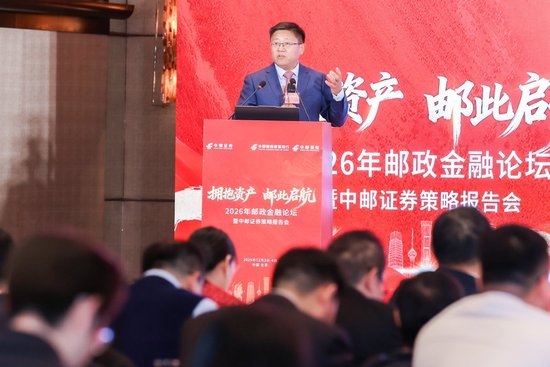
中邮证券黄付生:制造业“K”型分化,居民财富将迎修复
Xin Lang Cai Jing· 2025-12-03 12:25
Core Insights - The report presented by Huang Fusheng at the "2026 Postal Financial Forum" highlights China's economic recovery, driven by the "14th Five-Year Plan" focusing on modern industrial systems and high-tech sectors [3][8]. Group 1: Economic Recovery and Industrial Policy - China is building a modern industrial system under the "14th Five-Year Plan," with a focus on high-tech sectors showing significant performance [3][8]. - The plan prioritizes the construction of a modern industrial system and strengthening the real economy, aiming to "recreate a Chinese high-tech industry" over the next decade [3][8]. - Key strategies include enhancing traditional industries, addressing core technology challenges, and fostering strategic emerging industries like new materials and quantum technology [3][8]. Group 2: Manufacturing Sector Performance - The manufacturing sector exhibits a K-shaped recovery, with high-tech product exports growing faster than the overall export growth rate of 5.3% in the first ten months of 2025 [4][9]. - Profit growth in upstream manufacturing sectors like transportation equipment and non-ferrous metal smelting significantly outpaces that of downstream industries such as furniture and apparel [4][9]. - A-share non-financial companies reported a revenue increase of 0.9% year-on-year in Q3 2025, with net profits rising by 3.29% [4][10]. Group 3: Consumer Wealth and Spending Trends - Recovery of resident wealth is projected to take 3-5 years, with service consumption identified as a future growth area [5][10]. - In 2025, there remains a significant gap in resident wealth compared to the peak in 2021, but optimistic scenarios suggest recovery to previous levels by 2028 [5][10]. - The consumption structure indicates a saturation in goods consumption (15% of GDP) compared to major Western countries, while service consumption in healthcare and education is below global averages, indicating substantial growth potential [5][10].
ETF日报:有色板块的景气度正在逐渐兑现,国内铜产业盈利能力较强,建议关注有色板块
Xin Lang Cai Jing· 2025-12-03 12:14
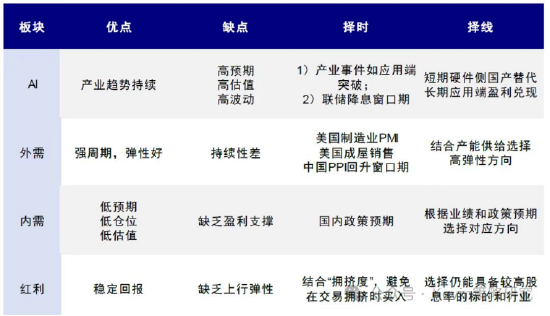
Market Overview - A-shares experienced a decline today, with the Shanghai Composite Index down 0.51% to 3878.00 points, the Shenzhen Component Index down 0.78%, the ChiNext Index down 1.12%, and the STAR Market Index down 0.95% [1][10] - The trading volume in the Shanghai and Shenzhen markets was approximately 16699.62 billion yuan, an increase of about 765.32 billion yuan compared to the previous trading day [1][10] - The market showed a low risk appetite, with 1443 stocks rising and 3876 stocks falling [1][10] Sector Performance - Dividend sectors performed well today, with transportation, non-ferrous metals, oil, mining, and coal showing positive results [1][10] - High-volatility sectors, including gaming, film and television, new energy vehicles, and computers, underperformed [1][10] - The market style showed that small-cap stocks lagged behind large-cap stocks, and growth stocks underperformed value stocks [1][10] Economic Outlook - The current macroeconomic state is characterized by a transition between old and new growth drivers, with a "K" shaped economic recovery [2][10] - Three sectors with growth potential identified are technology (AI revolution, policy support, overseas mapping), upstream anti-involution (solar, lithium batteries), and exports (global manufacturing recovery, positive overseas fiscal expectations) [2][10] - The technology and upstream sectors are still on an upward trend but carry risks due to previous significant gains [2][10] Investment Recommendations - Investors are advised to maintain a balanced allocation strategy, utilizing the "seesaw effect" to hedge daily volatility and optimize holding experiences [10] - Suggested ETFs for potential opportunities include non-ferrous metals 60 ETF (159881), mining ETF (561330), chemical leading ETF (516220), and industrial mother machine ETF (159667) [2][10] - As a hedging option, cash flow ETF (159399) is recommended [2][10] Bond Market Insights - The recent bond market environment shows a divergence between macro conditions and trading sentiment, with a weak nominal growth rate and a low interest rate environment supported by macro realities [7][16] - The People's Bank of China announced the purchase and sale of 50 billion yuan in government bonds, with the 30-year government bond yield rising by 2.40 basis points to 2.23% [14][16] - Financial institutions maintain a moderately optimistic outlook for the bond market in December, with a downward trend in funding rates observed since November [16][8]
奋楫“十五五”,资本与国策共创
Sou Hu Cai Jing· 2025-12-03 01:52
Core Insights - The focus of national development is shifting from "quantitative recovery" post-pandemic to "qualitative leap" in the "15th Five-Year Plan" [1] - The "15th Five-Year Plan" emphasizes "high-level technological self-reliance" and aims for a dual goal of "effective qualitative improvement and reasonable quantitative growth" [5][11] Group 1: Economic and Industrial Strategy - The national strategy is entering a new cycle centered on innovation efficiency, industrial structure, and regional collaboration, marking a shift from "policy following" to "system co-creation" [4] - The plan aims to build a modern industrial system with advanced manufacturing as the backbone, focusing on future industries like quantum technology, biomanufacturing, and hydrogen energy [11] - The transition from "incremental manufacturing" to "efficiency manufacturing" indicates a shift in focus from merely increasing production to optimizing resource allocation [12] Group 2: Investment Opportunities - Hard technology investment, including semiconductors and advanced materials, is positioned as a foundational logic for "systematic breakthroughs" [10] - Investment institutions are encouraged to engage in pre-financing and result transformation for national technology tasks, fostering capital co-creation [10] - The emphasis on "entrepreneurial investment + risk-sharing mechanisms" presents opportunities for investment firms to participate in national innovation initiatives [10] Group 3: Green Development - The "15th Five-Year Plan" elevates green development from a secondary goal to a structural institution, influencing all industrial allocations [17] - The integration of green issues into financial and market mechanisms signifies a shift in perspective, making green development a capital issue [17] - Sustainable investment opportunities in green infrastructure and carbon asset management are expected to grow [20] Group 4: Consumer and Market Dynamics - The plan positions consumption upgrade as a core driver of economic structural transformation, moving from recovery to quality enhancement [22] - The "silver economy" is recognized as a significant industrial opportunity, transforming aging issues into growth engines [22][25] - Investment opportunities in healthcare, elder care, and technology-assisted living are anticipated to rise due to demographic shifts [25] Group 5: Regional Development - The focus of regional policy is shifting from "development gradient" to "structural coordination," promoting a unified market and efficient resource allocation [27] - Investment institutions are encouraged to collaborate with local guiding funds to strengthen project foundations and facilitate new industry development in less developed regions [30] Group 6: Financial Market Reforms - The "15th Five-Year Plan" emphasizes structural improvements in capital markets, transitioning from a focus on financing to a comprehensive investment-funding-exit cycle [32] - Direct investment institutions are identified as key players in building a strong financial nation, with multiple exit pathways being developed [35] - The plan aims to enhance the inclusivity and adaptability of capital market systems, promoting direct financing methods [31] Strategic Summary - The "15th Five-Year Plan" outlines new engines for China's economic growth, including technological innovation and green transformation, while establishing a more inclusive capital market system [36] - Investment institutions are encouraged to align their strategies with national planning, leveraging professional judgment to identify promising sectors and companies for investment [36]

焦点访谈丨向着新目标前进:未来五年 打好关键核心技术攻坚战
Yang Shi Xin Wen Ke Hu Duan· 2025-12-02 06:40
Core Viewpoint - The article emphasizes the importance of key core technology breakthroughs in China's "14th Five-Year Plan" and outlines a strategic approach to achieve these breakthroughs through focused efforts in six critical areas [1][3][9]. Group 1: Strategic Focus Areas - The "14th Five-Year Plan" identifies six key areas for technology breakthroughs: integrated circuits, industrial mother machines, high-end instruments, basic software, advanced materials, and biomanufacturing [3][9][21]. - These areas are strategically chosen to address urgent technological challenges and leverage new opportunities in the context of global technological competition [9][11][19]. Group 2: New Approaches and Measures - The plan proposes a "new type of national system" to enhance coordination and resource allocation for technology innovation, ensuring a unified effort across government and market sectors [23][25]. - "Extraordinary measures" will be implemented to overcome existing institutional barriers, focusing on urgent issues and mobilizing all available resources to achieve targeted breakthroughs [25][27]. Group 3: Comprehensive Chain Integration - A "full-chain approach" is advocated, integrating research, technology development, and industrial cultivation to ensure a seamless transition from innovation to market application [27][29]. - The integration of various chains, including industry, innovation, funding, and talent, is crucial for addressing past disconnects and ensuring effective collaboration [29]. Group 4: Investment and Progress - China's R&D investment is projected to exceed 3.6 trillion yuan in 2024, reflecting a 48% increase from 2020, with a focus on strengthening foundational research and innovation capabilities [19][21]. - The country has achieved significant milestones in key technology areas, moving from a position of following to leading in certain sectors, such as the production of ultra-thin steel materials [17][19].
厚实家底支撑核心技术攻关底气 “新提法”“新目标”新在何处?解读↓
Yang Shi Wang· 2025-12-02 04:32
Core Insights - The "14th Five-Year Plan" emphasizes the importance of key core technology breakthroughs, highlighting it as a crucial element for achieving high-quality development in China [1][3][12] - The plan outlines a shift from a broad approach to a more targeted strategy, focusing on six key areas for technological advancement [6][8][19] Summary by Categories Key Areas of Focus - The six major fields identified for concentrated efforts are integrated circuits, industrial mother machines, high-end instruments, basic software, advanced materials, and biomanufacturing [8][9][12] - These areas are critical for overcoming existing technological bottlenecks and seizing new opportunities presented by technological revolutions [9][12] Strategic Approach - The plan introduces a "new proposal" and "new goals" for tackling key core technologies, emphasizing a comprehensive and integrated approach [3][5] - The strategy involves a "new type of national system" that promotes collaboration and resource allocation across various sectors to enhance innovation [19][20] Investment and Resources - By 2024, China's total R&D investment is projected to exceed 3.6 trillion yuan, a 48% increase from 2020, with a research intensity of 2.68%, surpassing the EU average [18] - The plan aims to strengthen both foundational research and the mechanisms that facilitate rapid technological advancement [18][20] Implementation Mechanisms - The strategy calls for "super-normal measures" to break existing constraints and accelerate reforms in technology development [20][21] - A full-chain approach is emphasized, ensuring that every link from research and development to industrial application is effectively integrated [21]
博时基金桂征辉:股债均衡,市场波动中的投资“平衡术”
Xin Lang Ji Jin· 2025-12-02 02:00
Group 1: A-Share Market Insights - The A-share market in 2025 is characterized by "structural differentiation and prominent main lines," with technology, non-ferrous metals, and new energy sectors standing out, particularly in AI computing power, semiconductor equipment, gold, and lithium resources [1] - The rise in these sectors is driven by the global explosion in AI demand, supportive new energy policies, and improved supply-demand relationships [1] - Challenges include slow recovery in traditional real estate and consumer sectors, as well as external factors like fluctuating Federal Reserve policies and geopolitical conflicts affecting market trends [1] Group 2: Global Economic Impact - Global macroeconomic events, such as Federal Reserve interest rate cuts and geopolitical tensions, have an indirect but significant impact on A-shares [2] - Interest rate cuts can attract foreign capital into A-shares, but expectations during the cut process may lead to short-term volatility [2] - Geopolitical conflicts may increase energy prices, affecting industry costs and enhancing the attractiveness of assets like gold [2] Group 3: Investment Opportunities - Three key areas to focus on include: 1. Technological innovation, such as AI, semiconductors, and biomanufacturing, benefiting from national policies and technological breakthroughs [3] 2. Consumption upgrades, including cultural tourism, health, and green consumption, showing strong demand resilience [3] 3. High-end manufacturing, like new energy equipment and industrial mother machines, aligning with global industrial chain restructuring trends [3] - Some sectors have seen valuation recoveries, suggesting a diversified approach through index or sector funds to mitigate risks associated with single-stock bets [3] Group 4: Bond Investment Risks - Key risks in bond investment include interest rate risk, where market rate changes can lead to bond price fluctuations, and credit risk, which refers to the possibility of the issuer failing to pay interest or principal [4] - Investors are advised to prioritize government bonds or high-credit-rated bonds to mitigate these risks [4] Group 5: Balanced Investment Strategy - The effectiveness of a balanced stock-bond strategy lies in the inverse relationship between stocks and bonds, where stocks provide returns during market upswings and bonds may appreciate during downturns, thus cushioning losses [5] - Historical data indicates that during significant A-share adjustments, the bond market often performs well, leading to lower drawdowns in balanced portfolios compared to pure equity investments [5] Group 6: Public Fund Benefits - Public funds address the high entry barriers of direct stock and bond investments by offering professional management, diversified investment, and low minimum investment thresholds [6] - Funds select a basket of stocks or bonds, automatically diversifying risk, and have flexible investment amounts starting as low as 10 yuan [6] Group 7: Risk Preference-Based Fund Allocation - Investors should assess their risk tolerance before determining stock-bond fund ratios, with suggested allocations for different risk profiles: 1. Defensive investors: Up to 30% in stock funds, at least 70% in bond funds, focusing on low-volatility assets [7] 2. Moderate investors: Approximately equal allocation (around 50% each) with potential inclusion of thematic or convertible bond funds [7] 3. Aggressive investors: 70%-80% in stock funds, 20%-30% in bond funds, focusing on growth-oriented stock funds [7] Group 8: Additional Considerations - Factors such as age and investment horizon should influence asset allocation, with younger investors leaning towards aggressive strategies and those nearing retirement shifting to defensive ones [8] - Regular review and adjustment of investment ratios are essential to align with life stages, market changes, and goals [8] - Diversification within the same asset class is crucial to further reduce non-systematic risks [8]
焦点访谈|未来五年,打好关键核心技术攻坚战
Yang Shi Wang· 2025-12-01 13:23
Core Insights - The article emphasizes the importance of tackling key core technologies as a strategic priority for China's high-quality development, particularly highlighted in the "14th Five-Year Plan" [1][4][10] - The focus will be on six critical areas: integrated circuits, industrial mother machines, high-end instruments, basic software, advanced materials, and biomanufacturing, which are deemed essential for overcoming technological bottlenecks and seizing new opportunities [6][8][14] Group 1: Strategic Framework - The "14th Five-Year Plan" proposes a new approach to technology development, emphasizing a comprehensive and targeted strategy rather than a broad, unfocused one [4][6] - The plan aims to establish a "new type of national system" that coordinates resources across government and market sectors to enhance innovation capabilities [16][18] - The strategy includes "extraordinary measures" to break existing barriers and accelerate reforms necessary for technological breakthroughs [18][20] Group 2: Implementation Tactics - The focus on "full-chain promotion" ensures that every aspect of the technology development process, from research to industrialization, is integrated and efficient [20] - The article highlights the need for a robust support system that combines funding, talent, and industry collaboration to facilitate rapid advancements in technology [12][14] - The commitment to investing in foundational research and creating a conducive environment for innovation is underscored, with projected R&D spending exceeding 3.6 trillion yuan by 2024, a 48% increase from 2020 [14] Group 3: Future Vision - The envisioned future includes advanced materials and technologies that enhance everyday life, such as smart buildings and sustainable food production methods [22] - The successful execution of the outlined strategies is expected to lead to significant advancements in various sectors, ultimately transforming the technological landscape of China [10][22]