
美妆

Search documents
毛戈平(01318.HK):25H1归母净利同比+36.1% 产品矩阵推新升级带动增长
Ge Long Hui· 2025-08-30 19:04
Core Viewpoint - The company reported strong revenue and profit growth for the first half of 2025, aligning with previous forecasts, driven by robust sales in the cosmetics and skincare segments [1][2][3] Financial Performance - In H1 2025, the company achieved revenue of 2.59 billion yuan, a year-on-year increase of 31.3%, and a net profit attributable to shareholders of 670 million yuan, up 36.1% [1] - Adjusted net profit for H1 2025 was also 670 million yuan, reflecting a 32.0% year-on-year growth [1] - The overall gross margin for H1 2025 was 84.2%, a slight decrease of 0.7 percentage points compared to the previous year [2] Business Segments - Revenue breakdown for H1 2025 showed cosmetics at 1.42 billion yuan, skincare at 1.01 billion yuan, fragrance at 10 million yuan, and makeup training and sales at 70 million yuan, with respective year-on-year growth rates of +31.1% and +33.4% for cosmetics and skincare [1] - The gross margins for cosmetics, skincare, fragrance, and makeup training were 82.7%, 87.5%, 77.6%, and 62.9%, with declines in cosmetics and skincare margins of 0.9 and 0.2 percentage points respectively [1] Channel Performance - Online and offline channels generated revenues of 1.30 billion yuan and 1.22 billion yuan respectively, with year-on-year growth rates of +39.0% and +26.6% [2] - Online sales accounted for 51.4% of total revenue, while offline sales made up 48.6% [2] - Membership numbers reached 13.4 million online and 5.6 million offline, with online and offline repurchase rates of 24.1% and 30.3%, reflecting increases of 2.6 and 1.6 percentage points year-on-year [2] Product Development - The company launched new products in the cosmetics and skincare segments, with flagship items generating significant sales, including over 200 million yuan for luxury caviar cushion and soft-focus powder [3] - The newly introduced fragrance series "Guo Yun Ning Xiang" and "Wen Dao Dong Fang" expanded the product portfolio [3] Profit Forecast and Investment Rating - The company is recognized as a rare high-end beauty brand in China, with an upgraded profit forecast for 2025-2027, projecting net profits of 1.20 billion, 1.52 billion, and 1.91 billion yuan respectively, reflecting year-on-year growth rates of +36.6%, +26.7%, and +25.2% [3] - The latest closing price corresponds to a price-to-earnings ratio of 35, 28, and 22 for 2025-2027, maintaining a "buy" rating [3]
毛戈平(01318.HK):2025H1业绩亮眼 高端国货美妆势能持续向上
Ge Long Hui· 2025-08-30 19:04
Core Viewpoint - The company reported a strong performance in H1 2025, with revenue and net profit growth exceeding 30%, aligning with expectations, and demonstrating sustained momentum in high-end brand positioning [1] Group 1: Financial Performance - H1 2025 revenue reached 2.588 billion yuan, reflecting a year-on-year increase of 31.3%, while net profit attributable to shareholders was 670 million yuan, up 36.1% [1] - The company maintains its profit forecast, expecting net profits of 1.179 billion, 1.536 billion, and 1.939 billion yuan for 2025-2027, with corresponding EPS of 2.41, 3.13, and 3.95 yuan [1] Group 2: Business Segmentation - In H1 2025, the makeup, skincare, and makeup art training segments generated revenues of 1.422 billion, 1.087 billion, and 67 million yuan, with year-on-year growth rates of 31.1%, 33.4%, and a decline of 5.9% respectively [2] - Online and offline channels achieved revenues of 1.297 billion and 1.224 billion yuan, with year-on-year growth of 39.0% and 26.6% [2] Group 3: Profitability and Cost Management - The company's gross margin for H1 2025 was 84.2%, a decrease of 0.7 percentage points, with specific margins for makeup, skincare, fragrance, and makeup art training at 82.7%, 87.5%, 62.9%, and 77.6% respectively [2] - The sales, management, and R&D expense ratios were 45.2%, 6.9%, and 0.6%, showing a year-on-year decrease of 2.3, 1.5, and 0.2 percentage points, indicating stable cost management [2] Group 4: Product Development and Market Expansion - The company continues to leverage synergies between makeup and skincare, with significant sales in high-end products such as the small gold fan powder and caviar cushion, each exceeding 200 million yuan [3] - The fragrance segment is expanding with new launches like "Guoyun Ningxiang" and "Wendao Dongfang," achieving sales of 11.41 million yuan [3] - The skincare segment saw retail sales of the caviar mask surpassing 600 million yuan, accounting for nearly 60% of skincare sales, with strong performance from key products [3] Group 5: Channel Strategy and Customer Engagement - The company has expanded its offline presence with 405 self-operated and 32 distributor counters across over 120 cities, achieving a repurchase rate of 30.3%, an increase of 1.6 percentage points [3] - Online sales during the 2025 618 promotion grew over 70%, and the company secured the top position in the Douyin makeup category during the Good Goods Festival, indicating effective online marketing strategies [3]
美妆赛道上半年成绩单出炉,谁掉队、谁赶超?
Zhong Guo Ji Jin Bao· 2025-08-30 11:55
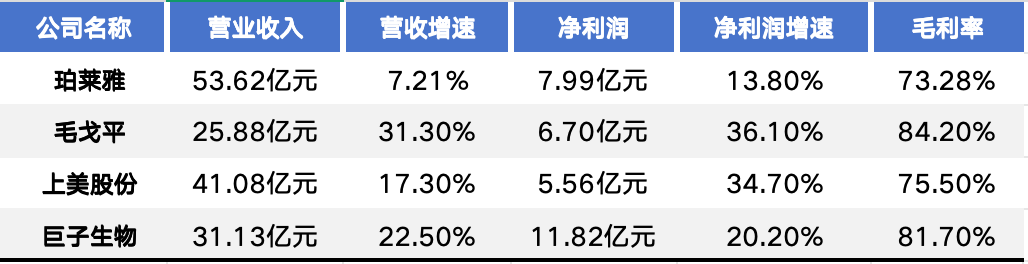
Core Insights - The beauty industry in China is experiencing a significant performance divergence among leading companies, with a notable emphasis on quality improvement amidst a deep industry adjustment [1][2]. Group 1: Industry Performance - In the first half of 2025, retail sales of cosmetics in China increased by 2.9% year-on-year, with domestic brands capturing over 55% market share [2]. - Exports of cosmetics surged by 12% to 25.8 billion yuan, indicating strong overseas growth potential [2]. Group 2: Leading Companies - Leading companies like Proya, Mao Geping, and Shangmei continue to excel, while others like Huaxi Biological and Fulejia are lagging behind [2]. - Proya reported revenue of 5.362 billion yuan, a 7.21% increase, and a net profit of 799 million yuan, up 13.8% [4]. - Mao Geping achieved a revenue of 2.588 billion yuan, with a remarkable growth rate of 31.3%, and a net profit of 670 million yuan, reflecting a 36.1% increase [5]. - Shangmei's revenue reached 4.108 billion yuan, growing by 17.3%, with a net profit of 556 million yuan, up 34.7% [5]. - Juzhi Biological reported revenue of 3.113 billion yuan, a 22.5% increase, and a net profit of 1.182 billion yuan, up 20.2% [5]. Group 3: Underperforming Companies - Huaxi Biological reported a significant decline, with revenue dropping nearly 19.57% to 2.261 billion yuan and net profit falling 35.38% to 221 million yuan [6]. - Fulejia's revenue decreased by 8.15% to 863 million yuan, with a net profit decline of 32.54% to 230 million yuan, largely due to increased marketing expenses [9][11]. Group 4: Second-Tier Companies - Second-tier companies like Shanghai Jahwa, Marubi, and Shuiyang are showing improved performance [13]. - Shanghai Jahwa's revenue was 3.478 billion yuan, up 4.8%, with a net profit of 270 million yuan, increasing by 11.7% [14]. - Marubi achieved revenue of 1.769 billion yuan, a 30.83% increase, but net profit growth was only 5.21% [14]. - Shuiyang reported revenue of 2.5 billion yuan, a 9.02% increase, and a net profit of 123 million yuan, up 16.54% [14].

美妆赛道上半年成绩单出炉,谁掉队、谁赶超?
中国基金报· 2025-08-30 11:52
Core Viewpoint - The beauty industry in China is experiencing a significant performance divergence among leading companies, with a notable increase in quality, as evidenced by the half-year reports of domestic beauty brands [2]. Group 1: Leading Companies Performance - Leading beauty companies such as Proya, Mao Geping, and Shangmei continue to outperform, while Huaxi Biological and Fulejia are lagging behind [2][4]. - Proya reported a revenue of 5.362 billion yuan, a year-on-year increase of 7.21%, and a net profit of 799 million yuan, up 13.8%. However, its main brand experienced a slight revenue decline of 0.08% [5][6]. - Mao Geping, known as the "first stock of high-end domestic beauty," achieved a revenue of 2.588 billion yuan, with a net profit of 670 million yuan, both showing over 30% growth. The gross margin reached 84.2% [6]. - Shangmei's revenue was 4.108 billion yuan, growing 17.3%, with a net profit of 556 million yuan, up 34.7%. The "newpage" brand saw a revenue increase of 146.5% [6][7]. - Juzhi Biological reported a revenue of 3.113 billion yuan, a 22.5% increase, and a net profit of 1.182 billion yuan, up 20.2%, although growth rates have slowed compared to the previous year [7]. Group 2: Underperforming Companies - Huaxi Biological, referred to as the "first stock of hyaluronic acid," reported a revenue decline of 19.57% to 2.261 billion yuan and a net profit drop of 35.38% to 221 million yuan, marking its worst interim report since listing [9]. - The decline in Huaxi's revenue is attributed to a significant drop in its functional skincare business, which saw a 31.62% year-on-year decrease in 2024 [9]. - Fulejia's revenue was 863 million yuan, down 8.15%, with a net profit of 230 million yuan, a decrease of 32.54%. The company faced a substantial increase in sales expenses, which rose by 39.56% [11][12]. Group 3: Second-Tier Companies - Second-tier beauty companies such as Shanghai Jahwa, Marubi, and Shuiyang are showing improved performance [13][14]. - Shanghai Jahwa achieved a revenue of 3.478 billion yuan, a 4.75% increase, and a net profit of 266 million yuan, up 11.66%, attributed to online channel growth [15]. - Marubi reported a revenue of 1.769 billion yuan, a 30.83% increase, but its net profit only grew by 5.21%, indicating a potential profitability challenge [15][16]. - Shuiyang's revenue reached 2.5 billion yuan, a 9.02% increase, with a net profit of 123 million yuan, up 16.54%. The company is transitioning to a global high-end beauty brand management model [16].

主品牌营收7年来首下滑,珀莱雅焦急谋变:冲刺港股二次上市
Xin Lang Cai Jing· 2025-08-30 11:13
Core Viewpoint - Proya has made significant management changes and announced plans for a secondary listing in Hong Kong, aiming to accelerate its international strategy and expand overseas business, despite facing slowing growth in its core brand revenue [3][5][6]. Management Changes - Proya appointed Guo Xiao as the Chief Marketing Officer (CMO), who has over 10 years of experience in brand strategy and marketing in the consumer sector [4]. - The company also appointed Xue Xia as the new board secretary, who brings extensive experience in capital market operations and multinational management [4]. Secondary Listing - Proya plans to initiate a secondary listing in Hong Kong to enhance its international strategy and overseas business development, aiming to improve its overseas financing capabilities and overall competitiveness [5][6]. - The decision for a Hong Kong listing is seen as a way to reduce financing costs and potentially support international business expansion [5]. Financial Performance - In the first half of the year, Proya achieved revenue of 5.362 billion yuan, a year-on-year increase of 7.21%, and a net profit of 799 million yuan, up 13.8% [5][6]. - This growth is significantly slower compared to previous years, where revenue and net profit growth rates were above 35% [5][6]. Brand Performance - Proya's main brand revenue decreased for the first time since 2018, with a reported revenue of 3.979 billion yuan, a slight decline of 0.08% year-on-year [6]. - The second brand, Caitang, also showed signs of slowing growth, with revenue of 705 million yuan in the first half of the year, representing a year-on-year increase of 21.11%, down from previous years' growth rates [6]. Channel Growth - Proya's online channel revenue accounted for 95.39% of total revenue, amounting to 5.109 billion yuan, with a year-on-year growth of 9.17% [7]. - However, the growth rate of online channel revenue has been declining over the past three years, indicating a potential challenge in maintaining strong growth in this area [7].

七夕南京美妆市场观察:国际巨头同台竞技,高端消费显现新动向
Yang Zi Wan Bao Wang· 2025-08-30 09:57
Core Insights - The article highlights a competitive market event among international beauty brands at Nanjing Deji Plaza during the Qixi Festival, showcasing strong consumer engagement and brand strategies [1][3][12] Group 1: Market Performance - Nanjing Deji Plaza is projected to achieve a revenue of 24.5 billion yuan in 2024, solidifying its position as a leading high-end shopping destination in China [3] - The opening of Louis Vuitton's first independent beauty store globally at Deji Plaza received a positive market response, with some limited edition products selling out on the first day [3][14] - Dior's Qixi marketing campaign led to significant sales growth, particularly for its new lipstick series, which has become a market highlight [3][5] Group 2: Consumer Trends - There is a notable increase in interest and purchasing intent among younger consumers for Gucci's fragrance and makeup products during the Qixi Festival [5] - The beauty sector at Deji Plaza is undergoing brand adjustments and upgrades, with new entries like Le Labo, enhancing its high-end beauty brand matrix [8] - Market surveys indicate that over half of Chinese consumers show a strong interest in personalized products and services, driving brands to enhance experiential offerings [12] Group 3: Marketing Strategies - Brands are innovating their marketing strategies by focusing on experiential consumption, with Dior's "Stunning Red Pavilion" featuring interactive areas like smart makeup mirrors [9] - Gucci's "Dream Garden" created an immersive fragrance experience, effectively boosting sales and consumer engagement [9][11] - Louis Vuitton's personalized engraving service and limited product offerings successfully created a sense of exclusivity and urgency among consumers [11] Group 4: Market Outlook - The results of the Qixi marketing campaigns reflect a recovery trend in the high-end beauty market, with expectations for steady growth in the second half of the year [14] - As traditional consumption peaks like Mid-Autumn Festival and National Day approach, brands are preparing new marketing initiatives to capitalize on the market momentum [14]

节日消费助推即时零售火热,美团七夕非餐饮即时零售日订单超2700万
Ge Long Hui A P P· 2025-08-30 08:58
Core Insights - On August 29, during the Qixi Festival, Meituan's non-food instant retail order volume reached a record high of 27 million, driven by gift demand from the "Flash Purchase Gifts" campaign [1] - The overall gift consumption scale for Meituan's flash purchase service also hit a new peak, with flower sales breaking records and categories like digital electronics, beauty products, and jewelry seeing sales double [1] - Consumer spending per capita on categories such as home appliances and beauty products significantly increased compared to last year's Qixi Festival [1] Group 1 - The trend of gift-giving is diversifying and becoming more quality-oriented, moving from traditional gifts like flowers and chocolates to a broader range of products, leading to substantial sales growth in high-priced categories [1] - Instant retail is becoming an important growth driver for major brands and retailers, with over 500 beauty, electronics, fast-moving consumer goods, and liquor brands experiencing multiple-fold sales growth on the platform [1] - The dual increase in order volume and average transaction value indicates a robust market response to the evolving gift-giving landscape [1]


珀莱雅的两种焦虑
Hua Er Jie Jian Wen· 2025-08-30 05:32
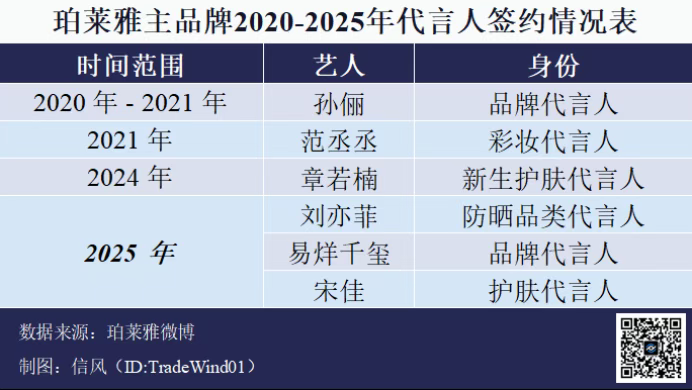
Core Viewpoint - Proya (603605.SH) has become the first domestic beauty brand to surpass 10 billion in revenue but is currently facing pressure from slowing performance [1][2] Financial Performance - In the first half of 2025, Proya reported revenue and net profit attributable to shareholders of 5.362 billion and 799 million respectively, representing year-on-year growth of 7.21% and 13.8% [1] - The second quarter showed a significant slowdown, with revenue of 3.003 billion, a year-on-year increase of only 6.49%, down over 30 percentage points compared to the same period in 2024 [1] - The main brand's revenue declined slightly by 0.08% to 3.979 billion in the first half of 2025, compared to a growth rate of 38% in the same period last year [5] Marketing Strategy - Proya has significantly increased its marketing expenditures, signing at least three top celebrities as brand ambassadors in 2025, which is more than the total of the past five years [1][9] - Marketing expenses reached 2.659 billion in the first half of 2025, a year-on-year increase of 13.64% [7] - The company is focusing on cost control, with operating costs down over 5% year-on-year to 1.427 billion [1][11] Competitive Landscape - Proya is set to compete with its peer, Shiseido's parent company, Up Beauty (2145.HK), which reported a revenue growth rate of 16% in the first half of 2025 [3][15] - Proya's market share is currently around 2%, indicating significant room for growth compared to mature markets [6] Future Plans - Proya is planning to list on the Hong Kong Stock Exchange, aiming to enhance its international strategy and financing capabilities [13][14] - The company has identified potential acquisition targets to boost its performance, with a goal of increasing its overall revenue to 35 billion from its own brands and 15 billion through acquisitions over the next decade [15][16]
雅诗兰黛业绩下滑 外资巨头面临挑战
Zhong Guo Jing Ying Bao· 2025-08-29 14:46
Core Insights - Estée Lauder reported an 8% year-over-year decline in organic net sales for the fiscal year 2025, with a loss of $785 million in operating profit [2][3] - The decline in the Chinese market was 6%, attributed to increased competition from local mid-to-high-end beauty brands and a failure to engage younger consumers [2][4] Financial Performance - For fiscal year 2025, Estée Lauder achieved organic net sales of $14.326 billion, down 8% from the previous year [2] - In mainland China, organic net sales were $2.741 billion, reflecting a 6% decline [3] - The company experienced a significant drop in net sales in previous fiscal years, with a 10.3% decrease in fiscal year 2023 and a 58% drop in net profit [3] Market Dynamics - The decline in sales is largely due to a downturn in global travel retail, which constitutes a significant portion of Estée Lauder's business [3][5] - The high-end beauty market is expected to grow by 2% to 3% in fiscal year 2026, with a recovery in travel retail anticipated [3] Competitive Landscape - Estée Lauder faces challenges from emerging local brands that are innovating in product concepts and marketing strategies, appealing to younger consumers [5][6] - The company has been criticized for its slow product innovation and lower R&D investment compared to competitors like L'Oréal [4][6] Strategic Challenges - Estée Lauder's reliance on travel retail channels and its slower product innovation cycle are seen as weaknesses in a rapidly changing market [6] - The company is also facing difficulties in adapting to the unique characteristics of the Chinese market, where online channels dominate and price competition is fierce [7] Future Outlook - The Chinese market is crucial for Estée Lauder, accounting for about 20% of its business, but the company must evolve its brand image and engage with younger consumers to avoid further declines [7] - Analysts suggest that the golden era for foreign mid-to-high-end brands in China may be over, with local brands increasingly taking the lead [7]

美团闪购:七夕单量涨50%,鲜花销量破峰,数码、美妆等翻倍增长
Xin Lang Cai Jing· 2025-08-29 14:23
Core Insights - Meituan Flash Purchase reported a 50% increase in order volume compared to the same period last year on Qixi Festival, indicating a significant rise in gifting consumption [1] - The trend of "Flash Purchase Gifting Everything" reflects a diversification and quality-oriented approach in consumer preferences, leading to record sales in various categories [1] - Notable sales growth was observed in flowers, digital products, beauty and skincare, and jewelry, with average spending in categories like 3C appliances and beauty significantly higher than last year [1] Industry Impact - Over 500 brands and retailers, including Huawei, Sephora, Watsons, and All Cotton Era, experienced a doubling in sales on Meituan Flash Purchase due to the surge in gifting demand on Qixi Festival [1]