
水泥

Search documents
瞄准能源转型 欧盟发布气候和能源新战略
Xin Hua She· 2025-10-17 11:59
Core Viewpoint - The European Commission has released the "EU Global Climate and Energy Vision," outlining action plans to promote the transition to clean energy and enhance international competitiveness in the clean technology sector [1] Group 1: Clean Technology Manufacturing - The EU aims to increase its clean technology manufacturing capacity to achieve a 15% share of the global technology market [1] - The plan includes strengthening international cooperation to create new business opportunities for the European clean technology industry [1] Group 2: Investment and Financing - The EU plans to allocate 30% of the €200 billion budget for its external cooperation financing tool "Global Europe" from 2028 to 2034 to climate and environmental expenditures [1] - This funding will support partner countries in developing actionable climate action plans and promoting clean industry development [1] Group 3: Policy Coordination and Carbon Pricing - The EU will enhance policy coordination, information exchange, and cooperation among member states to support partner countries in establishing and improving carbon pricing policies [1] Group 4: Carbon Border Adjustment Mechanism - The EU's "Carbon Border Adjustment Mechanism" is set to be implemented in 2026, imposing "carbon tariffs" on imports of products like cement, fertilizers, and steel from countries with relatively lax carbon emission restrictions [1] - This measure has faced criticism from some trading partners, who argue it increases the burden on developing countries [1]
“上面到底知不知道下面有多难?”--从温差到“轮候”的再解释
水皮More· 2025-10-17 10:18
Core Viewpoint - The article emphasizes the disparity between macroeconomic narratives and the real struggles faced by individuals and industries, highlighting that while some sectors thrive, others are left behind, leading to a sense of frustration and urgency for change [1][2]. Group 1: Macroeconomic Data and Its Implications - Macroeconomic indicators like GDP and industrial output reflect aggregate values, meaning that growth in one area can offset declines in another, leading to a misleading overall positive outlook [3][5]. - The article argues that macro data does not lie but often fails to capture the nuanced realities of individual sectors, creating a "temperature difference" between macro performance and micro experiences [5]. Group 2: Industry Transition and Employment - Over the past two decades, China has seen significant shifts in pillar industries approximately every five years, with the latest transition focusing on AI, commercial aerospace, and third-generation semiconductors [6]. - The article illustrates that individuals affected by these transitions are not necessarily abandoned but are caught in a timing mismatch, where their skills may not align with emerging opportunities [6]. Group 3: Policy Measures and Their Effectiveness - Recent policies have aimed to support technological innovation and talent development, with over 60% of new special bond quotas allocated to "new infrastructure" projects [8]. - However, the article points out that while policies provide support for those near the transition, they often leave behind those further away, creating a gap that is difficult to bridge without additional resources [9]. Group 4: Recommendations for Future Action - To facilitate smoother transitions, the article suggests increasing direct funding to businesses, improving transparency regarding job market needs, and establishing specialized unemployment insurance for those affected by industry shifts [10][11]. - It emphasizes the importance of personal initiative in adapting to changes, encouraging individuals to enhance their skills and prepare for new opportunities [14][16]. Group 5: Conclusion and Call to Action - The article concludes by urging individuals to remain proactive and resilient, suggesting that while frustration is valid, it should be coupled with efforts to adapt and grow in response to changing economic landscapes [18][20].


海螺水泥10月30日举行董事会会议审议及批准前三季度业绩
Ge Long Hui· 2025-10-17 09:10
格隆汇10月17日丨海螺水泥(00914.HK)宣布于2025年10月30日(星期四)就以下目的举行董事会会议:1. 审议及批准截至2025年9月30日止九个月集团未经审核之业绩;2.审议及批准根据香港联合交易所有限 公司证券上市规则刊载截至2025年9月30日止九个月集团未经审核之业绩公告;及3.处理其他事宜(如 有)。 ...
“十五五”研究系列(一):“十五五”规划前瞻:从政策方向寻找产业线索
Ping An Securities· 2025-10-17 09:07
Group 1 - The "14th Five-Year Plan" has achieved high-quality completion of most policy goals, including economic growth, labor productivity, and R&D investment, with significant progress in urbanization and life expectancy indicators [9][10][11] - The "15th Five-Year Plan" is positioned as a critical period for achieving Chinese-style modernization, focusing on solidifying the foundation for modernization and comprehensive development [7][8] Group 2 - Four industrial clues are identified for the "15th Five-Year Plan": fostering new productive forces, expanding domestic demand, advancing the construction of a unified national market, and enhancing resource utilization and protection [4][12][16] - The macroeconomic environment shows new momentum in domestic growth, with a need to address insufficient effective demand, emphasizing the importance of technology innovation and expanding domestic consumption [13][14] Group 3 - The focus on new productive forces includes the development of emerging industries, traditional industry upgrades, and the stimulation of digital economy innovation [4][12][18] - Expanding domestic demand involves promoting consumption through initiatives like "old-for-new" exchanges and investing in human capital, alongside infrastructure investment to support urban renewal [4][12][16] Group 4 - The construction of a unified national market aims to reduce internal competition and enhance efficiency in sectors like new energy, traditional cycles, and consumer goods [4][12][16] - Resource utilization and protection strategies emphasize the development of the marine economy and the safeguarding of strategic mineral resources [4][12][16] Group 5 - The market outlook suggests that technology innovation sectors such as TMT, new energy, and biomedicine will continue to be key investment themes, supported by policy and industry growth [4][12][16] - Historical analysis indicates that A-share market trends around the announcements of previous five-year plans show a pattern of initial growth followed by sector rotation and differentiation [4][12][16]
亚洲水泥(中国)(00743)发盈喜 预期前三季度股东应占溢利约1.46亿元
智通财经网· 2025-10-17 09:01
智通财经APP讯,亚洲水泥(中国)(00743)发布公告,预期集团于截至2025年9月30日止九个月未经审核 的权益持有人应占溢利约为人民币1.46亿元,相比截至2024年同期则应占亏损约为人民币4.59亿元。董 事会认为上述预期溢利增加主要由于在此期间集团销售成本较2024年同期下降所致。 ...
亚洲水泥(中国)(00743.HK)预计前三季度权益持有人应占溢利约1.46亿元 同比实现扭亏为盈
Ge Long Hui· 2025-10-17 08:55
董事会认为上述预期溢利增加主要由于在此期间集团销售成本较2024年同期下降所致。 格隆汇10月17日丨亚洲水泥(中国)(00743.HK)公布,预期集团于截至2025年9月30日止九个月未经审核 的权益持有人应占溢利约为人民币1.46亿元,相比截至2024年同期则应占亏损约为人民币4.59亿元。 ...
水泥板块10月17日跌1.36%,上峰水泥领跌,主力资金净流出3.65亿元
Zheng Xing Xing Ye Ri Bao· 2025-10-17 08:35
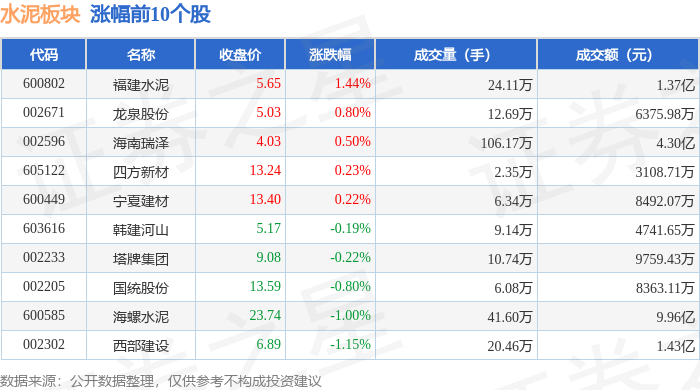
Market Overview - On October 17, the cement sector declined by 1.36% compared to the previous trading day, with Shangfeng Cement leading the drop [1] - The Shanghai Composite Index closed at 3839.76, down 1.95%, while the Shenzhen Component Index closed at 12688.94, down 3.04% [1] Individual Stock Performance - Shangfeng Cement (000672) closed at 10.70, down 4.21% with a trading volume of 401,800 shares and a turnover of 436 million yuan [2] - Fujian Cement (600802) closed at 5.65, up 1.44%, with a trading volume of 241,100 shares and a turnover of 137 million yuan [1] - Other notable stocks include Longquan Co. (002671) at 5.03, down 0.80%, and Sichuan Jinding (600678) at 9.08, down 2.16% [2] Capital Flow Analysis - The cement sector experienced a net outflow of 365 million yuan from institutional investors, while retail investors saw a net inflow of 328 million yuan [2][3] - Fujian Cement had a net inflow of 10.72 million yuan from institutional investors, but a net outflow of 14.03 million yuan from retail investors [3] - Tianshan Co. (000877) reported a net inflow of 7.88 million yuan from institutional investors, while retail investors had a slight outflow [3]

房地产及建材行业双周报(2025、10、03-2025、10、16):地产销售表现分化,建材稳增长政策将改善企业盈利-20251017
Dongguan Securities· 2025-10-17 08:28
Investment Rating - The report maintains a "Neutral" rating for both the real estate and building materials sectors [2]. Core Insights - The real estate market is experiencing a divergence in performance, with core cities seeing a recovery in new home sales due to policy optimization and promotional activities, while the second-hand housing market is affected by holiday travel [4][25]. - The building materials sector is expected to benefit from government policies aimed at stabilizing growth, which will improve corporate profitability [4][47]. Summary by Sections Real Estate Sector - The real estate policy environment is at its historically loosest stage, but recent transaction data remains weak, indicating that further policy support is needed for a comprehensive recovery [4][25]. - More cities are expected to implement new policies to relax housing market restrictions, focusing on optimizing purchase limits, reducing costs, and enhancing credit support [4][25]. - The report suggests focusing on stable central state-owned enterprises and regional leaders in first and second-tier cities, such as Poly Developments (600048), Binjiang Group (002244), and China Merchants Shekou (001979) [4][25]. Building Materials Sector - The Ministry of Industry and Information Technology and other departments have issued a plan to stabilize growth in the building materials industry, which includes prohibiting new cement clinker and flat glass production capacity [4][47]. - The plan aims to eliminate 100 million tons of inefficient capacity by 2026, promoting industry concentration and supporting the development of advanced materials [4][47]. - The report highlights the importance of digitalization and green technology in enhancing production efficiency and management levels within the building materials sector [4][47]. Cement Industry - Current demand for cement remains weak, but the acceleration of special bond issuance and policies for urban renewal and rural revitalization are expected to boost demand [48]. - As the industry continues to enhance its "anti-involution" measures, staggered production will help stabilize prices [48]. - The report recommends focusing on companies like Conch Cement (600585), Taipai Group (002233), and Huaxin Cement (600801) due to their favorable dividend yields [48]. Glass and Fiberglass Industry - The glass industry is currently sluggish, but the photovoltaic glass segment is seeing a decline in inventory and price stabilization [49]. - The report anticipates a shift in the photovoltaic glass industry towards a technology-driven, high-end, and green growth model [49]. - The demand for fiberglass is increasing due to the rapid development of electric vehicles and renewable energy sectors, with companies like China Jushi (600176) recommended for investment [50]. Consumer Building Materials - Since 2025, some consumer building material companies have improved profit margins through price increases, supported by urban renewal policies [50]. - Leading companies are enhancing their operational quality and market share by optimizing channel structures and upgrading product lines [50]. - Recommended companies in this segment include Beixin Building Materials (002791), Rabbit Baby (002043), and Three Trees (603737) [50].
摩洛哥中小企业面临较大“碳压力”
Shang Wu Bu Wang Zhan· 2025-10-17 05:37
Core Insights - The European Union's Carbon Border Adjustment Mechanism (CBAM) is set to be implemented in early 2026, prompting large Moroccan industrial enterprises to adopt decarbonization strategies, while small and medium-sized enterprises (SMEs) struggle with funding, manpower, and information gaps [1][2] - From 2026, carbon costs of €60 to €100 per ton will be imposed on imports of products like steel, cement, and fertilizers, which currently account for only 3.7% of Morocco's exports to the EU, indicating limited short-term impact [1] - Concerns exist that if the carbon tax expands to sectors like automotive and aviation, the entire Moroccan industrial system could face significant challenges, as global trade partners may follow the EU's lead in imposing carbon taxes [1] Challenges for SMEs - SMEs in Morocco face three main challenges: a lack of qualified personnel for EU-standard carbon emissions accounting, high costs for carbon audits, equipment upgrades, and clean energy replacements, and limited access to policy information [1][2] - Without compliant data, the EU will assign a "default carbon value" that is often higher than actual emissions, leading to increased tax rates on exports [1] Government Initiatives - The Moroccan government is advancing a "National Low Carbon Strategy" and a "Green Development Support Plan" to address these challenges [2] - The Economic, Social and Environmental Council (CESE) recommends establishing a national carbon tax mechanism to facilitate compliance with EU regulations and prevent capital outflow, alongside a proposed "decarbonization fund" for SMEs, with an estimated annual investment of $270 million to $300 million [2] - The CESE warns that without unified coordination, rapid response, and targeted financial support, the CBAM could become an "invisible trade barrier" for Morocco's industrial sector, potentially forcing many SMEs out of the green transition race [2]
中国银河证券:“金九”需求边际恢复 政策加速建材供需向好
智通财经网· 2025-10-17 01:33
Group 1: Cement Industry - In September, there was a marginal improvement in cement demand, with an increase in the operating load of cement mills month-on-month [1] - Cement prices experienced a slight month-on-month increase of 1.80%, with expectations for continued growth in demand during October [1] - The supply-side adjustments, including the reduction of clinker production, are anticipated to support a phase of price increases in the cement market [1] Group 2: Consumer Building Materials - Retail sales of building and decoration materials showed a year-on-year growth of 1.8% from January to August 2025, but a decline of 0.7% year-on-year in August [2] - The demand for building materials is expected to be supported by ongoing urban renewal strategies and the promotion of high-quality green building materials [2] Group 3: Fiberglass Industry - There is a recovery in demand for fiberglass, with increased stocking by downstream users and a slight reduction in supply, leading to a stabilization in prices [3] - The demand for electronic fiberglass is improving, with expectations for price increases due to strong demand for high-end products [3] Group 4: Float Glass Industry - The float glass market saw a marginal recovery in demand in September, with some improvement in orders from medium to large processing plants [4] - Prices for float glass are expected to stabilize, supported by policy measures aimed at supply control, although significant improvements in the overall supply-demand structure are not yet evident [4]
