
高耗能行业

Search documents
8月经济运行的三点特征
EBSCN· 2025-08-31 09:00
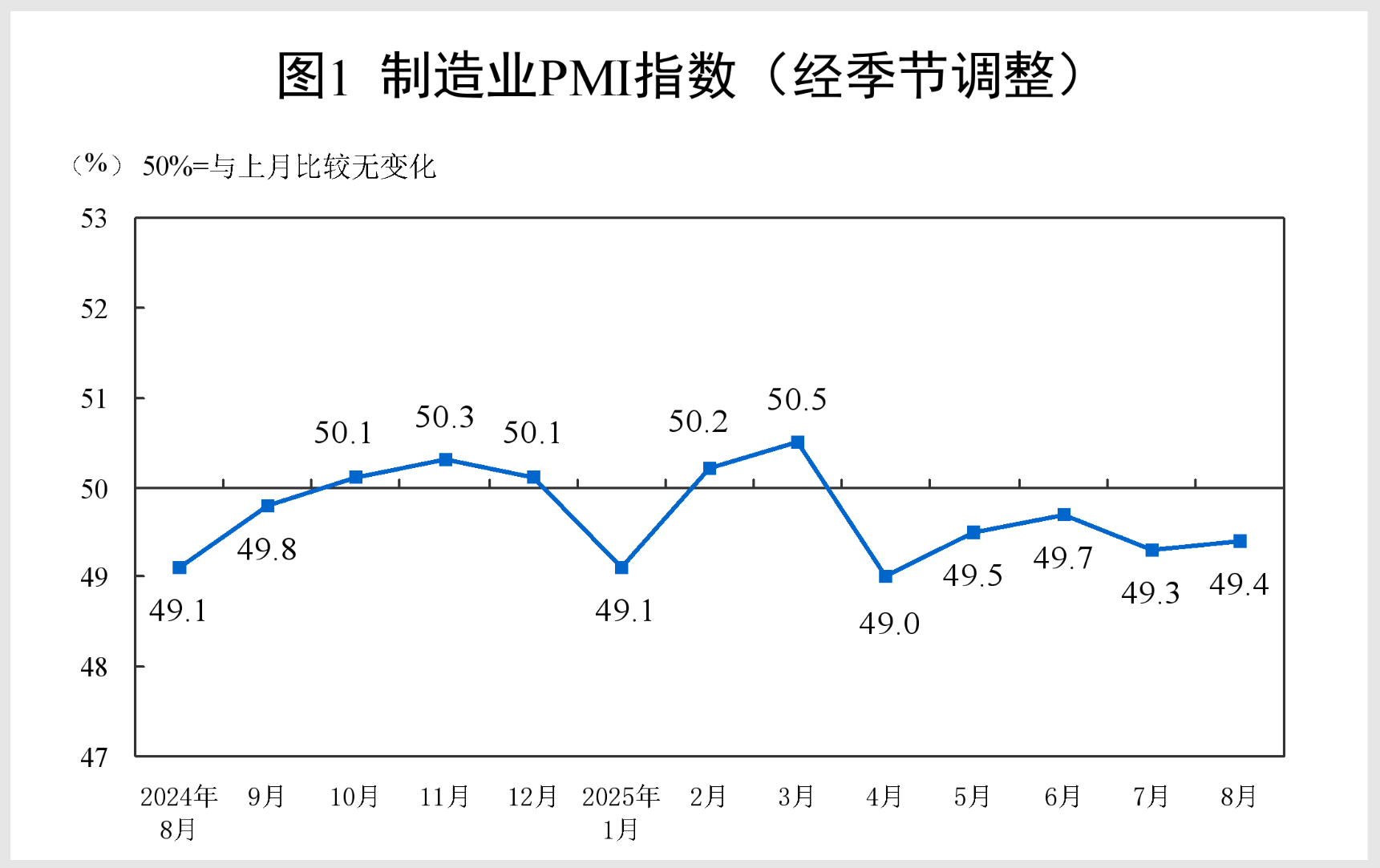
Manufacturing Sector - August manufacturing PMI increased by 0.1 percentage points to 49.4%, exceeding the market expectation of 49.1%[2] - Production index rose to 50.8%, up 0.3 percentage points from the previous month; new orders index increased to 49.5%, up 0.1 percentage points[5] - Large enterprises' PMI improved significantly to 50.8%, up 0.5 percentage points, while small enterprises' PMI rose to 46.6%, up 0.2 percentage points; medium enterprises' PMI fell to 48.9%, down 0.6 percentage points[5] Export and Import Trends - New export orders index rose to 47.2%, up 0.1 percentage points, indicating stabilization in export momentum[20] - Import index increased to 48.0%, up 0.2 percentage points, reflecting ongoing production expansion[20] Price Indices - Raw material purchase price index rose to 53.3%, up 1.8 percentage points; factory price index increased to 49.1%, up 0.8 percentage points, indicating a potential upward trend in PPI[25] - Raw material inventory index increased to 48.0%, up 0.3 percentage points, while finished goods inventory index decreased to 46.8%, down 0.6 percentage points[25] Service Sector - Service sector business activity index rose to 50.5%, up 0.5 percentage points from the previous month, and higher than last year's 50.2%[29] - The business activity expectation index for the service sector increased to 57.0%, indicating positive market sentiment[29] Construction Sector - Construction sector business activity index fell by 1.5 percentage points to 49.1%, continuing a downward trend for two consecutive months[32] - The decline in construction activity is attributed to adverse weather conditions and reduced demand from real estate and infrastructure investments[32]
2025年8月PMI数据解读:8月PMI:新动能或主要支撑经济修复
ZHESHANG SECURITIES· 2025-08-31 08:54
证券研究报告 | 宏观专题研究 | 中国宏观 8 月 PMI:新动能或主要支撑经济修复 —2025 年 8 月 PMI 数据解读 核心观点 8 月制造业采购经理指数(PMI)为 49.4%,较 7 月回升 0.1 个百分点,说明 经济维持修复态势,经济的主要支撑来自政策组合拳协同共振,内生动能尚 有一定改善空间。从结构上看,生产指数和供应商配送时间指数均高于临界 点,新订单指数、原材料库存指数和从业人员指数低于临界点,说明制造业 有效需求依然承压,供给侧的韧性主要来自工业稳增长政策效能释放。我们 认为,前期的"两重"和"两新"等政策稳步发力,新近推出的财政贴息、加 强全国碳市场建设、金融支持新型工业化、"人工智能+"行动等政策也更多 支撑新动能。 从重点行业来看,新动能加快扩张,传统产业边际改善。8 月高技术制造业和 装备制造业 PMI 分别为 51.9%和 50.5%,比上月上升 1.3 和 0.2 个百分点, 支撑引领作用持续增强;消费品行业 PMI 为 49.2%,比上月下降 0.3 个百分 点;高耗能行业 PMI 为 48.2%,比上月上升 0.2 个百分点,景气水平连续回 升。 大类资产方面,我们认 ...
国家统计局解读2025年8月PMI数据
Guo Jia Tong Ji Ju· 2025-08-31 05:53
Group 1: Manufacturing PMI Insights - In August, the Manufacturing PMI rose to 49.4%, indicating an improvement in economic conditions compared to the previous month [2] - The production index reached 50.8%, up by 0.3 percentage points, marking four consecutive months above the critical point, suggesting accelerated manufacturing production [2] - The new orders index increased to 49.5%, reflecting a slight rise in demand, with notable performance in the pharmaceutical and electronics sectors [2] - The purchasing activities have accelerated, with the purchasing volume index rising to 50.4% [2] - The prices of major raw materials and factory prices increased, with the raw material purchase price index at 53.3% and factory price index at 49.1%, indicating an overall improvement in market prices [2] Group 2: Enterprise Size and Sector Performance - Large enterprises reported a PMI of 50.8%, up by 0.5 percentage points, indicating sustained expansion [3] - Medium-sized enterprises saw a decline in PMI to 48.9%, reflecting a downturn in economic conditions [3] - Small enterprises experienced a slight improvement with PMI at 46.6%, up by 0.2 percentage points [3] - High-tech manufacturing and equipment manufacturing sectors showed strong performance with PMIs of 51.9% and 50.5%, respectively [3] Group 3: Non-Manufacturing Sector Insights - The Non-Manufacturing Business Activity Index rose to 50.3%, indicating continued expansion in the non-manufacturing sector [5] - The service sector's business activity index reached 50.5%, marking a significant recovery and the highest point of the year [5] - Certain industries, such as capital market services and transportation, reported business activity indices above 60.0%, indicating robust growth [5] - The construction sector's business activity index fell to 49.1% due to adverse weather conditions, reflecting a slowdown [5] Group 4: Comprehensive PMI Overview - The Comprehensive PMI Output Index increased to 50.5%, indicating an overall acceleration in production and business activities across sectors [6] - The manufacturing production index and non-manufacturing business activity index were reported at 50.8% and 50.3%, respectively, contributing to the overall expansion [6]
国家统计局:8月份高技术制造业和装备制造业PMI分别为51.9%和50.5%
Jing Ji Guan Cha Bao· 2025-08-31 05:07
经济观察网 国家统计局数据显示,8月份高技术制造业和装备制造业PMI分别为51.9%和50.5%,比上月 上升1.3和0.2个百分点,支撑引领作用持续增强;消费品行业PMI为49.2%,比上月下降0.3个百分点; 高耗能行业PMI为48.2%,比上月上升0.2个百分点,景气水平连续回升。 (原标题:国家统计局:8月份高技术制造业和装备制造业PMI分别为51.9%和50.5%) ...
中国8月官方制造业PMI小幅回升至49.4,新订单指数升至49.5
Hua Er Jie Jian Wen· 2025-08-31 04:08
Summary of Key Points Core Viewpoint - In August, China's manufacturing sector showed slight improvement in economic sentiment, while non-manufacturing activities accelerated expansion, indicating a general trend of economic growth [1][2]. Manufacturing Sector - The Manufacturing Purchasing Managers' Index (PMI) rose to 49.4%, an increase of 0.1 percentage points from the previous month, indicating a slight improvement in manufacturing sentiment [3][5]. - The production index and new orders index both showed recovery, with the production index at 50.8%, up 0.3 percentage points, suggesting accelerated manufacturing production [5][7]. - The new orders index improved to 49.5%, reflecting a slight enhancement in market demand [5][6]. - Large enterprises reported a PMI of 50.8%, while medium and small enterprises had PMIs of 48.9% and 46.6%, respectively, indicating varying levels of economic activity across different enterprise sizes [5]. Non-Manufacturing Sector - The Non-Manufacturing Business Activity Index increased to 50.3%, up 0.2 percentage points, indicating continued expansion in the non-manufacturing sector [1][18]. - The service sector's business activity index reached 50.5%, marking a year-to-date high, with significant growth in sectors like capital market services and transportation [2][13]. - The construction sector's business activity index fell to 49.1%, indicating a decline in activity [13][16]. Price Indices - The main raw material purchase price index rose to 53.3%, and the factory price index increased to 49.1%, both showing a continuous upward trend for three months [1][2]. - The input price index for non-manufacturing remained stable at 50.3%, indicating a general increase in operational costs [16]. Future Expectations - The production and business activity expectation index for manufacturing was reported at 53.7%, suggesting increased confidence among manufacturers regarding future market conditions [2][17]. - The business activity expectation index for non-manufacturing reached 56.2%, indicating optimism about market prospects [17][18].

国家统计局:8月制造业产需指数均有回升 市场预期总体向好
Xin Hua Cai Jing· 2025-08-31 03:22
Group 1: Manufacturing PMI Insights - In August, the Manufacturing PMI rose to 49.4%, indicating an improvement in economic conditions compared to the previous month [2] - The production index reached 50.8%, up 0.3 percentage points, marking four consecutive months above the critical point, suggesting accelerated manufacturing production [2] - The new orders index increased to 49.5%, reflecting a slight rise in demand [2] - Large enterprises showed a PMI of 50.8%, up 0.5 percentage points, indicating sustained expansion, while medium and small enterprises experienced declines [3] - High-tech manufacturing and equipment manufacturing sectors maintained expansion with PMIs of 51.9% and 50.5%, respectively [3] Group 2: Non-Manufacturing PMI Insights - The Non-Manufacturing Business Activity Index reached 50.3%, up 0.2 percentage points, continuing its expansion [4] - The service sector's business activity index rose to 50.5%, the highest point of the year, with significant growth in capital market services and transportation sectors [4] - The construction sector's business activity index fell to 49.1%, down 1.5 percentage points, due to adverse weather conditions [4] Group 3: Composite PMI Insights - The Composite PMI Output Index stood at 50.5%, up 0.3 percentage points, indicating an overall acceleration in production and business activities [5][6]
刚刚发布,49.4%
中国基金报· 2025-08-31 02:27
Group 1: Manufacturing PMI Insights - In August, the Manufacturing PMI rose to 49.4%, indicating a slight improvement in economic conditions compared to the previous month [3][8]. - The production index reached 50.8%, up by 0.3 percentage points, marking the fourth consecutive month above the critical point, suggesting accelerated manufacturing production [3][11]. - The new orders index increased to 49.5%, reflecting a minor improvement in market demand [3][11]. - Large enterprises showed a PMI of 50.8%, up by 0.5 percentage points, indicating ongoing expansion, while medium and small enterprises reported lower PMIs of 48.9% and 46.6%, respectively [4][10]. Group 2: Non-Manufacturing PMI Insights - The Non-Manufacturing Business Activity Index was 50.3%, up by 0.2 percentage points, indicating continued expansion in the non-manufacturing sector [5][15]. - The service sector's business activity index reached 50.5%, marking a significant recovery and the highest point of the year [5][18]. - The construction sector's business activity index fell to 49.1%, down by 1.5 percentage points, due to adverse weather conditions affecting production [5][16]. Group 3: Comprehensive PMI Insights - The Comprehensive PMI Output Index stood at 50.5%, up by 0.3 percentage points, indicating an overall acceleration in production and business activities across sectors [6][23]. - The manufacturing production index and non-manufacturing business activity index contributed to the comprehensive PMI, with values of 50.8% and 50.3%, respectively [6][23].

国家统计局解读2025年8月中国采购经理指数
Guo Jia Tong Ji Ju· 2025-08-31 01:51
Group 1: Manufacturing PMI Insights - In August, the manufacturing PMI rose to 49.4%, indicating an improvement in economic conditions compared to the previous month [2] - The production index reached 50.8%, up by 0.3 percentage points, marking four consecutive months above the critical point, signaling accelerated manufacturing production [2] - The new orders index increased to 49.5%, reflecting a slight rise in demand [2] - Large enterprises showed a PMI of 50.8%, up by 0.5 percentage points, indicating sustained expansion, while medium and small enterprises experienced declines [3] - High-tech manufacturing and equipment manufacturing PMIs were 51.9% and 50.5%, respectively, showing continued strength in these sectors [3] - The production and business activity expectation index rose to 53.7%, suggesting increased confidence among manufacturers regarding future market conditions [3] Group 2: Non-Manufacturing PMI Insights - The non-manufacturing business activity index reached 50.3%, up by 0.2 percentage points, indicating ongoing expansion in the sector [4] - The service industry business activity index rose to 50.5%, the highest point of the year, with significant growth in capital market services and transportation sectors [4] - The construction industry business activity index fell to 49.1%, impacted by adverse weather conditions, indicating a slowdown in construction activities [4] - The business activity expectation index for the service sector increased to 57.0%, reflecting optimism about future market developments [4] Group 3: Comprehensive PMI Insights - The comprehensive PMI output index rose to 50.5%, up by 0.3 percentage points, indicating overall expansion in production and business activities [5] - The manufacturing production index and non-manufacturing business activity index were 50.8% and 50.3%, respectively, contributing to the comprehensive PMI's positive trend [5]
8月份制造业采购经理指数小幅回升 非制造业商务活动指数扩张加快
Yang Shi Wang· 2025-08-31 01:43
Group 1: Manufacturing PMI Insights - In August, the Manufacturing Purchasing Managers' Index (PMI) rose to 49.4%, indicating an improvement in economic conditions compared to the previous month [2] - The production index reached 50.8%, up by 0.3 percentage points, marking the fourth consecutive month above the critical point, suggesting accelerated manufacturing production [2] - The new orders index increased to 49.5%, reflecting a slight rise in demand [2] - Large enterprises showed a PMI of 50.8%, up by 0.5 percentage points, indicating ongoing expansion, while medium and small enterprises experienced declines [3] - High-tech manufacturing and equipment manufacturing sectors reported PMIs of 51.9% and 50.5%, respectively, indicating sustained growth [3] Group 2: Non-Manufacturing PMI Insights - The Non-Manufacturing Business Activity Index was 50.3% in August, up by 0.2 percentage points, continuing the expansion trend [4] - The service sector's business activity index reached 50.5%, the highest point of the year, with significant growth in capital market services and transportation sectors [4] - The construction sector's business activity index fell to 49.1%, down by 1.5 percentage points, due to adverse weather conditions [4] Group 3: Composite PMI Insights - The Composite PMI Output Index stood at 50.5%, an increase of 0.3 percentage points, indicating an overall acceleration in production and business activities [5][6]
国家统计局:8月份制造业采购经理指数小幅回升 非制造业商务活动指数扩张加快
Guo Jia Tong Ji Ju· 2025-08-31 01:37
Group 1: Manufacturing PMI Insights - In August, the Manufacturing PMI rose to 49.4%, indicating an improvement in economic conditions compared to the previous month [2] - The production index reached 50.8%, up by 0.3 percentage points, marking four consecutive months above the critical point, suggesting accelerated manufacturing production [2] - The new orders index increased to 49.5%, reflecting a slight rise in demand [2] - Large enterprises showed a PMI of 50.8%, up by 0.5 percentage points, indicating sustained expansion, while medium and small enterprises experienced declines [3] - High-tech manufacturing and equipment manufacturing sectors reported PMIs of 51.9% and 50.5%, respectively, indicating strong performance [3] Group 2: Non-Manufacturing PMI Insights - The Non-Manufacturing Business Activity Index rose to 50.3%, reflecting continued expansion in the sector [4] - The service industry saw a significant increase, with a business activity index of 50.5%, reaching a yearly high [4] - Capital market services and transportation sectors reported business activity indices above 60.0%, indicating robust growth [4] - The construction industry faced a decline in activity, with a business activity index of 49.1%, down by 1.5 percentage points due to adverse weather conditions [4] Group 3: Composite PMI Insights - The Composite PMI Output Index increased to 50.5%, indicating an overall acceleration in production and business activities [5] - The manufacturing production index and non-manufacturing business activity index were reported at 50.8% and 50.3%, respectively, contributing to the composite index's growth [5]