智能手机

Search documents
首次商用!华为重大发布!
证券时报· 2025-11-25 08:56
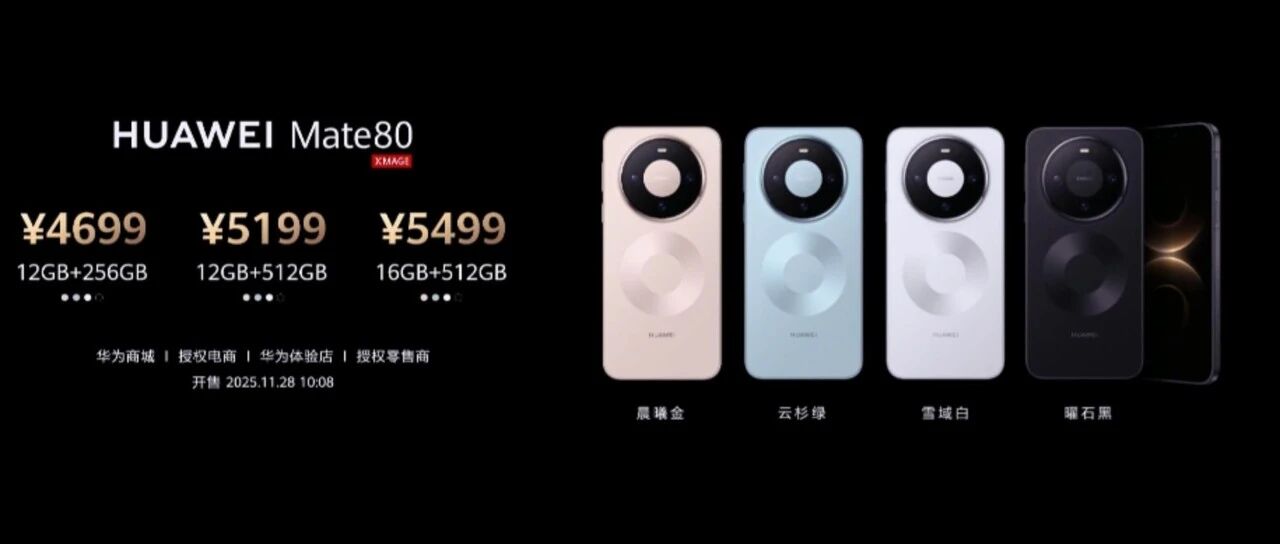
Core Insights - Huawei has launched the new Mate 80 and Mate 80 Pro series, with starting prices of 4699 yuan and 5999 yuan respectively, featuring HarmonyOS 6 and set to officially go on sale on November 28 [1] - The new foldable phone Mate X7 has been introduced, which utilizes A2A (Agent to Agent) intelligent collaboration for various tasks [1] - Huawei's WATCH ULTIMATE DESIGN is priced at 24999 yuan and includes advanced features such as Beidou satellite voice messaging and eSIM independent communication [1] Market Performance - According to IDC, the Chinese smartphone market is projected to see a shipment volume of 68.86 million units in Q2 2025, a year-on-year decline of 4.1% [2] - Huawei has returned to the top of the domestic market with a shipment of 12.5 million units, capturing an 18.1% market share [2] - Competitors include Vivo with 11.9 million units (17.3% market share), OPPO with 10.7 million units (15.5%), Xiaomi with 10.4 million units (15.2%), and Apple with 9.6 million units (13.9%) [2] Financial Performance - Huawei reported a revenue of 427.039 billion yuan for the first half of 2025, a year-on-year increase of 3.94%, while net profit decreased by 32% to 37.195 billion yuan [2] - R&D investment reached 96.95 billion yuan, up 9.04% year-on-year, accounting for 22.7% of total revenue [2] - Despite global market challenges, Huawei managed to achieve slight revenue growth, indicating a strong commitment to future competitiveness through substantial R&D investments [2]

抄底成功!雷军一亿港元增持,单日浮盈450万!小米市值重回万亿,新的起点还是昙花一现?
雪球· 2025-11-25 08:54
Market Overview - A-shares saw a collective rise in the three major indices, with the Shanghai Composite Index up 0.87% to 3870.02 points, the Shenzhen Component Index up 1.53% to 12777.31 points, and the ChiNext Index up 1.77% to 2980.93 points [2] - The trading volume in the Shanghai and Shenzhen markets reached 181.21 billion, an increase of 84.4 billion compared to the previous day [2] - The market showed broad-based gains, particularly in sectors such as education, gaming, precious metals, energy metals, communication equipment, batteries, chemical pharmaceuticals, optical electronics, insurance, and consumer electronics, while the shipbuilding sector faced declines [2] Xiaomi's Stock Performance - Xiaomi's stock rebounded significantly, closing up 4.35%, with a market capitalization returning to over 1 trillion [3] - Founder Lei Jun purchased 2.6 million shares at an average price of approximately 38.58 HKD per share, totaling over 100 million HKD, resulting in a paper profit of 4.5 million HKD by the end of the trading day [6] - Prior to this, Xiaomi had repurchased 21.5 million shares over two days, spending over 800 million HKD, with a total of 55.62 million shares repurchased this year for over 2.3 billion HKD [9] - Xiaomi's stock has faced pressure, with a cumulative decline of over 35% since reaching a year-high of 61.45 HKD on June 27 [10] Google's Market Impact - Google's stock surged 6.31% following the release of its new AI model, Gemini3, with a three-month increase of over 50% [12] - Google plans to open its self-developed Tensor AI chip usage rights to companies like Meta, expanding its competitive landscape against Nvidia [14] - A-share sectors related to Google's TPU supply chain and AI applications saw significant gains, with stocks like Zhongji Xuchuang and Shenghong Technology rising over 5% [12][14] Federal Reserve's Interest Rate Outlook - The S&P 500 index recorded its largest weekly gain in six weeks, driven by rising expectations for a Federal Reserve rate cut in December [17] - Fed officials have signaled a dovish stance, with a high probability of a 25 basis point rate cut in December now at 80.9%, up from 42.4% a week prior [18] - Analysts from Morgan Stanley and UBS suggest that the recent sell-off in the U.S. stock market may be nearing an end, with potential for a rebound as the Fed is expected to implement rate cuts [20]

新力量NewForce总第4910期
First Shanghai Securities· 2025-11-25 08:13
Group 1: Pinduoduo (PDD) Analysis - Pinduoduo's Q3 revenue reached RMB 108.276 billion, a year-on-year increase of 9%, aligning with market expectations[8] - Online marketing services revenue was RMB 53.348 billion, up 8% YoY, while transaction services revenue was RMB 54.929 billion, up 10% YoY, indicating a deepening commercial model[8] - The company maintained a net profit of RMB 29.328 billion, a 17% increase YoY, with a net profit margin of 27.1%[8] - Target price for Pinduoduo is set at USD 148.90, reflecting a 31% upside potential from the current price of USD 113.24[11] Group 2: Xiaomi Group (1810) Analysis - Xiaomi's Q3 smartphone revenue was RMB 45.97 billion, a decline of 3.1% YoY, with global smartphone shipments at 43.3 million units, a 0.5% increase YoY[16] - The automotive business achieved revenue of RMB 29.01 billion, with a gross margin of 25.5%, marking the first quarterly profit of RMB 700 million[18] - Xiaomi's IoT revenue increased by 5.6% YoY to RMB 27.6 billion, with a gross margin of 23.9%[17] - Target price for Xiaomi is set at HKD 50.20, indicating a potential upside of 31.83% from the current price of HKD 38.08[22]

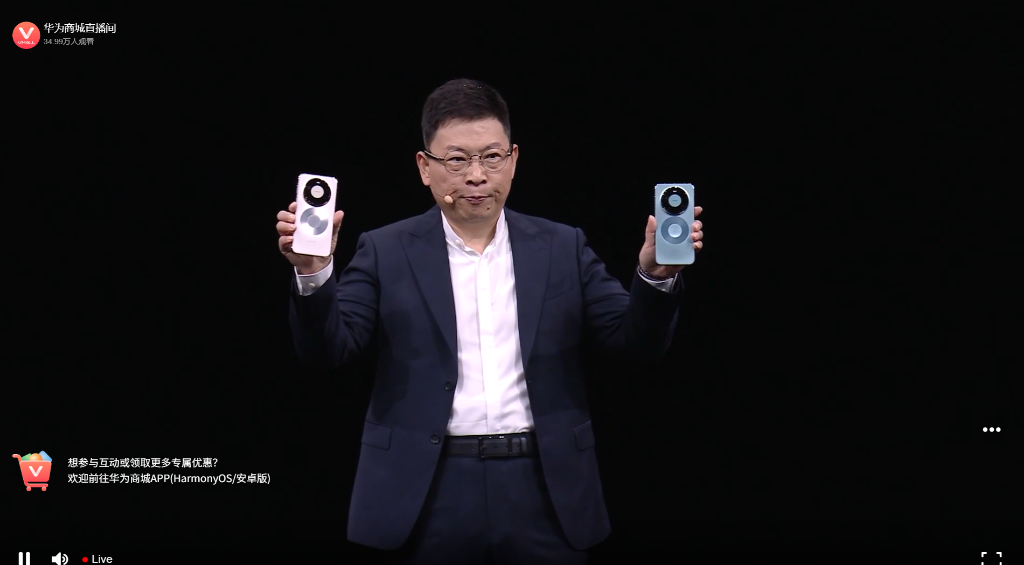
华为发布会直击:Mate 80系列全金属架构、首搭载鸿蒙6系统
Hua Er Jie Jian Wen· 2025-11-25 07:19
Core Viewpoint - Huawei launched the Mate 80 series, which includes four models: Mate 80, Mate 80 Pro, Mate 80 Pro Max, and Mate 80 RS Master Edition, showcasing significant advancements in display technology, performance, and design [1][3]. Group 1: Product Features - The Mate 80 series consists of four models with various color options: Mate 80 and Pro versions come in Obsidian Black, Snow White, Dawn Gold, and Spruce Green; the Pro Max offers Extreme Night Black, Extreme Polar Silver, Extreme Day Gold, and Aurora Blue; the high-end RS Master Edition features Mallow Purple, Mysterious Black, and Bright White [3]. - All models feature a 2.5D flat screen design, with the Mate 80 Pro Max boasting a 6.9-inch display and a 3D TOF depth-sensing camera for enhanced facial recognition and interaction [5]. - The Mate 80 Pro Max introduces a dual-layer OLED display with a peak brightness of 8000 nits, setting a new industry record, and improves screen lifespan by 40% and peak brightness by 80% compared to the previous generation [7]. Group 2: Performance Enhancements - The Mate 80 series benefits from the HarmonyOS 6 optimization and a unified hardware-software architecture, resulting in over a 35% overall performance improvement compared to the Mate 70 series, with the 16GB RAM versions seeing performance boosts exceeding 42% [9]. - Application launch speeds have improved by 30% to 40%, and 3D JS rendering performance has increased by 33%, with gaming ray tracing calculations exceeding 20 million per second [9]. Group 3: Connectivity and Design - The Mate 80 Pro Max features a full metal body that enhances antenna capabilities, achieving a signal strength improvement of 1dB over the Mate 70 Pro+, and approximately 3dB higher than the iPhone 17 Pro Max, resulting in a 55% higher streaming smoothness under weak network conditions [11]. - The series has seen high pre-order demand, with some models' shipping dates extending into 2026, attributed to the production capacity of the Kirin 9020 and Kirin 9030 chips [13].
时隔6个月快速迭代,荣耀推出500系列
Guo Ji Jin Rong Bao· 2025-11-25 06:30
Core Insights - Honor officially launched the new Honor 500 series on November 24, featuring the new MagicOS 10 operating system and two versions: the standard version with Snapdragon 8s Gen4 and the Pro version with Snapdragon 8 Elite, priced at 2699 yuan and 3599 yuan respectively [1][2] Company Overview - Honor, established in 2013 as a sub-brand of Huawei, initially targeted the young consumer market with smartphones priced below 3000 yuan. After becoming independent in November 2020, Honor has developed a comprehensive product matrix covering all price segments, including various series such as Play, X, Power, Digital, GT, V Purse, Magic, and foldable products [1] Market Position - The digital series is positioned as a "light flagship" and has historically been a strong sales performer. The recently launched Honor 400 series achieved over 6 million units shipped globally prior to the 500 series launch. The 500 series aims to set a new user experience standard in its price segment [2] Industry Context - The price range of 2000 to 4000 yuan is highly competitive in the Chinese smartphone market. According to IDC, global smartphone shipments reached 322.7 million units in Q3, with a year-on-year growth of only 2.6%. In China, shipments were approximately 68.4 million units, reflecting a 0.5% decline. Honor ranked fifth with a shipment of 9.9 million units and a market share of 14.4% [2] Competitive Landscape - IDC's research manager noted that rising cost structures are expected to exert significant pressure on global smartphone manufacturers. In the high-end market, consumers show less price sensitivity if products demonstrate sufficient technological breakthroughs and innovative experiences. Conversely, in the mass market, price factors heavily influence consumer decisions, leading to increased challenges for brands in this price segment [2] Product Expansion - In addition to the 500 series, Honor introduced two new wearable products: the Honor Watch X5 and the Honor Ear Clip Headphones 2 Pro, enhancing its smart ecosystem. The headphones are priced at 549 yuan (effectively 466.65 yuan after subsidies), while the watch is priced at 449 yuan (effectively 381.65 yuan after subsidies) [3]
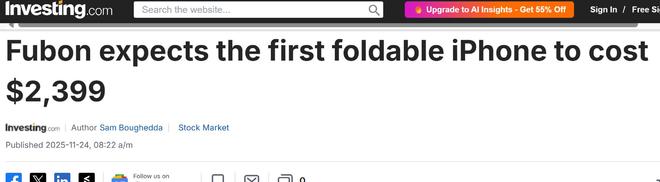
苹果首款折叠屏iPhone预计2026年推出,售价或为2399美元
Huan Qiu Wang Zi Xun· 2025-11-25 03:57
来源:环球网 在成本高企的背景下,苹果首款折叠屏iPhone因面板、铰链及轻量化材料等核心组件成本较高,定价被 推向市场预测区间高端。富邦研究结合供应链分析与苹果利润结构,给出2399美元的预测售价。此前, 郭明錤曾预测该机型售价在2000美元至2500美元之间,彭博社马克·古尔曼则预计售价约2000美元。 尽管定价偏高,但富邦研究对该机型销售表现持乐观态度。以7%的市场渗透率为测算基础,这款折叠 屏iPhone的生命周期销量预计可达1540万部,其中2026年出货量约540万部。 【环球网科技综合报道】11月25日消息,据Investing报道,富邦研究近日发布行业报告,2026年全球智 能手机市场或将持续萎缩,但苹果首款折叠屏iPhone的亮相有望成为市场亮点,其预计售价2399美元, 生命周期销量预计达1540万部。 报告指出,2026年全球智能手机出货量预计降至12亿台,同比缩减4%;中国市场出货量约为2.75亿 台,同比下降3%;iPhone整体出货量预计为2.34亿台,同比减少4%。零组件成本上涨成为行业主要压 力来源,其中DRAM合约价较2024年第四季度上涨逾75%,2026年智能手机物料成本 ...

招商证券:维持小米集团-W(01810)“强烈推荐”评级 高端化、全球化持续推进
智通财经网· 2025-11-25 03:19
Core Viewpoint - Xiaomi Group is recommended as a strong buy due to its position as one of the top three global smartphone manufacturers and the largest AIoT smart hardware platform, with a favorable outlook in the AI-driven industrial restructuring process [1] Smartphone Business - In Q3 2025, Xiaomi's global smartphone shipments increased by 0.5% year-on-year to 43.3 million units, maintaining a market share of 13.6% globally and 16.7% domestically, ranking second [2] - The company has adjusted its total shipment target for 2025 to 170 million units, while facing ongoing cost pressures from rising storage prices [2] Automotive Business - Xiaomi achieved its first quarterly operating profit in Q3 2025, with revenue from smart electric vehicles and AI-related businesses reaching 29 billion yuan, a year-on-year increase of 199% and a quarter-on-quarter increase of 36% [3] - The company delivered over 40,000 vehicles monthly in September and October, on track to meet its annual delivery target of 350,000 units [3] IoT and Internet Business - In Q3 2025, IoT business revenue reached 27.6 billion yuan, a year-on-year increase of 5.6%, with significant growth in overseas markets [4] - The internet business achieved record revenue of 9.38 billion yuan, a year-on-year increase of 10.8%, with a gross margin of 76.9% [4] - The number of global monthly active users reached 740 million, reflecting an 8.2% year-on-year growth [4]


雷军斥资1亿港元增持,小米集团涨超5%
Huan Qiu Lao Hu Cai Jing· 2025-11-25 02:50
Core Viewpoint - Xiaomi Group's founder and CEO Lei Jun increased his stake in the company by purchasing 2.6 million B shares at an average price of HKD 38.58, totaling HKD 100 million, amidst a significant stock price decline [1][2] Group 1: Stock Buyback and Shareholding - Lei Jun now holds a total of 4.063 billion A shares and 1.994 billion B shares, representing 23.26% of the total share capital [1] - Xiaomi Group conducted a stock buyback of 21.5 million shares on November 20 and 21, with a total expenditure exceeding HKD 800 million, bringing the total buyback amount for the year to over HKD 2.3 billion [1] Group 2: Financial Performance - For Q3, Xiaomi Group reported total revenue of CNY 113.121 billion, a year-on-year increase of 22.3%, but a quarter-on-quarter decrease of 2.4% [2] - Adjusted net profit reached CNY 11.311 billion, marking a historical high with a year-on-year growth of 80.9% and a quarter-on-quarter increase of 4.4% [2] Group 3: Smartphone Business Challenges - The smartphone segment saw a revenue decline of 3.1% year-on-year, totaling CNY 45.97 billion, with global shipments of 43.3 million units, a slight increase of 0.5% [2] - The smartphone gross margin decreased to 11.1% from 11.7% year-on-year, attributed to a drop in average selling price (ASP) [2] Group 4: Automotive Business Highlights - Xiaomi's automotive division achieved its first quarterly profit, with revenue of CNY 29.01 billion, a year-on-year increase of 199.2%, and a gross margin of 25.5% [3] - The automotive segment's profitability was driven by increased sales and higher ASP, with cumulative deliveries exceeding 260,000 units in the first three quarters of the year [3]
雷军超1亿港元增持小米股票;屈臣氏CEO在香港跳海救人;三只松鼠回应入职要姓“鼠”;斐乐店员被曝给顾客备注“买鞋都嫌贵”...
Sou Hu Cai Jing· 2025-11-25 02:38
Group 1 - The number of applicants for the national master's degree entrance examination in China has decreased for the first time in eight years, with 2026 registrations at 3.43 million, down from 4.74 million in 2023, marking a reduction of 1.31 million [4] - Xiaomi's founder Lei Jun has increased his stake in the company by purchasing over HKD 100 million worth of shares, raising his ownership to 23.26% [5] - The CEO of Watsons, Ed, made headlines for rescuing a drowning woman in Hong Kong, showcasing a commitment to public safety [5][6] Group 2 - The company Xpeng faced backlash after a customer reported being injured by a door at one of its dealerships, leading to discussions about customer service and safety protocols [9] - The company Jiyue Automotive's associated company has filed for bankruptcy, highlighting financial struggles within the electric vehicle sector [11] - Apple is reportedly undergoing layoffs in its sales department, affecting several positions, despite the company's strong revenue growth [12] Group 3 - OpenAI is actively recruiting from Apple's hardware engineering team, indicating a competitive landscape in the AI sector [14] - Amazon plans to invest up to $50 billion to enhance its AWS capabilities for government clients, focusing on AI and high-performance computing [13] - The Chinese company ZhiYuan has launched a platform allowing users to customize robot characteristics without coding knowledge, reflecting advancements in robotics technology [24]


【招商电子】小米集团:25Q3高端化、全球化持续推进,汽车业务首度盈利
招商电子· 2025-11-25 02:23
Core Viewpoint - The company reported strong and resilient growth in its Q3 2025 financial results, with total revenue reaching 113.1 billion yuan, a year-on-year increase of 22.3% and a net profit of 11.3 billion yuan, up 80.9% year-on-year, indicating robust performance across its business segments [1]. Group 1: Financial Performance - Q3 2025 total revenue was 113.1 billion yuan, with a year-on-year growth of 22.3% and a quarter-on-quarter decline of 2.4% [1]. - Adjusted net profit for Q3 2025 was 11.3 billion yuan, reflecting an 80.9% year-on-year increase and a 4.4% quarter-on-quarter increase [1]. - Gross margin improved to 22.9%, up 2.5 percentage points year-on-year and 0.4 percentage points quarter-on-quarter [1]. Group 2: Mobile Business - Q3 2025 mobile business revenue was 46 billion yuan, a year-on-year decrease of 3.1% but a quarter-on-quarter increase of 1.0% [2]. - The average selling price (ASP) slightly declined, with a gross margin of 11.1%, down 0.6 percentage points year-on-year and 0.4 percentage points quarter-on-quarter [2]. - Global smartphone shipments reached 43.3 million units, a year-on-year increase of 0.5%, maintaining a market share of 13.6% [2]. Group 3: Automotive Business - The automotive segment achieved revenue of 29 billion yuan in Q3 2025, a significant year-on-year increase of 199% and a quarter-on-quarter increase of 36% [3]. - The segment recorded a gross margin of 25.5%, with a slight decrease of 0.9 percentage points quarter-on-quarter [3]. - The company achieved its first quarterly operating profit of 700 million yuan in this segment, indicating a positive trend for future profitability [3]. Group 4: IoT and Internet Business - Q3 2025 IoT business revenue was 27.6 billion yuan, a year-on-year increase of 5.6% but a quarter-on-quarter decline of 28.8% [4]. - The gross margin for IoT was 23.9%, up 3.1 percentage points year-on-year and 1.4 percentage points quarter-on-quarter [4]. - Internet business revenue reached a record high of 9.38 billion yuan, reflecting a year-on-year growth of 10.8% and a quarter-on-quarter increase of 3.1% [4]. Group 5: Strategic Outlook - The company is focused on high-end product strategies and international expansion in its mobile business, while the IoT segment is expected to benefit from enhanced self-research capabilities and overseas market opportunities [5]. - The automotive business aims to enter the top five global automakers by 2025-2027, supported by a robust product matrix and ecosystem synergies [5].