通信

Search documents
今日111只个股涨停 主要集中在传媒、机械设备等行业
Zheng Quan Shi Bao Wang· 2026-01-09 07:40
Core Viewpoint - On January 9, a total of 111 stocks reached the daily limit up in the A-share market, with significant concentration in the media, machinery equipment, computer, pharmaceutical biology, and communication sectors [1] Group 1: Market Performance - Among the tradable A-shares in the Shanghai and Shenzhen markets, 3,718 stocks increased in value, while 1,272 stocks decreased, and 182 stocks remained flat [1] - Excluding newly listed stocks on that day, there were 111 stocks that hit the upper limit, and 3 stocks hit the lower limit [1] Group 2: Industry Concentration - The stocks that reached the upper limit were primarily concentrated in the following industries: media, machinery equipment, computer, pharmaceutical biology, and communication [1]
永鼎股份股价涨5.07%,汇添富基金旗下1只基金重仓,持有1.49万股浮盈赚取2.12万元
Xin Lang Cai Jing· 2026-01-09 03:00
Group 1 - The core viewpoint of the news is that Yongding Co., Ltd. has seen a significant increase in its stock price, rising by 5.07% to 29.42 CNY per share, with a trading volume of 3.47 billion CNY and a turnover rate of 8.48%, resulting in a total market capitalization of 43.01 billion CNY [1] - Yongding Co., Ltd. is based in Suzhou, Jiangsu Province, and was established on June 30, 1994, with its stock listed on September 29, 1997. The company specializes in the research, production, and sales of communication products and software, overseas power engineering contracting, automotive wiring harnesses, and superconducting materials [1] - The revenue composition of Yongding Co., Ltd. includes automotive wiring harnesses (34.63%), power engineering (29.96%), optical communication (18.93%), superconducting and copper conductors (15.91%), and big data applications (0.58%) [1] Group 2 - From the perspective of fund holdings, only one fund from Huatai-PineBridge has a significant position in Yongding Co., Ltd. The Huatai-PineBridge CSI 2000 ETF (159536) reduced its holdings by 8,500 shares in the third quarter, holding a total of 14,900 shares, which represents 0.35% of the fund's net value, making it the third-largest holding [2] - The Huatai-PineBridge CSI 2000 ETF (159536) was established on September 13, 2023, with a latest scale of 53.81 million CNY. Year-to-date returns are 3.75%, ranking 2244 out of 5509 in its category, while the one-year return is 48.35%, ranking 1282 out of 4198 [2]

通信行业点评报告:重视国产AI产业浪潮
KAIYUAN SECURITIES· 2026-01-09 02:42
Investment Rating - The industry investment rating is "Overweight" (maintained) [1] Core Insights - The report emphasizes the positive outlook for the AI industry, particularly in the context of the "AI + Manufacturing" initiative launched by the Ministry of Industry and Information Technology, which aims to promote deep integration of AI technology in manufacturing by 2027 [4] - The report highlights a potential recovery in domestic AIDC (Artificial Intelligence Data Center) bidding, indicating an increase in demand for domestic AI computing power [5] - Century Internet's financial performance shows significant growth, with a 21.7% year-on-year revenue increase in Q3 2025, suggesting a continued recovery in the AIDC sector [6] Summary by Sections AI Industry Development - The report notes that the government is actively promoting AI applications, which is expected to drive demand for domestic AI computing power [4] - The focus is on three core areas: AIDC, network endpoints, and computing endpoints, with specific recommended stocks for each segment [7] Financial Performance Indicators - Alibaba's capital expenditure for FY2026 Q2 reached 31.501 billion yuan, a year-on-year increase of 80.1%, indicating strong investment in AI cloud computing infrastructure [5] - Century Internet reported a total revenue of 2.58 billion yuan in Q3 2025, with adjusted EBITDA growing by 27.5% year-on-year, reflecting robust operational performance [6] Recommended Stocks - For AIDC data centers, recommended stocks include: Guanghuan New Network, Aofei Data, and others [7] - For AIDC liquid cooling and power supply, recommended stocks include: Yingweike and others [7] - For network endpoints, recommended stocks include: Zhongji Xuchuang, and others [7] - For computing endpoints, recommended stocks include: Oulutong, and others [7]




沪指继续收阳线
Hua Tai Qi Huo· 2026-01-09 02:40
1. Report Industry Investment Rating - Not mentioned in the provided content 2. Core Viewpoints of the Report - The market volume remains high, but large funds control the market rhythm well. This round of the market does not follow the "crazy bull" pattern. The narrowing short - term gains do not affect the long - bull situation, and investors can actively seize investment opportunities in stock index futures [3] 3. Summary by Relevant Catalogs 3.1 Market Analysis - **Macro - economic Information**: In China, the Deputy Minister of Finance, Liao Min, met with the CEO of the London Stock Exchange Group, indicating that China's economy will be stable and improving in 2025. In the United States, the number of initial jobless claims last week rose to 208,000, slightly lower than market expectations. The number of layoffs in December last year was 35,553, the lowest in 17 months. The trade deficit in October 2025 narrowed by 39% month - on - month to $29.4 billion, the lowest since June 2009 [1] - **Spot Market**: A - share indexes fluctuated. The Shanghai Composite Index had 15 consecutive positive lines but fell 0.07% to close at 4082.98 points on the day. The ChiNext Index fell 0.82%. Most sector indexes declined, with National Defense and Military Industry, Media, Building Decoration, and Real Estate leading the gains, while Non - Banking Finance, Non - ferrous Metals, and Communication leading the losses. The trading volume of the Shanghai and Shenzhen stock markets remained at 2.8 trillion yuan. Overseas, the three major US stock indexes closed mixed, with the Dow Jones rising 0.55% to 49,266.11 points and the Nasdaq falling 0.44% to 23,480.02 points [1] - **Futures Market**: In the futures market, the basis of stock index futures rebounded. The trading volume and open interest of IF and IM increased simultaneously [2] 3.2 Strategy - Although the short - term gains are narrowing, it does not affect the long - bull pattern. Investors can actively seize investment opportunities in stock index futures [3] 3.3 Charts 3.3.1 Macro - economic Charts - Include charts showing the relationship between the US dollar index and A - share trends, US Treasury yields and A - share trends, RMB exchange rates and A - share trends, and US Treasury yields and A - share style trends [6][7][9] 3.3.2 Spot Market Tracking Charts - **Stock Index Performance**: The Shanghai Composite Index closed at 4082.98, down 0.07%; the Shenzhen Component Index closed at 13,959.48, down 0.51%; the ChiNext Index closed at 3302.31, down 0.82%; the CSI 300 Index closed at 4737.65, down 0.82%; the SSE 50 Index closed at 3122.06, down 0.73%; the CSI 500 Index closed at 7894.54, up 0.25%; the CSI 1000 Index closed at 7971.59, up 0.82% [12] - Also include charts of the trading volume of the Shanghai and Shenzhen stock markets and margin trading balances [6][13] 3.3.3 Stock Index Futures Tracking Charts - **Trading Volume and Open Interest**: The trading volume of IF was 119,688, an increase of 6990; the open interest was 288,744, an increase of 5981. The trading volume of IH was 44,844, a decrease of 2701; the open interest was 91,182, an increase of 937. The trading volume of IC was 147,847, a decrease of 1682; the open interest was 294,237, a decrease of 8269. The trading volume of IM was 196,014, an increase of 18,492; the open interest was 374,177, an increase of 2896 [14] - **Basis**: The basis of each contract of IF, IH, IC, and IM showed different changes. For example, the basis of IF's current - month contract was 0.15, an increase of 4.02 [40] - **Inter - period Spread**: The inter - period spreads of IF, IH, IC, and IM also showed different changes. For example, the spread between the next - month and current - month contracts of IF was - 11.60, an increase of 0.20 [45]
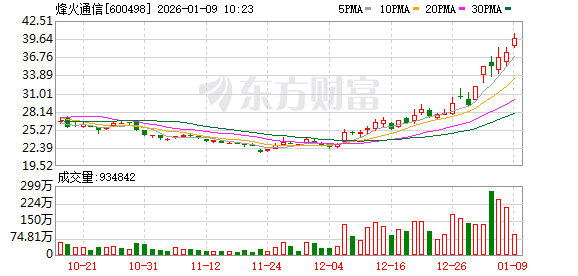
烽火通信盘中创历史新高
Zheng Quan Shi Bao Wang· 2026-01-09 02:23
(文章来源:证券时报网) 烽火通信股价创出历史新高,截至9:52,该股上涨7.25%,股价报40.22元,成交量7231.69万股,成交金 额28.31亿元,换手率5.69%,该股最新A股总市值达546.25亿元,该股A股流通市值511.45亿元。 证券时报·数据宝统计显示,烽火通信所属的通信行业,目前整体跌幅为0.71%,行业内,目前股价上涨 的有79只,涨幅居前的有信科移动、富士达、震有科技等,涨幅分别为20.00%、15.40%、12.80%。股 价下跌的有43只,跌幅居前的有蘅东光、中际旭创、新易盛等,跌幅分别为5.60%、4.71%、4.45%。 公司发布的三季报数据显示,前三季度公司共实现营业收入170.72亿元,同比下降19.30%,实现净利润 5.13亿元,同比增长30.28%,基本每股收益为0.4300元,加权平均净资产收益率3.59%。(数据宝) 两融数据显示,该股最新(1月8日)两融余额为26.02亿元,其中,融资余额为25.86亿元,近10日增加 8.78亿元,环比增长51.41%。 ...


当宠物学会“打电话”,这家中国公司如何用AI重构情感连接
Feng Huang Wang· 2026-01-09 02:15
Core Insights - The article discusses the innovative approaches of UCL (优克联) in the pet communication sector, emphasizing the importance of bridging the communication gap between humans and pets in the AI data era [1] Group 1: Product Innovations - UCL's PetPhone aims to address deeper needs for two-way communication and emotional companionship, moving beyond traditional pet tracking and monitoring devices [1] - The company is training AI to recognize specific behaviors in pets, allowing them to initiate calls to their owners based on actions like jumping or spinning [2] - UCL is developing a new communication language for pets based on behavior and sound, differentiating between species like cats and dogs [2] Group 2: Technology and Connectivity - UCL is re-evaluating its technology strategy in the context of eSIM proliferation, highlighting the differences between Cloud SIM and traditional eSIM [2] - The company's "HyperConnect" technology aggregates network resources from over 200 countries, enabling automatic network selection based on the best signal for the current application [3] - UCL positions itself as a partner to telecom operators, helping them manage excess roaming traffic and filling coverage gaps with its global cloud SIM pool [3] Group 3: Future Development - UCL aims to create a more open ecosystem, integrating emotional products like PetPhone while providing flexible network services that break the physical constraints of traditional SIM cards [3]
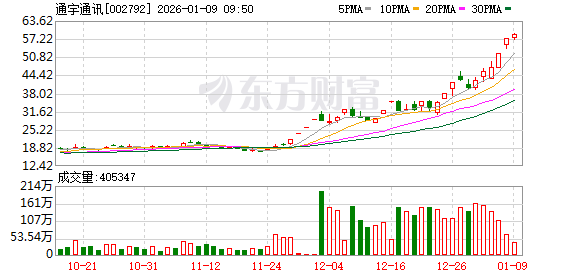
通宇通讯持续走强,股价再创新高
Zheng Quan Shi Bao Wang· 2026-01-09 01:49
Group 1 - The stock price of Tongyu Communication has reached a historical high, with the stock continuously breaking records over the past month, achieving 12 trading days of new highs [2] - As of 09:35, the stock is up 2.86%, priced at 58.95 yuan, with a trading volume of 26.02 million shares and a transaction amount of 1.504 billion yuan, resulting in a turnover rate of 7.70% [2] - The latest total market capitalization of the stock is 30.88 billion yuan, with a circulating market value of 19.91 billion yuan [2] Group 2 - The communication industry, to which Tongyu Communication belongs, has an overall decline of 1.64%, with 58 stocks rising, including Xinke Mobile, Fujida, and Dongxin Peace, which have increased by 13.18%, 11.38%, and 6.24% respectively [2] - Conversely, 70 stocks have declined, with notable drops from Xinyi Sheng, Hengdong Light, and Shijia Technology, which fell by 6.39%, 6.19%, and 5.37% respectively [2] Group 3 - The latest margin trading data shows that as of January 8, the margin balance for Tongyu Communication is 1.249 billion yuan, with a financing balance of 1.247 billion yuan, reflecting an increase of 226 million yuan over the past 10 days, a growth of 22.17% [2] Group 4 - The company's Q3 report indicates that for the first three quarters, it achieved an operating income of 815 million yuan, a year-on-year decrease of 3.34%, and a net profit of 25.27 million yuan, down 50.91% year-on-year, with basic earnings per share of 0.0481 yuan and a weighted average return on equity of 0.01% [2]

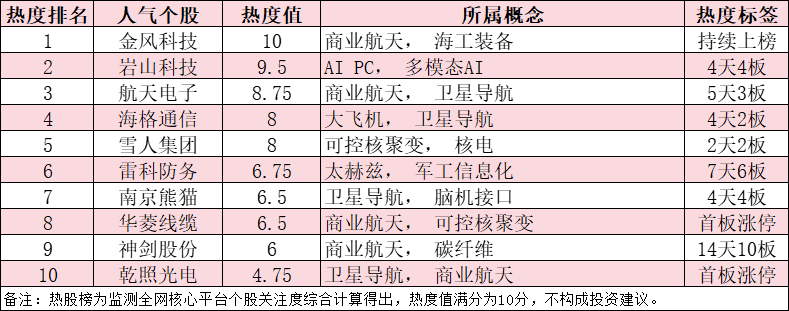
今日十大热股:金风科技、岩山科技领衔,雷科防务7天6板,神剑股份14天10板持续爆炒
Jin Rong Jie· 2026-01-09 01:28
Market Overview - On January 8, A-shares saw most major indices decline, with the Shanghai Composite Index down 0.07%, Shenzhen Component down 0.51%, and ChiNext down 0.82%, while the Sci-Tech 50 index rose 0.82% [1] - The total trading volume in the Shanghai and Shenzhen markets was 2.80 trillion yuan, a decrease of approximately 53.8 billion yuan from the previous day [1] - There were 3,533 stocks that rose and 1,514 stocks that fell [1] Sector Performance - The aerospace and shipbuilding sectors saw the highest net inflows of funds, while sectors such as silver, energy metals, and brokerage firms experienced the largest declines [1] Popular Stocks - The top ten popular stocks included Jin Feng Technology, Yan Mountain Technology, Aerospace Electronics, Hai Ge Communication, Xue Ren Group, Lei Ke Defense, Nanjing Panda, Hualing Cable, Shen Jian Co., and Qian Zhao Optoelectronics [1][2] Key Factors Influencing Stock Prices - Jin Feng Technology's popularity is attributed to its leading position in the wind power industry and strong fundamentals, with significant growth in the sales capacity of wind turbines and an increased proportion of large-capacity units [3] - Yan Mountain Technology's rise is linked to its alignment with multiple hot technology sectors, including AI PC and multi-modal AI, and partnerships with AMD to expand terminal applications [3] - Aerospace Electronics benefits from the overall heat in the commercial aerospace sector, with policy support for projects like Qian Fan Constellation and China Star Network [3] - Hai Ge Communication's popularity stems from its technical capabilities in satellite navigation and communication, with applications in various scenarios [3] - Xue Ren Group's stock price increase is driven by the rising interest in controllable nuclear fusion, supported by significant capital inflow [4] - Lei Ke Defense is gaining attention due to its involvement in commercial aerospace and military information technology [4] - Nanjing Panda's stock is influenced by speculation around brain-computer interface technology, although the company has indicated that its related technology is still in the R&D phase [4] - Hualing Cable's growth is linked to its special cable business, which has seen significant revenue increases in high-end equipment sectors [4] - Shen Jian Co. benefits from both commercial aerospace and carbon fiber concepts, with strong fundamentals supporting its stock performance [4]




人工智能长坡厚雪,通信ETF(515880)景气依旧高企
Sou Hu Cai Jing· 2026-01-09 01:09
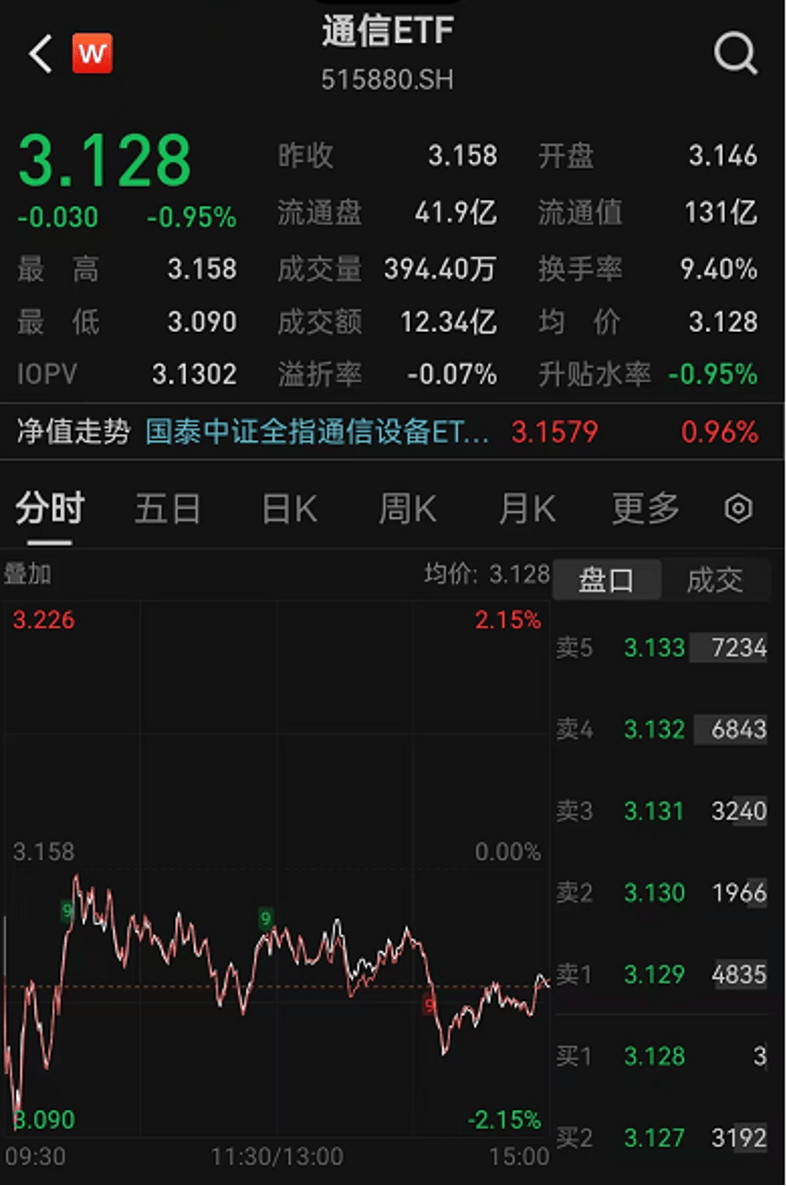
Core Viewpoint - The communication ETF is currently experiencing fluctuations without showing a clear upward trend, with a focus on potential performance in January and upcoming earnings reports from major companies [1][2]. Group 1: Communication ETF Performance - The communication ETF (515880.SH) closed at 3.128, with a trading volume of 394.40 million and a turnover rate of 9.40% [2]. - The ETF's highest price was 3.158, while the lowest average price was 3.128, indicating a slight decline of 0.95% [2]. - The net asset value of the ETF is reported at 3.1579, with an indicative price of 3.1302 reflecting a discount of 0.07% [2]. Group 2: AI and NVIDIA Developments - NVIDIA's CEO Jensen Huang revealed details about the Rubin platform at CES 2026, which will include six core chips, enhancing AI capabilities significantly [3][5]. - The Rubin platform is expected to achieve up to 50 PFLOPS of NVFP4 inference capability, with a performance doubling compared to the previous Blackwell architecture [5][6]. - The new architecture will integrate 72 NVIDIA Rubin GPUs into a unified performance domain, providing a bandwidth of 3.6 TB/s per GPU and a total connection capability of 260 TB/s [5][6]. Group 3: Market Outlook and Trends - The communication industry is expected to benefit from upcoming earnings forecasts in January, alongside a seasonal market rally, with a focus on companies with strong fundamentals [6]. - Major North American companies will enter their earnings reporting period at the end of January, with NVIDIA's report expected in February and the GTC conference in March [6]. - The communication ETF's core segments, including optical modules, optical fibers, and servers, account for over 76% of its composition, with a projected leading growth rate in 2025 [8].

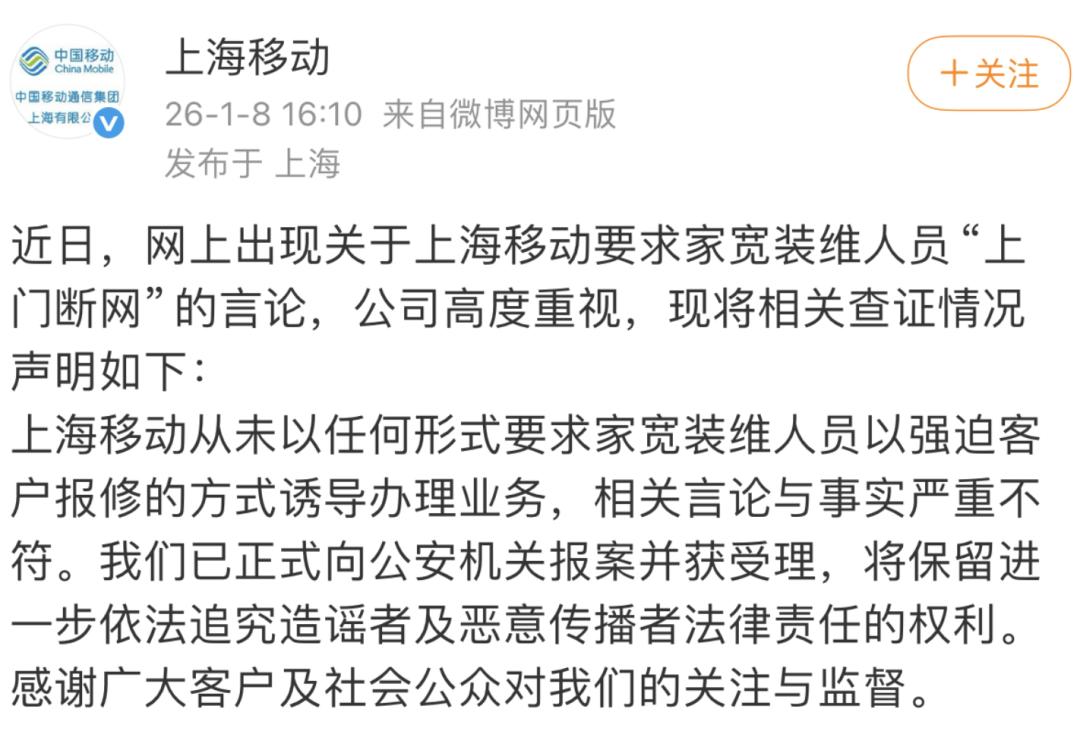
8点1氪丨继“小便门”后,海底捞再曝火锅异物事件;商务部回应审查Meta收购Manus;上海移动辟谣强迫员工“上门断网”言论
3 6 Ke· 2026-01-09 00:08
Group 1 - Apple plans to launch a 200-megapixel iPhone in 2028, marking a significant upgrade from the 48-megapixel camera introduced in the iPhone 14 series in 2022 [5] - A breakthrough in cancer vaccine research was published by a team from Peking University in the journal Nature, introducing a new strategy for "degradable vaccines" that shows promising results in tumor suppression [6] - Xiaomi's former executive Wang Teng has established a new company focused on sleep health products, named "Today Yixiu" [7] Group 2 - The Ministry of Commerce of China is reviewing Meta's acquisition of the AI platform Manus, emphasizing compliance with Chinese laws and regulations for foreign investments and technology exports [2] - China National Petroleum Corporation and China Aviation Oil announced a restructuring plan approved by the State-owned Assets Supervision and Administration Commission [4] - After declaring a failed restructuring, Huiyuan Group announced it would fully take over Beijing Huiyuan due to the previous investor's failure to fulfill investment agreements [8] Group 3 - JPMorgan Chase has become the new issuer of the Apple Card, replacing Goldman Sachs, with the transition expected to take up to 24 months [8] - IKEA plans to close seven stores, including one in Shanghai, as part of its strategy to adapt to changing retail environments and consumer behaviors [10][11] - Samsung Electronics expects its profits to triple in the last quarter of the previous year due to soaring demand for storage chips driven by artificial intelligence [8]