
房地产

Search documents
房地产行业今日净流入资金6.27亿元,合肥城建等6股净流入资金超亿元
Zheng Quan Shi Bao Wang· 2026-01-20 08:44
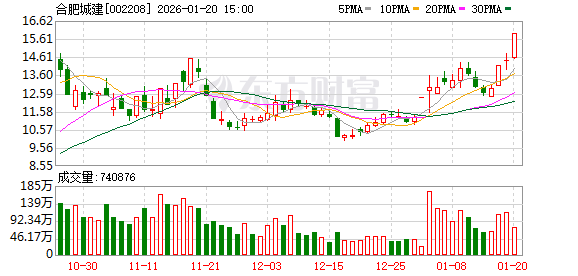
Market Overview - The Shanghai Composite Index fell by 0.01% on January 20, with 20 industries experiencing gains, led by the oil and petrochemical sector and building materials, which rose by 1.74% and 1.71% respectively. The real estate sector ranked third in terms of gains [2] - The telecommunications and defense industries saw the largest declines, with drops of 3.23% and 2.87% respectively [2] Capital Flow Analysis - The net outflow of capital from the two markets reached 95.72 billion yuan, with 11 industries experiencing net inflows. The banking sector led with a net inflow of 1.47 billion yuan and a daily increase of 0.80%. The real estate sector followed with a daily increase of 1.55% and a net inflow of 627 million yuan [2] - The industries with the largest net outflows included the power equipment sector, which saw a net outflow of 19.05 billion yuan, and the electronics sector, with a net outflow of 18.39 billion yuan. Other sectors with significant outflows included telecommunications, defense, and computers [2] Real Estate Sector Performance - The real estate sector increased by 1.55%, with a total net inflow of 627 million yuan. Out of 100 stocks in this sector, 76 rose, including 5 that hit the daily limit, while 21 fell, with 3 hitting the lower limit. A total of 55 stocks experienced net inflows, with 6 stocks seeing inflows exceeding 100 million yuan [3] - The top stocks by net inflow included Hefei Urban Construction with 277 million yuan, followed by Wo Ai Wo Jia and Poly Development with inflows of 233 million yuan and 165 million yuan respectively [3] Top Gainers in Real Estate Sector | Code | Name | Daily Change (%) | Turnover Rate (%) | Main Capital Flow (10,000 yuan) | | --- | --- | --- | --- | --- | | 002208 | Hefei Urban Construction | 10.03 | 9.23 | 27662.79 | | 000560 | Wo Ai Wo Jia | 7.33 | 27.70 | 23316.23 | | 600048 | Poly Development | 4.31 | 3.51 | 16473.16 | | 600649 | Urban Investment Holdings | 10.11 | 3.58 | 12810.67 | | 600675 | China Enterprises | 10.14 | 3.22 | 12651.12 | | 000002 | Vanke A | 1.27 | 2.16 | 10971.52 | | 600266 | Urban Construction Development | 2.32 | 14.86 | 7311.35 | | 000031 | Dayue City | 10.17 | 1.54 | 6907.80 | | 000514 | Chongqing Development | 5.72 | 8.90 | 5353.57 | | 600383 | Jindi Group | 2.93 | 2.92 | 5332.09 [4] Top Losers in Real Estate Sector | Code | Name | Daily Change (%) | Turnover Rate (%) | Main Capital Flow (10,000 yuan) | | --- | --- | --- | --- | --- | | 000036 | Hualian Holdings | -9.95 | 7.38 | -21128.16 | | 600376 | Shoukai Shares | -4.72 | 5.10 | -12971.76 | | 600340 | Huaxia Happiness | -9.88 | 9.08 | -11362.09 | | 600641 | Xian Dao Ji Dian | -4.20 | 6.73 | -10618.38 | | 600895 | Zhangjiang High-Tech | -0.87 | 2.68 | -10515.38 | | 000620 | Yingxin Development | 0.56 | 15.70 | -9666.43 | | 600246 | Wantong Development | -2.20 | 5.83 | -7825.24 | | 600515 | Hainan Airport | -1.88 | 1.83 | -7275.72 | | 600658 | Electronic City | -3.90 | 3.94 | -2817.30 | | 600173 | Wolong New Energy | -5.05 | 3.51 | -2327.00 [6]






博时市场点评1月20日:两市继续震荡,市场风格切换
Xin Lang Cai Jing· 2026-01-20 08:41
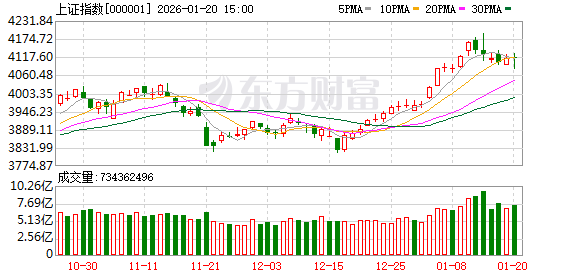
Economic Overview - The core economic data for 2025 indicates a year-on-year GDP growth of 5.0%, with Q4 GDP growth at 4.5%, aligning with market expectations [1][7] - In December, the industrial added value increased by 5.2% year-on-year, while fixed asset investment showed a cumulative decline of 3.8% [1][7] - Retail sales growth in December was only 0.9%, highlighting weak domestic demand [1][7] - The economic environment is characterized by stronger supply than demand, with external demand outperforming internal demand [1][7] Policy and Strategic Initiatives - The National Development and Reform Commission (NDRC) plans to implement a strategy to expand domestic demand from 2026 to 2030, aiming to create new demand through new supply [2][9] - A national-level merger fund is being considered to promote industrial integration and optimize the competitive landscape [9] - The establishment of a unified national market is a long-term goal, which will enhance resource allocation efficiency and improve the market environment [9] Market Performance - On January 20, the A-share market saw declines across major indices, with the Shanghai Composite Index at 4113.65 points, down 0.01%, and the Shenzhen Component Index at 14155.63 points, down 0.97% [10][11] - The market turnover reached 28,044.27 billion yuan, showing a slight increase from the previous trading day [12] - The two financing balances reported a decrease to 27,231.75 billion yuan [12]
突发!特朗普威胁对这些法国商品征200%关税!贵金属全线爆拉,金银刷新历史高位!
雪球· 2026-01-20 08:40
Core Viewpoint - The article discusses the mixed performance of A-shares, highlighting the significant rise in precious metals and the active performance of the chemical and real estate sectors amid ongoing market fluctuations and geopolitical tensions [2][5][14]. Group 1: Precious Metals - COMEX gold prices increased by 2.94%, reaching $4730.41 per ounce, while silver surged by 6.93% to $94.67 per ounce, both marking historical highs [3]. - The increase in gold ETF holdings by 28 tons last week represents the largest weekly gain since September, indicating heightened investor interest in gold as a safe haven [5]. - Analysts predict that gold prices could reach $5000 per ounce within three months, with silver potentially hitting $100 per ounce, driven by rising risk aversion and weakening dollar confidence [5]. Group 2: Chemical Sector - The chemical sector saw a collective rise, with companies like Hongbaoli and Shandong Heda hitting their daily price limits [8]. - Recent price increases in key chemical products, such as a 7.9% weekly rise in epoxy propane, are attributed to supply-side improvements and regulatory changes promoting zero-carbon factory construction [10]. - The industry is expected to benefit from a reduction in supply due to the elimination of outdated capacities and increased demand driven by national policies aimed at expanding domestic consumption [10]. Group 3: Real Estate Sector - The real estate sector showed resilience with stocks like Dayuecheng and Chengtou Holdings reaching their daily price limits, while I Love My Home rose over 7% [12]. - Recent policy changes, including a reduction in the minimum down payment for commercial housing loans to 30%, aim to adapt to new market dynamics and support the development of the real estate sector [14]. - Analysts believe that the real estate market has undergone significant adjustments, and with recent government support, the sector is poised for a positive turnaround, making it an attractive investment opportunity [14].



A股震荡调整,化工、贵金属板块走强
Shang Hai Zheng Quan Bao· 2026-01-20 08:28
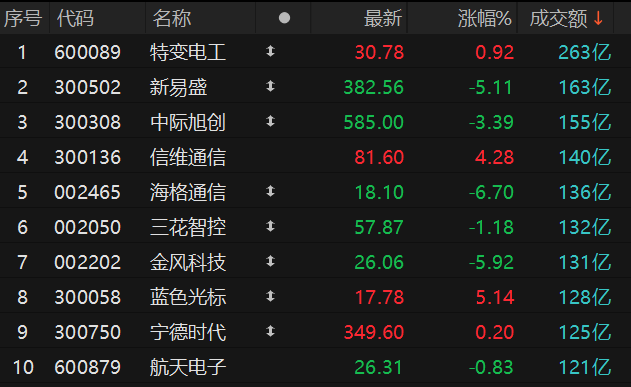
Market Overview - The A-share market continued its volatile adjustment pattern, with the Shanghai Composite Index closing at 4113.65 points, down 0.01%. The Shenzhen Component Index fell by 0.97%, the ChiNext Index decreased by 1.79%, and the Sci-Tech Innovation Board Index dropped by 1.65%. The total trading volume in the Shanghai and Shenzhen markets was 28,041 billion yuan [1]. Sector Performance - The chemical sector showed strength during the trading session, with over ten stocks including Weiyuan Co. and Hongqiang Co. hitting the daily limit. The precious metals sector remained active, with Hunan Silver reaching the daily limit. The real estate sector experienced fluctuations, with Dayue City and Urban Investment Holdings also hitting the daily limit. The AI application concept saw localized activity, with Jiayun Technology and Zhejiang Wenhu Interconnect reaching the daily limit. Conversely, the commercial aerospace and optical communication modules faced significant declines [1]. Individual Stock Highlights - TBEA Co. had the highest trading volume at 26.3 billion yuan. It was followed by Xinyi Technology and Zhongji Xuchuang, with trading volumes of 16.3 billion yuan and 15.5 billion yuan, respectively. Other notable stocks included Xinwei Communication and Haige Communication, with trading volumes of 14 billion yuan and 13.6 billion yuan, respectively [2][3]. Market Signals - Two significant signals emerged in the market: first, the renewed trade war between the US and Europe has led to a risk-averse sentiment in global capital markets, pushing gold prices to new highs and strengthening the A-share precious metals sector. Second, China has introduced a new round of demand expansion plans, leading to a recovery in the consumer sector, with stocks like He Bai Group, Kangxin New Materials, and Hanshang Group hitting the daily limit [3].
港股收评:恒指跌0.29%,科技股弱势,黄金股拉升走强,招金矿业等多股再创新高
Ge Long Hui· 2026-01-20 08:20
Market Performance - The Hong Kong stock market indices experienced a decline, with the Hang Seng Technology Index falling by 1.16%, while the Hang Seng Index and the National Enterprises Index decreased by 0.29% and 0.43% respectively, with the Hang Seng Index dropping below the 26,500 points mark [1] Sector Performance - Major technology stocks continued to decline, particularly Xiaomi, which fell nearly 3% to reach a new low, while Tencent and Meituan dropped over 1% [1] - Geopolitical tensions led to a rise in international gold prices, benefiting gold stocks such as Zijin Mining International, China National Gold International, and Zhaojin Mining, which reached historical high prices [1] - The civil aviation sector is expected to see record passenger transport volume during the Spring Festival, with three major airline stocks leading the aviation sector's gains [1] - The real estate sector remained active due to ongoing favorable policies, with optimism for 2026 [1] Declining Sectors - The commercial aviation, automotive, and Apple-related stocks faced significant declines, while the biopharmaceutical sector continued its downward trend [1] - Popular sectors such as military, semiconductor, and AI applications showed weakness, with leading stock SMIC dropping over 3%, and Zhizhu falling over 7% [1] - Copper-related stocks continued to decline, with China Nonferrous Mining falling for four consecutive days [1]
2026年北京供地计划公布,商品住宅用地安排200-240公顷
Cai Jing Wang· 2026-01-20 08:14
Core Viewpoint - Beijing's 2026 land supply plan aims to enhance urban development and optimize housing supply, particularly for new citizens and service personnel, while promoting sustainable urban growth and resource allocation [1][2][3][4] Group 1: Land Supply and Urban Development - The plan outlines a total construction land supply of approximately 3,240 to 3,740 hectares for 2026, with new land supply expected to be between 3,040 and 3,540 hectares [1] - The plan emphasizes a reduction in urban construction land by 500 hectares compared to 2025, reflecting a shift towards quality over quantity in urban planning [2] - The strategy includes a focus on activating existing land resources, with a target for urban renewal projects to match or exceed new land supply, aiming for 65% of land supply to come from existing resources [2] Group 2: Housing and Public Services - The plan allocates 350 hectares for affordable housing to better meet the rental needs of new citizens and urban service personnel, addressing the demand for "one bed" and "one room" [3] - A total of 650 hectares is designated for public management and service land, with an additional 300 hectares specifically for green spaces and squares, promoting the development of garden cities [4] - The transportation infrastructure will receive significant attention, with 950 to 1,350 hectares allocated for transport land, enhancing connectivity and resilience of municipal infrastructure [4] Group 3: Industry and Innovation - The plan includes 480 to 540 hectares for industrial land, representing an increase of 10 to 30 hectares from 2025, focusing on high-tech and emerging industries [3] - There is a commitment to ensure that at least 85% of new industrial land supports key sectors and infrastructure, reinforcing the integration of technology and industry [3]
2026年宏观经济与资产配置前瞻——专访西部证券首席宏观分析师边泉水
Sou Hu Cai Jing· 2026-01-20 07:53
Economic Outlook - In 2026, China's economy is expected to be in a phase of restorative growth, supported by expanding domestic demand, continued policy easing, and rising prices [1][5] - The nominal GDP growth is projected to improve significantly due to inflation recovery, positively impacting the income of households, businesses, and the government [2][3] - The shift from old to new industries is anticipated to become more pronounced, with new industries contributing increasingly to economic growth [3][5] Industry Changes - The transition from traditional industries to new productive forces is highlighted, with the "three new" economy (new industries, new business formats, and new models) expected to account for over 18% of GDP by 2024 [3][5] - The real estate sector is undergoing adjustments, returning to a focus on residential attributes, while new engines of economic growth are emerging from innovative sectors [3][5] Policy Implications - Macroeconomic policies will focus on balancing short-term and long-term needs, with a more proactive fiscal policy and moderately accommodative monetary policy expected [4][5] - The emphasis on domestic demand as a strategic foundation for economic development is reinforced, with initiatives to boost consumption and income for urban and rural residents [4][5] Investment Opportunities - The A-share market is expected to see a more balanced style in 2026, with market catalysts shifting from liquidity to price earnings [8][9] - Structural opportunities are anticipated in cyclical and high-end manufacturing sectors, which have begun to show signs of recovery [9][10] - The AI and new productive forces are identified as key engines for future economic development, with significant contributions expected from emerging and future industries [5][12]


今日62只个股涨停 主要集中在化工、电力设备等行业
Zheng Quan Shi Bao Wang· 2026-01-20 07:49
Group 1 - On January 20, in the Shanghai and Shenzhen stock markets, there were 2,139 stocks that rose, 2,918 stocks that fell, and 122 stocks that remained flat [1] - Excluding newly listed stocks on that day, there were 62 stocks that hit the upper limit and 24 stocks that hit the lower limit [1] - The industries with the most stocks hitting the upper limit included chemicals, electrical equipment, electronics, real estate, and non-ferrous metals [1]
A股再度调整 有这些原因!大资金“压盘”仍在继续
Mei Ri Jing Ji Xin Wen· 2026-01-20 07:49
Market Overview - The three major indices in the A-share market collectively declined, with the ChiNext Index dropping over 2% at one point. The Shanghai Composite Index closed down 0.01%, the Shenzhen Component Index down 0.97%, and the ChiNext Index down 1.79% [2][3] - Over 3,100 stocks in the market experienced declines, with a total trading volume of 2.78 trillion yuan, an increase of 69.4 billion yuan compared to the previous trading day [2] Sector Performance - The chemical sector showed strong performance, while precious metals continued to maintain strength. The real estate sector was also active. In contrast, sectors such as computing hardware and commercial aerospace saw significant declines [2][12] - The average stock price across the A-share market recorded a second consecutive bearish candlestick, indicating a potential cooling signal [4] Market Sentiment and External Factors - The market's weak support was attributed to external factors, including negative sentiment from U.S. stock index futures and concerns stemming from Japan's political developments and trade tensions related to Greenland [7][8] - The A-share market faced pressure from funding and short-term sentiment, with a notable decrease in margin trading. The total margin buying amount fell to 267.4 billion yuan, a decrease of 20.35% from the previous Friday and 40.68% from the peak of 450.8 billion yuan on January 14 [8][10] Investment Trends - There has been a significant outflow of funds from stock ETFs, with over 400 million yuan net outflow recorded, marking the third consecutive day of substantial outflows [10] - The market is witnessing a shift in investment strategies, with active funds adjusting their portfolios to seek more value-oriented investments. The technology sector, particularly computing hardware and AI applications, has seen a notable pullback [12][15] Policy and Industry Developments - The Ministry of Industry and Information Technology, along with other government bodies, has issued guidelines to promote zero-carbon factory construction in the chemical industry, which is expected to support the sector's green transition and high-quality development [17] - Analysts suggest that the Chinese chemical industry may experience a revaluation due to reduced capacity expansion, potentially leading to increased dividend yields and a transformation from a cash-consuming sector to a cash-generating one [17]
信用债周报:发行及成交规模增长,收益率多数下行-20260120
BOHAI SECURITIES· 2026-01-20 07:47
1. Report Industry Investment Rating No relevant content provided. 2. Core Viewpoints of the Report - During the period from January 12th to January 18th, 2026, the issuance guidance rates announced by the National Association of Financial Market Institutional Investors all declined, with an overall change range of -8 BP to -1 BP. The issuance scale of credit bonds increased month - on - month, but the net financing amount decreased due to the increase in the maturity scale. In the secondary market, the trading volume of credit bonds increased month - on - month, and most of the yields declined. The credit spreads of medium - and short - term notes and urban investment bonds were differentiated, while those of enterprise bonds mostly narrowed. In the long run, the yields of credit bonds are still in a downward channel, but one should be cautious when chasing high, and can increase positions during adjustments. One can implement a coupon strategy through credit sinking and extending the duration, and pay attention to the coordination and transformation of allocation and trading strategies [1][53]. - The central and local governments are continuously optimizing real estate policies, which play a positive role in stabilizing the real estate market. As the market stabilizes, risk - preferring funds can consider early deployment in real estate bonds, focusing on enterprises with outstanding new financing and sales performance. The allocation focus is on central and state - owned enterprises with stable historical valuations and high - quality private enterprise bonds with strong guarantees [2][55]. - Under the principle of coordinating development and security, the probability of urban investment bond default is very low, and it can still be a key allocation variety for credit bonds. One can pay attention to the reform and transformation opportunities of "entity - type" financing platforms, and the allocation strategy can prioritize short - to - medium - term credit sinking, while the trading strategy can choose to extend the duration of medium - and high - grade bonds [3][55]. 3. Summary According to Relevant Catalogs 3.1 Primary Market Situation 3.1.1 Issuance and Maturity Scale - From January 12th to January 18th, 2026, a total of 335 credit bonds were issued, with an issuance amount of 288.193 billion yuan, a month - on - month increase of 7.58%. The net financing amount was 34.34 billion yuan, a month - on - month decrease of 82.176 billion yuan. The issuance amounts of enterprise bonds, corporate bonds, and short - term financing bills increased, while those of medium - term notes and private placement notes decreased. The net financing amounts of all varieties decreased, with negative net financing for enterprise bonds, medium - term notes, and private placement notes, and positive net financing for corporate bonds and short - term financing bills [12]. 3.1.2 Issuance Interest Rates - The issuance guidance rates announced by the National Association of Financial Market Institutional Investors all declined, with an overall change range of -8 BP to -1 BP. By term, the 1 - year variety rate changed from -6 BP to -1 BP, the 3 - year variety from -8 BP to -1 BP, the 5 - year variety from -6 BP to -2 BP, and the 7 - year variety from -6 BP to -1 BP. By rating, the key AAA - grade and AAA - grade variety rates changed from -3 BP to -1 BP, the AA + - grade variety from -5 BP to -3 BP, the AA - grade variety from -6 BP to -3 BP, and the AA - - grade variety from -8 BP to -3 BP [13][15]. 3.2 Secondary Market Situation 3.2.1 Market Trading Volume - From January 12th to January 18th, 2026, the total trading volume of credit bonds was 931.702 billion yuan, a month - on - month increase of 9.52%. The trading volume of short - term financing bills decreased, while that of other varieties increased [16]. 3.2.2 Credit Spreads - For medium - and short - term notes, the credit spreads of each variety were differentiated. For enterprise bonds, most of the credit spreads narrowed. For urban investment bonds, the credit spreads were also differentiated [19][25][28]. 3.2.3 Term Spreads and Rating Spreads - For AA + medium - and short - term notes, the 3Y - 1Y, 5Y - 3Y, and 7Y - 3Y term spreads all narrowed, and most of the 3 - year rating spreads also narrowed. For AA + enterprise bonds, the term spreads mostly narrowed, and the 3 - year rating spreads all narrowed. For AA + urban investment bonds, the 3Y - 1Y and 7Y - 3Y term spreads narrowed, and the 3 - year rating spreads all narrowed [37][42][46]. 3.3 Credit Rating Adjustment and Default Bond Statistics 3.3.1 Credit Rating Adjustment Statistics - From January 12th to January 18th, 2026, there were no company rating (including outlook) adjustments [51]. 3.3.2 Default and Extended - Maturity Bond Statistics - During the same period, there were no defaults or extensions of credit bonds under any issuer [52]. 3.4 Investment Views - The overall view is consistent with the core viewpoints, emphasizing that credit bonds will continue the repair market, and one can implement a coupon strategy through credit sinking and extending the duration, while paying attention to the coordination of strategies and the impacts of policies, the equity market, and the supply - demand pattern [53].