
证券

Search documents
中国资产相对占优,中债看避险,A股看结构20260209
Orient Securities· 2026-02-10 08:12
Market Outlook - Chinese assets are expected to benefit from a steady decline in domestic risk evaluation, contrasting with challenges faced by the governance capabilities of the US and Japan[18] - The probability of the Federal Reserve restarting interest rate cuts in June 2026 is estimated at 50%[17] Asset Performance - A-shares have shown a decline, with the Shanghai Composite Index down by 1.27% over the past week, and the ChiNext Index down by 3.28%[11] - The bond market has seen a short-term rebound, with 10-year government bonds showing a 0.48% increase[11] Risk Assessment - Short-term uncertainty for commodities and gold is on the rise, while A-shares, US stocks, and US bonds exhibit stable medium-term uncertainty[25] - The overall market sentiment remains cautious due to potential extreme risk events, such as US-China relations and global geopolitical tensions[6] Economic Cooperation - Recent visits by leaders from the UK and Uruguay to China indicate a trend of mid-sized countries seeking economic cooperation with China, enhancing their maneuverability against the US[18]

“数”看期货:大模型解读近一周卖方策略一致观点-20260210
SINOLINK SECURITIES· 2026-02-10 08:08
- The report discusses the performance of the four major stock index futures contracts (IF, IC, IM, IH) over the past week, highlighting that IH had the highest increase of 0.90%, while IC experienced the largest decline of -0.08%[3][11] - The average trading volume of the contracts showed mixed performance, with IC increasing the most by 2.72%, and IH decreasing the most by -16.58%[3][11] - The average open interest of all four contracts declined, with IF showing the largest decrease of -11.61%, and IM the smallest decrease of -0.69%[3][11] - The annualized basis rates for the current contracts of IF, IC, IM, and IH were -2.13%, -4.76%, -8.13%, and -0.44%, respectively, as of last Friday's close[3][11] - The inter-month spread rates for IF, IC, IM, and IH contracts were at the 3.10%, 0.60%, 11.80%, and 31.30% percentiles of their historical distributions since 2019, with IM and IH at normal levels and IF and IC at relatively low levels[4][12] - Dividend forecasts for the next year indicate that the Shanghai and Shenzhen 300 Index, CSI 500 Index, SSE 50 Index, and CSI 1000 Index will impact index points by 81.23, 90.90, 72.77, and 68.78, respectively[4][12] - The report provides a formula for calculating forward and reverse arbitrage returns in index futures trading, considering factors such as transaction costs, margin ratios, and risk-free rates[46] - The dividend estimation method involves using historical dividend patterns and EPS data to predict future dividend points, with specific formulas provided for calculating the impact on index points[48][52]

投行收费制度待加强!中证协最新通报
证券时报· 2026-02-10 08:07
Core Viewpoint - The China Securities Association (CSRC) has issued a notice highlighting the need for improvement in the fee structure and integrity practices of securities firms, emphasizing the importance of compliance and ethical conduct in the industry [1][2]. Group 1: Fee Structure and Compliance - The notice indicates that some securities firms have not clearly defined or agreed upon the standards for ongoing supervision fees, and some have failed to report fee principles and agreements in a timely manner [1][2]. - The CSRC has initiated a joint on-site inspection for the 2025 annual review of integrity practices and fee structures in the investment banking sector to ensure compliance with regulations and promote a culture of integrity [1][2]. Group 2: Integrity Practices - Issues related to integrity practices include inadequate internal mechanisms, insufficient training for employees, and failure to conduct annual integrity checks, with some firms substituting self-assessments for comprehensive reviews [2][3]. - The importance of integrity in the industry is underscored by recent regulatory changes, including the revision of evaluation indicators for securities firms, which now include integrity as a critical assessment criterion [3][4]. Group 3: Regulatory Actions - The CSRC has noted that last year, certain firms faced penalties for integrity violations, highlighting the need for enhanced education and internal control measures within these organizations [3][4].


国信证券(002736):老牌券商启新程,ROE优势有望稳固
GF SECURITIES· 2026-02-10 08:03
Investment Rating - The report assigns a "Buy" rating to Guosen Securities [3] Core Insights - Guosen Securities is positioned to strengthen its ROE advantage, supported by its robust profitability and strategic positioning in the Greater Bay Area [8] - The company has shown resilience in earnings, with a projected increase in net profit of 34% in 2026 and 20% in 2027, driven by policy benefits and market activity [8] - The business structure, focusing on self-operated investment and wealth management, underpins its high ROA advantage, while investment banking and asset management serve as growth points [8] Financial Forecast - Revenue is expected to grow from 173.17 billion yuan in 2023 to 383.89 billion yuan in 2027, with a CAGR of 17% [2] - Net profit is projected to increase from 64.27 billion yuan in 2023 to 189.67 billion yuan in 2027, reflecting a CAGR of 20% [2] - EPS is forecasted to rise from 0.63 yuan in 2023 to 1.85 yuan in 2027, indicating strong earnings growth [2] Business Analysis - The investment and trading business is a key driver of performance, with significant revenue growth of 56.49% year-on-year in the first three quarters of 2025 [50] - Wealth management serves as a stabilizing force, with brokerage income showing a substantial increase of 109.30% year-on-year [66] - The investment banking segment remains competitive, with a focus on equity underwriting, particularly in the technology sector [80] Competitive Advantages - Guosen Securities benefits from a strong foundation backed by state-owned assets, enhancing operational efficiency and market adaptability [8] - The company has established a leading position in the brokerage and asset management sectors, with a focus on technology-driven solutions to enhance client engagement [8] - Strategic acquisitions, such as the purchase of Wanhe Securities, position the company favorably within the cross-border financial services landscape [8]

资本热话 | 春节持股VS持币?一众新基金给出破题思路
Sou Hu Cai Jing· 2026-02-10 07:54
Core Insights - The A-share market is experiencing fluctuations as the Spring Festival approaches, leading to discussions among investors about whether to hold cash or stocks during the holiday [5][6] - New fund issuance has accelerated, with 163 new funds established by February 6, totaling 1510.7 billion units, marking a 76% increase in issuance compared to the previous year [2][3] Fund Issuance and Market Activity - There are currently 47 funds in the issuance process, with nearly 30 new products confirmed for upcoming sales, indicating a potential influx of capital into the A-share market [2] - 63 funds have announced early closure of fundraising, a nearly 50% increase year-on-year, reflecting a strong market recovery trend [2][3] - Some funds have seen rapid fundraising success, with 52 products closing in under five days, including notable cases of "one-day sellouts" [3] Investment Themes and Strategies - New funds are targeting sectors such as non-ferrous metals, chips, and new energy batteries, with 7 funds focused on non-ferrous metals and 16 on Hong Kong stock opportunities [4] - Fund managers are actively buying into the market, with 151 new products showing net value fluctuations, indicating a proactive investment approach [4] Market Sentiment and Predictions - Analysts suggest that there is no absolute advantage to holding cash or stocks; the decision should align with investors' risk tolerance [6] - The market is expected to shift focus to growth sectors with clear performance catalysts post-holiday, as risk appetite is anticipated to rebound [6][7] - The A-share market is currently characterized by strong upward momentum, with a significant probability of price increases after the Spring Festival [7]

瑞穗展望日本“后大选时代”:短期“高市交易”主导 中期关注消费税减免
智通财经网· 2026-02-10 07:52
Core Viewpoint - The Liberal Democratic Party (LDP) of Japan achieved a historic victory in the House of Representatives election, securing 316 out of 465 seats, allowing them to hold a two-thirds majority and reintroduce previously rejected bills [1][2] Short-term Market Dynamics - The market may initially react to the overwhelming victory of the LDP, with expectations that Prime Minister Sanna Takashi will consolidate her party's support and promote a responsible fiscal policy, potentially leading to a rise in the stock market and a steepening of the Japanese government bond yield curve [4] - The bond market's reaction may be complex, as many participants believe that the LDP's victory could reduce the likelihood of aggressive fiscal expansion policies [4][5] Medium-term Market Dynamics - After the market digests the election results, attention will shift to the feasibility of the proposed consumption tax reduction policy, which is contingent on the government's fiscal discipline [7][8] - The government aims to implement a consumption tax reduction by the fiscal year 2026 without relying on special deficit bonds, but there is currently no clear plan to cover the estimated annual tax revenue shortfall of approximately 5 trillion yen [7][8] Potential Market Reactions to Tax Policy Decisions 1. If the government finds a stable funding source to cover the tax revenue shortfall, concerns about fiscal discipline may ease, positively impacting the bond and foreign exchange markets [9] 2. If the government adheres to its commitment not to issue special deficit bonds and either postpones the tax reduction or implements a limited reduction, this may not significantly affect Japan's fiscal situation but could lead to a decline in the government's approval ratings [10] 3. Conversely, if the government decides to implement a large-scale tax reduction without funding support, it could be viewed as fiscal irresponsibility, potentially leading to a significant sell-off in long-term bonds, the stock market, and the yen [10]
日经股指连创新高,股民出现“踏空焦虑”
日经中文网· 2026-02-10 07:30
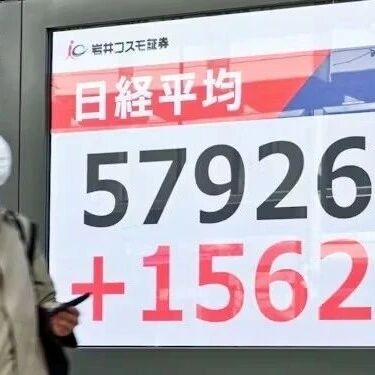
Group 1 - The core viewpoint of the article highlights the significant rise in the Japanese stock market, with the Nikkei average index closing at 57,650 points, up 1,286 points (2.28%) from the previous day, and approaching the 58,000-point mark during trading [2][4] - Over 80% of stocks in the Tokyo Stock Exchange's Prime market experienced gains, driven by strong corporate earnings and investor anxiety about missing out on potential profits [2][4] - The article notes that the recent surge in the stock market is influenced by expectations surrounding the new government led by Kishi Fumio, as well as the performance of companies like Furukawa Electric, which saw a two-day increase of 48.27% [2] Group 2 - Investor sentiment is characterized by a fear of missing out, with comments from Nomura Securities indicating that if new buyers push stock prices higher, others will feel compelled to follow suit [4] - The article mentions that despite fears regarding the current high market levels, investors remain cautious of the risk of missing out on potential gains [4] - The context of the market rally is further supported by the performance of U.S. stock indices, which also saw gains, and the stability of the Japanese yen against the dollar, contributing to a favorable economic outlook [4]
北交所周报:指数震荡调整,可持续发展信披指南修订发布
ZHONGTAI SECURITIES· 2026-02-10 07:25
Investment Rating - The report maintains an "Accumulate" rating for the industry, indicating a forecasted increase of over 10% relative to the benchmark index in the next 6 to 12 months [27]. Core Insights - The overall market performance of the Beijing Stock Exchange (BSE) shows a decline, with the BSE 50 index dropping by 3.59% to close at 1531.55 points as of January 30, 2026. In comparison, the Shanghai and Shenzhen indices showed minor fluctuations [4][10]. - The average market capitalization of the 292 constituent stocks on the BSE is 3.207 billion yuan, with a total industry market value of 936.302 billion yuan and a circulating market value of 580.261 billion yuan [4][10]. - The report highlights the top-performing sectors for the week, including Oil and Petrochemicals (33.99%), Media (4.97%), Agriculture, Forestry, Animal Husbandry, and Fishery (4.69%), Transportation (2.28%), and Communications (2%) [4][17]. Summary by Sections BSE Market Overview - As of January 30, 2026, the BSE has 292 constituent stocks, with an average market capitalization of 3.207 billion yuan. The BSE 50 index experienced a decline of 3.59% during the week, while the Shanghai Composite Index and other indices showed minimal changes [4][10]. - The average daily trading volume for the BSE was 28.731 billion yuan, reflecting a 7.20% increase from the previous week, with a turnover rate of 5.88% [15]. New Stocks on BSE - One new stock, Meidele (920119.BJ), was issued during the week. Additionally, several companies are at various stages of the IPO process, including Huadian Guangda, which has been accepted for review [5][22]. Key News from BSE - The BSE released a revised guideline for sustainable development reporting on January 30, 2026, aimed at enhancing the quality of information disclosure among listed companies. This includes new application guidelines focusing on pollutant emissions, energy use, and water resource utilization [6][24]. - The first IPO of the year was accepted for Beijing Huadian Guangda Environmental Co., which specializes in new catalytic materials for air pollution control, aiming to raise approximately 260 million yuan [6][24]. Investment Strategy - The report suggests focusing on sectors expected to perform well in 2026, including Data Centers, Robotics, Semiconductors, Consumer Goods, and Military Information Technology. Specific companies highlighted include KLT, Suzhou Axis, and Hualing Co. [25].
202602保险客户资产配置月报:A股关注中盘蓝筹,中债阶段性对冲配置
Orient Securities· 2026-02-10 07:20
Asset Allocation Insights - A-shares are focusing on mid-cap blue chips, with a neutral stance on bonds and US stocks, and a cautious outlook on gold in the short term[2] - The risk appetite in A-shares is shifting, with structural opportunities being the main focus amid overall market fluctuations[2] - Bond performance in February is expected to follow risk appetite trends, serving as a hedge against risk assets[2] Market Sentiment and Risk Assessment - Regulatory measures in January have led to a more balanced risk preference, with high-risk investors showing decreased appetite while low-risk investors gain confidence[9] - Trading sentiment across large, mid, and small-cap stocks has cooled, but medium-term uncertainty remains relatively stable[9] Industry and Sector Recommendations - Current price increases in cyclical goods are key indicators for asset allocation, with a positive outlook on sectors like chemicals, agriculture, and non-ferrous metals[30] - The report highlights two main drivers for price increases: industrialization in emerging economies and geopolitical tensions affecting import prices[30] Model and Strategy Suggestions - The recommendation includes increasing positions in mid-term bonds and focusing on sectors such as non-ferrous metals, chemicals, and military technology for February[5] - The multi-asset allocation strategy suggests a combination of passive and active enhancements, with a focus on risk parity models for stock and bond allocations[48] Performance Metrics - The low-volatility strategy has achieved an annualized return of 11.8%, while the high-volatility strategy has reached 18.1% since 2025[9] - The industry rotation strategy has outperformed benchmarks with an annualized return of 44.8% since 2025[9]
202602保险客户资产配置月报:A股关注中盘蓝筹,中债阶段性对冲配置-20260210
Orient Securities· 2026-02-10 06:52
Market Outlook - A-shares are focusing on mid-cap blue chips, with a neutral stance on bonds and US stocks, and a cautious outlook on gold in the short term[2] - Risk appetite in A-shares is shifting, with structural opportunities being the main focus amid overall market fluctuations[2] - The bond market is expected to continue following risk appetite trends, serving as a hedge against risk assets[2] Investment Strategy - The report recommends increasing allocations to mid-cap blue chips and sectors such as non-ferrous metals, chemicals, new energy, military, communication, and electronics[5] - A dual strategy of passive and active enhancement is suggested for stock-bond allocation, with a focus on increasing positions in mid-term bonds[48] Industry Insights - Price increases in cyclical goods are highlighted as key investment clues, particularly in the chemical, agricultural, and non-ferrous sectors[30] - Geopolitical tensions are raising global economic risk assessments, which is a fundamental driver for commodity price increases[30] Performance Metrics - The low-volatility strategy has achieved an annualized return of 11.8%, while the high-volatility strategy has reached 18.1% since 2025[9] - The industry rotation strategy has outperformed benchmarks with an annualized return of 44.8% since 2025[9] Risk Considerations - Extreme risk events could disrupt market expectations, and there is a risk of quantitative models failing to predict future trends[6]