
银行业

Search documents
美国只有3亿人,为何消费力能远超中国14亿人?现在全“露馅”了,2026年1月的数据显示,美国消费者的储蓄率跌到了三年来的最低点
Sou Hu Cai Jing· 2026-02-06 16:05
Core Insights - The article highlights a significant decline in American consumer spending and savings, indicating a tightening financial situation for many households [1][3][11] Economic Indicators - The personal savings rate in the U.S. dropped to approximately 3.2% in January 2026, marking a three-year low, meaning Americans are saving only about $3 for every $100 earned [3] - The Consumer Price Index (CPI) increased by over 3% year-on-year in January, with notable rises in rent and food prices, suggesting that high inflation is driving consumer spending rather than increased purchasing power [3][5] Consumer Behavior - A new trend among young Americans is the "zero consumption challenge," reflecting a shift from luxury spending to frugality, with a 40% surge in search interest for this term [5] - Many consumers are facing negative balances after accounting for essential expenses, indicating a reliance on credit cards, which has led to a record high credit card debt of over $1.1 trillion [5][7] Retail Dynamics - Sales of private label products in major supermarkets have seen double-digit growth, indicating that even middle-class consumers are cutting back on spending [9] - The retail sales figures are misleading, as they are inflated by rising prices rather than an increase in the volume of goods sold, suggesting a contraction in actual consumer demand [7][9] Financial Stability - The tightening credit environment is affecting middle-class consumers who are accustomed to living on minimum payments, leading to increased financial strain [7][11] - The article suggests that the current economic situation, characterized by low savings and high debt, is unsustainable and may lead to a significant shift in consumer behavior [11]

全线暴跌!超43万人爆仓!美股、金银、比特币、石油全都崩了!
Sou Hu Cai Jing· 2026-02-06 15:16
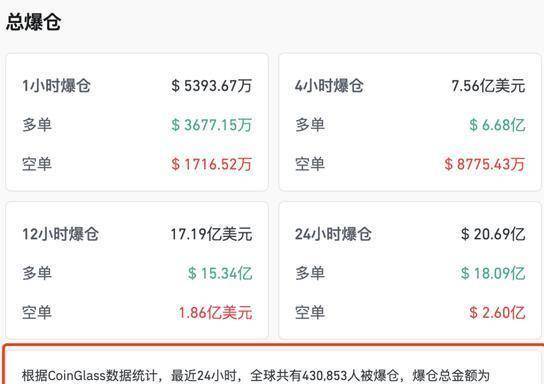
Group 1: Cryptocurrency Market - The cryptocurrency market experienced a significant crash, with Bitcoin dropping below $70,000, a daily decline of 12.81%, and Ethereum and XRP falling over 13% [1] - The collapse triggered a liquidation of over 430,000 investors, with a total liquidation amount reaching $2.069 billion [1] - The market faced a chain reaction due to the hawkish nomination of the new Federal Reserve Chairman Kevin Walsh, leading to a 1.2% rise in the dollar index and a subsequent liquidation in the cryptocurrency market [2] Group 2: Stock Market - The U.S. stock market saw a collective plunge, with the Nasdaq index experiencing its highest three-day cumulative decline since April 2024, and major tech stocks like Amazon and Microsoft losing over 4% in a single day [1] - Nvidia's market value dropped by $128.1 billion, marking the largest single-day loss for a U.S. publicly traded company, amid concerns over AI technology not meeting expectations [5] - The labor market showed signs of strain, with January layoffs reaching 108,000, the highest since the global financial crisis [5] Group 3: Precious Metals Market - The precious metals market faced a catastrophic sell-off, with spot silver plummeting over 31% and gold prices falling below $5,000 [1] - Silver's price drop was attributed to multiple factors, including hawkish comments from the Federal Reserve and a significant reduction in open contracts on COMEX [6] - The Chicago Mercantile Exchange raised margin requirements for gold and silver, exacerbating the situation by triggering further liquidations [6] Group 4: Oil Market - The oil market experienced a collapse, with WTI crude oil futures dropping below $63 per barrel, a 22% decline from the year's high [7] - Contributing factors included a rebound in U.S. shale oil production and increased Iranian oil exports, which alleviated supply concerns [7] - Despite the price drop, U.S. refinery utilization remained high at 85%, indicating underlying demand issues [7] Group 5: Market Sentiment and Systemic Risk - Retail investors were significantly impacted, with Binance processing over 800,000 liquidation orders in a single day, and Robinhood's margin balance decreasing by $12 billion [8] - The New York Fed initiated a $150 billion overnight repurchase operation to inject liquidity into the market, but confidence in policy effectiveness remained low [8] - The current market volatility has surpassed historical averages, raising concerns about the effectiveness of traditional risk models [8][10]

欧盟委员会公布新一轮对俄制裁方案
Yang Shi Xin Wen· 2026-02-06 15:10
Core Viewpoint - The European Commission has proposed the 20th round of sanctions against Russia, focusing on energy, financial services, and trade sectors [1] Group 1: Energy Sector - A comprehensive ban on maritime services for Russian crude oil is proposed, pending coordination with G7 allies [1] - The new sanctions will add 43 vessels to the "shadow fleet" list, bringing the total to 640 [1] - Measures will be taken to make it more difficult for Russia to acquire tankers for the "shadow fleet" and to prohibit maintenance and other services for liquefied natural gas carriers and icebreakers [1] Group 2: Financial Services - The sanctions will include the addition of 20 regional Russian banks to the sanctions list [1] - Actions will be taken against companies and platforms involved in cryptocurrency transactions [1] Group 3: Legal and Regulatory Measures - The proposal includes the first use of anti-circumvention tools and suggests strengthening legal protections for EU companies [1]
结构性货币政策工具不可替代降息
Hua Xia Shi Bao· 2026-02-06 14:55
Group 1 - The People's Bank of China announced a 0.25 percentage point reduction in re-lending and rediscount rates effective January 19, 2026, along with the establishment of a 1 trillion yuan re-lending facility for private enterprises and an adjustment of the total quota for technological innovation and transformation re-lending to 1.2 trillion yuan [2] - The central bank's carbon reduction support tool will operate quarterly, with an annual operation volume not exceeding 800 billion yuan, aimed at enhancing credit supply to specific sectors and reducing financing costs for enterprises [2] - The overall GDP growth target for 2025 is set at 5.0%, with a gradual decline in quarterly growth rates from 5.4% in Q1 to 4.5% in Q4, indicating that weak demand remains a significant obstacle to economic growth [2] Group 2 - The Consumer Price Index (CPI) for 2025 is projected to remain flat compared to the previous year, reflecting a low demand environment, with the real estate sector being a critical factor [3] - In 2025, the sales area of newly built commercial housing is expected to decline by 8.7% to 881 million square meters, with sales revenue dropping by 12.6% to 8.39 trillion yuan, indicating a significant downturn in the real estate market [3] - The average selling price of new residential properties in major cities is expected to show an expanding decline, with first-tier cities experiencing a 1.7% drop, while second and third-tier cities see declines of 2.5% and 3.7% respectively [3] Group 3 - The central bank's monetary policy aims to stabilize economic growth and promote reasonable price recovery, with a focus on appropriate easing measures, including interest rate cuts [4] - Lowering interest rates is intended to reduce borrowing costs, stimulate investment and consumption, particularly in the real estate sector, where declining prices have weakened buyer sentiment [4][5] - The balance of consumer loans excluding personal housing loans increased by 0.7% in 2025, indicating a slowdown in growth compared to 6.2% in 2024, attributed to relatively high interest rates [5] Group 4 - The central bank's deputy governor indicated that there is still room for further reductions in the required reserve ratio and interest rates, with the average reserve ratio currently at 6.3% [6] - The overall direction of monetary policy for the year is expected to focus on comprehensive interest rate cuts, supported by stable exchange rates and a steady net interest margin for banks [7]

国债月报:风险偏好回落,债市延续震荡-20260206
Wu Kuang Qi Huo· 2026-02-06 13:58
1. Report Industry Investment Rating - Not provided in the report 2. Core View of the Report - The economic recovery's internal driving force remains unstable, with the January official manufacturing PMI falling below expectations and the economy's upward foundation being unsteady. There is still room for reserve - requirement ratio cuts and interest rate cuts, but the timing of overall easing may be postponed after structural interest rate cuts. The bond market is expected to continue its volatile trend, and the long - term strategy is to buy on the dips [11][13][14] 3. Summary by Relevant Catalogs 3.1 Monthly Assessment and Strategy Recommendation - **Economic and Policy**: In January, the official manufacturing PMI dropped to 49.3, lower than expected. Production and demand declined, and enterprise profit margins may be under pressure. The export orders decreased, large enterprises were in the expansion range, and small and medium - sized enterprises were in the contraction range. The service industry in the non - manufacturing sector declined due to the off - season, and the construction industry's prosperity significantly dropped. Overseas, the US liquidity improved, and the market postponed the expectation of the Fed's interest rate cut to mid - year. The central bank held a meeting to develop various types of finance and support key areas. The RatingDog manufacturing PMI in China rose to 50.3, maintaining an expansion trend. The Australian central bank raised interest rates by 25 basis points [11] - **Liquidity**: The central bank conducted 10055 billion yuan in reverse repurchases and 8000 billion yuan in outright reverse repurchases this week, with 17615 billion yuan in reverse repurchases and 7000 billion yuan in outright reverse repurchases maturing, resulting in a net withdrawal of 6560 billion yuan. The DR007 rate closed at 1.48% [13] - **Interest Rates**: The latest 10 - year Treasury bond yield was 1.82%, up 0.59 BP week - on - week; the 30 - year Treasury bond yield was 2.27%, down 1.25 BP week - on - week; the latest 10 - year US Treasury bond yield was 4.21%, down 5.00 BP week - on - week [13] - **Summary**: The January official PMI data showed a decline in both supply and demand, and the economic recovery's momentum needs to be observed. There is still room for reserve - requirement ratio cuts and interest rate cuts, and the central bank will maintain a stable capital situation. The bond market's allocation power is strong, but the market is expected to continue to fluctuate [13] - **Fundamental Assessment**: The economic fundamentals need further improvement, and the net basis is low. The bond market's downward adjustment space is limited, and the long - term strategy is to buy on the dips [14] - **Trading Strategy Recommendation**: The recommended strategy is to buy on the dips for a 6 - month period, with a profit - loss ratio of 3:1, driven by loose monetary policy and difficult credit improvement [15] 3.2 Futures and Spot Markets - **T Contract**: Presented the closing price, annualized premium, settlement price, and net basis trends of the T - contract's current - quarter and main contracts [18] - **TL Contract**: Showed the closing price, annualized premium, settlement price, and net basis trends of the TL - contract's current - quarter and main contracts [23] - **TF Contract**: Displayed the closing price, annualized premium, settlement price, and net basis trends of the TF - contract's current - quarter and main contracts [26] - **TS Contract**: Demonstrated the closing price, annualized premium, settlement price, and net basis trends of the TS - contract's current - quarter and main contracts [28] - **TS and TF Positions**: Presented the closing price and position volume trends of the TS and TF contracts [33] - **T and TL Positions**: Showed the closing price and position volume trends of the T and TL contracts [38] 3.3 Main Economic Data 3.3.1 Domestic Economy - **GDP and PMI**: In Q3, 2025, the actual GDP growth rate was 4.8%, exceeding expectations. In January 2026, the manufacturing PMI was 49.3%, down 0.8 percentage points from the previous value, and the service industry PMI was 49.5%, down 0.2 percentage points [43] - **Manufacturing PMI Sub - items**: In January 2026, the manufacturing supply and demand weakened. The production index decreased by 1.1 percentage points to 50.6%, and new orders decreased by 1.6 percentage points to 49.2 [44][49] - **Price Index**: In December 2025, the CPI increased by 0.8% year - on - year, the core CPI increased by 1.2% year - on - year, and the PPI decreased by 1.9% year - on - year. The month - on - month CPI, core CPI, and PPI all increased by 0.2% [52] - **Export Data**: In December 2025, China's export data was stronger than expected, with exports increasing by 6.5% year - on - year and imports increasing by 5.7% year - on - year. Exports to the US decreased by 30.0% year - on - year, while exports to ASEAN maintained a high growth rate [55] - **Industrial Added Value and Retail Sales**: In December 2025, the industrial added - value growth rate was 5.2% year - on - year, and the year - on - year growth rate of total retail sales of consumer goods was 0.9%, down 0.4 percentage points [58] - **Fixed - Asset Investment and Real Estate**: From January to December 2025, the cumulative year - on - year growth rate of fixed - asset investment was - 3.8%, and the real estate investment growth rate was - 17.2%. In December 2025, the month - on - month price of second - hand housing in 70 large and medium - sized cities was - 0.7%, and the year - on - year price was - 6.1% [62] - **Real Estate Construction and Sales**: In December 2025, the cumulative value of new housing starts was 587700,000 square meters, with a cumulative year - on - year decrease of 20.4%. The cumulative value of new housing construction was 6598900,000 square meters, with a cumulative year - on - year decrease of 10.0%. The cumulative year - on - year data of the completion end decreased by 18.16%, and the new - home sales data in 30 large - and medium - sized cities was weak [65][68] 3.3.2 Foreign Economy - **US Economy**: In Q3 2025, the US GDP at current prices was 3109.5 billion US dollars, with an actual year - on - year growth rate of 2.33% and a quarter - on - quarter growth rate of 4.30%. In December 2025, the US CPI increased by 2.7% year - on - year, and the core CPI increased by 2.6% year - on - year and 0.0% month - on - month. In November 2025, the US durable goods orders were 323.7 billion US dollars, with a year - on - year increase of 12.29%. In December 2025, the seasonally adjusted non - farm payrolls increased by 50,000, and the unemployment rate was 4.4%. In January 2026, the US ISM manufacturing PMI was 52.6, and the non - manufacturing PMI was 53.8 [71][74][77] - **EU Economy**: In Q3 2025, the EU GDP increased by 1.4% year - on - year and 0.3% quarter - on - quarter [77] - **Eurozone Economy**: In December 2025, the Eurozone CPI increased by 2% year - on - year. In January 2026, the preliminary manufacturing PMI was 49.4, and the service industry PMI was 51.9 [80] 3.4 Liquidity - **Money Supply and Social Financing**: In December 2025, the M1 growth rate was 3.8%, and the M2 growth rate was 8.5%. The M1 growth rate declined due to the base effect. The social financing increment was 2.21 trillion yuan, with a year - on - year decrease of 645.7 billion yuan. The new RMB loans were 9700 trillion yuan, with a year - on - year decrease of 800 billion yuan [85] - **Social Financing Sub - items**: In December 2025, the year - on - year growth rate of government bonds in social financing slowed down, and the financing of the real - economy sector was stable. The social financing growth rate of the household and enterprise sectors was 6.1%, and the government bond growth rate was 17.1% [88] - **MLF and Reverse Repurchases**: In January 2026, the MLF balance was 6950 billion yuan, with a net MLF injection of 700 billion yuan. This week, the central bank conducted 10055 billion yuan in reverse repurchases and 8000 billion yuan in outright reverse repurchases, with 17615 billion yuan in reverse repurchases and 7000 billion yuan in outright reverse repurchases maturing, resulting in a net withdrawal of 6560 billion yuan. The DR007 rate closed at 1.48% [91] 3.5 Interest Rates and Exchange Rates - **Interest Rate Changes**: Provided the latest rates, daily, weekly, and monthly changes of various types of interest rates, including repurchase rates, Treasury bond yields, and US Treasury bond yields [94] - **Interest Rate Trends**: Presented the trends of Treasury bond yields, bank - to - bank pledged repurchase rates, US Treasury bond yields, and the bond yields of the UK, France, Germany, and Italy [98][99][103] - **Fed Target Rate and Exchange Rates**: Showed the trends of the Fed's target rate, the USD/RMB exchange rate, and the US dollar index [105]
光大证券:光大证券和光大银行均为光大集团旗下子公司
Zheng Quan Ri Bao· 2026-02-06 13:38
证券日报网讯 2月6日,光大证券在互动平台回答投资者提问时表示,光大证券和光大银行均为光大集 团旗下子公司,光大证券为光大集团唯一具有证券牌照的子公司。我国金融行业仍为商业银行业、证券 业分业经营的格局,混业经营政策尚未出台。《证券法》总则第六条规定,证券业和银行业、信托业、 保险业实行分业经营、分业管理,证券公司与银行、信托、保险业务机构分别设立。 (文章来源:证券日报) ...


人民银行北京市分行:积极支持扩大和提振消费
Bei Jing Shang Bao· 2026-02-06 13:15
会议要求,强化对重点领域的金融支持力度。持续做好首都金融"五篇大文章",建设多层次金融服务体 系,着力支持扩大内需、科技创新、中小微企业等重点领域。充分发挥北京市中关村国家自主创新示范 区区位优势,加力推进科技金融探索创新。积极支持扩大和提振消费。稳步推进绿色金融。深入开展民 营小微企业金融服务能力提升工程。不断拓展数字金融。 北京商报讯(记者 董晗萱)2月6日,据人民银行北京市分行官微,人民银行北京市分行召开2026年北 京辖区金融管理工作通报会。 ...
人民银行北京市分行:打造数字人民币2.0版本特色应用场景
Bei Jing Shang Bao· 2026-02-06 13:15
会议要求,落实好2026年"北京服务"工作任务。做好重点商户外卡受理环境建设,常态长效优化支付服 务。继续做好一次性个人信用修复政策实施,强化征信数据源头治理。打造数字人民币2.0版本特色应 用场景。扎实做好基础现金业务。持续做好国库服务工作。 北京商报讯(记者 董晗萱)2月6日,据人民银行北京市分行官微,人民银行北京市分行召开2026年北 京辖区金融管理工作通报会。 ...

人民银行:建设高水平法治央行
Bei Jing Shang Bao· 2026-02-06 12:29
Core Viewpoint - The People's Bank of China emphasizes the importance of legal frameworks in enhancing financial stability and development, with significant progress in financial legislation and administrative law enforcement noted for 2025 [1] Group 1: Financial Legislation Progress - In 2025, substantial advancements were made in financial legislation, including the development of laws related to the central bank and financial stability [1] - Continuous efforts in the clearance of regulations and normative documents were highlighted, indicating a systematic approach to legal frameworks [1] Group 2: Administrative Law Enforcement - The meeting noted improvements in the quality and effectiveness of administrative law enforcement, with standardized practices in inspections and penalties [1] - Efficient handling of administrative review and litigation cases was emphasized, showcasing a commitment to legal service and research [1] Group 3: Goals for 2026 - For 2026, the focus will be on building a high-level legal framework for the central bank, enhancing financial services to the real economy, and mitigating financial risks [1] - The meeting called for breakthroughs in financial legislation and administrative enforcement, aiming to establish a comprehensive legal system [1] - There will be an emphasis on improving the administrative review process and strengthening legal service support and public legal education [1] - Development of legal talent and capabilities within the organization will be prioritized to ensure effective governance [1]
保持全国第一!2025年上海人民币跨境收付金额32.4万亿元,同比增9%
Guo Ji Jin Rong Bao· 2026-02-06 12:04
Core Viewpoint - The People's Bank of China (PBOC) Shanghai Headquarters held a meeting to summarize the cross-border RMB business in Shanghai for 2025 and outline key tasks for 2026, highlighting significant growth and the importance of financial services in supporting economic development [1][2]. Group 1: 2025 Achievements - In 2025, Shanghai's cross-border RMB business achieved a total payment amount of 32.4 trillion yuan, marking a 9% year-on-year increase and maintaining its position as the national leader [1]. - Key enterprises, sectors, and regions saw positive progress in RMB usage, with successful implementation of reforms such as the offshore trade finance service pilot in the Lingang New Area and upgrades to the free trade account functions [1]. Group 2: 2026 Focus Areas - The PBOC emphasized the need to adhere to the principle of prioritizing the local currency, aiming to enhance the convenience of cross-border RMB settlements and promote its use in trade, investment, and financing [1]. - There is a commitment to serve the real economy by diversifying cross-border RMB financial products and improving the professionalism and precision of financial services to better meet market demands [2]. - The focus will also be on reform and innovation, expanding the offshore trade finance service pilot in the Lingang New Area and supporting quality enterprises in the free trade account upgrade pilot [2]. - Financial risk prevention is a priority, with an emphasis on compliance management and balancing development with safety, as well as enhancing the management and risk control capabilities of cross-border capital flows [2].