
军工

Search documents
全球矿业研究 | 2026年金属市场的七大展望
彭博Bloomberg· 2026-02-25 06:05
Core Viewpoint - The article discusses the 2026 outlook for the metals and mining sector, focusing on three main themes: persistent safe-haven demand, supply structure changes driving divergence in base metals, and resource security becoming a policy priority [3][4]. Group 1: Precious Metals - Gold is expected to outperform the S&P 500 again in 2026, with an average price projected around $5,000 per ounce [3][6]. - Silver may experience a modest correction after a strong rally, but its average price is still anticipated to be significantly above market consensus [3][5]. Group 2: Supply Structure Changes - The copper market is expected to tighten, with prices likely to remain above $12,000 per ton, while nickel may see a price drop to around $15,000 due to oversupply unless Indonesia intervenes [4][5]. - The alumina market is projected to see price support from cost curves, with a potential decline limited to about 10% [4]. Group 3: Resource Security - Government funding is driving accelerated development of rare earth resources, with an estimated $10 billion in public sector investment expected [4][5]. - U.S. steel tariffs are likely to remain in place, benefiting domestic producers [4]. Group 4: Mining Companies Outlook - Major mining companies are reflecting a rebound in market risk appetite, with a trend of capital reallocation towards tangible assets [9]. - The structural supply constraints in metals, particularly copper, support price resilience, indicating potential upward revisions in profit forecasts [9]. Group 5: Silver Mining Companies - Silver mining companies, including Fresnillo, are expected to maintain strong performance in 2026, benefiting from high precious metal prices and robust operational execution [11]. - The consensus forecast predicts a 44% year-over-year increase in earnings for silver companies in 2026, based on silver and gold prices of $83 and $4,820 per ounce, respectively [11][12].


国防ETF(512670)涨超1%,马斯克设想从月球电磁弹射AI卫星
Xin Lang Cai Jing· 2026-02-25 06:00
Group 1 - The core idea of the news highlights the potential for the U.S. space exploration company, led by CEO Elon Musk, to deploy AI-specific data center satellite networks using electromagnetic catapults from the Moon to Earth orbit [1] - Short-term demand for domestic commercial aerospace and aviation is expected to grow significantly over the next five years, with both sectors being trillion-level markets, likely to continue attracting market interest [1] - The year 2026 marks the beginning of a new stocking cycle for the mainframe sector, with upstream supply chains expected to benefit first, and order traction anticipated to start as early as early 2026 [1] Group 2 - Mid-term military trade demand is expected to reach a significant turning point, driving an increase in both quantity and price of equipment demand, benefiting mainframe and key subsystem manufacturers [1] - Strong demand for AI in the power generation sector is likely to sustain the momentum of the gas turbine industry chain [1] - Long-term defense spending is projected to maintain a high growth rate of around 7% leading up to the centenary of the military in 2027, alongside accelerated iterations of next-generation main battle equipment and rising demands for new combat capabilities [1] Group 3 - As of February 25, 2026, the CSI Defense Index (399973) rose by 1.40%, with component stocks such as Feiliwa rising by 17.72%, Gangyan Gaona by 4.94%, and Xibu Superconductor by 3.74% [1] - The Defense ETF (512670) increased by 1.08%, marking its fourth consecutive rise, with the latest price reported at 1.03 yuan [1] - The CSI Defense Index closely tracks companies under the ten major military industrial groups and those providing weaponry to the national armed forces, reflecting the overall performance of defense industry listed companies [2]
刚定下访华日程,不到1天,特朗普底牌尽失,中国发现了美国弱点
Sou Hu Cai Jing· 2026-02-25 04:46
Core Viewpoint - The U.S. Supreme Court ruled against Trump's tariff policy, declaring it illegal and invalidating tariffs imposed under the International Emergency Economic Powers Act (IEEPA), which could lead to the return of over $175 billion in tariffs to U.S. businesses [1][3][5] Group 1: Legal and Economic Implications - The Supreme Court's decision means that tariffs collected under IEEPA, which exceeded $175 billion, are now subject to refund, impacting hundreds of U.S. companies that are preparing to file lawsuits for refunds [3][5] - The ruling highlighted that the IEEPA does not authorize the President to impose tariffs without Congressional approval, undermining Trump's justification of trade deficits as a national emergency [7][9] - The Congressional Budget Office had estimated that IEEPA tariffs could generate over $1.4 trillion in revenue over the next decade, which was intended to support tax cuts, but this revenue stream is now jeopardized [7] Group 2: Trade Relations and Negotiation Dynamics - Trump's aggressive tariff strategy, which included rates as high as 145% on Chinese goods, has been significantly weakened by the Supreme Court ruling, diminishing U.S. leverage in trade negotiations with China [5][11] - The U.S. is facing a critical situation regarding rare earth elements, as China controls a significant portion of the global supply, which is vital for U.S. defense industries [13][20] - The U.S. has limited domestic capabilities to process rare earth materials, and efforts to establish alternative supply chains are projected to take years, further complicating the trade landscape [13][20] Group 3: Public Sentiment and Political Context - Approximately 60% of Americans oppose Trump's tariff policies, with nearly half believing these policies have worsened the economy, indicating a potential political backlash [15] - The upcoming visit to China is seen as a crucial opportunity for Trump to recover from the political fallout of the tariff ruling, as he seeks tangible results to present to voters ahead of the midterm elections [22][23] - The Supreme Court's ruling has altered the negotiation landscape, as it signals that the President can no longer unilaterally use tariffs as a bargaining tool, which may affect the outcomes of future trade discussions [25]

未知机构:重点提示老票新推四川九洲极具扩张性的地方军工国企资产整合平台后续催化-20260225
未知机构· 2026-02-25 02:50
Summary of Conference Call Records Company Overview - **Company**: Sichuan Jiuzhou - **Industry**: Military and Aerospace Key Points 1. Stock Price Safety Margin - The controlling entity, Jiuzhou Group, is about to launch a convertible bond project, with an expected premium of at least 30% on the conversion price compared to the current stock price in six months [1] - The group is undergoing a management change, with market value management being a top priority for 26 years, supported by a strong and professional business team [1] 2. Positioning of the Listed Platform - Jiuzhou Group aims to achieve a revenue target of 100 billion by the end of the 14th Five-Year Plan, with the group having only realized 46 billion in revenue over 25 years [1] - The listed company is expected to be a major contributor to revenue growth during the 14th Five-Year Plan, with value creation driven from top to bottom, focusing on both organic and external growth [1] - National strategic funds are expected to invest in the group, with a focus on capital operations through the listed company, highlighting the value positioning of the listed company as a core military asset [1] 3. Short-term Beta Catalysts - The low-altitude economy is being promoted by five ministries, with the listed company being a domestic leader in low-altitude safety infrastructure hardware [2] - The company anticipates doubling its revenue in the low-altitude business over the next three years, with higher profitability, leveraging a strategic partnership with Huawei for advanced 5G-A multi-detection technology [2] - The company is a strategic partner of COMAC, historically trusted as a key supplier, with significant potential in the C919 and C929 aircraft systems, indicating strong competitive advantages [2] 4. Fundamentals and Valuation - The company's performance has been slightly pressured due to the broader environment, but core business contributions are at the bottom of the cycle, aligning with key construction directions of the 14th Five-Year Plan [2] - A cash acquisition of a comprehensive RF business is expected to be consolidated soon, serving as a catalyst for performance improvement [2] - Jiuzhou Group is the only local state-owned enterprise with core military product development capabilities, benefiting from the military-civilian integration cluster in Mianyang, with Sichuan Jiuzhou aiming for a market value target of 40 billion during the 14th Five-Year Plan [2]

冲突延宕四年 乌克兰危机哪里走
Xin Lang Cai Jing· 2026-02-24 19:19
Group 1: Military Situation - The military situation between Russia and Ukraine is characterized by a "high consumption" stalemate, with Russia maintaining a slight advantage but struggling to resolve the deadlock [5][6] - Russia has made slow but steady progress towards its strategic goals, having regained control over key areas such as the entirety of Kursk Oblast and significant positions in Kharkiv Oblast [5] - Ukraine has increased its long-range strike capabilities, targeting Russian military assets and infrastructure, with reports indicating that Russia is intercepting between 1,000 to 2,000 Ukrainian drones weekly [5][6] Group 2: Economic Impact - The conflict has evolved into a "resource and economic war," significantly impacting the economies and social conditions of both Russia and Ukraine [7] - Russia's economy has shown resilience despite Western sanctions, with a decrease in trade volume but an increase in efforts to explore new markets [7] - Ukraine's economy has been severely affected, with a poverty rate of 36.9% reported, and direct losses from the conflict amounting to $195 billion, with reconstruction costs projected at $588 billion [7][8] Group 3: Debt and Financial Stability - Ukraine's public debt is projected to reach 108.6% of its GDP by 2025, indicating a critical financial situation where domestic earnings are insufficient to cover debt obligations [8] - The national budget deficit for Ukraine in 2026 is estimated at 1.9 trillion hryvnias (approximately $450 million), necessitating reliance on loans and aid, particularly from the EU [8] Group 4: Negotiation Dynamics - Recent trilateral talks between Russia, the US, and Ukraine have focused on substantive issues, indicating a potential opening for dialogue [9] - The negotiation landscape is complicated by differing core demands, with territorial and security guarantees being major sticking points [10] - Public sentiment in both Russia and Ukraine reflects a complex and often contradictory attitude towards the conflict and negotiations, with significant portions of the population expressing skepticism about the prospects for peace [10]

美银证券维持洛克希德马丁持有评级,目标价660美元
Xin Lang Cai Jing· 2026-02-24 18:20
经济观察网 美银证券于2026年2月24日维持对洛克希德马丁的"持有"评级,目标价为660美元。根据机 构数据,当前20家机构对洛克希德马丁的目标价均值为663.10美元,与最新股价663.09美元基本持平; 2026年2月机构观点中,持有评级占比64%,买入或增持占比28%,减持或卖出占比8%,显示机构整体 持谨慎态度。 洛克希德马丁2025年第四季度财报(2026年1月29日公布)显示,营收203.21亿美元,超出预测值198.58 亿美元,同比增长9.12%;净利润13.44亿美元,同比增长155.03%,但略低于预测值13.75亿美元。根据 最新预测,2026年第一季度营收预计为185.11亿美元,同比增长4.13%,盈利预期整体稳健。 股票近期走势 近一周(2026年2月18日至24日),洛克希德马丁股价波动上行,区间涨幅2.04%,最高价669.75美元 (2月19日),最低价648.41美元(2月20日)。截至2月24日收盘,股价报663.09美元,当日涨0.37%, 年初至今累计上涨37.13%,表现强于大盘(道指同期跌0.86%)。 以上内容基于公开资料整理,不构成投资建议。 近期事件 近期 ...
商务部重拳出击:三菱、斯巴鲁等40家日本实体被列入出口管制名单
制裁名单· 2026-02-24 13:39
Core Viewpoint - The Chinese Ministry of Commerce announced the inclusion of 40 Japanese entities in export control lists to safeguard national security and counter Japan's militarization and nuclear ambitions [1][5]. Group 1: List Classification and Core Measures - The export control action employs a "dual-list" mechanism, implementing differentiated controls based on the nature of the entities [2]. - Control List (20 entities): Comprehensive export ban on key Japanese military and aerospace companies, including Mitsubishi Heavy Industries and Kawasaki Heavy Industries, prohibiting the export of dual-use items to these entities [3]. - Attention List (20 entities): Includes well-known companies like Subaru and Mitsubishi Materials, requiring stricter scrutiny and risk assessment for exports, with a written commitment that dual-use items will not enhance Japan's military capabilities [4]. Group 2: Policy Background and Official Statements - The Ministry of Commerce emphasized that the measures aim to halt Japan's militarization and nuclear ambitions, clarifying that the actions target only a few entities and do not affect normal Sino-Japanese trade [5]. - This announcement follows a previous notice on January 6, 2026, which prohibited all dual-use items from being exported to Japanese military users and any entities enhancing Japan's military capabilities [5]. Group 3: List Details (Partial) - Control List (Partial): 1. Mitsubishi Shipbuilding Co., Ltd. 2. Mitsubishi Heavy Industries Aero Engine Co., Ltd. 3. Kawasaki Heavy Industries Aerospace Systems Co., Ltd. 4. IHI Aerospace Co., Ltd. 5. NEC Aerospace Systems Co., Ltd. 6. National Defense Medical University 7. Japan Aerospace Exploration Agency [6] - Attention List (Partial): 1. Subaru Corporation 2. Mitsubishi Materials Corporation 3. TDK Corporation 4. Nitto Denko Corporation 5. Tokyo University of Science [7]

海内外催化不断,大飞机、军贸成新风口?军工ETF华宝马年开门红!机构高呼“加大军工板块配置”
Xin Lang Ji Jin· 2026-02-24 11:44
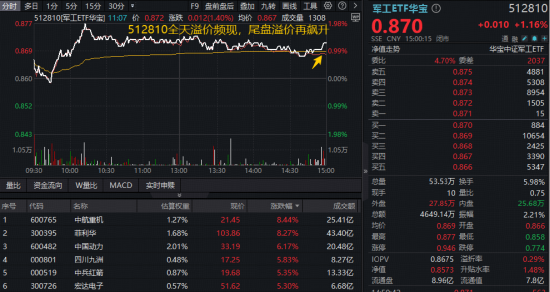
Core Viewpoint - The military industry sector in A-shares shows strong performance on the first trading day of the Year of the Horse, with significant interest in military ETFs, particularly the Huabao ETF, which has seen a price increase and active buying [1][3]. Group 1: Market Performance - The military sector experienced a quick recovery after a brief dip, with the Huabao ETF reaching a high of 1.98% and closing up 1.16%, marking three consecutive days of gains [1]. - Among the constituent stocks, 57 increased while 23 decreased, with notable gains from Zhonghang Heavy Machinery and Feiliwa, both rising over 8%, and China Power increasing by 6.17% [1]. - Major stocks such as China Shipbuilding, Aero Engine Corporation of China, and Guangqi Technology all rose by over 2% [1]. Group 2: Industry Catalysts - The military industry is experiencing multiple catalysts, including a significant increase in domestic flight operations of the C919 aircraft, which averaged nearly 50 flights per day during the Spring Festival, representing a year-on-year growth of 52.6% [3]. - The commercial aerospace sector is expected to see intensive testing of recoverable rocket experiments from March to June [3]. - Internationally, heightened tensions between the U.S. and Iran have led to increased urgency in China's defense construction, as evidenced by the U.S. Navy's approval of Raytheon Technologies' smart weapon for use on the Super Hornet fleet [3]. Group 3: Investment Recommendations - Dongfang Securities recommends increasing allocation to the military sector, particularly focusing on large aircraft and military trade, anticipating accelerated progress in large aircraft production and increased market share in military trade in new markets like the Middle East [3]. - The Huabao ETF, which covers various popular themes such as large aircraft, commercial aerospace, low-altitude economy, satellite navigation, military informationization, and controllable nuclear fusion, is highlighted as an efficient tool for investing in core military assets [3].



军工ETF(512660)涨超1%,连续5日净流入超4.4亿元,国防科技工业体系建设加速催化板块
Mei Ri Jing Ji Xin Wen· 2026-02-24 07:19
Core Viewpoint - The defense and military industry in China is transitioning from the "14th Five-Year Plan" to the "15th Five-Year Plan," with 2026 being a crucial year for accelerating the construction of an advanced national defense technology industrial system [1] Group 1: Industry Outlook - The domestic military equipment construction efforts are expected to strengthen further under the guidance of the centenary goal of military building [1] - The global military trade sector is anticipated to experience a sustained upward trend over the next 5 to 10 years due to the current period of global turmoil and transformation [1] Group 2: Commercial Aerospace - Commercial aerospace has become a focal point in the capital market, with a resonance of enthusiasm between the primary and secondary markets [1] - Significant progress has been made in reusable rocket technology, which is expected to revolutionize the traditional low frequency of rocket launches and long maintenance cycles [1] Group 3: Military ETF - The military ETF (512660) tracks the CSI Military Industry Index (399967), which selects listed companies primarily controlled by major military groups and related to the military industry [1] - The index reflects the overall performance of listed companies in the military sector, covering various fields such as aviation, aerospace, and shipbuilding, with industry distribution including aviation equipment and military electronics [1]

中兵红箭股价涨5.03%,国泰基金旗下1只基金位居十大流通股东,持有812.49万股浮盈赚取763.74万元
Xin Lang Cai Jing· 2026-02-24 05:43
Group 1 - The core point of the news is that Zhongbing Hongjian's stock price increased by 5.03% to 19.62 CNY per share, with a trading volume of 785 million CNY and a turnover rate of 2.93%, resulting in a total market capitalization of 27.322 billion CNY [1] - Zhongbing Hongjian Co., Ltd. is located in Nanyang, Henan Province, and was established on March 10, 1998, with its listing date on October 8, 1993. The company specializes in the research, production, and sales of superhard materials and their products, internal combustion engine parts, and military products such as large-caliber shells, rockets, missiles, and ammunition [1] - The revenue composition of Zhongbing Hongjian includes special equipment at 53.87%, superhard materials and products at 37.35%, automotive parts at 5.73%, and special vehicles at 3.05% [1] Group 2 - From the perspective of the top ten circulating shareholders, Guotai Fund has a fund that ranks among them. The Guotai Zhongzheng Military Industry ETF (512660) reduced its holdings by 1.5593 million shares in the third quarter, holding a total of 8.1249 million shares, which accounts for 0.58% of the circulating shares [2] - The Guotai Zhongzheng Military Industry ETF (512660) was established on July 26, 2016, with a latest scale of 10.652 billion CNY. It has achieved a return of 7.9% this year, ranking 1638 out of 5580 in its category, and a return of 44.16% over the past year, ranking 1212 out of 4297 [2] - The fund manager of Guotai Zhongzheng Military Industry ETF (512660) is Ai Xiaojun, who has a cumulative tenure of 12 years and 46 days, managing total fund assets of 188.936 billion CNY, with the best fund return during his tenure being 327.02% and the worst being -46.54% [2]
