装备制造业

Search documents
收入端中游一枝独秀——1-2月工业企业利润点评
一瑜中的· 2025-03-28 00:47
Core Viewpoint - The industrial enterprises' profits showed a slight decline in January-February, with a year-on-year decrease of 0.3%, compared to a decline of 3.3% for the entire previous year [1][18]. Summary by Sections Industrial Profit Data - In January-February, the profits of industrial enterprises above designated size decreased by 0.3% year-on-year, while the inventory increased by 4.2% compared to the previous year [1][18]. - The profit margin for January-February was 4.53%, slightly lower than the 4.67% in the same period last year [19]. Industry Performance - The mining industry experienced a significant decline with a growth rate of -25.2%, while manufacturing saw a recovery with a growth rate of 4.8% [2][23]. - Notable growth in manufacturing sectors included agricultural and sideline food processing (37.8%), non-ferrous metal processing (20.5%), and transportation equipment (88.8%) [2][23]. Revenue Analysis - The revenue of industrial enterprises increased by 2.8% year-on-year in January-February, with the midstream sector showing strong performance at 8.1% growth [3][7]. - The upstream manufacturing sector's revenue growth was only 0.73%, while downstream manufacturing grew by 1.67% [3][7]. Factors Influencing Performance - Three main factors contributed to the revenue growth: strong export performance, new policies promoting equipment updates, and advancements in "hard technology" [4][10]. - The export delivery value of the equipment manufacturing industry grew by 7.23% in January-February, with significant contributions from sectors like railways and aerospace [4][10]. Future Outlook - The main uncertainty for the midstream equipment manufacturing sector comes from export dependency, which is at 21.1% for 2024 [15]. - Despite the uncertainties, the expected revenue growth for the equipment manufacturing sector is anticipated to be better than last year due to substantial domestic policy support and increased capital expenditure in "hard technology" [15].


前2个月装备制造业和原材料制造业利润由降转增 工业企业效益延续恢复态势
Shang Hai Zheng Quan Bao· 2025-03-27 19:15
工业企业效益延续恢复态势。国家统计局3月27日发布的数据显示,今年前2个月,规模以上工业企业营 业收入继续改善,利润降幅收窄。装备制造业和原材料制造业利润由降转增。受访专家表示,消费品以 旧换新政策加力扩围带动相关产品所在行业及链条行业效益向好。 今年前2个月,全国规模以上工业企业营业收入同比增长2.8%,增速较2024年全年加快0.7个百分点;利 润同比下降0.3%,降幅较2024年全年收窄3个百分点。 从营业收入扣减营业成本计算的毛利润角度看,今年前2个月,规模以上工业企业毛利润由2024年全年 的同比下降0.3%转为同比增长2.0%。 "2025年开年,工业企业利润总体延续改善势头。结构上,装备制造和原材料制造行业带动较强,这得 益于'两新'政策带来的需求支撑。上游采矿利润增速回落也有助于中下游成本压力缓解。"平安证券首 席经济学家钟正生表示。 分行业看,制造业对工业企业盈利的支撑作用回升。从数据看,制造业利润改善明显,今年前2个月制 造业利润同比增长4.8%,拉动全部规模以上工业企业利润增长3.2个百分点。 ◎记者 陈芳 国家统计局工业司统计师于卫宁表示,在新能源产业国内外市场需求增加带动相关产品价格 ...
CPI暂回踩,后续易升难降——2月物价数据解读【财通宏观•陈兴团队】
陈兴宏观研究· 2025-03-09 07:44
Group 1: CPI Analysis - The CPI year-on-year growth rate decreased to -0.7% in February, down 1.2 percentage points from the previous month, primarily due to the impact of the Spring Festival timing [1][4] - Excluding the Spring Festival effect, the CPI year-on-year increased by 0.1% in February, indicating a moderate recovery in prices [1][4] - Food prices contributed over 80% to the total decline in CPI, with fresh vegetable prices dropping by 12.6% year-on-year [5][6] Group 2: PPI Analysis - The PPI year-on-year decline narrowed to 2.2% in February, with the average for January-February also showing a 2.2% decrease compared to the previous year [2][7] - The main reasons for the PPI decline include the off-peak industrial production season and weak demand for construction materials [2][7] - The prices of production materials fell by 2.5%, while living materials prices decreased by 1.2%, with specific industries like coal processing seeing significant price drops [7][8] Group 3: Market Sentiment and Future Outlook - The PMI data indicated an increase in raw material and finished product price indices, but the PPI only slightly narrowed, suggesting a discrepancy between perceived and actual market conditions [3] - The current policy uncertainty may lead to a cautious approach from enterprises, affecting production enthusiasm [3] - Positive signals from the upcoming Two Sessions may help restore market demand and improve production and demand dynamics [3]

刚刚公布!↓0.7%
券商中国· 2025-03-09 01:54
Core Viewpoint - The article discusses the decline in consumer prices (CPI) and producer prices (PPI) in February 2025, highlighting the impact of seasonal factors and international commodity price fluctuations on these indices [9][10][11]. Group 1: Consumer Price Index (CPI) Analysis - In February 2025, the national CPI decreased by 0.7% year-on-year, with urban and rural areas both experiencing a decline of 0.7% [1] - The average CPI for January-February 2025 showed a slight decrease of 0.1% compared to the same period last year [1] - Food prices fell by 3.3%, significantly impacting the CPI, while non-food prices saw a minor decline of 0.1% [1][10] - The decline in fresh vegetable prices by 12.6% was a major contributor to the CPI drop, affecting it by approximately 0.31 percentage points [4][10] - Seasonal factors, such as the timing of the Spring Festival, contributed to the CPI's year-on-year decline, with a calculated impact of -1.2 percentage points from last year's price changes [10] Group 2: Producer Price Index (PPI) Analysis - The PPI for February 2025 decreased by 2.2% year-on-year and by 0.1% month-on-month, with the decline in producer prices showing a slight narrowing compared to the previous month [2][9] - The drop in industrial producer prices was primarily driven by a 2.5% decrease in production material prices, which affected the overall PPI by approximately 1.86 percentage points [6] - The construction sector faced reduced demand due to seasonal factors, leading to a 10.6% decline in black metal smelting and rolling prices [11] - International commodity price fluctuations, particularly in coal and oil, also contributed to the PPI decline, with coal processing prices down by 24.7% year-on-year [11] Group 3: Price Changes in Specific Categories - In February, the prices of food, tobacco, and alcohol categories decreased by 1.9% year-on-year, impacting the CPI by about 0.54 percentage points [4] - The prices of other categories showed mixed results, with clothing prices increasing by 1.2% while transportation and communication prices fell by 2.5% [4] - The industrial producer prices for food decreased by 1.6%, while durable consumer goods prices fell by 2.5% [6][8] - Some sectors, such as energy and certain consumer goods, experienced price increases, indicating a mixed recovery in demand [12]

700字!极简版政府工作报告来了
证券时报· 2025-03-05 02:10
Group 1 - The core viewpoint of the article emphasizes the government's economic goals for 2024 and 2025, focusing on growth, stability, and social development [1][2] - The GDP target for 2024 is set at 134.9 trillion yuan, with a growth rate of 5%, contributing approximately 30% to global economic growth [1] - The expected growth rate for GDP in 2025 is around 5%, with a focus on maintaining a stable urban unemployment rate of about 5.5% and creating over 12 million new urban jobs [1][2] Group 2 - The government plans to implement a more proactive fiscal policy with a deficit rate of around 4%, aiming for a deficit scale of 5.66 trillion yuan and issuing long-term special government bonds of 1.3 trillion yuan [2] - A moderately loose monetary policy will be adopted, including potential interest rate cuts to promote healthy development in the real estate and stock markets [2] - Key tasks for 2025 include boosting consumption, enhancing investment efficiency, and expanding domestic demand comprehensively [2]
2024年全国统计公报解读:稳中求进逐新而上
国新证券股份· 2025-03-03 12:31
Economic Performance - In 2024, China's GDP growth reached 5.0%, with the total economic output surpassing 130 trillion yuan for the first time[3] - The GDP growth in Q4 was 5.4%, accelerating by 0.8 percentage points compared to Q3[3] - Industrial added value increased by 5.7%, contributing 34.1% to economic growth, an increase of 12.7 percentage points[3] Sector Contributions - The service sector's added value grew by 5.0%, contributing 56.2% to economic growth, serving as a stabilizing force[3] - Domestic demand accounted for 69.7% of economic growth, highlighting its role as the main driver[3] - Net exports contributed 30.3% to economic growth, showing a significant improvement from the previous year[3] Emerging Industries - The share of high-tech manufacturing and equipment manufacturing in total industrial added value rose to 16.3% and 34.6%, respectively[4] - Notable growth in specific high-tech sectors included smart vehicle equipment (25.1%) and drones (53.5%)[4] Social Indicators - The urban unemployment rate averaged 5.1%, a decrease of 0.1 percentage points from the previous year[4] - Urban employment increased by 12.56 million, maintaining above 12 million for four consecutive years[4] - Per capita disposable income rose by 5.1%, with consumption expenditure also increasing by 5.1%[8] Food and Energy Security - In 2024, total grain production reached 1.413 trillion jin, marking the first time it exceeded 1.4 trillion jin[8] - Energy self-sufficiency remained above 80%, with coal production hitting a record 4.78 billion tons[8] Future Outlook - The economic growth forecast for 2025 is around 5%, with a stable foundation and strong potential for high-quality development[10] - The report highlights both opportunities and challenges for the upcoming year, emphasizing a favorable environment for growth[10]
宋雪涛:“抢出口”带动PMI重回扩张
雪涛宏观笔记· 2025-03-03 07:37
Core Viewpoint - The resilience of the economy is maintained by the "export grabbing" strategy, with the sustainability of economic recovery dependent on future export conditions and policy responses [1][4]. Group 1: Economic Indicators - The manufacturing PMI for February is at 50.2, indicating a return above the growth line, with a month-on-month increase of 1.1 percentage points, surpassing the average increase of 0.8 percentage points from 2015 to 2019 [1]. - The production index rose by 2.7 percentage points to 52.5%, while the new orders index increased by 1.9 percentage points to 51.1% [1]. - The export new orders index in February increased by 2.2 percentage points to 48.6%, driven by the "export grabbing" trend [2]. Group 2: Export Dynamics - The "export grabbing" mode has been accelerated since Trump's election, with a 10.1% year-on-year increase in U.S. imports from China in December 2024 and a 15.6% increase in Chinese exports to the U.S. [2]. - In January 2025, U.S. container imports reached a record 2.487 million TEU, with a month-on-month increase of 10.6% from China [2]. - The manufacturing sector's performance is bolstered by the "export grabbing," with the equipment manufacturing production index remaining above 54% in February [2]. Group 3: Price Trends - In February, the main raw material purchase prices and factory gate prices indices increased by 1.3 and 1.1 percentage points, respectively, providing positive guidance for the PPI data [3]. Group 4: Trade Tensions and Policy Outlook - The intensification of U.S.-China trade tensions since February raises concerns about the sustainability of the "export grabbing" window, with new tariffs announced by the U.S. [4]. - The manufacturing PMI's production and raw material inventory indices declined by 0.8 and 0.7 percentage points, indicating uncertainty in export performance [4]. - Current domestic policies are focused on stabilizing the economy, with monetary policy emphasizing coordination rather than aggressive measures, and fiscal policy prioritizing debt management [5][6].

东北第一座万亿城市,可能是它
创业邦· 2025-03-03 02:50
Core Viewpoint - The article discusses the potential for Dalian to become the first city in Northeast China to surpass a GDP of 1 trillion yuan by 2025, driven by strong economic growth and industrial development [1][3]. Economic Performance - Dalian's GDP reached 8752.9 billion yuan in 2023, with a growth rate of 6%, and is projected to grow to 9516.9 billion yuan in 2024, reflecting a year-on-year increase of 5.2% [3]. - The second industry in Dalian contributed significantly, with an added value of 3715.2 billion yuan in 2023, growing by 9% [3]. - In 2024, the second industry's growth rate is expected to be the highest among all sectors at 6.6% [3]. Industrial Development - Traditional industries such as petrochemicals and equipment manufacturing are performing well, with the Longxing Island Economic Zone's industrial output surpassing 2525.5 billion yuan in 2024, accounting for 29.7% of Dalian's industrial output [3][4]. - The high-tech manufacturing sector in Dalian saw an increase of 11.0% in added value in 2024, maintaining double-digit growth for 21 consecutive months [4]. Consumer Market - Dalian's total retail sales of consumer goods reached 2085.9 billion yuan in 2024, with a year-on-year growth of 3.9%, driven by significant increases in the sales of upgraded consumer goods [4]. Challenges and Opportunities - To achieve the 1 trillion yuan GDP target by 2025, Dalian needs to address gaps in its service industry, particularly in high-end services like financial innovation and technology research [5][6]. - Talent retention remains a challenge, as Dalian's competitive edge in salary and career opportunities lags behind first-tier cities, leading to talent outflow [6]. Regional Dynamics - Other cities in Northeast China, such as Shenyang and Changchun, are also targeting the 1 trillion yuan GDP milestone, with Shenyang projected to reach 9027.1 billion yuan in GDP in 2024 [8][9]. - Shenyang's government aims for a GDP growth of over 5.5% in 2025, which could position it to join the "trillion club" by 2026 [9]. Strategic Importance - The rise of Dalian and Shenyang is crucial not only for Liaoning Province but also for the overall economic revitalization of Northeast China, although geographical limitations may affect Dalian's regional influence [10].

中采PMI|制造业景气保持较好状态(2025年2月)
中信证券研究· 2025-03-02 11:02
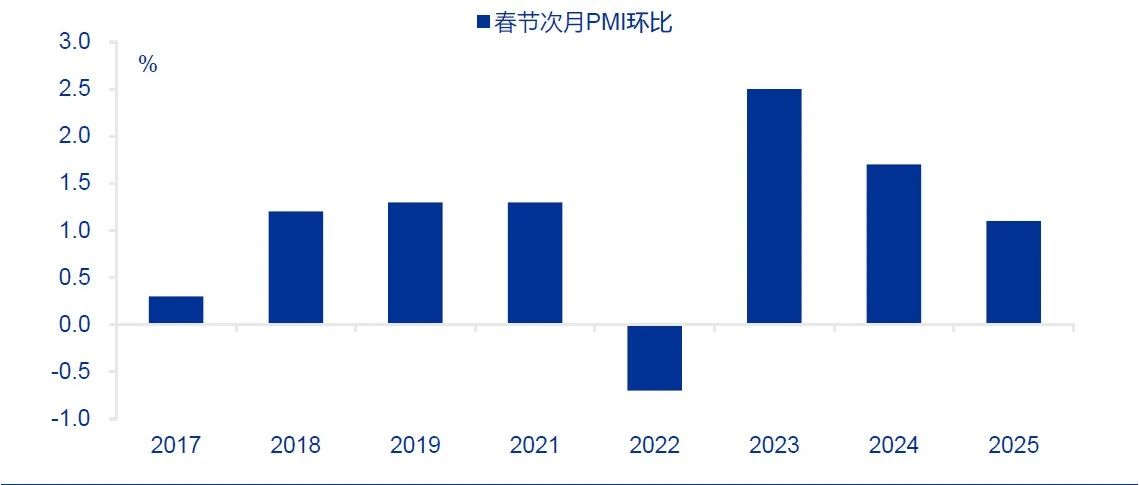
Core Viewpoint - The manufacturing PMI for February returned above the threshold, indicating a relatively good state of manufacturing prosperity, with the average PMI for January and February overall better than in 2024 [1][3] Manufacturing PMI Analysis - The manufacturing PMI for February is 50.2%, an increase of 1.1 percentage points from the previous month, and 0.1 percentage points lower than the average of the past five years [2][3] - The average PMI for January and February is 49.65%, which is higher than the 49.15% in the same period of 2024, reflecting a better recent manufacturing climate [3] Economic Supply and Demand - Both supply and demand sides of the economy are performing well in the short term, with a potential short-term rebound in PPI readings [4] - The production index for February is 52.5%, up 2.7 percentage points from last month, and the average operating rate for six major industrial sectors is 71.0%, which is 2.0 percentage points higher than the same period in 2024 [4] Sector Performance - Among 15 major manufacturing industries, 7 have PMIs above the threshold, with the equipment manufacturing sector performing relatively well, such as electrical machinery at 57.1% and automotive manufacturing at 53.1% [5] - Conversely, some low-value-added industries are underperforming, such as non-metallic mineral products at 43.4% and petroleum processing at 42.6% [5] Non-Manufacturing PMI Insights - The non-manufacturing PMI for February is 50.4%, an increase of 0.2 percentage points from the previous month, driven mainly by seasonal recovery in the construction industry [6] - The service sector PMI decreased to 50.0%, while the construction PMI increased to 52.7%, indicating a seasonal rebound in construction activities post-Spring Festival [6] Future Economic Outlook - The overall economic performance is benefiting from previous consumption-boosting policies, tariff expectations, and the concentrated issuance of special bonds in the fourth quarter [7] - Future attention should be paid to the details of macro policies from the Two Sessions, the effects of consumption promotion on large items, and the impact of tariffs on exports [7]
PMI:无喜无忧、结构分化
赵伟宏观探索· 2025-03-01 12:16
Core Viewpoint - The February PMI shows a mild recovery post-Spring Festival, with a clear "strong-weak" differentiation in structure [2][9]. Manufacturing Sector - The manufacturing PMI rose to 50.2%, up 1.1 percentage points from the previous month, indicating a recovery, albeit moderate [5][16]. - Key sub-indices such as production and new orders showed significant recovery, with production index increasing by 2.7 percentage points to 52.5% and new orders index rising by 1.9 percentage points to 51.1% [5][16]. - The new export orders index remains in contraction at 48.6%, despite a 2.2 percentage point increase [5][17]. Non-Manufacturing Sector - The non-manufacturing PMI increased by 0.2 percentage points to 50.4%, with construction PMI showing a notable rise of 3.4 percentage points to 52.7% [5][18]. - Service sector PMI declined by 0.3 percentage points to 50.0%, with significant drops in consumer-related sectors such as retail, accommodation, and catering [4][19]. Industry Observations - Capital-intensive industries like high-tech and equipment manufacturing show higher PMI levels, while labor-intensive sectors such as consumer goods and high-energy industries remain below the expansion threshold [3][12]. - In the construction sector, the increase in the construction PMI indicates accelerated infrastructure work, while real estate performance appears weaker [3][13]. Future Outlook - The economic recovery foundation remains fragile, with potential export risks increasing. Continuous monitoring of incremental policy changes is necessary [4][15]. - The manufacturing PMI's slight recovery above the neutral line suggests a moderate recovery level, with ongoing export pressures evident [4][15].