餐饮

Search documents
华源晨会精粹20260205-20260205
Hua Yuan Zheng Quan· 2026-02-05 10:23
Group 1: North Exchange IPO Insights - In January 2026, five companies were listed on the North Exchange, raising a total of 1.8 billion yuan, approximately one-fourth of the fundraising amount in 2025 [2][7] - The average first-day increase for new IPOs in January 2026 was 196%, a decrease from the 368% average in 2025, primarily due to larger and traditional industry IPOs [2][7] - The average online subscription funds reached a historical high of 910.3 billion yuan in January 2026, compared to 662.4 billion yuan in 2025, indicating increased interest in new listings [2][8] Group 2: AI and Energy Sector Analysis - The return of the Trump administration has shifted the U.S. macro policy environment towards growth, industrial security, and resource safety, impacting energy and financial systems [10][11] - AI's large-scale application is rapidly reshaping energy demand structures, with significant implications for power supply and infrastructure [12] - The report suggests a long-term positive outlook for nuclear power, uranium, and energy storage as key growth areas in the context of AI and digital economy [14] Group 3: Food and Beverage Sector - Babi Foods - Babi Foods reported a revenue of 1.86 billion yuan in 2025, a year-on-year increase of 11.2%, while net profit decreased by 1.3% to 273 million yuan [15][16] - The company is focusing on expanding its new store model, with plans to open 1,000 new stores in 2026, leveraging strong sales performance from the new model [16][17] - The net profit margin is expected to improve due to effective cost management and new product development [17] Group 4: Chemical Logistics - Milkway - Milkway is a leading player in the hazardous chemical supply chain, with a dual-driven model of comprehensive logistics and chemical distribution [18][19] - The hazardous chemical logistics market is projected to grow from 2.05 trillion yuan in 2020 to 2.44 trillion yuan in 2024, with a CAGR of 4.45% [19] - The company has established a global service network and is expected to benefit from industry consolidation as smaller players exit the market [20] Group 5: Electronics - BOE Technology - BOE Technology has become a global leader in the semiconductor display industry, with a revenue of 101.28 billion yuan in the first half of 2025, reflecting an 8.45% year-on-year growth [22][23] - The company is entering a new growth phase, with its LCD business benefiting from increased demand for large-size displays [23] - The OLED segment is also expected to grow significantly, driven by the increasing penetration of OLED in mobile devices and upcoming product launches from major brands [24][25]
2026年,钱从哪挣?
创业家· 2026-02-05 10:21
Core Viewpoint - The article discusses the importance of exploring international markets for Chinese companies in response to domestic demand shortages and increasing competition, emphasizing the need for a comprehensive approach to overseas expansion that includes the entire value chain [2][5][6]. Group 1: Value Chain Expansion - The concept of "going overseas" has evolved from merely exporting products to relocating the entire value chain, including branding, research and development, and business models to foreign markets [8][11]. - An example is Miniso, which engages with its millions of private domain users to understand their preferences and directly opens stores overseas to enhance brand recognition [12][13]. Group 2: Collaborating with Industry Leaders - Many industry leaders are beginning to expand internationally, but successful overseas operations require integrating complex supply chain systems and collaborating with local partners [14][15]. - Tesla's Shanghai Gigafactory exemplifies this, as it operates efficiently due to the support of numerous upstream and downstream suppliers within a 300-kilometer radius [18][20]. Group 3: Leveraging Unique Advantages - Companies are finding success in international markets by leveraging their unique advantages, such as cost efficiency and product innovation [23][25]. - For instance, a factory owner in Yiwu has opened a store on a cross-border platform, where products can sell for double the domestic price [26]. Group 4: Building Long-Term Trust - Establishing long-term trust with customers is crucial, as demonstrated by the story of Pang Donglai, who prioritizes employee welfare and customer service, leading to a loyal customer base [31][34]. - This trust allows businesses to better understand customer feedback and improve their offerings [35][36]. Group 5: Meeting Evolving Consumer Needs - The article highlights a shift in consumer behavior, where individuals are willing to pay for enhanced experiences, indicating a growing demand for services that cater to these desires [39][46]. - Businesses must create scenarios that fulfill these needs, as traditional mass-market opportunities diminish [43][44].


南京建邺城管持续推动餐饮行业垃圾分类提质增效
Yang Zi Wan Bao Wang· 2026-02-05 10:19
Core Viewpoint - The article highlights the efforts of Nanjing's Jianye District to enhance waste classification in the restaurant sector, focusing on compliance and education to improve waste management practices [1][2]. Group 1: Actions Taken - The Jianye Urban Management Team conducted a special inspection focusing on over 30 restaurants to promote proper waste classification and reduce waste generation [1]. - A "net-style" inspection approach was implemented, ensuring comprehensive coverage of the area, particularly in densely populated restaurant zones [1][2]. Group 2: Key Focus Areas - The inspection emphasized two main aspects: standardized waste bin configuration and normalized disposal operations, requiring restaurants to set up bins for four categories: kitchen waste, recyclables, other waste, and hazardous waste [2]. - Most restaurants showed strong awareness of waste classification, but some smaller establishments faced issues such as insufficient bin numbers and improper waste separation [2]. Group 3: Improvement and Future Plans - After a week of concentrated supervision, the waste classification accuracy among restaurants significantly improved, leading to better overall sanitation [2]. - The Urban Management Team plans to implement a closed-loop mechanism of "inspection-guidance-follow-up" to ensure ongoing compliance and shift the mindset of merchants from "I have to classify" to "I want to classify" [2].
百胜中国(09987):25Q4 业绩点评:25Q4 业绩超预期,26 年同店收入及利润率预计继续改善
EBSCN· 2026-02-05 09:50
Investment Rating - The report maintains a "Buy" rating for Yum China (9987.HK) [1] Core Insights - The company reported Q4 2025 revenue of $2.823 billion, a year-on-year increase of 9% (or 7% excluding foreign currency effects), and operating profit of $187 million, up 25% (or 23% excluding foreign currency effects) [5][6] - Same-store sales growth accelerated in Q4 2025, with system sales up 7% year-on-year, and same-store sales up 3% [6] - The company plans to exceed 20,000 stores by 2026, with a net addition of over 1,900 stores, accelerating from 2025 [7] Revenue Performance - Q4 2025 same-store sales growth was driven by KFC and Pizza Hut, with KFC's same-store sales up 3% and Pizza Hut's up 1% [6] - The company expects continued growth in same-store revenue and system sales in 2026, projecting high single-digit growth [6] Store Expansion - In Q4 2025, the company added 587 new stores, bringing the total to 18,101 [7] - The company achieved a net addition of 1,706 stores in 2025, meeting its target of 1,600-1,800 new stores [7] Profitability Improvement - Q4 2025 restaurant profit margin improved to 13.0%, up 0.7 percentage points year-on-year [8] - The core operating profit for Q4 2025 was $185 million, a 23% increase year-on-year, driven by operational efficiency and favorable commodity prices [8] New Business Developments - The company made significant progress in new business initiatives, including the expansion of KFC Coffee and KPRO, which contributed to sales growth [9] - New product offerings, such as KFC's spicy chicken and Pizza Hut's handmade thin-crust pizza, attracted younger consumers and drove sales [9] Financial Forecast and Valuation - The report raises the net profit forecast for 2026-2027 to $1.027 billion and $1.109 billion, respectively, with an EPS of $2.90 for 2026 [10] - The current stock price corresponds to a P/E ratio of 17x for 2026, indicating strong growth potential for the leading Western fast-food company [10]
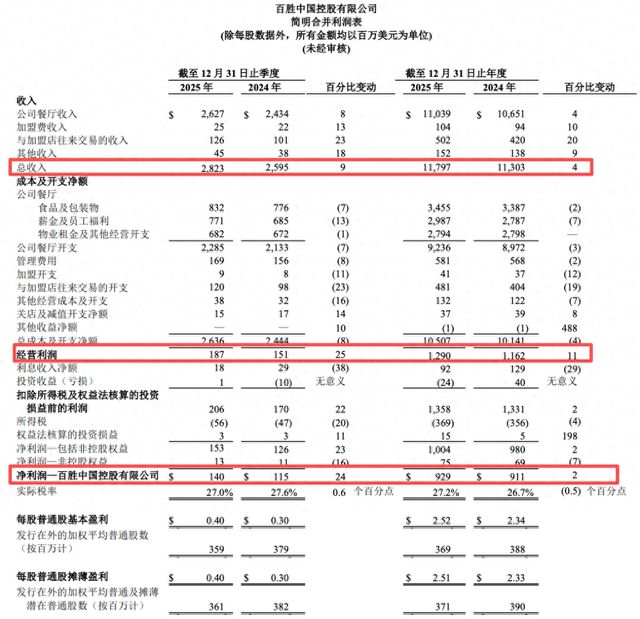
百胜中国去年营收增长4%:外卖业务占比近五成
Xin Lang Cai Jing· 2026-02-05 09:34
Core Viewpoint - Yum China reported a profit margin increase despite fierce competition in the food delivery sector, with management indicating that the share of delivery business will continue to rise [1][7]. Financial Performance - In Q4 2025, Yum China's total revenue grew by 9% year-on-year to $2.823 billion, with operating profit reaching $187 million, up 25% [1][9]. - For the full year 2025, total revenue increased by 4% to $11.797 billion, and operating profit was $1.29 billion, reflecting an 11% growth [1][9]. - The net profit for Q4 was $140 million, a 24% increase, while the annual net profit was $929 million, up 2% [1][9]. Same-Store Sales and Transactions - Same-store sales increased for the third consecutive quarter, with a 3% growth in Q4 and a total of 20 billion transactions for the year, an 8% increase [8][13]. - The company has achieved a continuous increase in same-store transaction volume for 12 consecutive quarters [8][13]. Delivery Business Growth - Delivery sales grew by 25% year-on-year, accounting for 48% of restaurant revenue, up from 39% the previous year [7][8]. - The share of delivery sales rose from 42% in Q1 to 53% in Q4 of the previous year [7]. Profitability Metrics - The operating profit margin for 2025 was 10.9%, an increase of 0.6 percentage points year-on-year, while restaurant profit margin was 16.3%, also up by 0.6 basis points [8][11]. - KFC's operating profit margin was 14.5%, and Pizza Hut's was 7.9%, marking the highest level since Yum China's listing in 2016 [11]. Store Expansion and Strategy - Yum China added 1,706 new stores in 2025, with a total store count reaching 18,101 [15]. - The company plans to exceed 20,000 stores by 2026, focusing on both self-operated and franchised models [16]. Future Outlook - Management expects system sales to grow in the high single digits in 2026, with slight improvements in restaurant and operating profit margins [16].
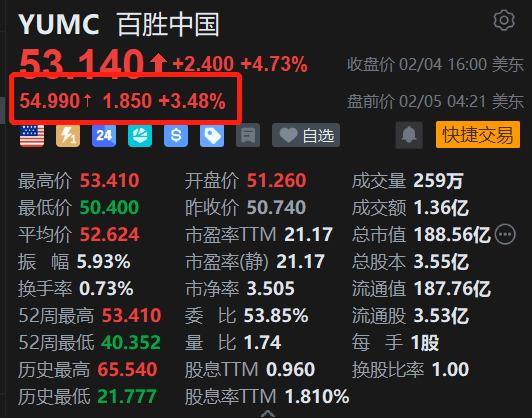
美股异动|受港股大涨带动,百胜中国盘前续涨3.5%,上季业绩超预期
Ge Long Hui· 2026-02-05 09:33
Group 1 - Yum China Holdings (YUMC) shares surged over 11% in Hong Kong, leading to a pre-market increase of 3.5% in US shares [1] - For 2025, Yum China's total revenue is projected to be $11.797 billion, representing a 4% year-on-year growth, with operating profit expected to reach $1.29 billion, a growth of 11% [1] - In Q4, Yum China's operating profit was $187 million, showing a significant year-on-year increase of 25% [1] Group 2 - UBS reported that Yum China's Q4 revenue, operating profit, and net profit grew by 9%, 24%, and 22% year-on-year, respectively, exceeding their expectations by 6.2%, 3.9%, and 7.8% [1] - Same-store sales growth was recorded at 3%, with an operating profit margin expansion of 0.8 percentage points [1] - UBS attributes the same-store sales growth to menu innovation and category expansion, believing that the company's strong supply chain capabilities and operational efficiency will continue to support healthy profit margin expansion [1] - UBS raised Yum China's US stock price target from $59 to $67.6, maintaining a "Buy" rating [1]
青春经济、入境游和数字化,上海更大力度提振消费做“乘法”
Di Yi Cai Jing Zi Xun· 2026-02-05 09:20
Group 1 - The core concept of "youth economy" is emerging in Shanghai, focusing on young consumers as the main driving force for consumption and innovation [1][3] - Shanghai's government aims to boost consumption as a strategic priority, with plans to implement special actions to enhance consumer spending and develop an international consumption center [1][2] - The youth economy in Shanghai is characterized by a market size of 4.3 trillion yuan, accounting for 68% of the new consumption sector, with Shanghai leading in various sub-sectors such as coffee shops and esports [3][4] Group 2 - The integration of cultural, tourism, and commercial exhibitions is seen as a multiplier effect to stimulate consumption potential [2][3] - Challenges exist for youth entrepreneurs, including high costs and limited financing options, with over 30% of youth shops failing within a year [4] - Recommendations include incorporating the youth economy into Shanghai's development plans, enhancing financial support, and creating a supportive regulatory environment [4] Group 3 - The influx of inbound tourists is expected to rise significantly, with a projected 39.58% increase in total inbound visitors by 2025, driven by a younger demographic [7] - The design of inbound tourism products should focus on enhancing experiential value to meet the preferences of both inbound and domestic travelers [7][8] - Suggestions for improving tourism offerings include developing unique attractions like a Ferris wheel on the Huangpu River to enhance the city's appeal [8] Group 4 - Digital transformation is crucial for the retail sector, with calls for businesses to leverage AI and other technologies to improve service quality and efficiency [10][11] - The restaurant industry faces challenges in maintaining food safety and service standards, necessitating a shift towards digital solutions for better regulatory compliance [10][11] - Proposals include creating an intelligent regulatory system to enhance food safety monitoring and improve the overall business environment [11]
美股中概股盘前多数上涨,哔哩哔哩涨3%
Mei Ri Jing Ji Xin Wen· 2026-02-05 09:11
Group 1 - The core viewpoint of the article highlights that U.S. listed Chinese stocks are mostly rising in pre-market trading on February 5, with notable increases in several companies [1] Group 2 - Bilibili saw a rise of 3% [1] - Yum China and NIO both increased by 2% [1] - Alibaba experienced a 2% increase, while Futu Holdings rose by 1% and Pinduoduo saw a slight increase of 0.3% [1]


广州将分批发放5000万元餐饮消费券 18类产品消费补贴比例最高达15%
Nan Fang Ri Bao Wang Luo Ban· 2026-02-05 09:09
Core Viewpoint - Guangzhou is implementing multiple measures to enhance consumer spending and ensure supply during the Spring Festival, anticipating a record high of 200 million passenger flows during the Spring Festival travel period [1] Group 1: Consumer Promotion - Guangzhou is setting up local specialty product counters in highway service areas to promote local goods [2] - The city is distributing 50 million yuan in dining vouchers in batches to stimulate consumption [2] - A maximum subsidy of 15% is being offered for 18 categories of products, including automobiles and electronics [2] - The Baihetan Fireworks Show on February 17 will feature 17 viewing areas and approximately 180,000 spots, with an expanded scale and new fireworks categories [2] Group 2: Flower Market Initiatives - The "Yuehong Kong-Macao Greater Bay Area Orchid Boutique Exhibition" has started, moving the flower market into parks for a better consumer experience [3] - Traditional flower street activities will take place in Beijing from March 3 to 10, promoting cultural and commercial exchanges [3] Group 3: Supply Assurance - Guangzhou is coordinating with over 1,000 supermarkets and 500 wholesale markets to ensure sufficient supplies of essential goods for the Spring Festival [4] - The city has a vegetable planting area exceeding 280,000 acres and a poultry stock of approximately 12.73 million birds to meet demand [4] - Major logistics companies are enhancing transport capacity to ensure smooth delivery of essential goods during the holiday [5] Group 4: Emergency Logistics Support - Guangzhou has established a professional emergency logistics team to respond to urgent transportation needs during the Spring Festival [5] - The city has over 86,000 operational trucks available for various cargo transport needs [5]
港股科网股、消费股,集体反弹
Di Yi Cai Jing Zi Xun· 2026-02-05 09:01
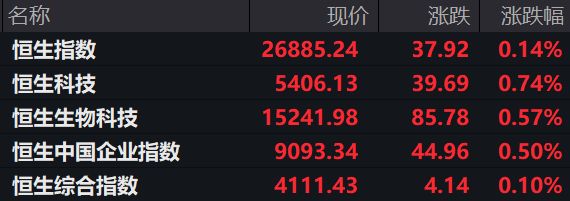
科网股午后反弹,联想集团、地平线机器人涨超3%,小米集团、百度集团、蔚来涨超2%,美团、比亚 迪股份等涨超1%,京东集团、腾讯控股、阿里巴巴等均翻红。 2月5日,香港恒生指数收涨0.14%,恒生科技指数涨0.74%。 | 名称 | 现价 | 涨跌 涨跌幅 | | --- | --- | --- | | 恒生指数 | 26885.24 | 0.14% 37.92 | | 恒生科技 | 5406.13 | 39.69 0.74% | | 恒生生物科技 | 15241.98 | 85.78 0.57% | | 恒生中国企业指数 | 9093.34 | 44.96 0.50% | | 恒生综合指数 | 4111.43 | 4.14 0.10% | | 名称 | 涨跌幅 ▲ 现价 | | --- | --- | | ASMPT | -6.60% 96.300c | | 兆易创新 | -4.47% 290.800c | | 上海复旦 | -3.34% 46.280 c | | 天数智芯 | -3.05% 168.300c | | 农机未营体 | -2.73% 99.600c | | 壁仞科技 | -2.68% 31.98 ...