
交通运输

Search documents
深度学习因子月报:Meta因子今年已实现超额收益36.8%-20250818
Minsheng Securities· 2025-08-18 08:55
Quantitative Factors and Models Summary Quantitative Factors and Construction Methods 1. **Factor Name**: DL_EM_Dynamic - **Construction Idea**: Extract intrinsic stock attributes from public fund holdings using matrix decomposition, and combine these attributes with LSTM-generated factor representations to create dynamic market state factors[19][21]. - **Construction Process**: - Matrix decomposition is applied to fund-stock investment networks to derive intrinsic matrices for funds and stocks[19]. - Static intrinsic attributes are updated semi-annually using fund reports and transformed into dynamic attributes by calculating their similarity to current market preferences[19]. - These dynamic attributes are combined with LSTM outputs and fed into an MLP model to enhance performance[19]. - The factor is used to construct a CSI 1000 enhanced index portfolio with constraints on tracking error (5%), industry exposure (±0.02), style exposure (±0.5), and individual stock weight (3%). Weekly rebalancing is applied, and transaction costs are set at 0.2% for both sides[21]. 2. **Factor Name**: Meta_RiskControl - **Construction Idea**: Incorporate factor exposure control into deep learning models to mitigate drawdowns during rapid style factor changes[26]. - **Construction Process**: - Multiply model outputs by corresponding stock factor exposures and include this in the loss function[26]. - Add penalties for style deviations and style momentum to the IC-based loss function[26]. - Use an ALSTM model with style inputs as the base model and integrate it with a meta-incremental learning framework for dynamic market adaptation[26]. - Construct enhanced portfolios for CSI 300, CSI 500, and CSI 1000 indices with constraints on market cap deviation (±0.5), industry deviation (±0.02), and individual stock weight (5x benchmark weight). Weekly rebalancing and 0.2% transaction costs are applied[29]. 3. **Factor Name**: Meta_Master - **Construction Idea**: Leverage market-guided stock transformer models (MASTER) and deep risk models to capture market states and improve factor performance[36]. - **Construction Process**: - Incorporate market state vectors derived from recent price-volume data of CSI 300, CSI 500, and CSI 1000 indices into the MASTER model[36]. - Construct 120 new features representing market states based on the styles of recently best-performing stocks[36]. - Replace the loss function with weighted MSE to enhance long-side prediction accuracy and use online meta-incremental learning for periodic model updates[36]. - Construct enhanced portfolios for CSI 300, CSI 500, and CSI 1000 indices with constraints on market cap deviation (±0.5), industry deviation (±0.02), and individual stock weight (5x benchmark weight). Weekly rebalancing and 0.2% transaction costs are applied[38]. 4. **Factor Name**: Deep Learning Convertible Bond Factor - **Construction Idea**: Address the diminishing excess returns of traditional convertible bond strategies by using GRU deep neural networks to model the complex nonlinear pricing logic of convertible bonds[50]. - **Construction Process**: - Introduce convertible bond-specific time-series factors into the GRU model[50]. - Combine cross-sectional bond attributes with GRU outputs to predict future returns, significantly improving model performance[50]. --- Factor Backtesting Results 1. **DL_EM_Dynamic Factor** - **RankIC**: 11.3% (July 2025, CSI 1000)[7][10] - **Excess Return**: 1.3% (July 2025, CSI 1000); 11% YTD (2025)[7][10] - **Annualized Return**: 29.7% (since 2019)[23] - **Annualized Excess Return**: 23.4% (since 2019)[23] - **IR**: 2.03 (since 2019)[23] - **Max Drawdown**: -10.1% (since 2019)[23] 2. **Meta_RiskControl Factor** - **RankIC**: 15.5% (July 2025, All A-shares)[7][13] - **Excess Return**: - CSI 300: 1.9% (July 2025); 6.4% YTD (2025)[31] - CSI 500: 1.4% (July 2025); 4.4% YTD (2025)[33] - CSI 1000: 1.3% (July 2025); 9.3% YTD (2025)[35] - **Annualized Return**: - CSI 300: 20.1% (since 2019)[31] - CSI 500: 26.1% (since 2019)[33] - CSI 1000: 34.1% (since 2019)[35] - **Annualized Excess Return**: - CSI 300: 15.0% (since 2019)[31] - CSI 500: 19.2% (since 2019)[33] - CSI 1000: 27.0% (since 2019)[35] - **IR**: - CSI 300: 1.58 (since 2019)[31] - CSI 500: 1.97 (since 2019)[33] - CSI 1000: 2.36 (since 2019)[35] - **Max Drawdown**: - CSI 300: -5.8% (since 2019)[31] - CSI 500: -9.3% (since 2019)[33] - CSI 1000: -10.2% (since 2019)[35] 3. **Meta_Master Factor** - **RankIC**: 18.9% (July 2025, All A-shares)[7][16] - **Excess Return**: - CSI 300: 2.0% (July 2025); 7.9% YTD (2025)[39] - CSI 500: 1.6% (July 2025); 5.5% YTD (2025)[45] - CSI 1000: 1.4% (July 2025); 8.1% YTD (2025)[47] - **Annualized Return**: - CSI 300: 22.0% (since 2019)[39] - CSI 500: 23.8% (since 2019)[45] - CSI 1000: 30.7% (since 2019)[47] - **Annualized Excess Return**: - CSI 300: 17.5% (since 2019)[39] - CSI 500: 18.2% (since 2019)[45] - CSI 1000: 25.2% (since 2019)[47] - **IR**: - CSI 300: 2.09 (since 2019)[39] - CSI 500: 1.9 (since 2019)[45] - CSI 1000: 2.33 (since 2019)[47] - **Max Drawdown**: - CSI 300: -7.2% (since 2019)[39] - CSI 500: -5.8% (since 2019)[45] - CSI 1000: -8.8% (since 2019)[47] 4. **Deep Learning Convertible Bond Factor** - **Absolute Return**: - July 2025: 5.8% (equity-biased), 3.8% (balanced), 3.3% (debt-biased)[52] - Annualized (since 2021): 13.2% (equity-biased), 11.8% (balanced), 12.7% (debt-biased)[52] - **Excess Return**: - July 2025: 1.5% (equity-biased), -0.4% (balanced), -0.9% (debt-biased)[55] - Annualized (since 2021): 5.8% (equity-biased), 4.0% (balanced), 4.4% (debt-biased)[55]
港股红利板块回调,恒生红利低波ETF(159545)半日获2100万份净申购
Mei Ri Jing Ji Xin Wen· 2025-08-18 05:49
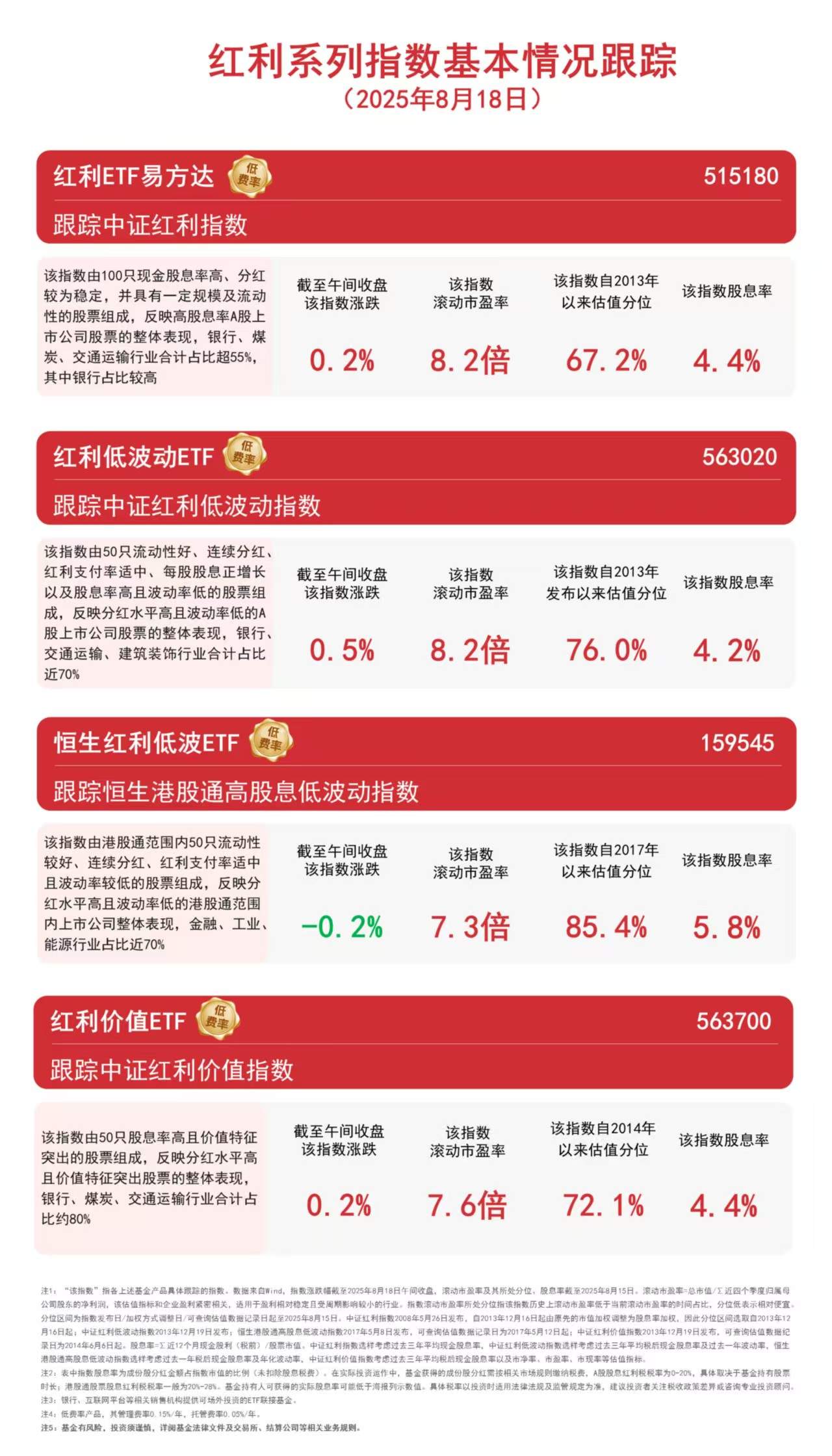
Core Viewpoint - The article discusses various dividend-focused ETFs, highlighting their composition, performance, and sector allocations, indicating a trend towards stable, high-dividend yielding stocks in the A-share and Hong Kong markets [2]. Group 1: Dividend ETFs Overview - The E Fund Dividend ETF tracks the China Securities Dividend Index, consisting of 100 stocks with high cash dividend yields, reflecting the overall performance of high-dividend A-share companies [2]. - The E Fund Low Volatility Dividend ETF tracks the China Securities Low Volatility Dividend Index, composed of 50 stocks with good liquidity and continuous dividends, indicating a focus on low volatility and stable dividend growth [2]. - The Hang Seng Low Volatility Dividend ETF tracks the Hang Seng High Dividend Low Volatility Index, made up of 50 stocks within the Hong Kong Stock Connect that exhibit low volatility and stable dividend payments [2]. Group 2: Performance Metrics - As of the latest trading session, the E Fund Dividend ETF showed a change of 0.2% with a rolling P/E ratio of 8.2 times and a valuation percentile of 67.2% since its inception in 2013 [2]. - The E Fund Low Volatility Dividend ETF recorded a change of 0.5% with a rolling P/E ratio of 8.2 times and a valuation percentile of 76.0% since its launch in 2013 [2]. - The Hang Seng Low Volatility Dividend ETF experienced a change of -0.2% with a rolling P/E ratio of 7.3 times and a valuation percentile of 85.4% since its introduction in 2017 [2]. Group 3: Sector Allocations - In the E Fund Dividend ETF, the banking, coal, and transportation sectors collectively account for over 55% of the index, with a significant weight in banking stocks [2]. - The E Fund Low Volatility Dividend ETF has nearly 70% of its composition in the banking, transportation, and construction sectors [2]. - The Hang Seng Low Volatility Dividend ETF has close to 70% of its holdings in the financial, industrial, and energy sectors [2].

300增强ETF(561300)涨超1.3%,多重因素支撑宽基指数配置价值
Mei Ri Jing Ji Xin Wen· 2025-08-18 04:44
Group 1 - The core viewpoint is that the CSI 300 index, as a broad-based index, demonstrates stable performance in dividend strategies, with a high weight in the banking sector and significant representation from coal and transportation industries [1] - High dividend-paying companies exhibit a return on equity (ROE) significantly above the industry average, showcasing strong cash flow protection and creating a positive cycle of stable earnings, continuous dividends, and improved ROE [1] - The CSI 300 Enhanced ETF (561300) tracks the CSI 300 index (000300), which consists of 300 large-cap, liquid securities from the Shanghai and Shenzhen markets, covering approximately 48% of the total market capitalization of A-shares [1] Group 2 - The industry distribution of the CSI 300 index is broad, encompassing cyclical sectors such as finance, materials, and industrials, while also increasing the weight of emerging sectors like information technology and healthcare as the economic structure transforms [1] - Investors without stock accounts can consider the Guotai CSI 300 Enhanced Strategy ETF Initiated Link A (021847) and Guotai CSI 300 Enhanced Strategy ETF Initiated Link C (021848) [1]
养老金二季度现身19只股前十大流通股东榜
Zheng Quan Shi Bao Wang· 2025-08-18 01:50
Group 1 - The pension funds have increased their presence in the secondary market, appearing in the top ten circulating shareholders of 19 stocks by the end of Q2, with 10 new entries and 6 increased holdings [1][2] - The total shareholding amount of pension accounts reached 145 million shares, with a total market value of 4.48 billion yuan [1][2] - The largest holding by pension accounts is in Hongfa Technology, with a total of 28.22 million shares, followed by Shenzhen Airport with 24.20 million shares [1][2] Group 2 - The pension accounts have a significant presence in the main board with 13 stocks, while 3 stocks are from the Sci-Tech Innovation Board and 3 from the Growth Enterprise Market [2] - The pension accounts are primarily concentrated in the machinery and basic chemical industries, with 4 and 3 stocks respectively [2] - Among the stocks held by pension accounts, 17 companies reported a net profit increase in their semi-annual reports, with Rongzhi Rixin showing the highest growth of 2063.42% year-on-year [2]


打造枢纽经济新高地
He Nan Ri Bao· 2025-08-17 23:26
Core Viewpoint - The establishment of hub economy pilot zones in Henan Province is expected to inject new vitality into high-quality economic development, leveraging the province's unique geographical advantages and transportation infrastructure [1][2]. Group 1: Hub Economy Development - Hub economy is defined as a highly concentrated and interconnected economic phenomenon that relies on urban and comprehensive transportation hubs, facilitating the flow of people, goods, information, and capital [1]. - The hub economy is seen as a powerful engine for economic and social development, promoting industrial agglomeration and structural optimization through a "snowball" effect [1]. Group 2: Strategic Advantages of Henan - Henan Province is positioned as a crucial transportation hub in China, with a developed "米" shaped high-speed rail network and significant international connectivity through initiatives like the Zhengzhou-Luxembourg "Air Silk Road" [1]. - The province's cross-border e-commerce platforms enable nearly 10,000 local enterprises to engage in global trade, enhancing the hub economy's growth potential [1]. Group 3: Challenges and Competitiveness - Despite progress, challenges remain, such as insufficient hub capabilities in cities like Luoyang, Shangqiu, and Nanyang, and the need for improved intermodal transport systems [2]. - Competition is intensifying as neighboring provinces like Shaanxi, Hubei, and Hunan increase investments in hub construction, including airport development and freight subsidies [2]. Group 4: Future Development Plans - Specific plans for hub economy pilot zones include creating a logistics distribution center in Luoyang, a core hub for waterway transport in Zhoukou-Luohe, and a high-efficiency connection in Zhengzhou [2]. - The integration of transportation and economic development is expected to accelerate the release of the multiplier effect of the hub economy [2].
就在今天|国泰海通 ·2025研究框架培训“洞察价值,共创未来”
国泰海通证券研究· 2025-08-17 22:48
Group 1 - The article outlines a comprehensive research framework training program titled "洞察价值,共创未来" (Insight Value, Co-create Future) scheduled for August 18-19 and August 25-26, 2025, focusing on various sectors including macroeconomics, consumption, finance, cycles, medicine, technology, and manufacturing [18][19]. - The training sessions will cover a wide range of topics, with specific time slots allocated for each area of research, such as food and beverage, internet applications, and renewable energy [14][15][16]. - The event will take place at the Guotai Junan Financial Bund Plaza in Shanghai, emphasizing the importance of in-depth analysis across all sectors [18]. Group 2 - The training program is designed to enhance the research capabilities of analysts and is led by various chief analysts specializing in different fields, ensuring a comprehensive approach to industry analysis [8][10]. - Participants will have the opportunity to engage with experts in macroeconomic research, strategy, fixed income, and various sector-specific studies, fostering a collaborative learning environment [14][15][16]. - The program aims to equip analysts with the necessary tools and insights to navigate the complexities of the financial markets and identify potential investment opportunities [18].

固定收益周报:风险偏好突破前高-20250817
Huaxin Securities· 2025-08-17 11:01
1. Report Industry Investment Rating No relevant content provided. 2. Core Viewpoints of the Report - The Chinese economy is in a marginal de - leveraging process, with the liability growth rate of the real - sector expected to decline. The government aims to stabilize the macro - leverage ratio, and the monetary policy will generally remain neutral and difficult to be continuously loose. The market is currently affected by risk preference, and the subsequent trends of risk preference, economic recovery, and the US economy need to be focused on [2][3][7] - In the context of the contraction of the national balance sheet, the allocation of financial assets should adopt a dumbbell - shaped strategy. The bond market is the large base, and the stock market is the small head. The stock allocation strategy is dividend plus growth, and the bond allocation strategy is duration plus credit - sinking [25] - In the contraction cycle, the equity - bond ratio favors equities to a limited extent, and the value style is more likely to be dominant. Red - dividend stocks with characteristics of non - expansion, good profitability, and survival are recommended [12][67] 3. Summary by Relevant Catalogs 3.1 National Balance Sheet Analysis - **Liability Side**: In July 2025, the liability growth rate of the real sector was 9.0%, with a lower - than - expected rebound. It is expected to decline to 8.9% in August and further to 8% by the end of the year. The government's liability growth rate is also expected to decline from 15.7% in July to 14.8% in August and 12.5% by the end of the year. The money market has tightened marginally, and the peak of the money market in August was likely in the first week [2][3][21] - **Monetary Policy**: The trading volume of funds decreased last week, and the price was stable. The one - year Treasury yield rose to 1.37%, and the term spread widened. The estimated lower limit of the one - year Treasury yield is 1.3%, the ten - year Treasury yield is about 1.6%, and the thirty - year Treasury yield is about 1.8% [3][22] - **Asset Side**: After a brief stabilization in June, the physical volume data declined again in July. The annual real economic growth target for 2025 is about 5%, and the nominal economic growth target is about 4.9%. Whether this will be the central target for the next 1 - 2 years needs further observation [4][23] 3.2 Stock - Bond Ratio and Stock - Bond Style - **Market Performance Last Week**: The money market tightened marginally, but risk preference increased. Stocks rose, and bonds fell. The equity growth style was dominant, and the stock - bond ratio favored stocks, breaking through the previous high on August 15th [6][26] - **Future Outlook**: The trend of risk preference is uncertain. There are three possible scenarios: range - bound fluctuations, a short - term upward trend, or a fundamental change in the subjective weighting of Chinese profitability. A portfolio of growth - type equity assets and long - term bonds is recommended, with a 70% position in the CSI 1000 Index and a 30% position in the 30 - year Treasury ETF [10][11][29] 3.3 Industry Recommendation - **Industry Performance Review**: The A - share market rose this week. The communication, electronics, non - bank finance, power equipment, and computer sectors had the largest increases, while the bank, steel, textile and apparel, coal, and public utilities sectors had the largest declines [35] - **Industry Crowding and Trading Volume**: As of August 15th, the top five crowded industries were electronics, computer, power equipment, machinery, and non - bank finance. The trading volume of the whole A - share market increased this week, with non - bank finance, real estate, and other sectors having the highest growth rates [36][38] - **Industry Valuation and Profitability**: The PE (TTM) of the comprehensive, communication, and other sectors increased the most this week, while the bank, steel, and other sectors declined. Industries with high 2024 full - year profit forecasts and relatively low current valuations include banks, coal, and oil and petrochemicals [41][42] - **Industry Prosperity**: External demand generally declined. The global manufacturing PMI decreased in July, and the CCFI index fell. Domestic indicators such as port throughput and industrial capacity utilization showed mixed trends [46] - **Public Fund Market Review**: In the second week of August, most active public equity funds outperformed the CSI 300. As of August 15th, the net asset value of active public equity funds was slightly higher than that in Q4 2024 [62] - **Industry Recommendation**: In the contraction cycle, the equity - bond ratio favors equities to a limited extent, and the value style is more likely to be dominant. An A + H red - dividend portfolio of 20 stocks and an A - share portfolio of 20 stocks, mainly concentrated in banks, telecommunications, and other industries, are recommended [12][67]
险资大力加仓股票:上半年净买入6400亿元 环比增长78%
智通财经网· 2025-08-17 08:52
Core Viewpoint - Current valuations of A-shares and Hong Kong stocks are relatively low, while dividend yields are high, suggesting that long-term capital allocation to equities may yield substantial returns and promote stable capital market operations [1] Group 1: Insurance Capital Allocation Trends - Insurance capital utilization has surpassed 36 trillion yuan, with a strong push towards equity investments due to low interest rates and asset scarcity [1][3] - As of the end of Q2, funds allocated to stocks reached 3.07 trillion yuan, an 8.9% increase from Q1, representing a net purchase of approximately 640 billion yuan in the first half of the year [3] - The proportion of insurance funds allocated to equities has risen from 7.3% at the end of 2024 to 8.47% [3] Group 2: Investment Strategy Shifts - Insurance funds are transitioning from a "position control" strategy to a "track selection" approach, adapting to market volatility and structural changes [2][5] - The preference for large-cap, high-dividend, and low-volatility assets is evident, with banks being the most favored sector, followed by public utilities and transportation [6] Group 3: Long-term Investment Reforms - Recent approvals for private fund management companies signal progress in long-term investment reforms for insurance capital, with the number of pilot funds increasing to seven [8] - Notable private equity funds have been established, including a 50 billion yuan fund initiated by China Life and New China Life, which has already invested in several A-share companies [8]
险资大力加仓股票:上半年净买入环比增长78%
财联社· 2025-08-17 08:36
Core Viewpoint - Current valuations of A-shares and Hong Kong stocks are relatively low, while dividend yields are high, suggesting that long-term capital allocation to equities may yield substantial returns and promote stable capital market operations [1][3]. Group 1: Insurance Capital Allocation Trends - Insurance capital utilization has surpassed 36 trillion yuan, with a strong push towards equity investments due to low interest rates and asset scarcity [1][3]. - As of the end of Q2, the balance of funds directed towards stocks reached 3.07 trillion yuan, reflecting an 8.9% increase from Q1, equating to a net purchase of approximately 640 billion yuan in the first half of the year [3][4]. - The proportion of insurance funds allocated to equities has risen from 7.3% at the end of 2024 to 8.47% [3][4]. Group 2: Investment Strategy Shifts - The insurance sector is transitioning from a focus on "controlling positions" to "selecting sectors," adapting to increased market volatility during the economic transition [2][5]. - Insurance companies have made 28 equity stakes in 23 listed companies this year, marking a four-year high in both the number of actions and companies involved [6]. - The preference for large-cap, high-dividend, and low-volatility stocks is evident, with banks being the most favored sector, followed by public utilities, transportation, and energy [6]. Group 3: Long-term Investment Reforms - Recent developments in long-term investment reforms for insurance capital include the establishment of several private fund management companies, with a total of seven pilot funds now in operation [8]. - Notable initiatives include the launch of the 500 billion yuan private equity fund by China Life and New China Life, which has already invested in several A-share companies [8].

险资大力加仓股票:上半年净买入6400亿元,环比增长78%丨36万亿险资重构资产底仓②
Xin Lang Cai Jing· 2025-08-17 08:17
Group 1 - The current valuation of A-shares and Hong Kong stocks is relatively low, while dividend yields are high, suggesting that long-term capital allocation to equities may yield substantial returns [1][2] - Insurance funds have significantly increased their stock allocations, with the proportion reaching a recent high, driven by low interest rates and asset scarcity [1][2] - As of the end of Q2, the balance of insurance funds allocated to stocks was 3.07 trillion yuan, an 8.9% increase from the previous quarter, equating to a net purchase of approximately 640 billion yuan in the first half of the year [2][3] Group 2 - The shift in insurance funds' investment strategy from "controlling positions" to "selecting sectors" is necessary due to increased market volatility during the economic transition [2][4] - Insurance funds have shown a preference for large-cap, high-dividend, and low-volatility assets, with banks being the most favored sector, followed by public utilities, transportation, and energy [4][5] - The investment in long-term equity has increased to 2.75 trillion yuan, representing 7.6% of the overall asset allocation, while the allocation to securities investment funds stands at 4.6% [3][4] Group 3 - Recent regulatory changes have facilitated insurance funds' entry into the capital market, allowing for increased investments through private equity funds and shareholding [4][7] - The number of equity stakes taken by insurance companies has reached a four-year high, with 28 stakes in 23 listed companies this year [4][7] - The establishment of new private fund management companies by major insurance firms indicates a growing trend towards long-term investment strategies [7]