
云计算

Search documents
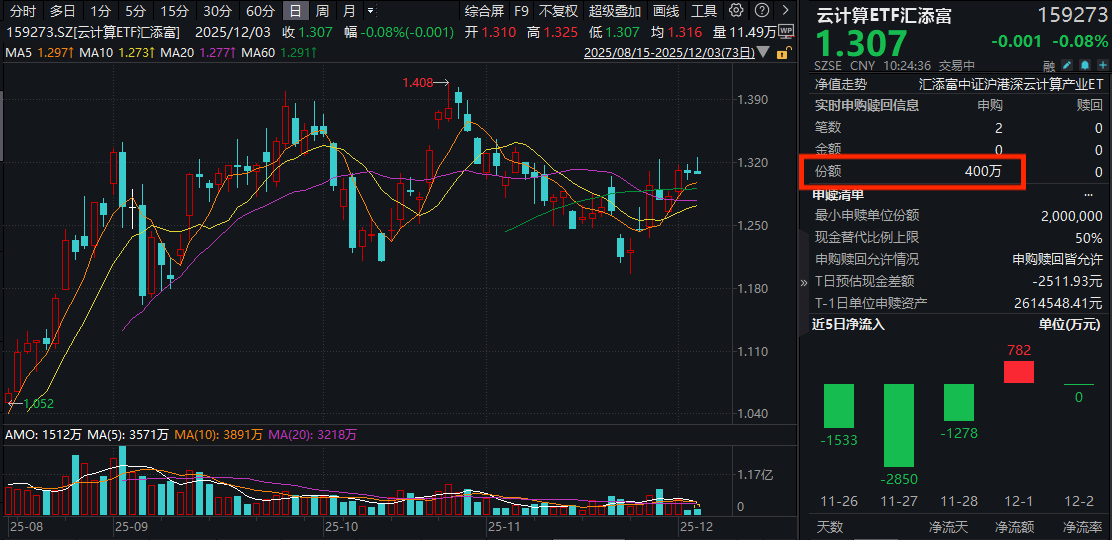
AI驱动光模块,新易盛涨超4%逆市冲击七连涨!云计算ETF汇添富(159273)冲高回落再度吸金!海外算力大战持续火热,亚马逊重磅发布!
Sou Hu Cai Jing· 2025-12-03 02:47
Core Insights - The cloud computing sector is experiencing fluctuations, with the Huatai Cloud Computing ETF (159273) seeing significant trading volume exceeding 15 million yuan and a net inflow of over 52 billion yuan [1][3]. Group 1: Cloud Computing Developments - Amazon Web Services (AWS) launched the next-generation AI training chip, Trainium 3, at the re:Invent conference, and announced plans for Trainium 4, aiming to compete with Nvidia and Google in the AI chip market [3]. - Morgan Stanley raised its forecast for Google's TPU production for 2027-2028, indicating a positive outlook for hardware suppliers related to optical modules [3]. - Domestic company DeepSeek released two official model versions, DeepSeek-V3.2 and DeepSeek-V3.2-Speciale, enhancing its AI offerings [3]. Group 2: Market Performance of Key Stocks - The majority of the index component stocks of the Huatai Cloud Computing ETF showed declines, with notable drops including Huasheng Tiancheng and Data Port, both down over 3%, while NewEase and Kehua Data saw increases of over 4% and nearly 1%, respectively [3][4]. Group 3: Optical Module Market Insights - According to招商证券, 2025 is expected to be a standout year for optical module suppliers with high AI business ratios, driven by significant revenue growth and profit margin expansion [5]. - Major cloud providers in the U.S. are projected to spend $230 billion on capital expenditures in 2024, a 55% year-on-year increase, with further investments expected to reach $367 billion in 2025 [5]. - The revenue growth rates for leading optical module manufacturers like Coherent, Zhongji Xuchuang, and NewEase are forecasted at 15%, 120%, and 175% respectively for 2024, with continued strong performance anticipated through 2026 [7]. Group 4: Supply Chain and Technology Trends - The optical module industry is facing supply chain challenges, particularly with EML chips, but advancements in silicon photonics technology are expected to alleviate some of these bottlenecks [8]. - By 2026, the share of silicon photonics is projected to exceed 50%, with significant growth in the shipment of 800G and 1.6T optical module products [8]. - Key suppliers like Lumentum and Coherent are planning substantial capacity expansions to meet the growing demand in the optical module market [9]. Group 5: AI Infrastructure and Applications - The launch of the Doubao mobile assistant by ZTE is part of a broader trend towards AI applications in mobile technology, with significant government support for AI integration across various sectors by 2027 [10][11]. - The demand for computing infrastructure is expected to accelerate due to the increasing deployment of AI applications, benefiting the related supply chain, including optical modules and edge computing solutions [11].


云计算一哥10分钟发了25个新品!Kimi和MiniMax首次上桌
量子位· 2025-12-03 02:38
Core Insights - Amazon Web Services (AWS) showcased an unprecedented number of product launches at the re:Invent 2025 event, with CEO Matt Garman challenging himself to release 25 products in 10 minutes, ultimately unveiling 40 new products in just over two hours, emphasizing practicality and addressing challenges in AI applications [1][7][9]. Group 1: AI Computing Power - AWS has restructured its AI computing supply model by focusing on self-developed chips, specifically the Trainium series, which has grown into a multi-billion dollar business with over 1 million chips deployed, outperforming competitors by four times in speed [15][20]. - The latest Trainium3 Ultra Servers, based on 3nm technology, offer a 4.4 times increase in computing performance and a 3.9 times increase in memory bandwidth compared to the previous generation [18]. - The upcoming Trainium4 chip promises significant advancements, including a 6 times increase in FP4 computing performance and a 4 times increase in memory bandwidth, tailored for large model training needs [20][22]. - AWS introduced AI Factories, allowing clients to deploy AWS AI infrastructure within their data centers, thus maintaining control and security while accessing top-tier AI computing power [23][24]. Group 2: Model Development and Integration - AWS launched Amazon Bedrock, a flexible and customizable model platform, which now includes Chinese models Kimi and MiniMax, marking their entry into the global developer ecosystem [26][28]. - The new Amazon Nova 2 series includes various models designed for different tasks, with Nova 2 Light focusing on cost-effectiveness and low latency, Nova 2 Pro excelling in complex tasks, and Nova 2 Sonic optimizing real-time voice interactions [30][32]. - Nova Forge introduces the concept of Open Training Models, allowing enterprises to integrate their proprietary data with AWS's training datasets, creating specialized models that retain general reasoning capabilities while understanding unique business knowledge [40][41]. Group 3: AI Agents - AI Agents emerged as a key focus, with Garman stating that the era of AI assistants is being replaced by AI Agents, which will be widely adopted across companies [45][46]. - AWS introduced several new Agents, including Kiro Autonomous Agent for complex development tasks, AWS Security Agent for proactive security measures, and AWS DevOps Agent for continuous system monitoring and troubleshooting [50][52][56]. - AWS provides tools like AWS Transform Custom for code migration and Policy in AgentCore for defining agent behavior, ensuring that agents operate within controlled parameters [58][61]. Group 4: Strategic Vision - AWS's strategy emphasizes the importance of practical applications of AI technologies, focusing on building a comprehensive, secure, and scalable enterprise-level infrastructure rather than solely on technological breakthroughs [68][70]. - The company aims to address challenges related to computing costs, model understanding of proprietary knowledge, and the controllability of AI Agents through its innovative solutions and partnerships [70].


AI泡沫担忧加剧,甲骨文债务恐慌指标创2009年以来新高
Hua Er Jie Jian Wen· 2025-12-03 01:45
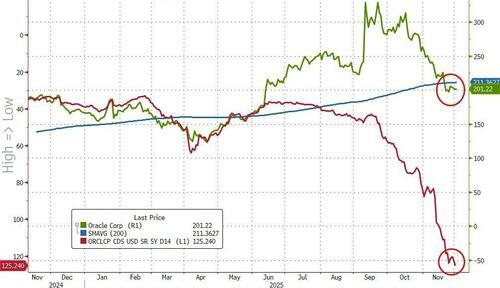
Core Viewpoint - Concerns about an AI bubble are escalating in the credit market, highlighted by Oracle's credit default swap (CDS) costs reaching their highest level since the 2009 financial crisis, indicating investor anxiety over the imbalance between massive AI investments and expected returns [1][3]. Group 1: Credit Market Indicators - Oracle's CDS prices rose to approximately 1.28% at the close in New York, marking the highest level since March 2009, and have more than doubled from a low of 0.36% in June [1][3]. - The surge in CDS prices reflects market worries about the vast capital expenditures in the AI sector, with Oracle having issued hundreds of billions in bonds recently, making its CDS a key tool for investors hedging against potential AI downturns [3][4]. Group 2: Debt Levels and Market Sentiment - Oracle is the lowest-rated among major cloud service providers, with a total debt of approximately $105 billion as of the end of August, including $95 billion in dollar bonds that are part of the Bloomberg U.S. Corporate Bond Index [4]. - The trading volume of Oracle's CDS has surged to about $5 billion over seven weeks, compared to just over $200 million in the same period last year, indicating heightened investor interest in hedging against its debt [4]. Group 3: Historical Context and Future Projections - The rising cost of default protection signals investor anxiety about the timing gap between massive AI investments and productivity gains or profit growth [5]. - Predictions suggest that the spending spree on AI infrastructure and power capacity will continue into next year, with U.S. investment-grade bond issuance expected to reach a record $2.1 trillion by 2026, having already surpassed $1.57 trillion this year [6]. Group 4: Supply and Demand Dynamics in Credit Markets - A new wave of large-scale bond issuance may overwhelm buyers, leading companies to offer higher yields to attract investors, with spreads expected to reach 100 to 110 basis points above benchmark rates next year [7]. - Historical precedents exist where industries have leveraged significantly without disastrous outcomes, but concerns remain about the credit quality of debt investments as companies continue to invest heavily in AI [7].

AWS CEO:亚马逊如何在AI时代逆袭?以超大规模交付更便宜、更可靠的AI
Hua Er Jie Jian Wen· 2025-12-03 01:39
Core Insights - Amazon Web Services (AWS) is reshaping the cloud computing market by deploying AI infrastructure directly into customer data centers through a new product model called "AI Factory" [1] - This model allows governments and large enterprises to scale AI projects while maintaining full control over data processing and storage locations, meeting compliance requirements [1] Group 1: AI Factory Product Model - The AI Factory integrates Nvidia GPUs, Trainium chips, and AWS's networking, storage, and database infrastructure into customer-owned data centers, operating like a private AWS region [1][2] - AWS offers two technology routes: a Nvidia-AWS integrated solution and a self-developed Trainium chip solution, enhancing interoperability between the two [2] - The Trainium3 UltraServers were announced at the Re:Invent conference, with plans for the Trainium4 chip to be compatible with Nvidia NVLink Fusion [2] Group 2: Commercial Validation and Market Focus - The Humain project in Saudi Arabia serves as a large-scale commercial validation for the AWS AI Factory model, showcasing AWS's capability in delivering massive AI infrastructure [3] - The AI Factory primarily targets government agencies and large organizations with strict data sovereignty and compliance requirements, allowing them to run AWS-managed services within their own data centers [4] - AWS's recent announcement to invest $50 billion to expand AI and high-performance computing capabilities for the U.S. government aligns with this strategic focus [5]
A股三大指数开盘涨跌不一,创业板指高开0.25%
Feng Huang Wang Cai Jing· 2025-12-03 01:32
Market Overview - A-shares opened mixed on December 3, with the Shanghai Composite Index down 0.09%, the Shenzhen Component Index up 0.11%, and the ChiNext Index up 0.25% [1] - Energy metals and cultivated diamonds sectors saw significant gains, while EDA and agricultural planting sectors experienced declines [1] Institutional Insights - CITIC Securities indicated that there is essentially no liquidity gap in December, and risks to the bond market are limited [2] - The 10-year government bond yield has risen to the upper range of 1.75% to 1.85% following adjustments in November, presenting trading opportunities [2] - However, CITIC Securities believes that the potential for year-end market performance may still be limited, suggesting a flexible adjustment of strategies based on marginal changes in the bond market [2] Investment Recommendations - Huatai Securities recommends focusing on three investment lines for the transportation sector by 2026: 1) Aviation: Anticipated improvement in passenger load factors and ticket prices due to supply constraints and demand recovery [3] 2) Oil shipping: Expected increase in oil shipping rates due to OPEC+ production increases and geopolitical factors [3] 3) Alpha stocks: Attractive valuations in leading companies and high-dividend stocks benefiting from increased allocations [3] Company Analysis - CITIC Jiantou highlighted Alibaba Cloud's acceleration in building B-end barriers through its Qwen model and open-source strategy [4] - The company is increasing capital expenditure to meet strong demand for computing power, with cloud revenue continuing to grow significantly [4] - Recommendations include focusing on Alibaba ecosystem players, early revenue realization in Pre-AI sectors, and vertical AI applications [4]




券商晨会精华 | 12月基本不存在流动性缺口 资金面对债市的风险有限
智通财经网· 2025-12-03 01:05
Market Overview - The market experienced fluctuations with a total trading volume of 1.59 trillion yuan, a decrease of 280.5 billion yuan compared to the previous trading day. The Shanghai Composite Index fell by 0.42%, the Shenzhen Component Index by 0.68%, and the ChiNext Index by 0.69% [1]. Liquidity and Bond Market - CITIC Securities indicated that there is essentially no liquidity gap in December, and the risks to the bond market are limited. The 10-year government bond yield has risen to a range of 1.75% to 1.85%, suggesting potential trading opportunities, although the year-end market may have limited upside [2]. Alibaba Cloud Developments - CITIC Jiantou reported that Alibaba Cloud is accelerating its growth by leveraging the Qwen large model to reshape its business. The company is building a B-end ecosystem barrier through its open-source strategy and strong performance. Alibaba is increasing capital expenditure to meet high computing power demands, with cloud revenue continuing to grow significantly [3]. - Recommendations include focusing on Alibaba ecosystem players, early revenue realization in Pre-AI sectors, and specific vertical AI scenarios for faster revenue growth. Cost reduction strategies are advised for AI coding and multimodal applications, with local inference gradually increasing in volume [3].
迪士尼卷入AI抢电大战
3 6 Ke· 2025-12-03 00:57
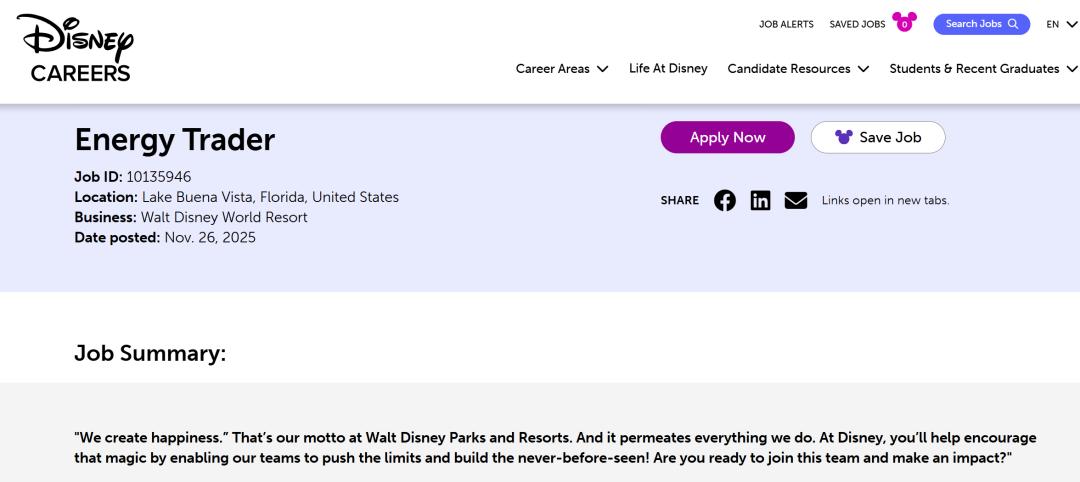
Group 1 - Disney is hiring an energy trader to manage wholesale electricity procurement and analysis, reflecting a trend among large companies to manage energy costs more effectively in the "AI era" [1][4] - The position is based in Orlando, Florida, and requires the trader to provide short-term electricity forecasts and generation resource analysis for the Florida tourism regulatory zone, which includes Walt Disney World [2][3] - The job requires at least 5 years of experience in the wholesale electricity market and familiarity with the local electricity market [3] Group 2 - Disney's recruitment reflects a broader industry trend where companies are building energy trading teams to ensure stable and cost-effective electricity supply, moving away from reliance on intermediaries or long-term fixed-price contracts [4] - Major tech companies like Meta, Google, Microsoft, and Amazon are already active in the wholesale electricity market, leveraging their power purchase agreements to sell excess electricity during price spikes [5] - The backdrop of rising electricity costs is highlighted by a record capacity cost of $16.1 billion in a recent auction by the largest U.S. grid operator, PJM, which will lead to increased electricity bills for consumers and businesses [5]

亚马逊重磅发布挑战谷歌英伟达:AI芯片Trainium 3更快更节能,四款Nova 2模型,首创“开放式训练”
美股IPO· 2025-12-03 00:57
Core Insights - Amazon Web Services (AWS) has launched the Trainium 3 AI training chip, which is the first 3nm AWS AI chip, providing 2.52 PFLOPs FP8 computing power and significantly enhancing memory capacity and bandwidth compared to its predecessor [1][3][8] - The introduction of the Nova 2 series models and the Nova Forge service aims to strengthen AWS's position in the competitive AI market against Nvidia and Google [3][5][19] Trainium 3 Chip Performance - Trainium 3 offers a performance increase of over 4 times in training and inference speed compared to the second generation, with memory capacity increased by 1.5 times to 144GB HBM3e and memory bandwidth improved by 1.7 times to 4.9TB/s [8][9] - The Trn3 UltraServer system, equipped with Trainium 3, achieves a total computing power of 362 PFLOPs and can accommodate up to 144 chips, providing up to 20.7TB of HBM3e memory [8][9] Competitive Positioning - AWS aims to attract cost-sensitive companies by offering Trainium chips that provide a more affordable and efficient alternative to Nvidia's GPUs [5][9] - The announcement of Trainium 4, which will support Nvidia's NVLink Fusion technology, is expected to enhance compatibility with Nvidia-based applications, potentially lowering the technical barrier for migration to AWS [10][11] Nova 2 Series Models - The Nova 2 family includes models designed for various applications, such as Nova 2 Lite for everyday workloads and Nova 2 Pro for complex tasks, demonstrating competitive performance against models from Claude and GPT [16][18] - Nova 2 Omni is the first unified multimodal reasoning and generation model, capable of processing and generating text, images, and audio simultaneously [18] Nova Forge Service - Nova Forge allows enterprises to build customized versions of Nova models, addressing challenges in integrating proprietary knowledge into AI applications [19][20] - This service provides exclusive access to model checkpoints and data mixing capabilities, enabling businesses to train AI models more effectively [19] Nova Act Service - Nova Act is a new service for building AI agents that can automate tasks in web browsers, achieving 90% reliability in early customer workflows [21][23] - Companies like Reddit and 1Password have successfully integrated Nova Act to enhance their operational efficiency and automate critical business tasks [20][23]

12月3日证券之星早间消息汇总:国家发改委主任重磅发声
Sou Hu Cai Jing· 2025-12-03 00:48
宏观要闻: 1.国家发展改革委主任郑栅洁在《党建》杂志发布《深入学习贯彻党的二十届四中全会精神以高质量发 展新成效谱写中国式现代化新篇章》署名文章。文章写道,在发展中保障和改善民生,提高人民生活品 质。加大保障和改善民生力度,扎实推进全体人民共同富裕。深入实施就业优先战略,完善收入分配制 度,提高居民收入在国民收入分配中的比重,提高劳动报酬在初次分配中的比重。 1.美东时间周二,美股三大指数12月02日收盘全线上涨。截至收盘,道琼斯工业平均指数比前一交易日 上涨185.13点,收于47474.46点,涨幅为0.39%;标准普尔500种股票指数上涨16.74点,收于6829.37 点,涨幅为0.25%;纳斯达克综合指数上涨137.75点,收于23413.67点,涨幅为0.59%。热门科技股多数 上涨,苹果涨超1%,续创历史新高,英特尔涨超8%,英伟达涨近1%,博通跌超1%,AMD跌超2%。 2.近日,全球最大的云服务公司亚马逊网络服务(AWS)主办的年度云计算盛会"AWS Re:Invent 2025"于 美国拉斯维加斯开幕。"Reinvent 2025"于当地时间12月1日至5日举行。今年"Reinvent" ...
中信建投:阿里云持续加速,开源生态+模型性能构建B端壁垒
Ge Long Hui A P P· 2025-12-03 00:32
Core Viewpoint - Alibaba is leveraging the Qwen large model foundation to achieve comprehensive business transformation, accelerating the construction of its B-end ecosystem barriers through an open-source strategy and strong performance [1] Group 1: Business Transformation - The company is significantly increasing capital expenditure to meet strong computing power demand, with cloud revenue continuing to grow rapidly, validating the closed-loop logic of "infrastructure investment - technology iteration - commercial monetization" [1] Group 2: Investment Opportunities - Attention is recommended on 1) Alibaba ecosystem players; 2) Pre-AI revenue, particularly in OA and ERP segments; 3) Faster AI revenue in certain vertical scenarios, focusing on cost reduction through AI-coding and multimodal approaches [1][1] - Local inference is gradually increasing in volume, and edge-side AI is also gaining traction [1]
