
制造业

Search documents
经济大省挑大梁,“十万亿俱乐部”再扩容
Yang Shi Wang· 2025-12-13 09:07
Core Insights - The central economic work conference emphasized the support for major economic provinces to take the lead in economic development [1] - Jiangsu and Shandong have announced significant economic growth data, with Jiangsu's GDP projected to exceed 14 trillion yuan and Shandong's GDP expected to surpass 10 trillion yuan [1][2] Group 1: Economic Growth of Jiangsu and Shandong - Jiangsu's GDP has increased from 10.5 trillion yuan in 2020 to 13.7 trillion yuan in 2024, marking a significant milestone as it approaches the 14 trillion yuan mark [1] - Shandong's GDP is projected to grow from 7.44 trillion yuan in 2020 to 9.86 trillion yuan in 2024, with a notable increase in its share of the national economy from 7.19% to 7.31% [2] Group 2: Industrial Transformation in Shandong - Shandong has successfully transitioned its industrial structure, with high-tech industries' output rising from 45.1% in 2020 to 55.2% in the first half of this year [2] - The province has built 26.6 thousand 5G base stations, ranking second nationally in the number of gigabit cities [2] Group 3: New Economic Landscape and Urban Development - Shandong announced a plan to expand its "trillion-yuan city" initiative, aiming to promote Weifang, Linyi, and Jining to become new trillion-yuan cities [4][6] - Currently, Shandong has three trillion-yuan cities: Qingdao, Jinan, and Yantai, and if successful, it will have six, enhancing its competitive position among leading provinces [6] Group 4: Competitive Position of Major Cities - Qingdao is positioned to potentially become the "second city in the north," with its GDP gap with Tianjin narrowing to less than 50 billion yuan [7] - The central economic work conference highlighted the importance of developing the marine economy, with Shandong's marine production value reaching 18.01 billion yuan, accounting for 17.1% of the national total [7] Group 5: National Economic Context - Guangdong is projected to be the first province to exceed 14 trillion yuan in GDP, with a potential milestone of reaching 15 trillion yuan soon [8] - Zhejiang is expected to reach approximately 9.5 trillion yuan in GDP this year, indicating a possible entry into the trillion-yuan club by 2026 [8]

蒸发1000亿,高市慌了,歼15百公里外死死锁定,稀土断供倒计时!
Sou Hu Cai Jing· 2025-12-13 07:12
Economic Impact - China's travel advisory against Japan has led to a significant decline in Japanese tourism, with Chinese tourists accounting for 21.3% to 35% of total foreign tourist spending in Japan in 2024 [2] - From November 15 to 18, Chinese airlines canceled approximately 500,000 tickets to Japan, representing 32% of the booking volume, potentially costing Japan around 2.2 trillion yen, equivalent to over 100 billion RMB [2] - Japan's cultural and seafood industries are also suffering, with many scheduled events being postponed or canceled, leading to losses in the film industry estimated in the tens of billions of RMB [4] Military Pressure - As of December 4, the number of Chinese vessels in the East Asia sea exceeded 100, creating a significant military presence [5] - Chinese J-15 fighter jets successfully locked onto Japanese F-15s at distances of 50 km and 150 km, indicating a substantial advancement in China's military capabilities [5] Legal and Diplomatic Response - China's Foreign Minister Wang Yi utilized international law to counter Japan's claims regarding Taiwan, referencing historical documents and international resolutions that affirm Taiwan as part of China [7] - This legal argument effectively undermines Japan's position on Taiwan, framing any Japanese intervention as a violation of post-World War II international order [8]

佛山南海荣鼎工贸有限公司成立 注册资本3万人民币
Sou Hu Cai Jing· 2025-12-13 06:56
Core Viewpoint - Recently, Foshan Nanhai Rongding Industrial Trade Co., Ltd. was established with a registered capital of 30,000 RMB, indicating a new player in the domestic trade and manufacturing sector [1] Company Summary - The registered capital of Foshan Nanhai Rongding Industrial Trade Co., Ltd. is 30,000 RMB [1] - The company’s business scope includes domestic trade agency, sales of rubber products, sales of sealing components, sales of sealing fillers, and sales of specialized chemical products (excluding hazardous chemicals) [1] - Additional activities include sales of sponge products, manufacturing of synthetic materials (excluding hazardous chemicals), sales of synthetic materials, wholesale and retail of footwear and hats, sales of raw and auxiliary materials for shoemaking, sales of daily necessities, leather sales, wholesale of clothing and accessories, and sales of clothing accessories [1]
新城市志︱经济大省挑大梁,“十万亿俱乐部”再扩容
Sou Hu Cai Jing· 2025-12-13 05:57
Core Insights - The recent Central Economic Work Conference emphasized the support for major economic provinces to take the lead in economic development [1] - Jiangsu and Shandong have announced significant economic growth data, with Jiangsu's GDP projected to exceed 14 trillion yuan and Shandong's GDP expected to surpass 10 trillion yuan [1][9] Summary by Sections Jiangsu's Economic Growth - Jiangsu's GDP has increased from 10.5 trillion yuan in 2020 to 13.7 trillion yuan in 2024, marking a significant milestone as it approaches the 14 trillion yuan mark [1] - This positions Jiangsu as the second province in China to cross the 14 trillion yuan GDP threshold after Guangdong [1] Shandong's Economic Development - Shandong's GDP is projected to grow from 7.44 trillion yuan in 2020 to 9.86 trillion yuan in 2024, achieving a significant milestone as it becomes the third province in China to exceed 10 trillion yuan [3][9] - The province's contribution to the national economy has increased from 7.19% to 7.31% during this period [3] Industrial Transformation in Shandong - Shandong has successfully transitioned its industrial structure, with high-tech industries' output rising from 45.1% in 2020 to 55.2% in the first half of 2024 [3] - The province has built 26.6 million 5G base stations, ranking second in the country for the number of gigabit cities [3] New Economic Zones and Urban Development - Shandong announced a plan to expand its "trillion-yuan city" initiative, aiming to elevate Weifang, Linyi, and Jining to trillion-yuan cities, which would increase its total to six [6] - The province's economic landscape is characterized by its dual-core cities, Qingdao and Jinan, each with distinct strategic roles [6] Qingdao's Economic Aspirations - Qingdao aims to accelerate its GDP growth to reach the 2 trillion yuan mark, with its GDP ranking 13th nationally and closing the gap with Tianjin [7] - The city is positioned to potentially become the "second city in the north," enhancing Shandong's competitive edge among major cities [7] National Economic Landscape - Guangdong remains the top province with a GDP exceeding 14 trillion yuan, while Zhejiang is projected to join the trillion-yuan club by 2026 [9] - The combined GDP of the top four provinces could place them among the top 20 economies globally, highlighting their significant role in China's economic framework [9]
经济观察|中企出海迎海南自贸港封关新机遇
Zhong Guo Xin Wen Wang· 2025-12-13 05:26
Core Viewpoint - The establishment of a Chinese enterprise overseas base in Hainan Free Trade Port aims to provide tailored solutions for companies looking to expand internationally, leveraging the region's favorable tax policies and resource integration [1][2]. Group 1: Economic Opportunities - The Hainan Free Trade Port is set to implement more liberal policies in trade, investment, and cross-border capital flow, creating a competitive environment for companies to align with international standards [2]. - In the first half of 2025, Chinese listed companies achieved overseas revenue of 4.9 trillion RMB, marking a 4.5% year-on-year increase, indicating strong resilience and vitality in overseas expansion [1]. Group 2: Industry Performance - Key sectors such as biomedicine and retail are showing significant growth, with the overseas licensing of innovative drugs exceeding 100 billion USD and major internet companies accelerating their overseas warehouse layouts [1]. - Hainan province reported a 43% year-on-year increase in newly registered foreign investment enterprises, totaling 296 companies in the first ten months of the year, alongside a 42.6% rise in actual foreign investment amounting to 3.17 billion USD [3]. Group 3: Strategic Development - The Hainan provincial government plans to enhance the region as a headquarters base for Chinese companies entering international markets, focusing on developing a comprehensive service platform for overseas expansion [2]. - The county of Chengmai is actively promoting its identity as a hub for overseas expansion, with five key sectors already in motion, including gaming, cross-border e-commerce, and new energy vehicles [3].
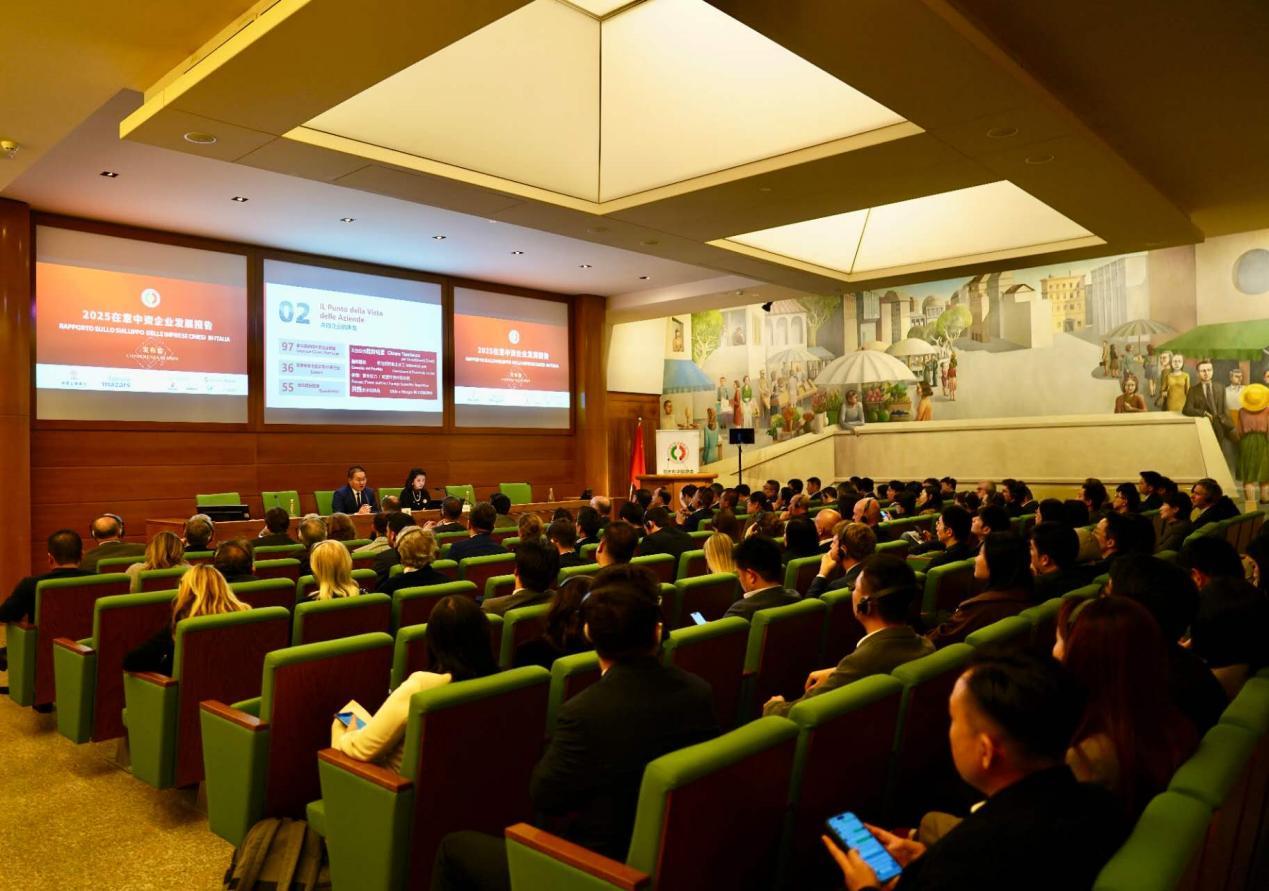
意大利中国商会发布《2025年在意中资企业发展报告》
人民网-国际频道 原创稿· 2025-12-13 04:52
Group 1 - The core viewpoint of the article is the release of the "2025 Development Report on Chinese Enterprises in Italy" by the Italian Chinese Chamber of Commerce, highlighting the growth and challenges faced by Chinese enterprises in Italy [1][2] - The report indicates that Chinese enterprises in Italy have expanded their investments across 36 major industries, focusing on high value-added and sustainable development sectors such as high-end manufacturing, new energy, life sciences, and cross-border e-commerce [2][3] - Currently, there are 604 Chinese-invested enterprises in Italy, providing over 30,000 jobs and generating more than 24 billion euros in revenue [2] Group 2 - The Italian government aims to play a strategic role in the new investment landscape between China and Europe, offering stable and professional policy support to investors, including Chinese enterprises [3] - The Lombardy region is committed to maintaining high-level dialogue with the Chinese market to promote growth, employment, and innovation, while supporting local businesses in expanding exports to China [3][8] - The report emphasizes the importance of dialogue and cooperation between China and Italy to eliminate trade barriers and establish a more orderly global supply chain [2]
盛希泰:中国不缺钱缺好资产,未来十年将迎黄金发展期|2025华夏机构投资者年会
Hua Xia Shi Bao· 2025-12-13 04:20
Core Insights - The forum emphasized the theme of "vitality and resilience, innovation and empowerment," aiming to address contemporary challenges and explore future pathways [2] - The founder of Hongtai Fund, Sheng Xitai, expressed optimism about China's development over the next decade, highlighting the importance of seizing opportunities amid industry transformations [2] - High-tech companies with genuine technological content are becoming the focal point for capital, indicating a market divide between quality assets and traditional industries [2][3] Industry Trends - The emergence of AI companies like DeepSeek has significantly reshaped market confidence in China's AI sector, alleviating previous concerns about the country's capabilities in generative AI [3] - Chinese industries are recognized for their competitive edge, with a notable ability to develop large model products at a cost of only 1% to 2% of what is typically required internationally [3] - The rapid rise of the robotics industry in China is attributed to 30 years of industrial accumulation, with Jiangsu province alone housing 100,000 supporting enterprises [4] Market Dynamics - China's industrial strength has garnered global attention, reflecting its undeniable manufacturing capabilities despite international uncertainties [4] - The share of Chinese industrial robots in the global market is reported to be between 60% and 70%, showcasing the country's leading manufacturing capacity and supply chain [4] - The ongoing implementation of China's "14th Five-Year" and "15th Five-Year" plans, along with the establishment of a unified national market, lays a solid foundation for long-term development [4]

“石油王国”经济版图重塑
第一财经· 2025-12-13 04:01
Core Viewpoint - Saudi Arabia's economy has undergone significant transformation over the past decade, with the non-oil sector's contribution to GDP rising from 45.4% to 55.6%, driven by the "Vision 2030" initiative aimed at economic diversification [3][4]. Economic Growth and Diversification - The non-oil economy's growth rate for the first three quarters of the year reached 4.7%, with an expected annual growth of 5%, making it a key driver of overall economic growth [5]. - The Saudi Ministry of Finance projects a GDP growth acceleration to 4.4% in 2025, with non-oil sector growth anticipated at 5% [3][5]. - Despite a decline in total fiscal revenue due to falling oil prices, non-oil revenue has exceeded expectations, confirming the effectiveness of the economic diversification process [5][6]. Key Sectors Supporting Growth - The growth of the non-oil sector is supported by various fields, including increased local content in public procurement, which stimulates domestic manufacturing [6]. - Wholesale and retail trade have become significant contributors to non-oil growth, closely linked to strong private consumption trends [6]. - Government measures, such as capping gasoline prices and providing direct financial support, have stabilized residents' real income and boosted consumption [6][7]. Role of National Development Fund (NDF) - The NDF plays a crucial role in the economic transformation by ensuring that all its funds align with the national vision [7][8]. - NDF acts as a catalyst to attract both domestic and international investors by providing funding support and capacity building [8]. - The NDF is adjusting its business model to facilitate the government's shift from public spending to capital-driven investment [8]. Investment Opportunities and International Cooperation - Saudi Arabia has become a major player in green investment, with $12 billion in green financing issued this year, capturing two-thirds of the Middle East's green finance market [8]. - The NDF is actively fostering cross-national partnerships, particularly with China, which is Saudi Arabia's largest trading partner [10][11]. - Infrastructure remains a primary area of interest for Chinese investors, with ongoing discussions and agreements to enhance cooperation in this sector [11].

世界银行发布毛里塔尼亚增长与就业国别报告
Shang Wu Bu Wang Zhan· 2025-12-13 01:46
Core Insights - The World Bank's report on Mauritania highlights the need for economic diversification beyond the mining sector to achieve sustainable and inclusive growth, as the current model is insufficient to meet the country's 2050 income aspirations [1] Economic Challenges and Policy Recommendations - Mauritania faces four long-term economic challenges: low labor demand, weak productivity growth, limited investment outside the mining sector, and high volatility in growth and income [2][3][4] - The labor participation rate is low, especially among youth and women, with 30% of the population living in poverty and only 42% of the labor force engaged in economic activities [2] - Recommendations include enhancing skills training, improving basic education, modernizing labor market regulations, and increasing female labor participation [2] - Productivity growth has been stagnant, with only a 26% increase over the past 22 years, primarily in the mining sector, necessitating reforms to stimulate enterprise innovation and competition [2] - Investment in sectors outside mining is limited, with 52.6% of foreign investment directed towards mining, indicating a need for improved business conditions and a more flexible labor market [3] - Economic growth is highly dependent on the mining sector, making it vulnerable to commodity price fluctuations and climate impacts, which necessitates better fiscal management and climate resilience strategies [4] Strategic Priorities for Reform - The report suggests prioritizing reforms based on feasibility, potential leverage, and impact on growth and employment, focusing on education, regulatory modernization, and private sector support [4] - Emphasis is placed on investing in human capital, particularly in STEM education, to facilitate economic diversification and reduce reliance on commodities [4]
两部门:推动金融支持绿色工厂建设
Ren Min Ri Bao Hai Wai Ban· 2025-12-13 01:16
Core Viewpoint - The Ministry of Industry and Information Technology and the People's Bank of China have jointly issued a notice to enhance the green finance support mechanism for the construction of green factories, which are crucial for achieving carbon neutrality goals and currently account for over 20% of the total output value of the manufacturing industry [1][2]. Group 1: Green Factory Development - Green factories are identified as the core unit of green manufacturing, with a total of 6,430 green factories cultivated at the national level [1]. - The notice aims to leverage green finance to encourage financial institutions to develop financial products that support energy-saving, low-carbon, water-saving, environmental protection, and resource utilization in green factories [1]. Group 2: Support Policies - The notice emphasizes the establishment of internal management mechanisms within financial institutions to create effective incentive mechanisms for supporting green factory development [2]. - It encourages financial institutions to tailor loan terms and repayment cycles based on the funding characteristics of green factories, enhancing green credit support [2]. - The notice also calls for the expansion of direct financing channels, supporting eligible enterprises in issuing green bonds and transformation bonds [2]. Group 3: Financial Collaboration - The Ministry of Industry and Information Technology plans to strengthen policy coordination with financial management departments to promote deep integration of industry and finance [2]. - It aims to enhance the role of national industry-finance cooperation platforms and city pilot projects, promoting integrated technology and industry finance initiatives [2].