半导体制造

Search documents
台积电,颠覆传统中介层
半导体芯闻· 2025-06-12 10:04
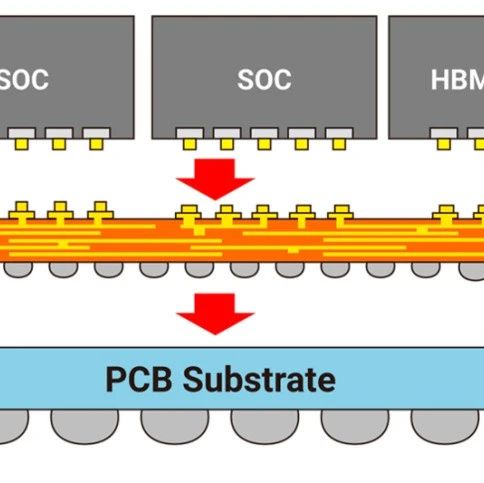
Core Viewpoint - The article discusses the significant rise of TSMC's CoWoS packaging technology, driven by the increasing demand for GPUs in the AI sector, particularly through its partnership with NVIDIA, which has deepened over time [1][3]. Group 1: CoWoS Technology and NVIDIA Partnership - NVIDIA has emphasized its reliance on TSMC for CoWoS technology, stating that it has no alternative partners in this area [1]. - TSMC has reportedly surpassed ASE Group to become the largest player in the global packaging market, benefiting from the growing demand for advanced packaging solutions [1]. - NVIDIA's upcoming Blackwell series will utilize more CoWoS-L packaging, indicating a shift in production focus from CoWoS-S to CoWoS-L to meet the high bandwidth requirements of its GPUs [3]. Group 2: Challenges and Innovations in CoWoS - The increasing size of AI chips poses challenges for CoWoS packaging, as larger chips reduce the number of chips that can fit on a 12-inch wafer [4]. - TSMC is facing difficulties with the use of flux in CoWoS, which is essential for chip bonding but becomes problematic as the size of the interposer increases [4][5]. - TSMC is exploring flux-free bonding technologies to improve yield rates and address the challenges posed by flux residue [5]. Group 3: Future Developments and Alternatives - TSMC plans to introduce CoWoS-L with a mask size of 5.5 times larger by 2026 and aims for a record 9.5 times larger version by 2027 [8]. - The company is also developing CoPoS technology, which replaces traditional wafers with panel substrates, allowing for higher chip density and efficiency [9][10]. - CoPoS is positioned as a potential alternative to CoWoS-L, targeting high-performance applications in AI and HPC systems [12]. Group 4: Technical Comparisons - FOPLP and CoPoS both utilize large panel substrates but differ in architecture; FOPLP does not use an interposer, while CoPoS does, enhancing signal integrity for high-performance chips [11]. - CoPoS is transitioning to glass substrates, which offer better performance characteristics compared to traditional organic substrates [12]. - The shift from round wafers to square panels in CoPoS aims to improve yield and reduce costs, making it more competitive in the AI and 5G markets [12]. Group 5: Challenges Ahead - Transitioning to square panel technology requires significant investment in materials and equipment, along with overcoming technical challenges related to pattern precision [14]. - The demand for finer RDL line widths poses additional challenges for suppliers, necessitating breakthroughs in RDL layout technology [14]. Conclusion - The future of TSMC's packaging technologies appears promising, with ongoing innovations and adaptations to meet the evolving demands of the semiconductor industry [14].


新洁能: 关于闲置募集资金现金管理赎回的公告
Zheng Quan Zhi Xing· 2025-06-12 09:16
Group 1 - The company approved the use of temporarily idle raised funds for cash management, with a maximum amount not exceeding 1,150 million RMB [1] - The investment will be in high-security and high-liquidity products, with a maximum investment period of 12 months [1] - The company will strictly comply with the relevant regulations of the Shanghai Stock Exchange regarding the management of raised funds [1] Group 2 - As of the date of the announcement, the balance of idle raised funds used for cash management is reported [2] - Specific details regarding the cash management products and their performance are provided, including the actual returns and maturity dates [2]

谈判暂停,美国要求日本做出让步,石破茂调转“枪口”对准中国
Sou Hu Cai Jing· 2025-06-11 03:35
Group 1 - The fifth round of US-Japan tariff negotiations has reached a deadlock due to significant disagreements among key US representatives, including Treasury Secretary Yellen, Commerce Secretary Raimondo, and Trade Representative Tai, leading to a temporary pause in talks [1][3] - Japan is attempting to sacrifice its interests with China to appease the US, proposing measures to limit Chinese influence in exchange for tariff concessions from the US [3][10] - Japan's proposal includes establishing partnerships with the US in critical mineral sectors like rare earths, despite its heavy reliance on Chinese imports, which could negatively impact its own industries [4][5] Group 2 - Japan's commitment to purchase more US semiconductor products and assist in semiconductor manufacturing aims to curb China's semiconductor industry growth, but it risks straining Japan's own trade relations with China [7] - Japan plans to increase imports of US liquefied natural gas to fill the market gap left by reduced Chinese imports, which may lead to higher costs and instability in energy supply [7] - The collaboration with the US on building icebreakers may weaken Japan's shipbuilding industry, diverting resources and reducing competitiveness in other ship types [8] Group 3 - Japan's strategy to use measures against China as leverage in tariff negotiations reflects a long-standing pro-US diplomatic stance, which may backfire economically and politically [9][10] - China's response to Japan's actions could include tightening export policies on rare earths and reassessing trade partnerships, potentially leading to economic repercussions for Japan [12] - The internal divisions within the US government regarding tariff policies add uncertainty to the negotiations, making it unclear whether Japan's concessions will lead to the desired tariff reductions [12]

NXP大量关闭8寸厂!
国芯网· 2025-06-10 10:42
Core Viewpoint - NXP Semiconductors plans to close four 8-inch wafer fabs to transition production to new 12-inch fabs, aiming for higher efficiency and profitability through reduced fixed and manufacturing costs [2]. Group 1 - NXP will close one fab in Nijmegen, Netherlands, and three in the United States over the next 10 years [2]. - The production capacity of 12-inch wafers is 2.25 times that of 8-inch wafers, leading to lower costs and higher profits [2]. - A joint venture with World Advanced, VSMC, will establish a 12-inch fab in Singapore, expected to start mass production in 2027, which mitigates capacity construction risks for NXP [2].


资讯日报-20250610
Guoxin Securities Hongkong· 2025-06-10 06:43
股票市场概览 港股市场表现 美股市场表现 | 2025 年 6 | 月 | 10 | 日 | | | --- | --- | --- | --- | --- | | 资讯日报 | | | | | | 海外市场主要股市上日表现 | | | | | | | | | | 升跌(%) | | 指数名称 | 收市价 | 单日 | 年内 | | --- | --- | --- | --- | | 恒生指数 | 24,181 | 1.63 | 20.55 | | 恒生国企 | 8,780 | 1.74 | 20.44 | | 恒生科技 | 5,433 | 2.78 | 21.60 | | 美国道琼斯 | 42,762 | (0.00) | 0.51 | | 美国标普 500 | 6,006 | 0.09 | 2.11 | | 美国纳斯达克 | 19,591 | 0.31 | 1.45 | | 德国 DAX | 24,174 | (0.54) | 21.42 | | 法国 CAC | 7,791 | (0.17) | 5.56 | | 英国富时 100 | 8,832 | (0.06) | 8.07 | | 日本日经 225 ...
汽车早餐 | 工信部重点抽查舆论关注度高、安全隐患大车型;哪吒汽车所持10亿股权再被冻结;亿纬锂能拟在港股上市
Zhong Guo Qi Che Bao Wang· 2025-06-10 01:46
Domestic News - The first meeting of the China-US economic and trade consultation mechanism was held in London, UK, on June 9, with Chinese Vice Premier He Lifeng attending [2] - The Ministry of Industry and Information Technology announced increased inspections on vehicles with significant safety risks and high public concern as part of the 2025 annual consistency supervision checks [3] - Beijing's economic and information bureau released a plan to encourage the development of high-end new vehicle models with a focus on technology and fashion, aiming to expand into overseas markets [4] - In the first five months, China's automobile exports reached 351.37 billion yuan, a year-on-year increase of 6.6%, with electric vehicle exports growing by 19% [5] - Hebei Province is promoting private sector participation in the construction and operation of charging infrastructure, aiming to attract diverse investment [6] International News - Waymo's autonomous vehicles were damaged during a protest in Los Angeles, with five vehicles destroyed, totaling approximately $600,000 in damages [7] - Tata Motors expects electric vehicle penetration to reach 20% by 2027 and over 30% by the fiscal year 2030, with plans to invest 33-35 billion Indian Rupees in solar business from 2026 to 2030 [8] - General Motors appointed Mike Trevorrow as the new Senior Vice President of Global Manufacturing following the departure of JP Clausen [9] Corporate News - Geely partnered with Indonesian electric vehicle charging operator Voltron to establish charging facilities at all of Geely's dealerships in Indonesia, with the first six stores set to complete infrastructure deployment [10] - Honda China's May automobile sales were 55,108 units, a year-on-year decline of 16.8%, with cumulative sales from January to May down 26% compared to the previous year [11] - EVE Energy announced plans to issue H-shares and list on the Hong Kong Stock Exchange to enhance capital strength and international brand image [12] - Zeekr Energy launched a charging map in Hong Kong, covering over 1,700 core stations and more than 2,300 charging piles, providing over 1,500 daily charging supports [13] - TSMC's construction plans for new factories in Japan and Germany may be adjusted due to supply chain issues and lower-than-expected market conditions [14] - Huawei's subsidiary announced a patent for a retractable steering wheel, aimed at improving driver comfort and saving space in vehicles [15] - Nezha Automobile's 1 billion yuan worth of shares has been frozen, with the freeze lasting from June 3, 2025, to June 2, 2028 [16]


斯达半导: 2024年年度权益分派实施公告
Zheng Quan Zhi Xing· 2025-06-09 12:48
? 每股分配比例 A 股每股现金红利0.63599元 证券代码:603290 证券简称:斯达半导 公告编号:2025-019 斯达半导体股份有限公司 本公司董事会及全体董事保证本公告内容不存在任何虚假记载、误导性陈述或者重大遗 漏,并对其内容的真实性、准确性和完整性承担法律责任。 重要内容提示: ? 相关日期 | 股份类别 | 股权登记日 | | 最后交易日 | 除权(息)日 | 现金红利发放日 | | --- | --- | --- | --- | --- | --- | | A股 | 2025/6/16 | - | 2025/6/17 | 2025/6/17 | | ? 差异化分红送转: 否 一、 通过分配方案的股东大会届次和日期 本次利润分配方案经公司2025 年 5 月 28 日的2024年年度股东大会审议通过。 二、 分配方案 截至股权登记日下午上海证券交易所收市后,在中国证券登记结算有限责任公司上海分 公司(以下简称"中国结算上海分公司")登记在册的本公司全体股东。 本次利润分配以方案实施前的公司总股本 239,473,466 股为基数,每股派发现金红利 三、 相关日期 | 股份类别 | 股权登记 ...

资讯日报-20250609
Guoxin Securities Hongkong· 2025-06-09 10:54
Market Overview - The Hang Seng Index closed at 23,793, down 0.48% for the day but up 18.61% year-to-date[3] - The Hang Seng China Enterprises Index fell 0.63% to 8,630, with a year-to-date increase of 18.38%[3] - The Hang Seng Tech Index also decreased by 0.63% to 5,287, maintaining an 18.32% rise for the year[3] US Market Performance - The Dow Jones Industrial Average rose 1.05% to 42,763, with a year-to-date gain of 0.51%[3] - The S&P 500 increased by 1.03% to 6,000, reflecting a 2.02% rise year-to-date[3] - The Nasdaq Composite climbed 1.20% to 19,530, with a year-to-date increase of 1.13%[3] Sector Performance - Major tech stocks in Hong Kong saw declines, with Xiaomi dropping over 2% and Alibaba down more than 1%[8] - Gold stocks surged, with China Silver Group rising over 26% and Tongguan Gold increasing by more than 5%[8] - The semiconductor sector faced significant losses, with SMIC and BeiKe both falling over 4%[8] Capital Flows - Southbound capital recorded a net inflow of HKD 6.766 billion on June 6[8] - Meituan was the top net bought stock with HKD 8.613 billion, while Tencent saw a net outflow of HKD 5.884 billion[23] Economic Indicators - The US non-farm payrolls data for May showed an increase of 139,000 jobs, exceeding market expectations[11] - The unemployment rate remained stable at 4.2%, indicating a resilient labor market despite economic slowdown concerns[11] Investment Insights - Circle, dubbed the "first stablecoin stock," saw a significant rise of over 29% on its second day of trading, accumulating a total increase of over 247% in two days[8] - Morgan Stanley revised its year-end target for the S&P 500 from 5,200 to 6,000, reflecting a bullish outlook[11]
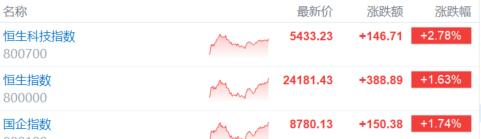
港股收评:技术性牛市!科技金融齐涨,中国稀土狂飙60%
Ge Long Hui· 2025-06-09 08:51
6月9日,中美经贸磋商会议在伦敦举行,市场风险情绪升温。 港股三大指数全天表现强势,恒生科技指数一度大涨3.2%,收涨2.78%;恒指涨1.63%站上24100点上方,从4月低点上涨21%进入技术性牛市,近乎收复此 前调整跌幅。 | 名称 | | 最新价 | 涨跌额 涨跌幅 | | --- | --- | --- | --- | | 恒生科技指数 | Fryst | 5433.23 | +146.71 +2.78% | | 800700 | | | | | 恒生指数 | Mar | 24181.43 | +388.89 +1.63% | | 800000 | | | | | 国企指数 | | 8780.13 | +150.38 +1.74% | | | M.N | | | 盘面上,大型科技股、大金融股、中字头股等权重集体表现活跃助力大市走强;医药板块大涨,创新药概念股涨幅居前;新消费概念股再度活跃,泡泡玛特 再创历史新高,半导体股、苹果概念股、军工股、稳定币概念股、石油股、教育股等热门板块齐涨。另一方面,市场避险情绪降温致金价下滑,黄金股逆势 下跌,铝、铜等有色金属股集体跟跌,啤酒股、汽车股、煤炭股普遍弱势。 ...