
焦炭

Search documents
瑞达期货焦煤焦炭产业日报-20251127
Rui Da Qi Huo· 2025-11-27 09:17
Report Summary 1. Report Industry Investment Rating - Not provided in the document 2. Core Viewpoints - On November 27, the JM2601 contract closed at 1071.0, down 0.19%. The spot price of Tangshan Meng 5 coking coal was reported at 1420, equivalent to 1200 on the futures market. The macro - situation: the NDRC issued a notice on ensuring the supply of thermal coal in 2026, weakening the market's expectations. Fundamentally, the capacity utilization rate of mines declined this period, and the coking coal inventory of mines and coal washing plants increased for 4 consecutive weeks. The overall inventory is at a moderate level with a seasonal upward trend. Technically, the daily K - line is below the 20 - day and 60 - day moving averages, and the short - term trend is expected to be weakly volatile [2]. - On November 27, the J2601 contract closed at 1607.0, up 0.03%. The fourth round of price increase for coke in the spot market has been implemented. The macro - situation: on November 24, South Korea announced anti - dumping duties on Chinese medium and heavy plates and alloy steel hot - rolled thick plates for 5 years. Fundamentally, in terms of demand, the pig iron output this period was 236.28 (-0.60) million tons, and the total coke inventory is relatively high compared to the same period. In terms of profit, the average profit per ton of coke for 30 independent coking plants across the country this period was 19 yuan/ton. Technically, the daily K - line is below the 20 - day and 60 - day moving averages, and the short - term trend is expected to be weakly volatile [2]. 3. Summary by Relevant Catalogs Futures Market - JM main contract closing price: 1071.00 yuan/ton, down 13.50 yuan; J main contract closing price: 1607.00 yuan/ton, down 12.00 yuan [2]. - JM futures contract open interest: 862195.00 lots, down 16796.00 lots; J futures contract open interest: 48293.00 lots, down 1586.00 lots [2]. - Net position of the top 20 JM contracts: - 112785.00 lots, down 10341.00 lots; net position of the top 20 J contracts: - 274.00 lots, up 101.00 lots [2]. - JM 5 - 1 month contract spread: 94.00 yuan/ton, up 2.00 yuan; J 5 - 1 month contract spread: 144.00 yuan/ton, down 2.00 yuan [2]. - Coking coal warehouse receipts: 0.00; coke warehouse receipts: 2070.00 [2]. Spot Market - Dry Qimantage Meng 5 raw coal: 1008.00 yuan/ton, unchanged; Tangshan first - grade metallurgical coke: 1885.00 yuan/ton, unchanged [2]. - Russian prime coking coal forward spot (CFR): 162.00 US dollars/wet ton, unchanged; Rizhao Port quasi - first - grade metallurgical coke: 1670.00 yuan/ton, unchanged [2]. - Jingtang Port Australian imported prime coking coal: 1510.00 yuan/ton, down 50.00 yuan; Tianjin Port first - grade metallurgical coke: 1770.00 yuan/ton, unchanged [2]. - Jingtang Port Shanxi - produced prime coking coal: 1670.00 yuan/ton, down 110.00 yuan; Tianjin Port quasi - first - grade metallurgical coke: 1670.00 yuan/ton, unchanged [2]. - Shanxi Jinzhong Lingshi medium - sulfur prime coking coal: 1610.00 yuan/ton, unchanged; J main contract basis: 278.00 yuan/ton, up 12.00 yuan [2]. - Inner Mongolia Wuhai - produced coking coal ex - factory price: 1380.00 yuan/ton, unchanged; JM main contract basis: 539.00 yuan/ton, up 13.50 yuan [2]. Upstream Situation - The clean coal output of 314 independent coal washing plants: 26.60 million tons per day, down 1.00 million tons; the clean coal inventory of 314 independent coal washing plants: 305.30 million tons per week, up 2.50 million tons [2]. - The capacity utilization rate of 314 independent coal washing plants: 0.36%, down 0.01%; raw coal output: 40675.00 million tons per month, down 475.50 million tons [2]. - Coal and lignite imports: 4174.00 million tons per month, down 426.00 million tons; the average daily raw coal output of 523 coking coal mines: 191.30 million tons, down 2.10 million tons [2]. - The imported coking coal inventory of 16 ports: 456.90 million tons per week, down 31.30 million tons; the coke inventory of 18 ports: 253.40 million tons per week, down 6.10 million tons [2]. - The total coking coal inventory of all - sample independent coking enterprises: 1038.19 million tons per week, down 30.78 million tons; the coke inventory of all - sample independent coking enterprises: 65.29 million tons per week, up 7.14 million tons [2]. - The coking coal inventory of 247 steel mills nationwide: 797.08 million tons per week, up 6.91 million tons; the coke inventory of 247 sample steel mills: 622.34 million tons per week, down 0.06 million tons [2]. - The available days of coking coal for all - sample independent coking enterprises: 12.97 days per week, up 0.10 days; the available days of coke for 247 sample steel mills: 11.05 days per week, down 0.01 days [2]. Industry Situation - Coking coal imports: 1059.32 million tons per month, down 33.04 million tons; coke and semi - coke exports: 73.00 million tons per month, up 19.00 million tons [2]. - Coking coal output: 3975.92 million tons per month, up 279.06 million tons; the capacity utilization rate of independent coking enterprises: 71.71%, up 0.07% [2]. - Profit per ton of coke for independent coking plants: 19.00 yuan/ton, up 53.00 yuan; coke output: 4189.60 million tons per month, down 66.00 million tons [2]. Downstream Situation - The blast furnace operating rate of 247 steel mills nationwide: 82.17%, down 0.62%; the blast furnace iron - making capacity utilization rate of 247 steel mills: 88.56%, down 0.26% [2]. - Crude steel output: 7199.70 million tons per month, down 149.31 million tons [2]. Industry News - The Chief Economist of the European Central Bank, Philip Lane, said that the world economy is undergoing profound changes beyond the impact of US tariffs, and Europe must start to seek growth drivers locally as its traditional sources of income are drying up [2]. - According to Bloomberg News, the Pentagon believes that Alibaba, Baidu, and BYD should be included in the list of enterprises assisting the Chinese military [2]. - From January to October, the total profit of the ferrous metal smelting and rolling processing industry was 105.32 billion yuan [2]. - Six departments including the Ministry of Industry and Information Technology issued the "Implementation Plan for Enhancing the Adaptability of Consumer Goods Supply and Demand and Further Promoting Consumption", aiming to form 3 trillion - level and 100 - billion - level consumer sectors by 2027 [2].
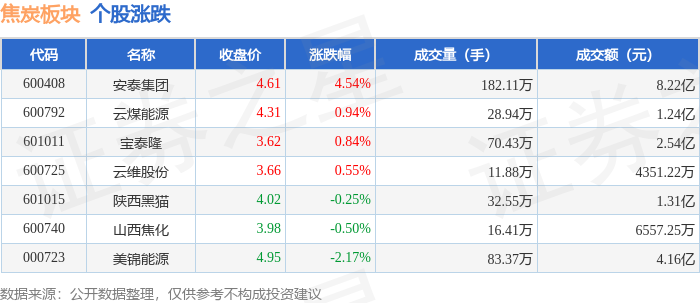
焦炭板块11月27日跌0.37%,美锦能源领跌,主力资金净流出3122.61万元
Zheng Xing Xing Ye Ri Bao· 2025-11-27 09:13
Core Viewpoint - The coking coal sector experienced a decline of 0.37% on November 27, with Meijin Energy leading the drop, while the Shanghai Composite Index rose by 0.29% [1] Group 1: Market Performance - The closing price of the Shanghai Composite Index was 3875.26, and the Shenzhen Component Index closed at 12875.19, down by 0.25% [1] - The coking coal sector's individual stock performance showed varied results, with Antai Group increasing by 4.54% to a closing price of 4.61, while Meijin Energy fell by 2.17% to 4.95 [1] Group 2: Trading Volume and Capital Flow - The total trading volume for the coking coal sector was significant, with Antai Group recording a volume of 1.82 million shares and a transaction value of 82.2 million yuan [1] - The coking coal sector saw a net outflow of 31.23 million yuan from main funds, while retail funds experienced a net outflow of 193,300 yuan [1] Group 3: Individual Stock Capital Flow - Baotailong had a main fund net outflow of 21.25 million yuan, while it also saw a retail net outflow of 10.88 million yuan [2] - Yunnan Coal Energy experienced a main fund net inflow of 7.99 million yuan, but a retail net outflow of 6.75 million yuan [2] - Meijin Energy faced a significant main fund net outflow of 40.39 million yuan, with retail investors contributing a net inflow of 35.38 million yuan [2]


广发期货《黑色》日报-20251127
Guang Fa Qi Huo· 2025-11-27 05:09
Group 1: Steel Industry Report Industry Investment Rating Not provided Core View of the Report The steel price is expected to maintain a volatile trend. With the current apparent demand and production levels, inventory reduction can be sustained, but it is necessary to pay attention to whether the current apparent demand is a pulse. The iron water output is -0.6 to 236.3 million tons, and the production is prone to decline and difficult to increase. Based on the upward revision of the apparent demand, under the weekly apparent demand of 8.74 million tons in November, the inventory pressure is not large, and the negative feedback of iron elements is not necessary. However, as the raw materials have not stabilized, the steel price is expected to decline within the range, with the rebar referring to the range of 3,000 - 3,200 and the hot-rolled coil referring to the range of 3,250 - 3,400 [1][3] Summary by Relevant Catalogs - **Steel Prices and Spreads**: Rebar and hot-rolled coil spot prices in most regions declined, and futures contract prices also showed a downward trend [1] - **Cost and Profit**: The cost of steel billets and slabs remained unchanged, while the cost of some steel products decreased. The profit of hot-rolled coils in some regions increased, and the profit of rebar in South China increased significantly [1] - **Supply**: The daily average iron water output decreased by 0.6 to 236.3 million tons, and the output of five major steel products increased by 1.9%. The output of rebar increased by 4.0%, with the converter output increasing by 5.4% and the electric furnace output decreasing by 4.6%. The output of hot-rolled coils increased by 0.7% [1] - **Inventory**: The inventory of five major steel products decreased by 3.0%, the inventory of rebar decreased by 4.0%, and the inventory of hot-rolled coils decreased by 2.0% [1] - **Transaction and Demand**: The building material trading volume decreased by 8.0%, and the apparent demand of five major steel products increased by 3.9%. The apparent demand of rebar increased by 6.7%, and the apparent demand of hot-rolled coils increased by 3.5% [1] Group 2: Iron Ore Industry Report Industry Investment Rating Not provided Core View of the Report The iron ore futures showed a relatively strong performance. On the supply side, the global iron ore shipments decreased week-on-week last week, while the arrivals at 45 ports increased significantly. On the demand side, the profit margin of steel mills decreased slightly, the iron water output decreased slightly, and the restocking demand of steel mills increased. It is expected that the iron ore will be difficult to have an independent unilateral market and will run in a volatile manner. It is recommended to wait and see on a unilateral basis [4] Summary by Relevant Catalogs - **Iron Ore - Related Prices and Spreads**: The warehouse receipt costs of various iron ore varieties increased slightly, and the basis of some varieties changed slightly. The 5 - 9 spread decreased by 5.7%, the 9 - 1 spread increased by 4.9%, and the 1 - 5 spread decreased by 4.1% [4] - **Spot Prices and Price Indexes**: The spot prices of iron ore in Rizhao Port increased slightly, and the prices of the Singapore Exchange 62% Fe swap and the Platts 62% Fe also increased slightly [4] - **Supply**: The 45 - port arrivals (weekly) increased by 24.2%, the global shipments (weekly) decreased by 6.8%, and the national monthly import volume decreased by 4.3% [4] - **Demand**: The daily average iron water of 247 steel mills (weekly) decreased by 0.3%, the 45 - port daily average port clearance volume (weekly) increased by 0.9%, the national monthly pig iron output decreased by 0.8%, and the national monthly crude steel output decreased by 2.0% [4] - **Inventory Changes**: The 45 - port inventory (weekly) increased by 0.3%, the imported ore inventory of 247 steel mills (weekly) decreased by 0.8%, and the inventory available days of 64 steel mills (weekly) decreased by 4.8% [4] Group 3: Coke and Coking Coal Industry Report Industry Investment Rating Not provided Core View of the Report - **Coke**: The coke futures showed a volatile downward trend, and the mainstream coke enterprises are expected to be proposed to reduce the price after the fourth round of price increase is fully implemented. The supply side shows that the coking profit has been repaired, but the coke price adjustment lags behind that of coking coal, and the start - up of some enterprises has decreased. The demand side shows that the steel mills' losses increase, the iron water output decreases, and the steel price fluctuates weakly, which has a certain suppression on the coke price. The inventory is slightly reduced, and the coke supply - demand situation has weakened. It is recommended to view the unilateral trend as volatile and bearish, with the range referring to 1,550 - 1,700, and recommend the 1 - 5 reverse spread arbitrage [7] - **Coking Coal**: The coking coal futures showed a volatile and weak trend, and the spot market showed signs of loosening. The supply side shows that some coal mines have stopped production for rectification, and the Mongolian coal customs clearance has increased significantly, and the port inventory has continued to rise. The demand side shows that the steel mills' losses increase, the iron water output decreases, the coking start - up decreases slightly, and the restocking demand weakens. The inventory is slightly reduced. It is recommended to view the unilateral trend as volatile and bearish, with the range referring to 1,050 - 1,150, and recommend the 1 - 5 reverse spread arbitrage [7] Summary by Relevant Catalogs - **Coke - Related Prices and Spreads**: The prices of some coke varieties decreased, and the futures contract prices also declined. The basis of some contracts changed [7] - **Coking Coal - Related Prices and Spreads**: The prices of some coking coal varieties decreased, and the futures contract prices also showed a downward trend. The basis of some contracts decreased [7] - **Supply**: The daily average output of all - sample coking plants decreased by 0.5%, and the daily average output of 247 steel mills remained unchanged. The raw coal output decreased by 0.3%, and the clean coal output decreased by 0.4% [7] - **Demand**: The iron water output of 247 steel mills decreased by 0.3%, and the daily average output of all - sample coking plants decreased by 0.5%, and the daily average output of 247 steel mills remained unchanged [7] - **Inventory Changes**: The total coke inventory increased slightly, the coke inventory of all - sample coking plants increased by 12.3%, the coke inventory of 247 steel mills remained basically unchanged, the port inventory decreased by 2.9%, and the coke supply - demand gap remained unchanged. The clean coal inventory of Fenwei coal mines increased by 11.9%, the coking coal inventory of all - sample coking plants decreased by 2.9%, the coking coal inventory of 247 steel mills increased by 0.9%, and the port inventory decreased by 2.3% [7]
永安期货焦炭日报-20251127
Yong An Qi Huo· 2025-11-27 02:58
900.00 1400.00 1900.00 2400.00 2900.00 3400.00 3900.00 4400.00 1月 2月 3月 4月 5月 6月 7月 8月 9月 10月 11月 12月 1月 吕梁出厂价 焦炭日报 研究中心黑色团队 2025/11/27 | | 最新 | 日变化 | 周变化 | 月变化 同比 | | 最新 | 日变化 | 周变化 | 月变化 同比 | | | --- | --- | --- | --- | --- | --- | --- | --- | --- | --- | --- | | 山西准一湿熄 | 1649.42 | 0.00 | 0.00 | 112.42 | -6.91% 高炉开工率 | 88.58 | | -0.22 | -1.36 | 0.00% | | 河北准一干熄 | 1900.00 | 0.00 | 0.00 | 110.00 | 11.11% 铁水日均产量 | 236.28 | | -0.60 | -3.62 | 0.20% | | 山东准一干熄 | 1825.00 | 0.00 | 0.00 | 110.00 | -6.65% 盘面05 | 17 ...
《黑色》日报-20251127
Guang Fa Qi Huo· 2025-11-27 01:18
Group 1: Steel Industry Report Industry Investment Rating Not provided Core View The steel price is expected to maintain a volatile trend. With the current apparent demand and production level, inventory reduction can be maintained, but it is necessary to pay attention to whether the current apparent demand is a pulse. The iron water output has decreased, and the production is likely to fall rather than rise. Based on the upward revision of the apparent demand, under the weekly apparent demand of 8.74 million tons in November, the inventory pressure is not significant, and there is little need for negative feedback on iron elements. However, as the raw materials have not stabilized, the steel price is expected to decline within the range, with the reference range for rebar being 3,000 - 3,200 and that for hot - rolled coils being 3,250 - 3,400 [1][3]. Summary by Directory - **Steel Price and Spread**: The prices of rebar and hot - rolled coil spot and futures have shown different degrees of decline. For example, the rebar spot price in North China decreased by 10 yuan to 3,210 yuan, and the rebar 10 - contract price decreased by 17 yuan to 3,155 yuan [1]. - **Cost and Profit**: The costs of steel billets and slabs remained unchanged. The costs of electric - arc furnace and converter rebar in Jiangsu decreased, and the profits of rebar and hot - rolled coils in different regions showed different changes. For instance, the profit of rebar in South China increased by 15 yuan to 108 yuan, and the profit of hot - rolled coils in East China increased by 5 yuan to - 62 yuan [1]. - **Supply**: The daily average pig iron output decreased by 0.6 tons to 236.3 tons, a decrease of 0.3%. The output of five major steel products increased by 15.5 tons to 849.9 tons, an increase of 1.9%. The output of rebar increased by 8.0 tons to 208.0 tons, an increase of 4.0% [1]. - **Inventory**: The inventory of five major steel products decreased by 44.2 tons to 1,433.1 tons, a decrease of 3.0%. The inventory of rebar decreased by 22.8 tons to 553.3 tons, a decrease of 4.0%, and the inventory of hot - rolled coils decreased by 8.4 tons to 402.1 tons, a decrease of 2.0% [1]. - **Transaction and Demand**: The building materials trading volume decreased by 0.8 to 9.3, a decrease of 8.0%. The apparent demand of five major steel products increased by 33.6 tons to 894.2 tons, an increase of 3.9%. The apparent demand of rebar increased by 14.4 tons to 230.8 tons, an increase of 6.7%, and the apparent demand of hot - rolled coils increased by 10.8 tons to 324.4 tons, an increase of 3.5% [1]. Group 2: Iron Ore Industry Report Industry Investment Rating Not provided Core View The iron ore futures showed a relatively strong performance. In the supply side, the global iron ore shipment volume decreased last week, while the arrival volume at 45 ports increased significantly. In the demand side, the steel mill profit margin declined slightly, the pig iron output decreased slightly, and the steel mill restocking demand increased. The inventory of ports increased slightly, and the steel mill's equity ore inventory decreased. It is expected that the iron ore will be difficult to have an independent unilateral market and will operate in a volatile manner. It is recommended to wait and see on a unilateral basis [4]. Summary by Directory - **Iron Ore - Related Price and Spread**: The warehouse - receipt costs of various iron ore powders increased slightly, and the basis of the 01 - contract for different iron ore powders showed different changes. For example, the warehouse - receipt cost of PB powder increased by 3.3 yuan to 846.9 yuan, an increase of 0.4%, and the basis of the 01 - contract for PB powder increased by 0.3 yuan to 49.9 yuan, an increase of 0.6% [4]. - **Spot Price and Price Index**: The spot prices of various iron ore powders at Rizhao Port increased slightly, and the prices of the Singapore Exchange 62% Fe swap and the Platts 62% Fe also increased slightly. For instance, the price of PB powder at Rizhao Port increased by 3 yuan to 798 yuan, an increase of 0.4% [4]. - **Supply**: The arrival volume at 45 ports (weekly) increased by 548.2 tons to 2,817.1 tons, an increase of 24.2%, and the global shipment volume (weekly) decreased by 238.0 tons to 3,278.4 tons, a decrease of 6.8%. The national monthly import volume decreased by 500.6 tons to 11,130.9 tons, a decrease of 4.3% [4]. - **Demand**: The daily average pig iron output of 247 steel mills (weekly) decreased by 0.6 tons to 236.3 tons, a decrease of 0.3%. The daily average port clearance volume at 45 ports (weekly) increased by 3.0 tons to 329.9 tons, an increase of 0.9%. The national monthly pig iron output decreased by 49.7 tons to 6,554.9 tons, a decrease of 0.8%, and the national monthly crude steel output decreased by 149.3 tons to 7,199.7 tons, a decrease of 2.0% [4]. - **Inventory Change**: The inventory at 45 ports (weekly, compared with Monday) increased by 46.9 tons to 15,101.54 tons, an increase of 0.3%. The imported ore inventory of 247 steel mills (weekly) decreased by 74.8 tons to 9,001.2 tons, a decrease of 0.8%. The inventory available days of 64 steel mills (weekly) decreased by 1 day to 20 days, a decrease of 4.8% [4]. Group 3: Coke and Coking Coal Industry Report Industry Investment Rating Not provided Core View - **Coke**: The coke futures showed a volatile downward trend, and the spot price had a downward expectation after the fourth - round price increase. The supply side saw a decrease in the coking coal price in the Shanxi market, and the coking profit was somewhat repaired. The demand side was affected by the decline in steel mill profits and iron water output, which put pressure on the coke price. The overall inventory decreased slightly, and the coke supply - demand relationship weakened. It is recommended to view it as a unilateral volatile and bearish market, with the reference range being 1,550 - 1,700, and recommend the 1 - 5 reverse spread of coke [7]. - **Coking Coal**: The coking coal futures showed a volatile and weak trend, and the spot price declined. The supply side was affected by the temporary shutdown of some mines and the increase in Mongolian coal customs clearance. The demand side saw a weakening of restocking demand due to the decline in steel mill and coking plant production. The overall inventory decreased slightly. It is recommended to view it as a unilateral volatile and bearish market, with the reference range being 1,050 - 1,150, and recommend the 1 - 5 reverse spread of coking coal [7]. Summary by Directory - **Coke - Related Price and Spread**: The prices of various coke products decreased to different extents. For example, the price of Rizhao Port's quasi - first - grade wet - quenched coke (warehouse - receipt) decreased by 11 yuan to 1,613 yuan, a decrease of 0.7%, and the coke 01 - contract price decreased by 24 yuan to 1,643 yuan, a decrease of 1.5% [7]. - **Coking Coal - Related Price and Spread**: The prices of various coking coal products also decreased. For instance, the price of Mongolian 5 raw coal (warehouse - receipt) decreased by 23 yuan to 1,200 yuan, a decrease of 1.9%, and the coking coal 01 - contract price decreased by 2 yuan to 1,085 yuan, a decrease of 0.1% [7]. - **Supply**: The daily average coke output of all - sample coking plants decreased by 0.3 tons to 62.7 tons, a decrease of 0.5%, and the daily average coke output of 247 steel mills remained unchanged at 46.2 tons. The raw coal output of Fenwei sample coal mines decreased by 2.4 tons to 851.5 tons, a decrease of 0.3%, and the clean coal output decreased by 1.8 tons to 433.8 tons, a decrease of 0.4% [7]. - **Demand**: The iron water output of 247 steel mills decreased by 0.6 tons to 236.3 tons, a decrease of 0.3%. The daily average coke output of all - sample coking plants decreased by 0.3 tons to 62.7 tons, a decrease of 0.5%, and the daily average coke output of 247 steel mills remained unchanged at 46.2 tons [7]. - **Inventory Change**: The total coke inventory increased by 1.3 tons to 880.6 tons, an increase of 0.1%. The coke inventory of all - sample coking plants increased by 7.1 tons to 65.3 tons, an increase of 12.3%, and the coke inventory of 247 steel mills decreased by 0.1 tons to 622.3 tons, a decrease of 0.0%. The coking coal inventory of Fenwei coal mines increased by 10.4 tons to 98.0 tons, an increase of 11.9%, the coking coal inventory of all - sample coking plants decreased by 30.8 tons to 1,038.2 tons, a decrease of 2.9%, and the coking coal inventory of 247 steel mills increased by 6.9 tons to 797.1 tons, an increase of 0.9% [7]. - **Supply - Demand Gap Change**: The coke supply - demand gap remained unchanged at - 5.5 tons [7].
2026年中国焦炭市场供需分析:随着海外需求的增加,消费量将达4.94亿吨[图]
Sou Hu Cai Jing· 2025-11-26 12:20
共研产业研究院通过对公开信息分析、业内资深人士和相关企业高管的深度访谈,以及分析师专业性判断 和评价撰写了《2026-2032年中国焦炭市场全景调查与投资战略报告》。本报告为焦炭企业决策人及投资者 提供了重要参考依据。 为确保焦炭行业数据精准性以及内容的可参考价值,共研产业研究院团队通过上市公司年报、厂家调研、 经销商座谈、专家验证等多渠道开展数据采集工作,并运用共研自主建立的产业分析模型,结合市场、行 业和厂商进行深度剖析,能够反映当前市场现状、热点、动态及未来趋势,使从业者能够从多种维度、多 个侧面综合了解当前焦炭行业的发展态势。 焦炭是一种由烟煤在隔绝空气的条件下,经高温干馏制成的多孔固体燃料,具有质硬、多孔、发热量高等 特点,主要用作高炉炼铁的还原剂和燃料,同时也在化工、铸造、气化等领域有广泛应用。 焦炭分类 焦炭行业正处于向高质量、现代化转型升级的关键阶段,落后产能淘汰有序推进。政策层面通过《焦化行 业产能置换实施办法》设定发展红线,倒逼行业淘汰落后产能,推动产能出清与效率提升并行。钢铁工业 仍是焦炭的最大应用领域,其需求特征显著分化。高端装备制造、新能源汽车等产业对优质焦炭的需求激 增,推动低灰分 ...
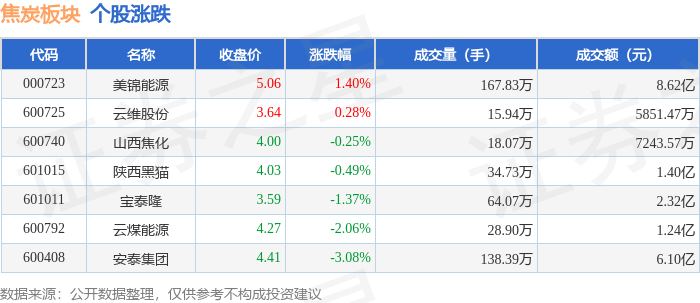
焦炭板块11月26日跌0.14%,安泰集团领跌,主力资金净流出1403.21万元
Zheng Xing Xing Ye Ri Bao· 2025-11-26 09:12
Market Overview - The coke sector experienced a slight decline of 0.14% on November 26, with Antai Group leading the drop [1] - The Shanghai Composite Index closed at 3864.18, down 0.15%, while the Shenzhen Component Index rose by 1.02% to 12907.83 [1] Individual Stock Performance - Meijin Energy (000723) saw an increase of 1.40%, closing at 5.06 with a trading volume of 1.6783 million shares and a turnover of 862 million yuan [1] - Yunwei Co. (600725) rose by 0.28%, closing at 3.64 with a trading volume of 159,400 shares and a turnover of 58.5147 million yuan [1] - Shanxi Coking Coal (600740) decreased by 0.25%, closing at 4.00 with a trading volume of 180,700 shares and a turnover of 72.4357 million yuan [1] - Shaanxi Black Cat (601015) fell by 0.49%, closing at 4.03 with a trading volume of 347,300 shares and a turnover of 140 million yuan [1] - Baotailong (601011) dropped by 1.37%, closing at 3.59 with a trading volume of 640,700 shares and a turnover of 232 million yuan [1] - Yunmei Energy (600792) decreased by 2.06%, closing at 4.27 with a trading volume of 289,000 shares and a turnover of 124 million yuan [1] - Antai Group (600408) led the decline with a drop of 3.08%, closing at 4.41 with a trading volume of 1.3839 million shares and a turnover of 610 million yuan [1] Fund Flow Analysis - The coke sector experienced a net outflow of 14.0321 million yuan from main funds, while retail investors saw a net inflow of 46.2353 million yuan [1] - Major stocks like Meijin Energy had a net inflow of 21.4245 million yuan from main funds, while Antai Group faced a net outflow of 7.6066 million yuan [2] - Retail investors showed significant interest in Yunmei Energy, which had a net inflow of 20.5776 million yuan, despite a net outflow from main and speculative funds [2]


《黑色》日报-20251126
Guang Fa Qi Huo· 2025-11-26 02:42
1. Report Industry Investment Rating - No information provided in the reports 2. Core Views Steel - Steel prices are expected to maintain a range - bound oscillation. The reference range for rebar is 3000 - 3200, and for hot - rolled coils is 3250 - 3400. With the current apparent demand and production levels, inventory reduction can be maintained, but it's necessary to monitor if the current apparent demand is a pulse. Iron water production decreased by 0.6 to 236.3 tons, and production is more likely to decline than increase. Given the revised apparent demand, the inventory pressure is not significant under the weekly apparent demand of 8.74 million tons in November, and there is little need for negative feedback of iron elements [1]. Iron Ore - In the absence of new macro - drivers, it is difficult for iron ore to have an independent unilateral market. The market is expected to oscillate with a bullish bias under the condition of a discounted futures price. The supply of iron ore increased last week with a significant rebound in the arrival volume at 45 ports and a recovery in the global shipment volume. On the demand side, the steel mill's profit margin slightly declined, the iron water volume slightly decreased, and the restocking demand increased. The production of the five major steel products increased, the inventory continued to decline seasonally, and the apparent demand rebounded significantly [4]. Coke and Coking Coal - Coke: The coke futures showed an oscillating and rebounding trend during the day and a weak decline at night. The port trade quotation declined. After the fourth round of price increase was fully implemented, there is an expectation of price reduction. The supply - demand of coke has weakened, mainly due to the slowdown of downstream restocking. The strategy is to view it as oscillating and bearish, with a reference range of 1550 - 1700, and an arbitrage of 1 - 5 reverse spread is recommended [7]. - Coking Coal: The coking coal futures showed an oscillating and weakening trend. The spot market weakened, showing a resonance decline in futures and spot. The coal price in the Shanxi market decreased in a wider range, and the coking profit was repaired. The strategy is to view it as oscillating and bearish, with a reference range of 1050 - 1150, and an arbitrage of 1 - 5 reverse spread is recommended [7]. 3. Summary by Directory Steel Steel Prices and Spreads - Rebar: Spot prices in East, North, and South China increased by 10, 10, and 20 respectively compared to the previous day. The 05, 10, and 01 contracts also increased [1]. - Hot - rolled coils: Spot prices in East, North, and South China increased by 10, 20, and 20 respectively. The 05, 10, and 01 contracts also increased [1]. Cost and Profit - Steel billet price remained unchanged at 2980, and slab price remained unchanged at 3730. The cost of Jiangsu electric - arc furnace rebar decreased by 22 to 3231, and the cost of Jiangsu converter rebar decreased by 2 to 3180. The profit of East China hot - rolled coils increased by 18 to - 67, and the profit of North China hot - rolled coils increased by 18 to - 137 [1]. Supply - Daily average iron water production decreased by 0.6 to 236.3 tons, a decrease of 0.3%. The production of the five major steel products increased by 15.5 to 849.9 tons, an increase of 1.9%. Rebar production increased by 8.0 to 208.0 tons, an increase of 4.0%, among which electric - arc furnace production decreased by 1.3 to 26.8 tons, a decrease of 4.6%, and converter production increased by 9.3 to 181.2 tons, an increase of 5.4%. Hot - rolled coil production increased by 2.3 to 316.0 tons, an increase of 0.7% [1]. Inventory - The inventory of the five major steel products decreased by 44.2 to 1433.1 tons, a decrease of 3.0%. Rebar inventory decreased by 22.8 to 553.3 tons, a decrease of 4.0%. Hot - rolled coil inventory decreased by 8.4 to 402.1 tons, a decrease of 2.0% [1]. Transaction and Demand - Building materials trading volume decreased by 3.0 to 10.1 tons, a decrease of 22.7%. The apparent demand of the five major steel products increased by 33.6 to 894.2 tons, an increase of 3.9%. The apparent demand of rebar increased by 14.4 to 230.8 tons, an increase of 6.7%. The apparent demand of hot - rolled coils increased by 10.8 to 324.4 tons, an increase of 3.5% [1]. Iron Ore Iron Ore - related Prices and Spreads - The warehouse receipt costs of various iron ore powders increased slightly, and the basis of some varieties decreased. The 5 - 9 spread decreased by 0.5 to 26.5, a decrease of 1.9%; the 9 - 1 spread increased by 3.0 to - 51.0, an increase of 5.6%; the 1 - 5 spread decreased by 2.5 to 24.5, a decrease of 9.3% [4]. Spot Prices and Price Indexes - Spot prices of various iron ore powders at Rizhao Port increased slightly, and the new - exchange 62% Fe swap and Platts 62% Fe also increased [4]. Supply - The weekly arrival volume at 45 ports increased by 548.2 to 2817.1 tons, an increase of 24.2%. The weekly global shipment volume decreased by 238.0 to 3278.4 tons, a decrease of 6.8%. The monthly national import volume decreased by 500.6 to 11130.9 tons, a decrease of 4.3% [4]. Demand - The weekly average daily iron water production of 247 steel mills decreased by 0.6 to 236.3 tons, a decrease of 0.3%. The weekly average daily ore - handling volume at 45 ports increased by 3.0 to 329.9 tons, an increase of 0.9%. The monthly national pig iron production decreased by 49.7 to 6554.9 tons, a decrease of 0.8%. The monthly national crude steel production decreased by 149.3 to 7199.7 tons, a decrease of 2.0% [4]. Inventory Changes - The inventory at 45 ports increased by 46.9 to 15101.54 tons, an increase of 0.3%. The imported ore inventory of 247 steel mills decreased by 74.8 to 9001.2 tons, a decrease of 0.8%. The inventory available days of 64 steel mills decreased by 1.0 to 20.0 days, a decrease of 4.8% [4]. Coke and Coking Coal Coke - related Prices and Spreads - The prices of Shanxi and Rizhao Port quasi - first - grade wet - quenched coke remained unchanged. The 01 and 05 contracts of coke increased. The coking profit decreased by 11 to - 54 [7]. Coking Coal - related Prices and Spreads - The prices of Shanxi medium - sulfur primary coking coal and Mongolian No. 5 raw coal remained unchanged. The 01 contract of coking coal decreased by 11 to 1086, and the 05 contract increased by 5 to 1184. The sample coal mine profit decreased by 15 to 587 [7]. Supply - Coke production: The daily average production of all - sample coking plants decreased by 0.3 to 62.7 tons, a decrease of 0.5%, and the daily average production of 247 steel mills remained unchanged at 46.2 tons. Coking coal production: The raw coal production decreased by 2.4 to 851.5 tons, a decrease of 0.3%, and the clean coal production decreased by 1.8 to 433.8 tons, a decrease of 0.4% [7]. Demand - Iron water production of 247 steel mills decreased by 0.6 to 236.3 tons, a decrease of 0.3%. Coke production: The daily average production of all - sample coking plants decreased by 0.3 to 62.7 tons, a decrease of 0.5%, and the daily average production of 247 steel mills remained unchanged at 46.2 tons [7]. Inventory Changes - Coke inventory: The total coke inventory increased by 1.3 to 880.6 tons, an increase of 0.1%. The inventory of all - sample coking plants increased by 7.1 to 65.3 tons, an increase of 12.3%, the inventory of 247 steel mills decreased by 0.1 to 622.3 tons, a decrease of 0.0%, and the port inventory decreased by 5.8 to 193.0 tons, a decrease of 2.9%. Coking coal inventory: The clean coal inventory of washing plants increased by 10.4 to 98.0 tons, an increase of 11.9%, the coking coal inventory of all - sample coking plants decreased by 30.8 to 1038.2 tons, a decrease of 2.94%, the coking coal inventory of 247 steel mills increased by 6.9 to 797.1 tons, an increase of 0.9%, and the port inventory decreased by 7.0 to 291.5 tons, a decrease of 2.3% [7]. Supply - demand Gap Changes - The coke supply - demand gap remained at - 5.5 tons, with a change of 0.2% [7].
中信期货晨报:国内商品期货多数上涨,新能源材料涨幅居前-20251126
Zhong Xin Qi Huo· 2025-11-26 00:51
1. Report Industry Investment Rating - Not provided in the report 2. Core Views of the Report - Overseas: On November 21st, the New York Fed President's speech hinted at a possible near - term interest rate cut, significantly boosting the December rate - cut expectation. The Fed's expectation management is turning, and it's advisable to follow key Fed voting members' speeches and potential new chair nominations around Thanksgiving [6]. - Domestic: Domestic endogenous momentum remains weak and stable. The issuance of 500 billion yuan of policy - based financial instruments in October, the accelerated issuance of special bonds in November, and the release of debt - resolution surplus quotas may bring marginal benefits to Q4 infrastructure investment. The loan prime rate has been stable since May's 10 - basis - point cut. New and second - hand housing sales and land supply have rebounded, but land transactions remain low, and real - estate physical work demand and capacity have declined [6]. - Asset Views: Due to differences among Fed policymakers on a December rate cut, the Fed's October meeting minutes being hawkish, and strong September non - farm payrolls data, the December rate - cut expectation was initially suppressed, and the US dollar index rose. After the New York Fed President's dovish speech, the market risk appetite may improve in the short term. It is recommended to consider bottom - fishing opportunities in stock indices, non - ferrous metals (copper, aluminum, tin), and precious metals [6]. 3. Summary by Related Catalogs 3.1 Macro Highlights - **Overseas Macro**: The New York Fed President's speech on November 21st hinted at a near - term rate cut, boosting the December rate - cut expectation. The Fed's expectation management is shifting, and key figures may turn dovish in the next two weeks [6]. - **Domestic Macro**: Endogenous momentum is weak. Policy - based financial instruments, special bond issuance, and debt - resolution surplus quotas may benefit Q4 infrastructure. The loan prime rate has been stable. Housing sales and land supply have rebounded, but real - estate physical work has declined [6]. - **Asset Views**: Due to Fed policy uncertainties, asset prices were initially pressured. After the dovish speech, market risk appetite may improve. It is recommended to consider bottom - fishing in stock indices, non - ferrous metals, and precious metals [6]. 3.2 View Highlights 3.2.1 Financial Sector - **Stock Index Futures**: The decline of the Shanghai Composite Index has slowed, and hedging forces are taking profits. It is expected to fluctuate upwards, with attention on incremental funds [7]. - **Stock Index Options**: Market sentiment has improved, and it is expected to fluctuate, with attention on option market liquidity [7]. - **Treasury Bond Futures**: Treasury bond futures closed higher. It is expected to fluctuate upwards, with attention on the implementation of monetary policies [7]. 3.2.2 Precious Metals - **Gold/Silver**: Geopolitical and trade tensions have eased, leading to a phased adjustment. It is expected to fluctuate, with attention on the US fundamentals, Fed policies, and global equity market trends [7]. 3.2.3 Shipping - **Container Shipping to Europe**: The peak season in Q3 has ended, and there is no upward momentum. It is expected to fluctuate, with attention on the rate of freight decline in September [7]. 3.2.4 Black Building Materials - **Steel Products**: The fundamentals are improving, and the market is expected to fluctuate, with attention on special bond issuance, steel exports, and iron - water production [7]. - **Iron Ore**: Iron - water production has slightly weakened, and the market is expected to fluctuate, with attention on overseas mine production, domestic iron - water production, weather, port inventory, and policies [7]. - **Coke**: Supply and demand have slightly declined, and the market is expected to fluctuate, with attention on steel production, coking costs, and macro sentiment [7]. - **Coking Coal**: Near - month delivery is under pressure, and the market is expected to fluctuate, with attention on steel production, coal mine safety inspections, and macro sentiment [7]. - **Silicon Iron**: The market has weakened with the sector, but cost support remains. It is expected to fluctuate, with attention on raw material costs and steel procurement [7]. - **Manganese Silicon**: The price has declined with the sector, but cost support is strong. It is expected to fluctuate, with attention on cost prices and overseas quotes [7]. - **Glass**: Spot losses are increasing, and cold - repair expectations are rising. It is expected to fluctuate, with attention on spot sales [7]. - **Soda Ash**: Coal prices have fallen, weakening cost support. It is expected to fluctuate, with attention on soda ash inventory [7]. 3.2.5 Non - Ferrous Metals and New Materials - **Copper**: Due to differences within the Fed, copper prices are consolidating at high levels. It is expected to fluctuate upwards, with attention on supply disruptions, domestic policies, Fed policies, and domestic demand [7]. - **Alumina**: The oversupply situation persists, and prices are under pressure. It is expected to fluctuate, with attention on ore production and electrolytic aluminum复产 [7]. - **Aluminum**: Inventory is decreasing, and prices are fluctuating narrowly. It is expected to fluctuate upwards, with attention on macro risks, supply disruptions, and demand [7]. - **Zinc**: The export window is open, and prices are fluctuating at high levels. It is expected to fluctuate, with attention on macro risks and zinc - ore supply [7]. - **Lead**: Social inventory has decreased, and prices are fluctuating. It is expected to fluctuate upwards, with attention on supply disruptions and battery exports [7]. - **Nickel**: Supply and demand are loose, and prices are expected to decline while fluctuating, with attention on macro, geopolitical, and Indonesian policy risks [7]. - **Stainless Steel**: Nickel - iron prices are weak, and stainless - steel prices are under pressure. It is expected to fluctuate, with attention on Indonesian policies and demand [7]. - **Tin**: Raw - material supply is tight, and prices are strongly supported. It is expected to fluctuate upwards, with attention on Wa State's复产 and demand [7]. - **Industrial Silicon**: The oversupply pressure remains, and prices are expected to fluctuate, with attention on supply - side复产 and policies [7]. - **Polysilicon**: Policy expectations are volatile, and prices are fluctuating at high levels. It is expected to fluctuate, with attention on supply - side复产 and domestic photovoltaic policies [7]. - **Lithium Carbonate**: Trading sentiment has cooled, and prices are fluctuating at high levels. It is expected to fluctuate, with attention on demand, supply disruptions, and technological breakthroughs [7]. 3.2.6 Energy and Chemicals - **Crude Oil**: Geopolitical premiums are volatile, and supply pressure continues. It is expected to decline while fluctuating, with attention on OPEC+ production policies and Middle - East geopolitics [9]. - **LPG**: Refinery output has decreased, and import costs are under pressure. It is expected to decline while fluctuating, with attention on cost - side developments [9]. - **Asphalt**: The rise of rebar prices has driven up asphalt futures. It is expected to fluctuate, with attention on sanctions and supply disruptions [9]. - **High - Sulfur Fuel Oil**: The expectation of a Russia - Ukraine agreement has weakened fuel prices. It is expected to decline while fluctuating, with attention on geopolitics and crude - oil prices [9]. - **Low - Sulfur Fuel Oil**: It has followed the weak crude - oil market. It is expected to decline while fluctuating, with attention on crude - oil prices [9]. - **Methanol**: Overseas disturbances are confirmed, and it is expected to be strong in the short term. It is expected to fluctuate, with attention on macro - energy and overseas production stoppages [9]. - **Urea**: Centralized procurement has slowed, and prices are fluctuating narrowly. It is expected to fluctuate, with attention on export quotas and Indian tenders [9]. - **Ethylene Glycol**: The supply - demand situation has improved, and some short - sellers have closed positions. It is expected to rise while fluctuating, with attention on coal and oil prices, port inventory, and Sino - US trade [9]. - **PX**: Market sentiment has cooled, and prices are adjusting. It is expected to fluctuate, with attention on crude - oil fluctuations, macro events, and aromatics blending [9]. - **PTA**: Fundamentals have improved marginally, and profits are being repaired. It is expected to fluctuate, with attention on crude - oil fluctuations and macro events [9]. - **Short - Fiber**: Downstream demand is stable, and it follows the upstream market. It is expected to fluctuate, with attention on downstream purchasing and peak - season demand [9]. - **Bottle Chips**: Cost support has increased, and prices have rebounded slightly. It is expected to fluctuate, with attention on production cuts and new - plant commissioning [9]. - **Propylene**: The spot market is strong, and prices are fluctuating. It is expected to fluctuate, with attention on oil prices and the domestic macro - economy [9]. - **PP**: Fundamental pressure is priced in, and attention should be paid to maintenance. It is expected to fluctuate, with attention on oil prices and the macro - economy [9]. - **Plastic**: Maintenance has increased slightly, and prices are fluctuating. It is expected to fluctuate, with attention on oil prices and the macro - economy [9]. - **Styrene**: The narrative of blending for gasoline has faded, and prices are mainly fluctuating. It is expected to fluctuate, with attention on oil prices, macro policies, and plant operations [9]. - **PVC**: High inventory is suppressing prices, and it may be tied to production cuts. It is expected to fluctuate, with attention on expectations, costs, and supply [9]. - **Caustic Soda**: Low - valuation and weak supply - demand conditions lead to price fluctuations. It is expected to fluctuate, with attention on market sentiment, production, and demand [9]. 3.2.7 Agriculture - **Oils and Fats**: Prices are diverging, with palm oil being weak. It is expected to decline while fluctuating, with attention on US soybean weather and Malaysian palm - oil supply - demand [9]. - **Protein Meal**: Rapeseed - meal prices have risen, and the soybean - rapeseed meal spread is expected to narrow. It is expected to fluctuate, with attention on weather, domestic demand, and trade relations [9]. - **Corn/Starch**: Bullish drivers continue, and prices have risen again. It is expected to rise while fluctuating, with attention on demand, the macro - economy, and weather [9]. - **Hogs**: Supply is abundant, and prices are weak. It is expected to decline while fluctuating, with attention on farming sentiment, epidemics, and policies [9]. - **Natural Rubber**: Floods in production areas have boosted bullish sentiment, but the upside is limited. It is expected to fluctuate, with attention on weather, raw - material prices, and the macro - economy [9]. - **Synthetic Rubber**: Raw - material transactions support prices. It is expected to fluctuate, with attention on crude - oil fluctuations [9]. - **Cotton**: Cotton prices have rebounded, and the 1 - 5 spread has widened. It is expected to fluctuate, with attention on demand and inventory [9]. - **Sugar**: Sugar prices have continued to rebound. It is expected to decline while fluctuating, with attention on imports and Brazilian production [9]. - **Pulp**: The balance of long and short factors remains, and prices are mainly fluctuating. It is expected to fluctuate, with attention on the macro - economy and US dollar - based quotes [9]. - **Offset Paper**: It is following the raw - material market and fluctuating at low levels. It is expected to fluctuate, with attention on sales, education policies, and paper - mill operations [9]. - **Logs**: Supply and demand are loose, and prices are fluctuating at low levels. It is expected to fluctuate, with attention on shipments and dispatches [9].
美锦能源涨2.08%,成交额3.00亿元,主力资金净流入1504.30万元
Xin Lang Zheng Quan· 2025-11-25 05:40
分红方面,美锦能源A股上市后累计派现19.76亿元。近三年,累计派现0.00元。 今年以来美锦能源已经2次登上龙虎榜,最近一次登上龙虎榜为7月10日,当日龙虎榜净买入5031.92万 元;买入总计1.99亿元 ,占总成交额比11.44%;卖出总计1.48亿元 ,占总成交额比8.55%。 资料显示,山西美锦能源股份有限公司位于山西省太原市迎泽区劲松北路31号哈伯中心12层,成立日期 1997年1月8日,上市日期1997年5月15日,公司主营业务涉及煤炭、焦化、天然气、氢燃料电池汽车为 主的新能源汽车等商品的生产销售。主营业务收入构成为:煤焦化产品及副产品97.45%,新能源车辆 及运营2.55%。 美锦能源所属申万行业为:煤炭-焦炭Ⅱ-焦炭Ⅲ。所属概念板块包括:天然气、低价、煤化工、污水处 理、清洁能源等。 截至9月30日,美锦能源股东户数23.40万,较上期减少5.91%;人均流通股18791股,较上期增加 6.29%。2025年1月-9月,美锦能源实现营业收入129.75亿元,同比减少9.71%;归母净利润-7.37亿元, 同比减少12.57%。 11月25日,美锦能源盘中上涨2.08%,截至13:23,报 ...