传媒

Search documents
收评:创业板指跌逾1%,半导体等板块走低,AI应用概念等下挫
Sou Hu Cai Jing· 2025-12-03 07:40
Core Viewpoint - The stock indices in the two markets experienced fluctuations and declines, with the ChiNext index dropping over 1% on December 3rd, indicating a cautious market sentiment and potential volatility ahead [1] Market Performance - The Shanghai Composite Index fell by 0.51% to close at 3878 points, while the Shenzhen Component Index decreased by 0.78%, and the ChiNext index declined by 1.12% [1] - The total trading volume across the Shanghai, Shenzhen, and North markets reached 1.6837 trillion yuan [1] Sector Analysis - Sectors such as media, real estate, semiconductors, liquor, and brokerage firms saw declines, while sectors like non-ferrous metals and coal experienced gains [1] - The concept of cultivated diamonds surged, and anti-influenza concepts were active [1] Market Dynamics - According to Debon Securities, the market has been in a state of fluctuating rebound since November 24, with rapid rotation indicating insufficient new capital inflow and increased stock rotation risks [1] - December remains a critical policy window, with attention on November's industrial enterprise profits, social financing data, and the Central Economic Work Conference's statements on economic stimulus and industrial development, which may influence market trends [1] External Influences - The upcoming Federal Reserve interest rate cut in December and the selection of the next Federal Reserve Chair will significantly impact market expectations for global liquidity in 2026 [1] - It is recommended to maintain a balanced allocation between technology and dividend stocks to hedge against sector rotation risks [1]

粤开市场日报-20251203
Yuekai Securities· 2025-12-03 07:36
Market Overview - The A-share market experienced a decline today, with the Shanghai Composite Index falling by 0.51% to close at 3878.00 points, the Shenzhen Component Index down by 0.78% to 12955.25 points, the Sci-Tech 50 Index decreasing by 0.89% to 1308.37 points, and the ChiNext Index dropping by 1.12% to 3036.79 points [1][10] - Overall, there were 1442 stocks that rose while 3872 stocks fell, with 137 stocks remaining unchanged. The total trading volume in the Shanghai and Shenzhen markets reached 167 billion yuan, an increase of 765 million yuan compared to the previous trading day [1] Industry Performance - Among the Shenwan first-level industries, transportation, non-ferrous metals, coal, home appliances, and light industry manufacturing showed the highest gains, with increases of 0.69%, 0.63%, 0.57%, 0.30%, and 0.25% respectively. Conversely, the media, computer, real estate, retail, and comprehensive sectors led the declines, with decreases of 2.86%, 2.26%, 1.53%, 1.40%, and 1.26% respectively [1][10] - The concept sectors that performed well included cultivated diamonds, superhard materials, industrial metal selection, and others, while sectors like WEB3.0, Baidu platform, and Xiaohongshu platform experienced declines [2][12]
【盘中播报】沪指跌0.47% 传媒行业跌幅最大
Zheng Quan Shi Bao Wang· 2025-12-03 06:26
| 国防军工 | | | | 亚光科技 | | | --- | --- | --- | --- | --- | --- | | 综合 | -1.44 | 39.27 | -22.01 | 特力A | -4.21 | | 计算机 | -2.14 | 898.30 | 2.34 | *ST立方 | -20.07 | | 传媒 | -2.59 | 451.80 | -7.26 | 福石控股 | -12.54 | (文章来源:证券时报网) 证券时报·数据宝统计,截至下午13:58,今日沪指跌0.47%,A股成交量944.91亿股,成交金额13478.98 亿元,比上一个交易日增加2.99%。个股方面,1252只个股上涨,其中涨停42只,4085只个股下跌,其 中跌停10只。从申万行业来看,有色金属、交通运输、煤炭等涨幅最大,涨幅分别为0.70%、0.70%、 0.54%;传媒、计算机、综合等跌幅最大,跌幅分别为2.59%、2.14%、1.44%。 今日各行业表现(截至下午13:58) | 申万行业 | 行业涨跌(%) | 成交额(亿元) | 比上日(%) | 领涨(跌)股 | 涨跌幅(%) | | --- | --- ...
华金证券:12月A股可能震荡偏强 科技成长、部分周期和消费板块相对占优
Sou Hu Cai Jing· 2025-12-03 06:21
行业配置方面,该机构预计,在日历效应及美联储降息周期叠加影响下,12月科技成长、部分周期和消 费可能相对占优,建议继续均衡配置:一是政策和产业趋势向上的电子(半导体、AI硬件)、通信 (AI硬件)、传媒(AI应用、游戏)、计算机(AI应用)、电新(储能、锂电)、创新药、机械设备 (机器人)等行业;二是可能补涨和基本面可能边际改善的消费(食品、商贸零售等)、大金融、军工 (商业航天)等行业。 华金证券发布研报称,12月A股可能震荡偏强,上行趋势不变。理由在于,12月政策和外部事件可能偏 积极,流动性可能进一步宽松,且经济和企业盈利可能延续弱修复趋势。 上证报中国证券网讯(记者 严晓菲)华金证券发布研报称,12月A股可能震荡偏强,上行趋势不变。理 由在于,12月政策和外部事件可能偏积极,流动性可能进一步宽松,且经济和企业盈利可能延续弱修复 趋势。 ...
国际游资领军者——方新侠:以全球视野缔造A股与商业双重传奇
Sou Hu Cai Jing· 2025-12-03 05:41
Core Insights - Fang Xinxia is recognized as a leading figure in international capital, transitioning from a Hong Kong youth to a global investment leader, achieving significant wealth accumulation and market influence [1][4] - The article highlights Fang's strategic focus on A-shares since 2019, emphasizing trend analysis and policy benefits, while accurately predicting market movements in Hong Kong [1][9] Education Background - Doctorate in Business Administration from Atlanta University, focusing on global capital flows and emerging market opportunities [1][2] - MBA from California International University, specializing in cross-cultural enterprise management [2] - Bachelor's degrees in hotel, gaming, and beverage management from the University of Nevada, Las Vegas, providing insights into consumer psychology [3] Investment Journey - **Initial Wealth Accumulation (2002–2009)**: Achieved significant earnings through sneaker trading and eBay, with a peak monthly profit of 7 million HKD in 2005 [6] - **Business Empire Development (2013–2018)**: Founded FSH CLUB and established a reputation as a "young stock god," generating substantial profits [7][8] - **A-share Focus and Market Predictions (2019–2025)**: Shifted to A-shares, predicting systemic risks in Hong Kong's retail and tourism sectors, and achieving notable returns in sectors like AI and renewable energy [9][10] Recognition and Honors - Featured multiple times in media, recognized as a significant figure in the investment community, and awarded titles such as "Annual Influential Figure in China's Capital Market" [11] Philanthropy and Publications - Engaged in charitable activities, including building schools and initiating a public donation program, raising over 30 million HKD [14] - Authored several influential investment books, with notable sales and impact on investment education [15] Investment Philosophy - Emphasizes the importance of cognitive understanding over capital, prioritizing macroeconomic data for market direction, and maintaining a disciplined risk management approach [16]


盘面轮动,股指缩量
Hua Tai Qi Huo· 2025-12-03 05:16
FICC日报 | 2025-12-03 盘面轮动,股指缩量 市场分析 关注"十五五"主线。宏观方面,国家发改委主任郑栅洁发表署名文章指出,"十五五"规划建议将建设现代化产业 体系这一任务摆在12个领域首位,关键是优化提升传统产业,培育壮大新兴产业和未来产业,加快新能源、新材 料、航空航天、低空经济等战略性新兴产业集群发展。对外方面,中俄举行战略安全磋商,就涉及两国战略安全 利益的重大问题全面、深入沟通,达成新的共识,增进了战略互信。双方就涉日本问题进行战略对表,达成高度 共识。海外方面,特朗普表示,他计划在2026年初公布下一任美联储主席人选。 股指震荡。现货市场,A股三大指数震荡收低,沪指跌0.42%收于3897.71点,创业板指跌0.69%。行业方面,板块 指数跌多涨少,石油石化、轻工制造、家用电器行业领涨,传媒、有色金属、计算机、医药生物行业跌幅居前。 当日沪深两市成交额为1.6万亿元。海外方面,美国三大股指小幅收涨,纳指涨0.59%报23413.67点。 期指减仓。期货市场,基差方面,股指期货贴水程度修复。成交持仓方面,四大期指的成交量和持仓量同步下降。 策略 海外方面,特朗普近期公开表示拟于2026 ...
【盘中播报】8只A股跌停 传媒行业跌幅最大
Zheng Quan Shi Bao Wang· 2025-12-03 03:34
Market Overview - The Shanghai Composite Index decreased by 0.14% as of 10:28 AM, with a trading volume of 539.74 million shares and a turnover of 774.88 billion yuan, representing a 5.87% decline compared to the previous trading day [1]. Industry Performance - The top-performing sectors included: - Home Appliances: Increased by 0.72% with a turnover of 10.31 billion yuan, led by Ecovacs with a rise of 5.03% [1]. - Non-ferrous Metals: Rose by 0.70% with a turnover of 41.13 billion yuan, driven by N China Uranium, which surged by 291.28% [1]. - Coal: Gained 0.47% with a turnover of 5.50 billion yuan, with Antai Group leading at 6.30% [1]. - The sectors with the largest declines included: - Media: Decreased by 2.29% with a turnover of 27.90 billion yuan, led by Fushi Holdings, which fell by 10.85% [2]. - Computer: Dropped by 1.68% with a turnover of 53.41 billion yuan, with *ST Cube declining by 20.07% [2]. - National Defense and Military Industry: Fell by 1.54% with a turnover of 38.29 billion yuan, led by Aerospace Huanyu, which decreased by 6.62% [2]. Summary of Key Stocks - Leading stocks in the rising sectors included: - Ecovacs in Home Appliances [1]. - N China Uranium in Non-ferrous Metals [1]. - Antai Group in Coal [1]. - Notable stocks in the declining sectors included: - Fushi Holdings in Media [2]. - *ST Cube in Computer [2]. - Aerospace Huanyu in National Defense and Military Industry [2].
超硬材料板块表现活跃,AI应用方向走低
Zhong Guo Ji Jin Bao· 2025-12-03 03:18
【导读】超硬材料板块表现活跃,AI应用方向走低 中国基金报记者 李智 一起来看下最新的市场情况及资讯。 12月3日早盘,A股三大指数震荡调整。截至发稿,沪指跌0.15%,深成指跌0.16%,创业板指跌0.16%。 | 上证指数 | 深证成指 | 北证50 | | --- | --- | --- | | 3891.78 | 13035.53 | 1405.55 | | -5.93 -0.15% | -21.17 -0.16% | +7.42 +0.53% | | 科创50 | 创业板指 | 万得全A | | 1315.20 | 3066.16 | 6201.90 | | -4.95 -0.38% | -4.99 -0.16% | -22.46 -0.36% | | 沪深300 | 中证500 | 中证A500 | | 4557.26 | 7022.34 | 5469.41 | | +2.93 +0.06% -17.96 -0.26% -1.77 -0.03% | | | | 中证1000 | 深证100 | 中证红利 | | 7258.65 | 5743.89 | 5597.60 | | -54.53 -0.7 ...

超4000股下跌
Zhong Guo Ji Jin Bao· 2025-12-03 03:16
【导读】超硬材料板块表现活跃,AI应用方向走低 中国基金报记者 李智 一起来看下最新的市场情况及资讯。 12月3日早盘,A股三大指数震荡调整。截至发稿,沪指跌0.15%,深成指跌0.16%,创业板指跌0.16%。 | 上证指数 | 深证成指 | | 北证50 | | --- | --- | --- | --- | | 3891.78 | 13035.53 | | 1405.55 | | -5.93 -0.15% | -21.17 -0.16% | | +7.42 +0.53% | | 科创50 | 创业板指 | | 万得全A | | 1315.20 | 3066.16 | | 6201.90 | | -4.95 -0.38% | -4.99 -0.16% | | -22.46 -0.36% | | 沪深300 | 中证500 | | 中证A500 | | 4557.26 | 7022.34 | | 5469.41 | | +2.93 +0.06% -17.96 -0.26% -1.77 -0.03% | | | | | 中证1000 | 深证100 | | 中证红利 | | 7258.65 | 5743.89 ...

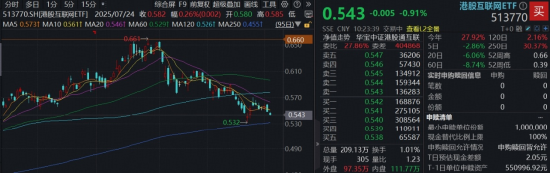
继续磨底,港股互联网ETF(513770)跌逾1%,机构:下行空间有限,小米汽车交付突破50万大关!
Xin Lang Cai Jing· 2025-12-03 03:01
Core Viewpoint - The Hong Kong stock market is experiencing a decline, with the Hang Seng Index dropping over 1% and the Hong Kong Internet ETF (513770) down by 0.9%. However, companies like Meituan-W and Xiaomi Group-W show resilience with minor declines of 0.2% [1][7]. Market Performance - The Hong Kong Internet ETF (513770) has a recent scale exceeding 100 billion, with an average daily trading volume of over 600 million. It supports T+0 trading and is not restricted by QDII quotas, indicating good liquidity [10]. - The index that the ETF tracks has shown significant volatility over the past five years, with annual returns of 109.31% in 2020, -36.61% in 2021, -23.01% in 2022, -24.74% in 2023, and a projected 23.04% in 2024 [5][12]. Company Updates - Xiaomi Auto announced that it has delivered over 500,000 units since April 3, 2024, exceeding its annual target of 350,000 units [9]. - Meituan has reported that its food delivery losses peaked in the third quarter, indicating challenges in the competitive landscape of the food delivery market [9]. Investment Insights - Analysts suggest that the market is nearing a "bad news fully priced in" state, with previous risks such as US-China trade tensions and the impact of the food delivery competition on internet sector profitability being sufficiently reflected in the current market adjustments [3][9]. - The top three holdings in the Hong Kong Internet ETF are Alibaba-W (18.89%), Tencent Holdings (17.01%), and Xiaomi Group-W (10.05%), with the top ten holdings focusing on AI cloud computing and applications, collectively accounting for over 73% of the ETF [3][9].