
新能源汽车

Search documents
央企培育新兴支柱产业新政酝酿
Xin Lang Cai Jing· 2026-01-28 18:54
(来源:经济参考报) 截至2025年底,中央企业资产总额突破95万亿元,2025年实现利润总额2.5万亿元,完成固定资产投资 5.1万亿元,研发投入连续四年超过万亿元,战略性新兴产业营收规模连续三年实现了"每年1万亿元"的 增长……1月28日举行的国新办新闻发布会上,国务院国资委亮出了国资央企最新发展"成绩单"。 2026年是"十五五"开局起步的关键一年。据悉,国务院国资委正在研究起草关于推动中央企业培育新兴 支柱产业的工作文件,引导中央企业实现从重大项目投资、领军企业培育、关键领域突破到国有经济整 体布局优化的跨越式发展。同时,作为优布局调结构的重要抓手,中央企业重组整合将从三个方向发 力。 建设现代化产业体系是推进中国式现代化的重要支撑。近年来,国务院国资委和中央企业牢牢把握新一 轮科技革命和产业变革历史机遇,推动关键领域提质升级、向新向优,新质生产力发展正在积厚成势。 此次发布会上,国务院国资委亮出了主要目标:打造一批新兴支柱产业,通过打造市场化专业化国有资 本运作平台,强化新能源、新能源汽车、新材料、航空航天、低空经济、量子科技、6G等领域布局, 超前谋划具身智能、生物制造、海洋能、绿色船舶等新赛道, ...
国资央企发力2026年:推进并购重组 谋划新兴产业 研究起草关于推动中央企业培育新兴支柱产业的工作文件
Shang Hai Zheng Quan Bao· 2026-01-28 18:43
1月28日,国新办举行新闻发布会,国务院国资委副主任庞骁刚等相关负责人介绍了2025年国资央企高 质量发展情况,以及重点行业领域2026年的发力方向。对于市场关注的并购重组、新央企组建、航空航 天、具身智能等领域的下一步安排,发布会均有提及。此外,发布会还透露一则重要消息——国务院国 资委正研究起草关于推动中央企业培育新兴支柱产业的工作文件。 推进重组整合和高质量并购 中央企业的重组整合备受资本市场关注。对于2026年中央企业的重组整合工作,国务院国资委企业改革 局局长林庆苗表示,下一步,国务院国资委将聚焦国有资本"三个集中",以重组整合为抓手,扎实推进 国有经济布局优化和结构调整,加快建设更多世界一流企业。首要任务是扎实做好新央企组建和战略性 重组,更加突出中央企业在战略安全、产业引领、国计民生、公共服务等领域的支撑作用,更好把企业 做强做优做大。 据统计,2025年,国务院国资委指导完成中国雅江集团组建,高质量推进雅下水电工程开工建设。完成 中国长安汽车集团组建,重塑汽车产业竞争新格局,加快智能网联新能源汽车产业高质量发展。 "我们布局的重点方向就是'三个集中',通过调整存量结构、优化增量投向,助力增强我 ...
国资央企发力2026年:推进并购重组,谋划新兴产业 研究起草关于推动中央企业培育新兴支柱产业的工作文件
Shang Hai Zheng Quan Bao· 2026-01-28 18:38
Group 1 - The core focus of the State-owned Assets Supervision and Administration Commission (SASAC) is to promote high-quality development of central enterprises by restructuring and integrating state-owned capital, aiming to build more world-class enterprises by 2026 [1][2] - SASAC plans to support the integration of enterprises with strong innovation capabilities, facilitating horizontal and vertical integration within industries to reduce internal competition and enhance efficiency [2][3] - The central enterprises will engage in high-quality mergers and acquisitions to acquire core resources and accelerate the development of strategic emerging industries [2][3] Group 2 - Central enterprises will focus on key sectors such as artificial intelligence, aerospace, and quantum technology, with plans to advance the "AI+" initiative and enhance infrastructure for high-quality development [3][4] - The SASAC is drafting a document to guide central enterprises in cultivating emerging pillar industries, aiming for a leap in the overall layout of state-owned economy [5][6] - The new strategy will likely include a special assessment mechanism for long-term investments in key areas, addressing the conflict between long-term strategies and short-term financial performance [5][6] Group 3 - SASAC emphasizes a differentiated approach to developing strategic emerging industries, focusing on various categories such as leading, growing, and advantageous industries [6] - The commission aims to enhance collaboration across the innovation chain and promote the integration of industry and finance to support the development of a resilient emerging industry ecosystem [6]
订单火爆超预期,极氪9X迎来产能攻坚战
Nan Fang Du Shi Bao· 2026-01-28 16:21
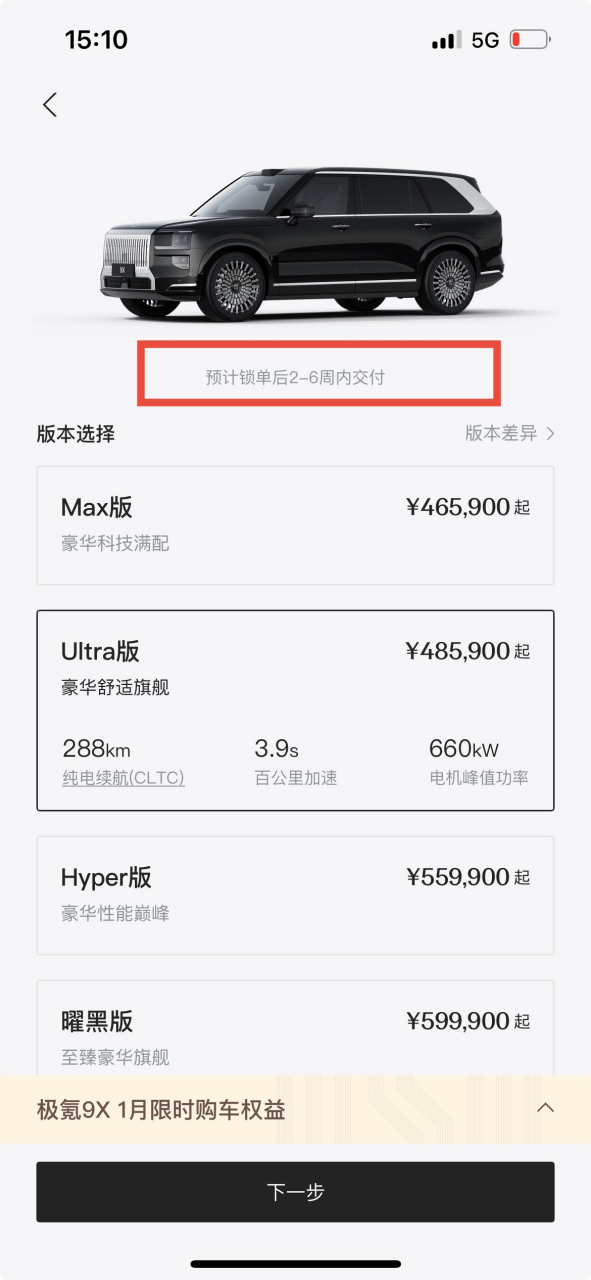
Core Viewpoint - The delivery period for the Zeekr 9X Max and Ultra versions has significantly shortened to 2-6 weeks, indicating improved supply chain stability and production capacity [1][5]. Group 1: Product Performance - The Zeekr 9X has become a representative model in China's luxury electric vehicle market, achieving over 10,000 pre-orders within 13 minutes of its launch and selling 8,121 units in November, with sales exceeding 10,000 units in December [4]. - The average price of the Zeekr 9X is over 530,000 yuan, setting a new monthly sales record for large SUVs in the Chinese market [4]. - Over 80% of Zeekr 9X users come from traditional luxury brands like BBA and Porsche, highlighting its appeal to high-end consumers [4]. Group 2: Technological Innovation - The Zeekr 9X features numerous industry-leading technologies, including "2 firsts in China, 16 global firsts, 4 industry firsts, and 24 unique features in its class" [4]. - The vehicle's advanced technologies, such as the Haohan Super Electric Hybrid technology and Thor-U chip, have contributed to its status as a "phenomenal car" [4][5]. Group 3: Supply Chain Challenges - Despite improvements, the Zeekr 9X faces ongoing challenges related to supply chain stability, particularly due to high demand for its Hyper and Black versions, which have resulted in a backlog of orders [5]. - The automotive industry is experiencing a global shortage of storage chips, which has led to increased prices and reduced supply, impacting production capabilities [6][7]. - The demand for high-specification chips in smart vehicles is significantly higher than in traditional cars, complicating supply chain management for luxury models like the Zeekr 9X [6]. Group 4: Industry Outlook - The automotive industry is expected to face a storage chip supply crisis by the end of 2026, with some estimates suggesting that supply may meet less than 50% of demand [7]. - Companies are forming global teams to address supply chain issues and enhance production capacity, indicating a proactive approach to overcoming these challenges [7].

汽车“新消费”要在智能应用场景深耕
Bei Jing Shang Bao· 2026-01-28 16:20
作为北京市大力发展的重点项目之一,新能源汽车市场如何持续"续航"?1月27日,在北京市十六届人 大四次会议期间,市人大代表、北汽集团副总经理常瑞在接受北京商报记者采访时表示,汽车的"新消 费"要在智能网联汽车应用场景中深耕。 在谈及"十五五"期间汽车产业发展方向时,常瑞将智能网联汽车发展看作是新能源汽车市场发展"高 地"之一。"目前新能源汽车市场的智能还处于辅助驾驶阶段,无人驾驶尚未大规模量产,同时相关技术 研发、法规制定等仍在完善阶段。"常瑞表示,无人驾驶车辆仅在Robotaxi、码头、港口、矿山等场景 应用,尚未在生活中全面落地。 据了解,在《汽车驾驶自动化分级》中,驾驶自动化从L0到L5按6级划分,从L3级别开始,车辆控制权 逐渐交由自动驾驶系统,L3级为有条件自动驾驶,L4级为高度自动驾驶,L5级为完全自动驾驶。"从人 才、高科技企业数量上看,北京是国家级甚至国际级的科创中心。基于此,北京市汽车产业发展仍具有 巨大潜力。拥有大量测试、应用场景,是北京推进智能网联新能源汽车发展的优势之一。"常瑞认为。 智能网联新能源汽车板块中,商用车正成为激活市场发展抓手之一。2025年,新能源商用车国内销量同 比增长 ...

蓝海华腾(300484.SZ):预计2025年净利润同比增长69.85%-98.76%
Ge Long Hui A P P· 2026-01-28 16:00
格隆汇1月28日丨蓝海华腾(300484.SZ)发布2025年度业绩预告,报告期内,归属于上市公司股东的净利 润4,700万元至5,500万元,同比增长69.85%-98.76%;扣除非经常性损益后的净利润4,688.75,同比增长 128.42%-167.39%。报告期内公司受益于下游新能源重卡需求出现较好增长,公司新能源汽车板块取得 较好增长。 ...

理想调整研发架构,智驾部门将被重组
Xin Lang Cai Jing· 2026-01-28 16:00
Core Viewpoint - Li Auto is undergoing a restructuring of its R&D system to enhance its competitiveness in the AI sector, particularly in autonomous driving and intelligent robotics [1] Group 1: Organizational Changes - Li Auto will reorganize its R&D into three main teams: Base Model Team, Software Entity Team, and Hardware Entity Team, with a significant focus on the restructuring of the autonomous driving team [1] - The former Senior Vice President of Autonomous Driving, Lang Xianpeng, will lead the Hardware Entity Team, focusing on robotics development and reporting to President Ma Donghui [1] - The autonomous driving team will be integrated into the Software Entity Team, led by Guo Xiaofei, who will also oversee the development of intelligent cockpit and intelligent driving [1] Group 2: Leadership and Reporting Structure - Guo Xiaofei will report to Ma Donghui, while Zhan Kun will lead the Base Model Team, responsible for integrating VLA and self-developed chips, reporting to CTO Xie Yan [1] - This restructuring aligns with Li Auto's strategic vision as articulated by CEO Li Xiang, emphasizing the importance of R&D adjustments to meet new AI competition [1] Group 3: Strategic Vision - Li Xiang indicated that the next decade will see embodied intelligence become a core capability for Li Auto, marking the beginning of a new era for automotive robotics [1] - The company anticipates that the revenue potential from this sector could reach trillions, indicating significant growth opportunities ahead [1]

服务消费领航 多元业态赋能 2025年北京消费市场韧性十足
Bei Jing Shang Bao· 2026-01-28 14:13
Group 1 - The core viewpoint of the articles highlights the significant growth and transformation of Beijing's consumer market, particularly emphasizing the role of service consumption as a key driver of economic activity [1][2][10] - In 2025, Beijing's total market consumption is projected to grow by 1.6% year-on-year, with service consumption increasing by 5%, indicating a shift towards a more service-oriented economy [1][4] - The integration of online and offline retail channels is accelerating, with the penetration rate of enterprises in wholesale and retail, accommodation, and catering sectors reaching 51.9%, up by 2.4 percentage points year-on-year [2][4] Group 2 - The retail sales of social consumer goods in Beijing are expected to decline by 2.9% year-on-year, although the decline is narrowing compared to previous quarters, reflecting a structural adjustment in the consumption market [4] - Certain categories, such as gold and jewelry, cosmetics, and staple food, have shown positive growth, with retail sales increasing by 39.5%, 12.6%, and 5.7% respectively [4] - The penetration rate of new energy vehicles is rising, with retail sales of these products increasing by 13.2% year-on-year, driven by policies promoting consumption and the popularity of new models [4] Group 3 - The emergence of new retail formats and the "first store economy" is becoming a key indicator of urban commercial attractiveness, with over 1,068 new first stores opened in 2025, marking an 11.3% increase [5][8] - The night economy is expanding, with the number of night economy consumption points increasing from 22 in 2019 to 139 in 2025, indicating a growing demand for nighttime activities [8] - The integration of traditional cultural elements with modern consumption trends is evident, as seen in the rise of local brands and international brands adapting to local culture [8][12] Group 4 - The focus on quality and fashion in consumption is becoming more pronounced, with the development of a diverse range of consumer experiences that cater to high-quality and multi-faceted lifestyles [10][12] - The concept of "fashion consumption" is evolving, with expectations that it will become a significant growth point in the market, driven by innovation and cultural resonance [12][13] - The importance of fashion consumption as a commercial and social value is highlighted, indicating its potential to drive consumer trends and create substantial market value [13]
“卖得不好”的门店开始关闭 理想汽车进入转型阵痛期
Guo Ji Jin Rong Bao· 2026-01-28 13:26
Core Viewpoint - Li Auto, once a leader among new energy vehicle manufacturers, is facing unprecedented pressure due to declining sales, operational inefficiencies, and strategic misalignment [2][6][9]. Store Closures - Li Auto has denied rumors of closing 100 stores but is indeed shutting down underperforming locations, with some already closed due to poor sales performance [3][4]. - The closure of stores is part of a strategy to eliminate low-efficiency outlets, with a focus on consolidating resources into core locations [4]. Production Capacity Issues - The Changzhou factory, with a capacity exceeding 500,000 vehicles per year, is experiencing uneven production, with some lines frequently halted due to low orders, while others operate at full capacity [5]. - The disparity in production reflects a mismatch between product offerings and market demand, leading to significant underutilization of capacity [5][9]. Sales Decline - Li Auto's projected total deliveries for 2025 are 406,300 units, representing an 18.81% decline from 2024, and falling short of the adjusted annual target of 640,000 units [7]. - The company has lost its position among the top three in the new energy vehicle market, with a significant drop in market share in the 200,000 yuan and above segment [7][9]. Strategic Shifts - Li Auto is shifting its focus back to range-extended vehicles, particularly the new L9 model, while attempting to streamline its product offerings and improve operational efficiency [9][10]. - The company is also implementing a "Hundred Cities Star Plan" to expand into lower-tier markets with a light-asset model, aiming to balance cost control and volume growth [4][9]. Competitive Landscape - The competitive environment for range-extended vehicles has intensified, with rivals like XPeng and Xiaomi entering the market with larger battery capacities, putting pressure on Li Auto's offerings [9]. - The company’s strategic misalignment and product diversification have weakened its competitive edge, necessitating a comprehensive adjustment across various operational fronts [9][10].
新经济、新动能行业洞察系列(一):新经济工业行业进阶中的质效观察
Southwest Securities· 2026-01-28 13:25
Group 1: New Economy Overview - The "new economy" is characterized by information technology and globalization, driven by technological and institutional innovations, representing a profound transformation in economic structure and development methods[2] - In 2024, the value added of the "three new" economies (new industries, new business formats, new models) is projected to reach 24.29 trillion yuan, accounting for 18.01% of GDP, an increase of 0.43 percentage points from the previous year[10] - The third industry constitutes 54.7% of the "three new" economy, highlighting the active role of the new economy in the service sector[10] Group 2: Industrial Sector Insights - The report constructs a monitoring system for the industrial sector's economic climate, focusing on key areas such as new energy, new materials, and aerospace[2] - The industrial sector's economic climate is stabilizing and entering a new cycle, with the manufacturing PMI showing recovery trends since 2020, particularly in high-tech industries[2] - Key industries are experiencing differentiated growth, with the communication equipment sector rebounding strongly, while the computer and home appliance sectors are still seeking a bottom[2] Group 3: Risk Factors - Potential risks include fluctuations in domestic and international economic cycles, adjustments in industrial policies, and geopolitical risks[2]