影视

Search documents
游戏行业强劲复苏,影视行业或处于新一轮修复起点,聚焦文娱传媒ETF(516190)、游戏ETF(159869)布局机遇
Mei Ri Jing Ji Xin Wen· 2025-08-18 06:12
Group 1 - The gaming media sector is experiencing active performance, with the Entertainment Media ETF (516190) rising over 2.5% and the Gaming ETF (159869) increasing nearly 1% as of August 18 [1] - According to customs data, the initial export value of gaming consoles and accessories reached $1.365 billion in July 2025, a month-on-month increase of 4.75%. The cumulative export value from January to July reached $7.857 billion, a year-on-year increase of 45.8% [1] - The initial export volume in July was 20,907 tons, up 4.65% month-on-month, while the cumulative export volume from January to July was 118,325 tons, reflecting a year-on-year increase of 20.1% [1] Group 2 - Tencent launched a new open-source game video generation framework called Hunyuan-GameCraft on August 14, allowing users to generate high-definition dynamic game videos in real-time with minimal input [1] - Tencent's Q2 2025 results showed that revenue from its online gaming business reached 59.2 billion yuan, with domestic market revenue at 40.4 billion yuan (up 17% year-on-year) and international market revenue at 18.8 billion yuan (up 35% year-on-year), marking a historical high for four consecutive quarters [1] - Huaxin Securities noted that the performance of Hong Kong stocks is closely tied to profitability and market capitalization, while AI is seen as a key driver for valuation in the media sector, with expectations for domestic AI applications in gaming media [2]

传媒行业周观察(20250811-20250815):看好游戏、IP、AI、影视等景气度方向
Huachuang Securities· 2025-08-18 05:47
Investment Rating - The report maintains a "Recommendation" rating for the media industry, expecting the industry index to outperform the benchmark index by over 5% in the next 3-6 months [3][44]. Core Viewpoints - The report highlights optimism in sectors such as gaming, intellectual property (IP), artificial intelligence (AI), and film, indicating a favorable market outlook [1][3]. - The media sector is currently experiencing a resurgence, with AI applications gaining traction and cultural confidence being bolstered through content output [3][6]. - The report emphasizes the potential for significant growth in the AI application industry, particularly in public cloud services and user engagement scenarios [3][6]. Market Performance Overview - The media sector index rose by 1.00% last week, underperforming the CSI 300 index, which increased by 2.37%, resulting in a relative underperformance of 1.37% [7][10]. - The media sector's total market capitalization is approximately 178.65 billion yuan, with 140 listed companies [3]. Gaming Sector Insights - The gaming market shows positive trends, with high-frequency data indicating upward movement and favorable mid-year report expectations [3][15]. - Notable games such as "Peacekeeper Elite" and "Honor of Kings" continue to dominate the iOS sales rankings, reflecting strong daily active user (DAU) engagement [15][16]. Film Market Analysis - As of August 15, 2025, the film box office has reached 33.006 billion yuan, recovering approximately 85% of the pre-pandemic levels in terms of box office revenue [20][21]. - The average ticket price is reported at 32.6 yuan, with a total of 20.879 million viewers during the week of August 11-15, 2025 [21][26]. AI Sector Developments - The report notes the ongoing advancements in AI applications, with a focus on companies like Kuaishou and Youzan, which are expected to benefit from AI integration [3][29]. - The launch of new AI technologies and products by major companies like Huawei and Apple is anticipated to further drive growth in the sector [29][30][31]. Key Company Recommendations - The report suggests focusing on companies such as Tencent, Alibaba, Kuaishou, and Meitu, which are well-positioned to leverage the current market dynamics [3][6]. - Specific stocks like Giant Network, G-bits, and Perfect World are highlighted as potential investment opportunities within the gaming sector [3][6].
创50ETF(159681)盘中涨超3%,金融科技股维持强势
Xin Lang Cai Jing· 2025-08-18 05:47
Group 1 - The core viewpoint indicates a strong performance in the market, with the 创50ETF (159681) rising by 3.08% and key stocks like 指南针 (300803) and 芒果超媒 (300413) showing significant gains of 18.90% and 18.35% respectively [1] - The brokerage and fintech sectors are maintaining strong momentum, with AI hardware stocks, particularly liquid-cooled servers, continuing to thrive [1] - 西部证券 expresses optimism about the prolonged narrative cycle of AI computing power, emphasizing the resonance of demand in both training and inference, as well as the supply of GPU and ASIC chips [1] Group 2 - As of July 31, 2025, the top ten weighted stocks in the 创业板50指数 (399673) account for 65.85% of the index, with notable companies including 宁德时代 (300750) and 迈瑞医疗 (300760) [2] - The 创50ETF closely tracks the 创业板50指数, which consists of the 50 stocks with the highest average daily trading volume in the创业板 market, reflecting the overall performance of well-known, large-cap, and liquid companies [1][2]
2025年8月总票房破40亿元
Zheng Quan Shi Bao Wang· 2025-08-18 04:46
人民财讯8月18日电,据猫眼专业版数据,8月18日12时25分,2025年8月总票房破40亿元,《南京照相 馆》持续领跑8月票房榜,《浪浪山小妖怪》《东极岛》分列二三位。 ...
普涨!A股市值首次突破100万亿,沪指创近10年新高
Sou Hu Cai Jing· 2025-08-18 04:44
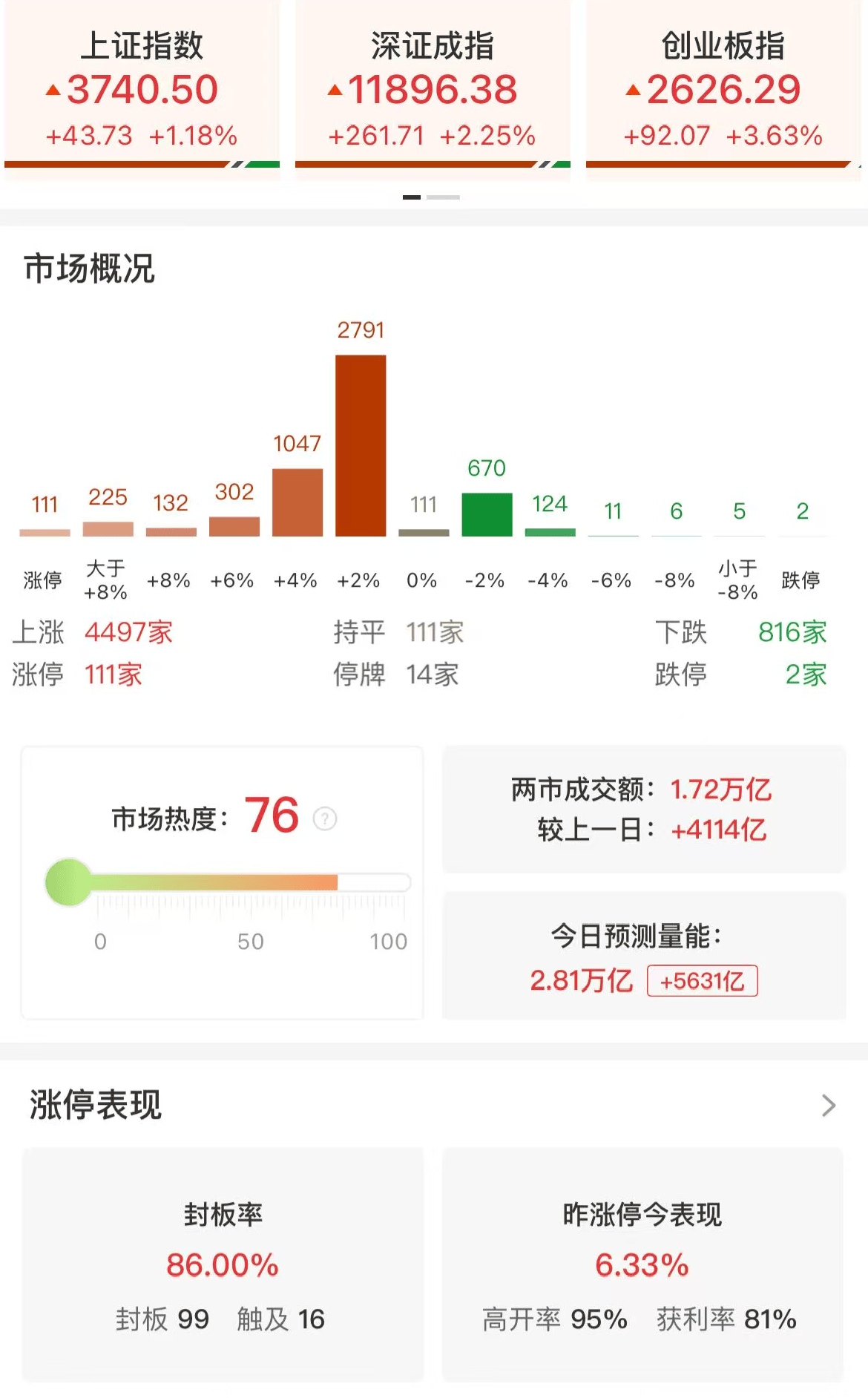
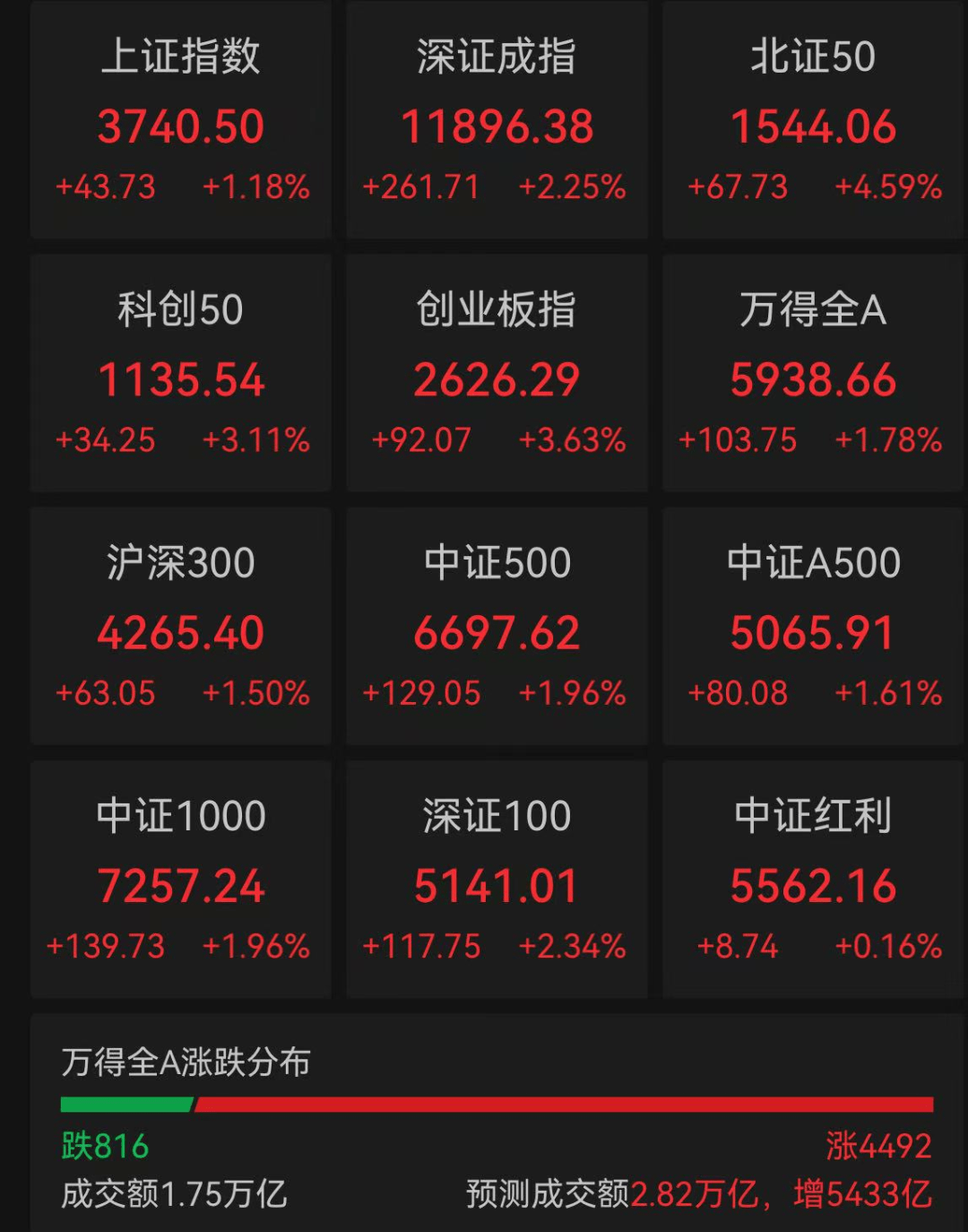
Core Points - A-shares reached a historic milestone with a total market capitalization exceeding 100 trillion yuan for the first time, marking a significant achievement in the A-share market [1][2] - The Shanghai Composite Index hit a nearly 10-year high, while the ChiNext Index surpassed its previous high from October 8, 2024, indicating strong market performance [1][2] - The trading volume in the Shanghai and Shenzhen markets was substantial, with a half-day turnover of 1.72 trillion yuan, an increase of 411.4 billion yuan compared to the previous trading day [1] Market Performance - The Shanghai Composite Index rose by 1.18% to 3740.50, the Shenzhen Component Index increased by 2.25% to 11896.38, and the ChiNext Index surged by 3.63% to 2626.29 [2] - Other indices such as the CSI 300 and CSI 500 also showed positive movements, with increases of 1.50% and 1.96% respectively [2] Sector Performance - Key sectors that performed well included film and television, liquid cooling servers, CPO (Chip-on-Board), and financial technology, while coal and a few other sectors experienced declines [3][4] - Specific stocks within the liquid cooling server sector saw a rise of 7.97%, indicating strong investor interest in this area [4]

百亿冲刺,港A影视股嗨翻!电影行业复苏势不可挡
Ge Long Hui· 2025-08-18 04:38
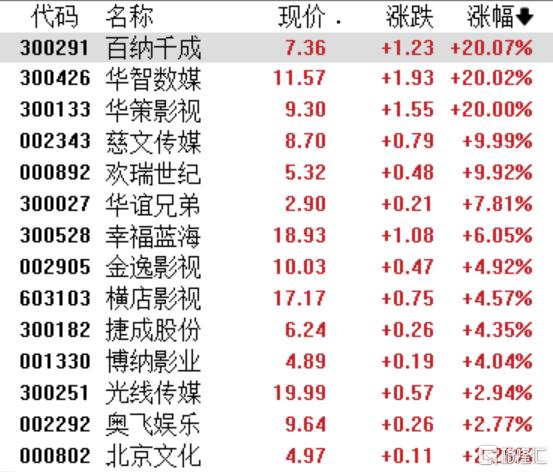
Core Viewpoint - The film and television sector in Hong Kong and A-shares has experienced a strong surge, with several companies reaching their daily limit increases, indicating a positive market sentiment and potential recovery in the industry [1][2][3]. Group 1: Market Performance - Companies such as Baida Qiancheng, Huazhi Shumedia, and Huace Film & TV have seen a daily limit increase of 20%, while others like Ciweng Media and Huanrui Century have increased by nearly 10% [1][2]. - In the Hong Kong market, Ningmeng Film and Television surged over 35%, with other companies like Xinshi Culture and Damai Entertainment also showing significant gains [3]. Group 2: Box Office Performance - As of August 18, 2025, the total box office for the summer season has reached 9.959 billion yuan, with expectations to surpass 10 billion yuan soon [3][10]. - The number of moviegoers has exceeded 260 million, showing a significant increase compared to the same period last year [3]. Group 3: Notable Films - The summer box office has been led by films such as "Nanjing Photo Studio," "Wang Wang Mountain Little Monster," and "Chang'an's Lychee," with the former achieving a box office of 2.568 billion yuan [10][14]. - "Wang Wang Mountain Little Monster" has become a standout animated film, grossing over 1 billion yuan and receiving high ratings [6][10]. Group 4: Industry Outlook - The film industry is believed to be at the beginning of a new recovery phase, supported by recent government policies aimed at promoting high-quality cultural development [10][15]. - Analysts suggest that the industry is transitioning towards improved business models, with a focus on quality content production and a potential recovery in audience demand [15][16].


A股市值历史首次突破100万亿元大关,上证指数创近10年新高
Sou Hu Cai Jing· 2025-08-18 04:20
Market Performance - A-shares continued to rise significantly on August 18, with the Shanghai Composite Index reaching a nearly 10-year high, up 1.18%, while the Shenzhen Component Index rose by 2.25% and the ChiNext Index increased by 3.63% [2][4] - The total market capitalization of A-shares surpassed 100 trillion yuan for the first time in history, marking a significant milestone [4] - The trading volume in the Shanghai and Shenzhen markets reached 1.72 trillion yuan, an increase of 411.4 billion yuan compared to the previous trading day [2][4] Sector Performance - Strong performance was noted in sectors such as brokerage firms and financial technology, with stocks like Zhinan Zhen and Strong Ray Technology hitting their historical highs [4] - AI hardware stocks, particularly those related to liquid cooling servers, experienced explosive growth, with several stocks reaching their daily limit [4] - The film and television sector also showed active performance, with companies like Huace Film & TV hitting their daily limit [4] Market Sentiment and Outlook - According to Industrial Securities, the current market rally is not primarily driven by improved macroeconomic expectations but rather by policy support and the emergence of new growth drivers, which have boosted market confidence and attracted new capital [6] - Guotai Junan Securities expressed a positive outlook for the Chinese stock market, suggesting that A-share indices may reach new highs, emphasizing the importance of institutional changes in the Chinese market [6]

百亿票房冲刺,港A影视股嗨翻!电影行业复苏势不可挡
Ge Long Hui A P P· 2025-08-18 04:14
Core Viewpoint - The film and television sectors in Hong Kong and mainland China have experienced a strong surge, with several companies reaching their daily limit increases, indicating a positive market sentiment and potential recovery in the industry [1][2][3]. Group 1: Market Performance - Companies such as Baida Qiancheng, Huazhi Shumedia, and Huace Film & TV have seen a daily limit increase of 20%, while others like Ciwen Media and Huanrui Century have increased by nearly 10% [1][2]. - In the Hong Kong market, Ningmeng Film and Television surged over 35%, with other companies like Xinshi Culture and Damai Entertainment also showing significant gains [2][3]. Group 2: Box Office Performance - As of August 18, 2025, the total box office for the summer season has reached 9.959 billion yuan, with expectations to surpass 10 billion yuan soon [3][4]. - The summer box office has seen a significant increase in audience attendance, exceeding 260 million, compared to the same period last year [3][4]. Group 3: Notable Films - The animated film "Wang Wang Mountain Little Monster" has emerged as a top performer, grossing over 1 billion yuan and receiving high ratings, marking a significant achievement for domestic animation [5][6]. - "Nanjing Photo Studio" has also performed well, grossing 2.5 billion yuan, showcasing a strong interest in historical narratives [7][9]. Group 4: Industry Outlook - Analysts suggest that the film industry may be at the beginning of a new recovery phase, supported by recent policy improvements aimed at promoting high-quality cultural content [12][13]. - The industry is expected to see a gradual improvement in business models, with a focus on high-quality long-form projects and a potential increase in short-form content becoming mainstream [13][14].

A股午评:沪指创近10年新高,券商、金融科技股走强
2 1 Shi Ji Jing Ji Bao Dao· 2025-08-18 04:11
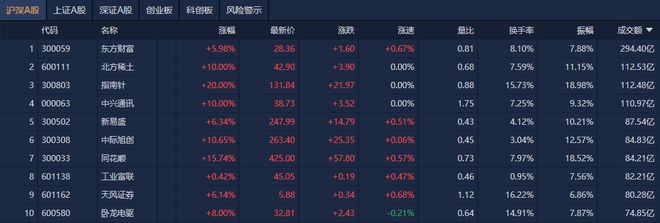
市场早盘高开高走,沪指创近10年新高,北证50指数创历史新高。南财金融终端显示,截至早盘收盘, 沪指涨1.18%,深成指涨2.25%,创业板指涨3.63%。 盘面上热点集中在AI硬件和大金融方向,个股涨多跌少,全市场近4500只个股上涨。 从板块来看,券商、金融科技股维持强势,指南针2连板续创历史新高; 液冷服务器等AI硬件股持续爆发,强瑞技术等多股涨停; 影视股表现活跃,华策影视等涨停。 沪深两市半日成交额1.72万亿元,较上个交易日放量4114亿。 个股方面,东方财富成交额超294亿元居首,北方稀土、指南针成交额靠前。 | 护深A股 | 上证A股 | 深证A股 | 创业板 | 科创板 风险警示 | | | | | | | | | --- | --- | --- | --- | --- | --- | --- | --- | --- | --- | --- | --- | | 代码 | | 名称 | | 深幅 | 最新价 | 深绿 | 淄博 | 盘比 | 换手率 | 張耀 | 成交額 ▼ | | 1 300059 | | 东方财富 | | +5.98% | 28.36 | +1.60 | +0.6796 | ...





ETF午评 | A股三大指数放量上涨,沪指创10年新高,AI硬件狂飙,创业板人工智能ETF涨6.43%,金融科技ETF涨5.93%
Sou Hu Cai Jing· 2025-08-18 04:00
Market Performance - The Shanghai Composite Index rose by 1.18%, reaching a 10-year high, while the ChiNext Index surged by 3.63%, surpassing last year's peak [1] - The total trading volume in the Shanghai, Shenzhen, and Beijing markets was 17,467 billion, an increase of 4,196 billion compared to the previous day [1] - Over 4,400 stocks in the market experienced an increase [1] Sector Highlights - AI hardware sectors, including liquid-cooled servers, copper-clad laminates, and CPO, reached new historical highs [1] - The financial technology concept continued to see explosive growth, with strong rebounds in rare earth and short drama concepts [1] ETF Performance - AI hardware ETFs, such as Southern, Da Cheng, Hua Bao, and Hua Xia, saw increases of 6.43%, 6.4%, 6.36%, and 6.2% respectively [5] - Film and television concept stocks also experienced gains, with Silver Hua Fund and Guotai Fund ETFs rising by 6.36% and 5.89% respectively [5] - The financial technology ETF from Hua Bao Fund increased by 5.93% [5] - The Sci-Tech Growth ETF experienced a decline of 4.18% [5] - Long-term government bond ETFs saw a decrease, with the 30-year bond ETFs from Boshi dropping by 1.2% and 1.16% [5] - Precious metals sector adjusted, with gold stock ETFs declining by approximately 0.98% to 0.95% [5]