
电子

Search documents
AI“抢芯”,手机、电脑、新能源车都要变贵?
3 6 Ke· 2026-01-10 06:19
Core Insights - The demand for AI servers is driving a significant cost change in the supply chain, affecting various manufacturing sectors beyond electronics [1] - The price increases in storage chips and precious metals are indicative of a broader inflationary trend in manufacturing costs [1] Group 1: Cost Transmission from Upstream - Samsung Electronics and SK Hynix plan to raise server DRAM prices by 60%-70% in Q1 2026 compared to Q4 2025, significantly higher than previous cycles [2] - AI servers are identified as the starting point for this cost transmission, with their increased GPU, memory, and bandwidth requirements creating a supply-demand gap [2] - Leading AI chip manufacturers like NVIDIA maintain high product prices, with high-end AI GPUs reaching tens of thousands of dollars, impacting the cost structure for server and cloud computing companies [2] Group 2: Pressure on End Consumer Products - Storage chips are the first to transmit cost increases to consumer products, with flagship smartphones seeing price hikes of 300-500 yuan and mid-range models by 200-300 yuan [3] - Memory costs account for approximately 15%-20% of the BOM cost in mid-range smartphones and 10%-15% in high-end models, indicating a significant impact from rising storage prices [3] - The automotive industry is also expected to face storage chip shortages, potentially leading to price increases in electric vehicles, as these chips are crucial for advanced features [3] Group 3: Market Dynamics and Predictions - The global memory market is experiencing an unprecedented structural shortage, with major manufacturers reallocating capacity to high-value products, limiting supply for traditional DRAM and NAND [4] - Citigroup predicts an 88% increase in average DRAM prices by 2026, while Nomura forecasts a 46% increase in DRAM and a 65% increase in NAND prices [4] - Price fluctuations in storage chips are influenced by market dynamics, with potential for short-term price corrections as new products are released [5] Group 4: Impact on Manufacturing and Cost Management - The rising costs are affecting various manufacturing sectors, with IDC predicting a contraction in the global smartphone market and price increases of 3%-8% depending on market conditions [5] - Major PC manufacturers are also expected to raise prices by 15%-20% due to increased component costs [5] - Industries with strong technological barriers and brand premium capabilities are better positioned to absorb these cost increases, while those in highly competitive, low-tech sectors may struggle [6]
2025年北向资金持仓全景揭晓,2026年外资持仓有望回升
Huan Qiu Wang· 2026-01-10 03:00
Core Insights - The data for Northbound capital holdings in the Chinese stock market for Q4 2025 shows a clear picture of foreign investment trends, indicating a sustained positive outlook from foreign investors towards Chinese equities [1][3]. Group 1: Northbound Capital Holdings - As of the end of Q4 2025, Northbound funds held a total of 3,257 stocks, with a combined holding of approximately 1,077.09 billion shares and a total market value of about 2.59 trillion yuan, reflecting an increase of 1,476.05 million shares from Q3 2025 [3]. - Compared to the end of 2024, Northbound capital's total market value increased by approximately 380 billion yuan, with a gradual upward trend in holdings throughout 2025 [3]. - In December 2025, foreign capital inflow into Chinese stocks accelerated to 3.5 billion USD, up from 2.3 billion USD in November, marking a significant turnaround from a net outflow of 26 billion USD in 2024 [3]. Group 2: Major Holdings and Sector Preferences - The top holding for Northbound funds as of Q4 2025 was Ningde Times, with a market value of 254.34 billion yuan, significantly higher than the second-largest holding, Midea Group, at 77.05 billion yuan [4]. - Other notable holdings included Kweichow Moutai, China Merchants Bank, and Zijin Mining, with a noticeable shift in the top ten holdings compared to the end of 2024, as some stocks like BYD and Mindray Medical dropped out of the list [4]. - In terms of sector distribution, the top three sectors for Northbound capital were power equipment, electronics, and non-ferrous metals, indicating a shift from the previous year's focus on power equipment, banking, and food and beverage [5]. Group 3: Net Buying and Selling Trends - Ningde Times led the net buying list with an inflow of 45.63 billion yuan, followed by Northbound Huachuang and BYD with 24.89 billion yuan and 13.03 billion yuan, respectively [6]. - Conversely, Kweichow Moutai, Changjiang Electric, and Agricultural Bank were the top three stocks for net selling, with outflows of 32.30 billion yuan, 16.21 billion yuan, and 12.27 billion yuan, respectively [6]. Group 4: Future Outlook - Looking ahead to 2026, institutions generally expect foreign capital holdings in Chinese stocks to further increase, with Goldman Sachs estimating potential buying funds could reach 10 billion USD, indicating a positive outlook for the Chinese stock market [7].







9点1氪丨系统故障致机票低至0.4折,海航:已售机票均有效;最高法:以婚姻为目的给予的购车、购房款应视为彩礼;MiniMax总市值超千亿港元
3 6 Ke· 2026-01-10 01:18
Group 1 - The interest rates for short-term large-denomination certificates of deposit (CDs) have dropped below 1%, entering the "0" range, with many banks offering rates as low as 0.9% for 1-month and 3-month terms [1][2] - Over 30 banks have announced the issuance of the first phase of large-denomination CDs for 2026, indicating a trend in the banking sector towards lower interest rates [1][2] - Major state-owned banks, including ICBC, ABC, BOC, and CCB, are currently offering short-term large-denomination CDs with a minimum deposit requirement of 200,000 yuan [1][2] Group 2 - The Supreme People's Court of China has clarified that funds given for purchasing cars or houses with the intention of marriage can be considered as bride price, which can be adjudicated under the same rules as traditional bride price disputes [2] - A recent case highlighted that a payment of 66,000 yuan and a car purchase of 150,000 yuan were deemed as bride price, leading to a court ruling for the return of over 170,000 yuan after considering shared expenses [2] Group 3 - MiniMax, a large model company, debuted on the Hong Kong Stock Exchange with an initial public offering price of 165 HKD per share, closing at 345 HKD, marking a 109.09% increase and a market capitalization exceeding 100 billion HKD [2] Group 4 - The number of corporate bankruptcies in Germany has reached a 20-year high, with 17,604 bankruptcy applications recorded in 2025, reflecting significant structural pressures on the German economy [2] - In December 2025 alone, there were 1,519 bankruptcy applications, which is 75% higher than the average from 2016 to 2019 [2] Group 5 - Apple is reportedly accelerating the selection process for a new CEO, with John Ternus, the current Senior Vice President of Hardware Engineering, emerging as the leading candidate [3] - Tim Cook, the current CEO, has expressed a desire to reduce his workload and may step down as early as this year, potentially transitioning to the role of Chairman of the Board [3] Group 6 - Xiaomi has announced a price reduction for its Xiaomi 17 smartphone and has eliminated the use of small print in its marketing materials, responding to criticism of "small print marketing" practices [5] - The company aims to enhance transparency and user experience by using larger fonts for product information [5] Group 7 - The Chinese government is implementing a nationwide policy for the cross-province pooling of personal medical insurance accounts, allowing family members to share funds for medical expenses [10] - This policy aims to optimize the use of personal medical insurance accounts and enhance mutual assistance among family members [10]

北向资金2025年持股数据亮相 重仓电力设备、电子、有色金属三大方向
Shang Hai Zheng Quan Bao· 2026-01-09 18:33
Group 1 - As of the end of Q4 2025, northbound funds held a total of 3,257 stocks, with a total holding amount of approximately 1,077.09 billion shares and a total market value of about 2.59 trillion yuan, showing an increase from the previous quarter [1] - The top holdings of northbound funds include leading stocks such as CATL, Midea Group, Kweichow Moutai, and China Merchants Bank, with CATL's market value held by northbound funds reaching 254.34 billion yuan, significantly higher than Midea Group's 77.05 billion yuan [2] - The three major sectors heavily invested by northbound funds are power equipment, electronics, and non-ferrous metals, marking a shift from the previous year's focus on power equipment, banking, and food and beverage [2] Group 2 - In Q4 2025, the sectors with the largest increase in market value for northbound funds were non-ferrous metals, communications, and basic chemicals, with notable individual stocks including Zijin Mining and China Aluminum [3] - The estimated net purchases by northbound funds for CATL reached 45.63 billion yuan, making it the top stock, followed by Northern Huachuang and BYD with net purchases of 24.89 billion yuan and 13.03 billion yuan respectively [3] - Looking ahead to 2026, foreign investment in Chinese stocks is expected to increase, with potential buying funds estimated to reach 10 billion dollars, driven by global long-term investors seeking diversification [4]

热点追踪周报:由创新高个股看市场投资热点(第 226 期)-20260109
Guoxin Securities· 2026-01-09 15:20
- The report introduces a quantitative model named "250-day new high distance" to track market trends and identify investment hotspots. The model is based on momentum and trend-following strategies, emphasizing the effectiveness of monitoring stocks near their 52-week high prices[11][19][20] - The construction process of the "250-day new high distance" model is as follows: Formula: $ 250\text{-day new high distance} = 1 - \frac{Close_t}{ts\_max(Close, 250)} $ Explanation: - $ Close_t $ represents the latest closing price - $ ts\_max(Close, 250) $ represents the maximum closing price over the past 250 trading days If the latest closing price reaches a new high, the distance equals 0; otherwise, it is a positive value indicating the degree of price fallback[11] - The report evaluates the model positively, highlighting its ability to capture market trends and identify leading stocks in various sectors. It references studies by George (2004), William O'Neil, and Mark Minervini, which support the effectiveness of tracking stocks near their high prices[11][19] - The model's testing results show that as of January 9, 2026, major indices such as the Shanghai Composite Index, Shenzhen Component Index, and CSI 500 have a "250-day new high distance" of 0.00%, indicating they are at their peak levels. Other indices like CSI 300 and ChiNext have distances of 0.66% and 0.06%, respectively[12][13][33] - A quantitative factor named "Stable New High Stocks" is constructed to identify stocks with smooth price paths and consistent momentum. The factor incorporates analyst attention, relative price strength, price path smoothness, and sustained new high performance[26][28] - The construction process of the "Stable New High Stocks" factor includes: - Analyst attention: At least five buy or overweight ratings in the past three months - Relative price strength: Top 20% in 250-day price change - Price path smoothness: Evaluated using metrics like price displacement ratio - Sustained new high performance: Average "250-day new high distance" over the past 120 days and the last five days[26][28] - The factor is positively evaluated for its ability to capture stocks with strong and consistent momentum, supported by studies on smooth price paths and investor underreaction to gradual price changes[26][28] - Testing results for the "Stable New High Stocks" factor show that 50 stocks were selected, with the highest representation in cyclical and technology sectors. Notable stocks include Yuanjie Technology, Yaxiang Integration, and Xinwei Communication[29][34]



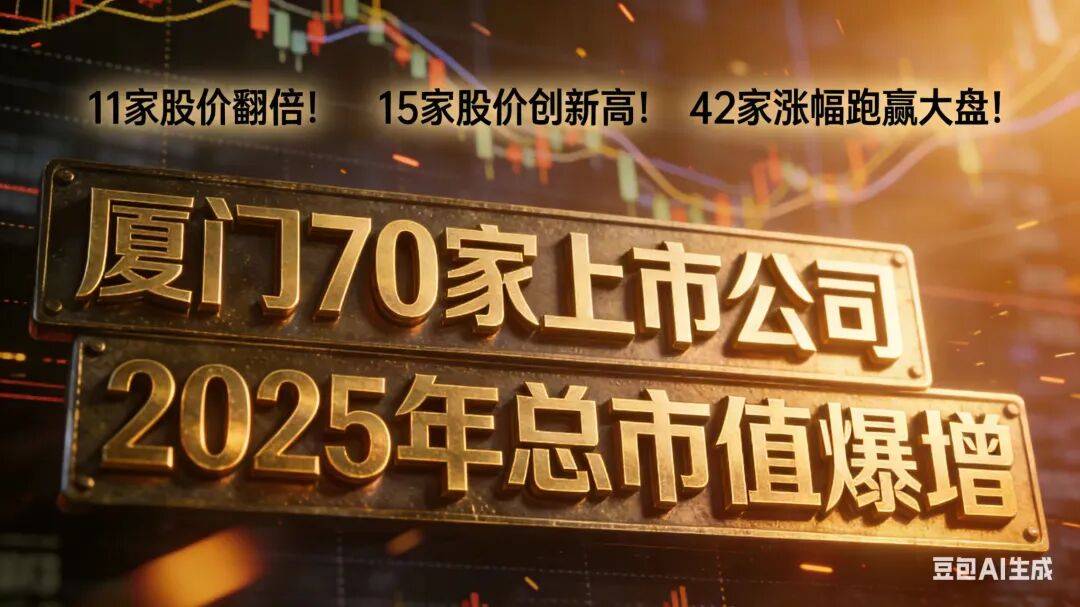
11家股价翻倍!厦门多数上市公司身价暴增
Sou Hu Cai Jing· 2026-01-09 14:38
Core Insights - The A-share market in China, particularly in Xiamen, has shown remarkable performance in 2025, with a total market capitalization reaching 903 billion yuan and 11 companies doubling their stock prices [1][3][7]. Group 1: Market Performance - The Shanghai Composite Index increased from 3,351.76 points at the beginning of 2025 to 3,968.84 points by the end of the year, reflecting an 18.4% year-on-year growth [3]. - Among 70 listed companies in Xiamen, 42 outperformed the market, with 11 companies achieving stock price increases of over 100% [3][7]. Group 2: Notable Companies - The top-performing companies in terms of stock price increase include: - Blue Electric Mining: 208.13% increase [4] - Yanjiang Co.: 186.10% increase [4] - Qianzhao Optoelectronics: 166.02% increase [4] - Other notable companies include Jiagong Technology, Honey Vegetable Medicine, and Wei Technology, all with significant increases [4]. Group 3: Market Capitalization - The total market capitalization of Xiamen's listed companies grew by 44.1% year-on-year, reaching 903.35 billion yuan [7]. - There are 30 companies with a market capitalization exceeding 10 billion yuan, accounting for over 40% of the total listed companies in Xiamen [7]. - Xiamen Tungsten Co. leads with a market capitalization of 65.186 billion yuan [8]. Group 4: New Listings and Growth - In 2025, Xiamen added 6 new listed companies, including 2 A-share companies, marking the highest number of new listings in nearly four years [11]. - The total number of listed companies in Xiamen has surpassed 100, with 70 being domestic listings, representing about 40% of the province's total [11]. Group 5: Recognition and Awards - Several Xiamen listed companies received accolades for best practices in corporate governance and annual report presentations, highlighting their operational excellence [13][14].
一周活跃股排行榜:100只股换手率超100%
Zheng Quan Shi Bao Wang· 2026-01-09 14:37
Market Overview - The Shanghai Composite Index increased by 3.82% this week, with 100 stocks experiencing a turnover rate exceeding 100% [1] - A total of 100 stocks had a turnover rate above 100%, while 366 stocks had a turnover rate between 50% and 100%, and 2793 stocks had a turnover rate between 10% and 50% [1] - The mechanical equipment sector had the highest number of stocks with a turnover rate over 100%, totaling 16 stocks, followed by the power equipment and electronics sectors with 11 and 10 stocks, respectively [1] High Turnover Stocks - Xin Guo Yi had the highest turnover rate at 270.52%, but its stock price fell by 8.44% during the week [2] - C Shan Lv followed with a turnover rate of 214.89% and a stock price decline of 1.67%, with a net inflow of 761.9 million yuan from major funds [2] - Yu Yin Co ranked third with a turnover rate of 210.60% and a slight price drop of 0.53%, experiencing a net outflow of 306 million yuan from major funds [2] Performance of High Turnover Stocks - Stocks with a turnover rate over 100% averaged a price increase of 16.80% this week, with 83 stocks rising and 17 stocks falling [2] - The top gainers included Shaoyang Hydraulic, Sanbo Brain Science, and Puni Testing, with increases of 84.91%, 56.15%, and 51.77%, respectively [2] - The largest declines were seen in Jin Hao Medical, Hongyuan Pharmaceutical, and Xin Guo Yi, with decreases of 17.74%, 11.60%, and 8.44%, respectively [2] Annual Performance Forecasts - Among the stocks with a turnover rate over 100%, 8 companies released annual performance forecasts, with 5 expecting profit increases and 1 expecting a profit [3] - Nanxing Co is projected to have the highest net profit growth, with a median expected profit of 105 million yuan, representing a year-on-year increase of 159.95% [3]


20cm速递丨科创板小盘成长机遇引关注,关注科创200ETF国泰(认购代码:589223)布局价值
Mei Ri Jing Ji Xin Wen· 2026-01-09 13:41
Group 1 - The core viewpoint highlights the contrasting investment styles of the Sci-Tech 200 and Sci-Tech 50 indices, providing investors with different risk-return choices [1] - The Sci-Tech 50 index, representing leading companies on the Sci-Tech board, has strong institutional attributes and performs well in the semiconductor sector amid rising market interest in domestic substitution [1] - In contrast, the Sci-Tech 200 index showcases a significant small-cap growth style, with its constituent companies being national-level "specialized and innovative" enterprises that invest heavily in R&D, leading to a higher R&D expense ratio compared to the Sci-Tech 50 index [1] Group 2 - The small and medium-sized enterprises on the Sci-Tech board are experiencing dual drivers of profit growth and valuation recovery, with the Sci-Tech 200 index focusing on hard technology sectors such as electronics, biomedicine, and machinery [1] - The median market capitalization of the emerging companies covered by the Sci-Tech 200 index is approximately 7.8 billion yuan, indicating high performance elasticity and resonance with industrial upgrades [1] - The newly launched Sci-Tech 200 ETF by Guotai (subscription code: 589223) offers investors a convenient way to invest in small-cap hard technology companies on the Sci-Tech board [1]
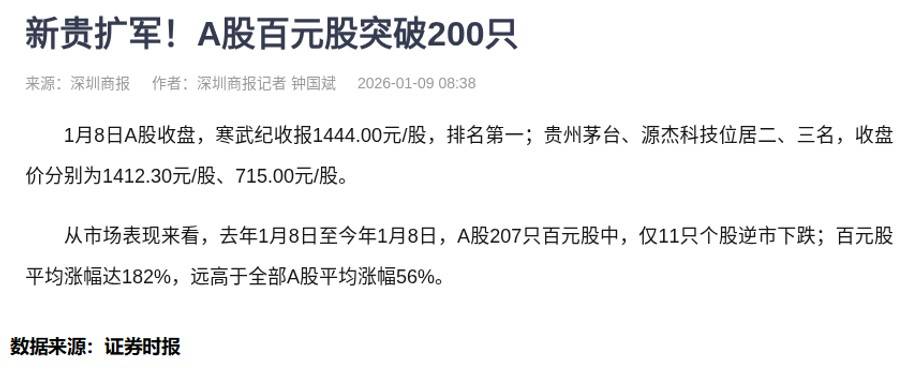
科技股占百元股近八成,我用数据看懂为啥能涨
Sou Hu Cai Jing· 2026-01-09 12:51
Group 1 - The core point of the news is that the surge in technology stocks, particularly those priced over 100 yuan, is driven by institutional investment rather than the inherent value of the stocks themselves [1][3] - Among the 207 stocks priced over 100 yuan, 165 are from the technology sector, with the electronic industry accounting for 76 stocks, indicating a strong preference from institutional investors for technology stocks [3] - The case of Cambrian, which surpassed Moutai in stock price, illustrates that its high valuation is supported by active institutional participation rather than a general preference for technology over traditional sectors like liquor [3][8] Group 2 - Adjustments in stock prices that appear to be opportunities may actually indicate institutional withdrawal, as seen in a colleague's experience where a stock's price drop followed a lack of institutional activity [4][6] - Monitoring institutional inventory is crucial; a stock that rises significantly but sees a drop in institutional interest is likely to decline further, as demonstrated by a stock that fell 40% after institutions stopped trading [8][10] - The average increase of 182% in the hundred-yuan stocks is attributed to active institutional involvement, emphasizing that price alone is not a reliable indicator of a stock's potential [8][10]
2026 年可转债年度策略:穿越“墨西拿海峡”
Huafu Securities· 2026-01-09 11:55
Group 1 - The report highlights that the valuation of convertible bonds does not directly reflect the volatility of the underlying stocks but rather follows the directional changes of the stocks. The market's confidence in the direction of stocks for 2026 remains strong, and the opportunity cost of convertible bonds is expected to be low in the near term [3][4] - The current high valuation of convertible bonds has already factored in significant expected increases in the underlying stocks' prices. The report suggests that the potential for further valuation increases in 2026 may rely more on the recovery of profitability rather than broad-based earnings growth [4][10] - The convertible bond market is expected to exhibit a "dumbbell" structure in 2026, with an increase in the number of new issues and changes in individual bond sizes and industry structures. However, the overall high valuation level may lead to new issues maintaining elevated listing valuations, making secondary market participation less attractive [5][10] Group 2 - The report discusses the construction of a long inflation strategy portfolio, including specific convertible bonds from sectors such as agriculture and electronics, while also preparing a corresponding cash flow strategy portfolio to mitigate potential adverse scenarios [9][10] - The analysis indicates that the high-low price strategy did not yield significant excess returns in 2025, and the report emphasizes the need to maintain a focus on low absolute price screening levels for future selections [6][10] - The report notes that the implied volatility of convertible bonds has recently exceeded the actual volatility of the underlying stocks, indicating a divergence that may reflect market sentiment rather than fundamental value [3][87]