加密货币

Search documents
2026年2月6日凌晨全球多类资产遭抛售:加密市场超43万人爆仓 涉资20.69亿美元
Sou Hu Cai Jing· 2026-02-08 13:22
Group 1 - The core viewpoint of the articles highlights a significant sell-off across various asset classes, particularly in the cryptocurrency market, leading to over 430,000 liquidations and a total liquidation amount of $2.069 billion within 24 hours [1] - The U.S. stock market, precious metals, and oil markets also experienced price volatility, with the three major U.S. stock indices collectively declining, and the Nasdaq facing its worst three-day sell-off since April of the previous year [1] - Market sentiment has shifted towards risk aversion, driven more by balance sheet mechanisms rather than market narrative logic, as noted by industry experts [1][2] Group 2 - The Chicago Mercantile Exchange announced adjustments to margin requirements for certain futures contracts, increasing the margin ratio for gold to 9% and for silver to 18%, effective after market close on February 6 [2] - The cryptocurrency market is undergoing a "crisis of confidence," as indicated by the shift from net buyers to net sellers of Bitcoin by U.S. ETFs that had previously accumulated significant holdings [1]
Web3行业周报:加密市场大幅转冷,中国证监会发布RWA监管指引
SINOLINK SECURITIES· 2026-02-08 10:45
Investment Rating - The report suggests a cautious approach to the cryptocurrency market due to the current low sentiment and advises focusing on companies with strong earnings reports or those transitioning to AI data centers [4][24]. Core Insights - The cryptocurrency market has seen a significant decline, with a total market capitalization of $2.17 trillion, down 23.6% from the previous week. Bitcoin's lowest price during the week was $60,074, and Ethereum's was $1,749 [1][10]. - The average holding price for Bitcoin is approximately $55,174, which is lower than the short-term investors' cost basis, indicating a bearish sentiment in the market. The Fear and Greed Index is at 8, reflecting "extreme fear" [11][1]. - Global cryptocurrency trading volume increased by 60.2% week-on-week, with Coinbase's spot trading volume rising by 113.9% [15][16]. Global Policy and Industry News - The China Securities Regulatory Commission issued guidelines for the issuance of asset-backed securities tokens overseas, which will be regulated by different authorities based on the type of asset [2][17]. - Tether reported record highs in Q4 2025, with a market cap of $187.3 billion and a user base of 535 million, marking significant growth [21][2]. - Ondo launched a platform for real-time trading of U.S. stocks post-IPO, allowing global users to trade major stocks and ETFs with leverage [21][2]. Company News - Bullish reported a record digital asset sales figure of $64.3 billion for Q4 2025, despite a net loss of $560 million. The company has become the second-largest Bitcoin options trading platform [22][3]. - Gemini announced a 25% workforce reduction and will focus on the U.S. market, exiting the UK and European markets [22][3]. - Cipher Mining plans to issue senior secured notes to raise $2 billion for data center construction [23][3]. - Bitfarms is transitioning from Bitcoin mining to developing high-performance computing and AI data centers, relocating its headquarters to the U.S. [23][3]. Investment Recommendations - Given the current market conditions, the report recommends maintaining caution and focusing on companies that are performing well during earnings season or those transitioning to AI data centers, such as Applied Digital and IREN Limited [4][24].
Web3行业周报:加密市场大幅转冷,中国证监会发布RWA监管指引-20260208
SINOLINK SECURITIES· 2026-02-08 08:26
Investment Rating - The report suggests a cautious approach in the current cryptocurrency market due to low sentiment and recommends focusing on companies with strong earnings during the earnings season or those transitioning from mining to AI data centers [4][24]. Core Insights - The cryptocurrency market has seen a significant decline, with a total market capitalization of $2.17 trillion, down 23.6% from the previous week. Bitcoin's lowest price during the week was $60,074, and Ethereum's was $1,749. The fear and greed index indicates extreme fear at a score of 8 [1][10][11]. - Tether reported record highs in its Q4 2025 report, with a market capitalization of $187.3 billion and a user base of 535 million, marking an increase of over 30 million users for eight consecutive quarters [21]. - The decentralized telecom network World Mobile has expanded its coverage to over seven countries, with more than 3 million daily active users and over 100,000 AirNodes deployed [17][18]. Market Review - The cryptocurrency market capitalization decreased by 23.6% this week, with Bitcoin and Ethereum prices dropping by 16.1% and 23.6%, respectively [10][14]. - The average holding price for Bitcoin is approximately $55,174, which is below the short-term investors' cost basis [11][12]. - Global cryptocurrency trading volume increased by 60.2% week-on-week, with Coinbase's spot trading volume rising by 113.9% [15][16]. Company News - Bullish reported a record digital asset sales figure of $64.3 billion for Q4 2025, with a net loss of $560 million and an adjusted EBITDA of $44.5 million [22]. - Gemini announced a 25% workforce reduction and plans to focus solely on the U.S. market, exiting the UK, EEA, and Australia [22]. - Cipher Mining plans to issue senior secured notes to raise $2 billion for data center construction [23]. Investment Recommendations - The report advises maintaining caution in the current market and suggests monitoring companies that perform well during earnings season or those transitioning to AI data centers, such as HUT 8 and IREN Limited [4][24].
美科技股“崩盘式”回调的信号:风险资产普涨时代终结,AI输家将被无情抛弃!
美股IPO· 2026-02-08 07:13
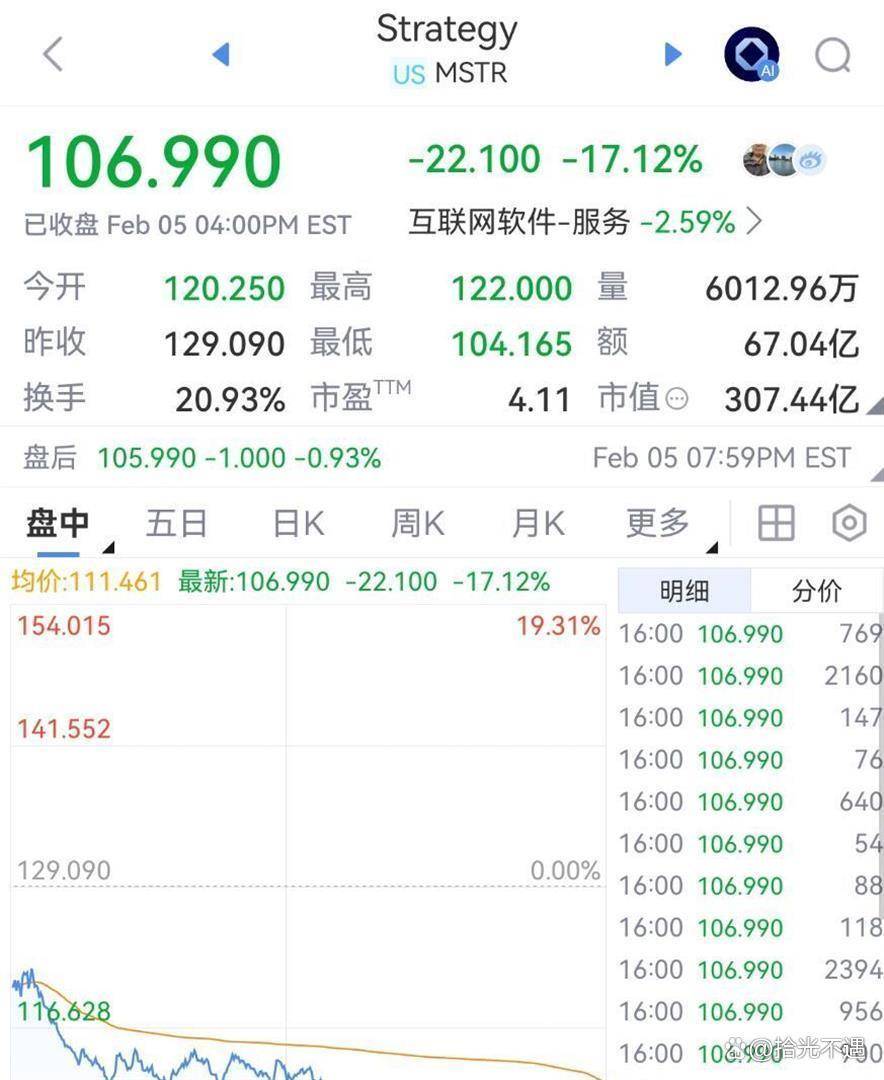
Core Viewpoint - A significant structural adjustment in global risk assets, termed a "tech stock disaster," is driven by the disruptive breakthroughs of AI technology, leading to a reassessment of investment paradigms and a harsh selection of winners and losers in the market [1][3][9]. Group 1: Market Adjustment - Global risk assets are undergoing a severe adjustment, with Goldman Sachs analysts labeling the current market condition as a "tech stock disaster" [3]. - This adjustment is not due to an AI bubble burst but rather the overwhelming success of AI technology disrupting traditional software and data service companies [3][7]. - Bitcoin has experienced a notable decline, halving from its historical peak and dropping over 20% this year [3][11]. Group 2: Industry Impact - The core of market turmoil stems from AI technology demonstrating disruptive capabilities that exceed expectations, prompting investors to reevaluate its impact on existing industry structures [7]. - The introduction of productivity tools by AI company Anthropic has intensified market concerns, indicating potential survival threats to traditional companies reliant on analytical capabilities and software [7]. - The software sector in the U.S. has plummeted by 16% this year, while traditional sectors like commodities and utilities in Europe have seen a 4% increase [7]. Group 3: Structural Changes - The current adjustment signifies the end of a prolonged bull market for risk assets, with a shift towards a brutal survival of the fittest based on the actual benefits of AI advancements [6][9]. - The market is transitioning from a phase of broad tech stock gains to a phase of structural differentiation, with a focus on the actual disruptive capabilities of AI technology [9]. Group 4: Challenges to Investment Paradigms - The structural adjustment in the tech stock market poses a substantial challenge to the long-standing "American exceptionalism" investment paradigm, which has dominated global capital allocation [10]. - The lack of consistent strategies in geopolitical and economic policies under the Trump administration has weakened international investors' confidence in U.S. assets [10]. - Despite potential support from the Federal Reserve and fiscal stimulus, the market is undergoing deep adjustments, highlighting its intrinsic structural characteristics [10]. Group 5: Cryptocurrency Market - The recent decline in Bitcoin prices underscores the fundamental drivers of its volatility, particularly the overall risk appetite in the market, especially concerning tech stocks [11]. - The narrative surrounding Bitcoin's anti-inflation and safe-haven attributes has proven inadequate in the face of reality [11]. - A significant quarterly operating loss of $17 billion reported by a Bitcoin-holding company illustrates the severe challenges faced by firms in the cryptocurrency space [11].


币圈超级“乌龙指”!韩国误发62万枚比特币,引发价格短时大幅下挫
Di Yi Cai Jing Zi Xun· 2026-02-08 01:52
本文字数:1044,阅读时长大约2分钟 来源 |证券时报 2026.02.08 美国财政部长斯科特·贝森特暗示,美国政府不会救助加密货币。此前,被问及美国财政部是否有权购 买比特币或其他加密货币时,贝森特表示:"我没有权力这么做,作为美国金融稳定监督委员会 (FSOC)主席,我也没有这个权力。" 英国加密货币投资公司研究部门负责人詹姆斯·巴特菲尔曾表示,7万美元是比特币价格的一个关键心理 价位。如果不能守住这一整数关口,价格很可能进一步跌至6万美元至6.5万美元区间。 截至目前,比特币价格已跌至69314美元/枚,CoinGlass数据显示,最近24小时,加密货币市场共有超11 万人爆仓,爆仓总金额超4亿美元。 | 指标 清算地图 | | | 爆仓信息 多空比 资金费率 △ | | | | --- | --- | --- | --- | --- | --- | | 実部 | BTC | ETH SOL | XRP | HYPE | =Q | | 总爆仓 | | | | | | | 1小时爆仓 | | 多单爆仓 | | 空单爆仓 | | | $819.2万 | | $722.3万 | | $96.9万 | | ...
巨幅震荡重创美股市场,多个板块显露颓势
Xin Lang Cai Jing· 2026-02-07 15:41
Core Viewpoint - The precious metals sector is experiencing a decline, Bitcoin prices are plummeting, and the U.S. labor market shows signs of weakness, which, combined with the revaluation of software companies, threatens the foundation of the AI-driven bull market [1][20] Group 1: Market Overview - The recent market turmoil has led to a loss of over $1.5 trillion in U.S. stock market value, raising doubts about the strength of the U.S. economy to support further stock market gains [20] - The rebound in the S&P 500 index on Friday does not indicate a stable market, as it often occurs during prolonged market pressure [1][20] - Various sectors are showing cracks, prompting investors to hedge against potential downturns [1][20] Group 2: Software Sector - The sell-off in software stocks is significant, with concerns that AI tools may disrupt the business of companies like DocuSign and Salesforce [29] - A report indicated that 72% of S&P 500 companies have updated disclosures regarding the significant risks posed by AI to their businesses [29] - The market is currently bearish on software stocks, raising concerns about risk spillover to other sectors [30][31] Group 3: Small Cap Stocks - Small-cap stocks were initially favored as investors moved away from overvalued tech stocks, but this strategy has faltered due to broad market adjustments and weak labor market data [4][22] - The Russell 2000 index has seen a decline of over 5% from recent highs, reflecting the impact of domestic economic conditions on small-cap companies [24][22] Group 4: Precious Metals - The precious metals sector, particularly gold and silver, has experienced extreme volatility, with the VanEck Gold Miners ETF suffering a 13% drop, the largest in over five years [25][27] - The sector has shifted from being a niche investment to a speculative tool for retail investors, raising concerns about its fundamental support [25][27] - Analysts note that the trading frenzy in precious metals has become "crazy," with significant price fluctuations that contradict their traditional role as safe-haven assets [27][9] Group 5: Digital Assets - Bitcoin, once referred to as "digital gold," is underperforming compared to physical gold, with its price dropping below $65,000, marking a 15-month low [28] - Companies involved in Bitcoin mining and digital asset management have seen significant stock price declines, with some dropping over 20% [28][10] - The largest Bitcoin exchange-traded fund also experienced a 16% drop, reflecting the broader downturn in the digital asset market [28] Group 6: Capital Markets - Concerns about AI disrupting various sectors may lead to a slowdown in capital market activities, including mergers and acquisitions, IPOs, and stock and bond issuances [29] - The technology sector was expected to contribute significantly to capital market revenues, but this outlook may be changing due to the potential disruptive effects of AI [29]
律师:中国加密资产新规暗藏哪些行业隐秘细节?
Xin Lang Cai Jing· 2026-02-07 15:36
Core Viewpoint - The recent regulatory documents regarding cryptocurrency in China indicate a tightening of the market, particularly affecting the survival of crypto assets and Web3-related businesses, while also introducing a framework for Real World Asset (RWA) tokenization, albeit with strict conditions [2][3][4]. Regulatory Framework - The documents define the attributes of RWA tokenization, marking a significant regulatory stance on the matter, which has been a topic of extensive discussion in the context of crypto asset regulation in China [3][4]. - The regulatory focus is primarily on preventing illegal financial activities associated with RWA, particularly concerning domestic assets and their tokenization [7][16]. Market Implications - The global landscape for RWA includes various types, with the U.S. market leading in traditional financial asset tokenization, while Hong Kong serves as a platform for qualified investors to access these assets [5][6]. - The regulatory documents emphasize the need for collaboration among various government departments to ensure a unified approach to crypto asset regulation, addressing inconsistencies in legal interpretations across regions [8]. Risk Management - The documents highlight the importance of preventing capital outflow through crypto assets, particularly via stablecoins, and outline measures to track and manage these flows [9]. - There is a clear warning against engaging in activities related to RWA in mainland China without proper regulatory approval, as this could lead to significant legal risks [10][16]. Industry Practices - The documents explicitly prohibit the use of virtual currencies as collateral or in insurance products, indicating a comprehensive approach to regulating crypto-related financial products [10][12]. - The regulatory stance against crypto mining remains firm, with a reiteration of the ban on mining activities and the sale of mining equipment within mainland China [14][15]. Future Directions - The framework allows for the possibility of RWA token issuance outside of China, provided that domestic entities comply with regulatory requirements and obtain necessary approvals [16][17]. - The documents suggest that only large, financially robust companies or established firms may be able to navigate the regulatory landscape to engage in RWA activities, indicating a high barrier to entry for smaller players [18][19].
Japan's Crypto Industry Faces Critical Test Ahead of Snap Election
Yahoo Finance· 2026-02-07 14:01
Group 1: Political Context and Election Significance - Prime Minister Sanae Takaichi is leveraging her high approval ratings of 60-80% to secure a parliamentary majority that could expedite crypto reforms [1] - The election is framed as a referendum on Takaichi's leadership, with her future as prime minister hinging on the outcome [1] - The dissolution of parliament marks Japan's second general election in two years, with Takaichi aiming to convert her personal popularity into seats for the Liberal Democratic Party [3] Group 2: Economic Conditions and Implications - Japan has experienced inflation above 2% for 45 consecutive months, alongside falling real wages and rising bond yields, raising concerns about fiscal discipline [2] - If Takaichi's coalition wins decisively, industry leaders anticipate faster legislative processes, including smoother tax reforms and stronger support for stablecoin and tokenization infrastructure [2] Group 3: Crypto Reforms and Industry Impact - Japan is pursuing significant crypto reforms, including plans to reduce taxes on crypto gains from 55% to 20% by 2028 and reclassifying 105 cryptocurrencies as financial products [4] - The proposed tax changes would allow investors to offset losses against other income, aligning crypto taxation with traditional financial assets [5] - A crypto-positive parliament could accelerate reforms related to stablecoins and tokenized securities, with tax reform seen as likely regardless of the election outcome [6]
China Widens Crypto Ban to Choke Off Stablecoins and Asset Tokenization
Yahoo Finance· 2026-02-07 12:48
Core Viewpoint - China's top financial regulators have significantly expanded the existing crypto ban, specifically targeting stablecoin issuances and the tokenization of real-world assets, marking the most aggressive tightening of capital controls since the 2021 prohibition on Bitcoin mining and trading [1][2]. Regulatory Actions - The joint notice was released on February 6 by eight agencies, including the People's Bank of China and the China Securities Regulatory Commission [1]. - New rules prohibit foreign entities from offering stablecoin or tokenization services to Chinese residents, addressing a surge in virtual asset activities perceived as a threat to financial stability [2]. Offshore Loophole Closure - The crackdown targets the "offshore loophole" by banning domestic firms and their overseas branches from issuing digital currencies without explicit government approval [3]. - The People's Bank of China emphasized that stablecoins, especially those pegged to fiat currencies, possess attributes of sovereign money [3]. Financial Control and Compliance - Authorities argue that private digital assets undermine the state's control over the money supply and circumvent anti-money-laundering protocols [4]. - The notice specifically prohibits any entity from issuing Renminbi-pegged stablecoins abroad, seen as a defense of the e-CNY, China's official central bank digital currency [4]. Real-World Asset Tokenization - The directive also targets the $24 billion Real-World Asset (RWA) tokenization sector, reclassifying unauthorized tokenization as "illegal public security offerings" and "unauthorized futures business" [5][7]. - Activities related to RWA tokenization within China, including intermediary and IT services suspected of illegal token issuance, are prohibited [7]. Compliance and Oversight - The notice allows limited activities on government-approved financial infrastructure but requires firms pursuing tokenization abroad to meet heightened compliance standards and obtain domestic clearance [8]. - The central government plans to implement a collaborative framework for local and national oversight to enforce these measures [8].
比特币惊魂雪崩!58万人爆仓蒸发26亿美元,谁在暗抽梯子?
Sou Hu Cai Jing· 2026-02-07 08:29
Market Overview - The cryptocurrency market experienced a significant crash, with Bitcoin dropping from around $70,000 to a low of $59,800, marking a maximum decline of over 17% within 24 hours [1] - Over 586,000 traders were liquidated globally, with a total liquidation amount reaching $2.665 billion, of which $2.314 billion was from long positions [1] Regulatory Impact - On February 6, the People's Bank of China and other regulatory bodies issued a joint statement reiterating that virtual currencies do not have legal tender status and prohibited the issuance of stablecoins linked to the RMB [3] - This regulatory action heightened market fears, prompting many investors to withdraw their funds to avoid regulatory repercussions [3] Institutional Behavior - On February 5, approximately $740 million flowed out of cryptocurrency-themed ETFs, with a total outflow of nearly $4 billion over the past three months [3] - Many institutional investors are facing significant losses, as the average cost of Bitcoin holdings in U.S. spot Bitcoin ETFs is around $84,100, while the current price is over $60,000 [3] Leverage and Market Dynamics - The use of high leverage in cryptocurrency trading exacerbated the market decline, with over $2.3 billion in long positions liquidated, creating a vicious cycle of further price drops [4] - Bitcoin's correlation with tech stocks has increased, with a correlation coefficient of 0.72 with the Nasdaq 100 index, indicating that Bitcoin is moving in tandem with tech stock fluctuations [4] Investor Sentiment - The market's "Fear & Greed Index" dropped to 10, indicating extreme fear among investors, leading to a mass exit from the market [1] - The perception of Bitcoin as a hedge against inflation has diminished, as it failed to perform as a safe haven during rising global risk aversion [4] Conclusion - The recent Bitcoin crash is attributed to a combination of tightened regulations, institutional withdrawals, leveraged trading, and a collapse of investor confidence [5] - The volatility and lack of legal protection in the cryptocurrency market suggest that ordinary investors should exercise caution and consider managing their investments in more stable assets [5][6]