医美

Search documents
同比增长超15%!春节前医美市场迎小高峰 美团推出专项活动助力用户“美美过新年”
Bei Jing Shang Bao· 2026-01-31 05:50
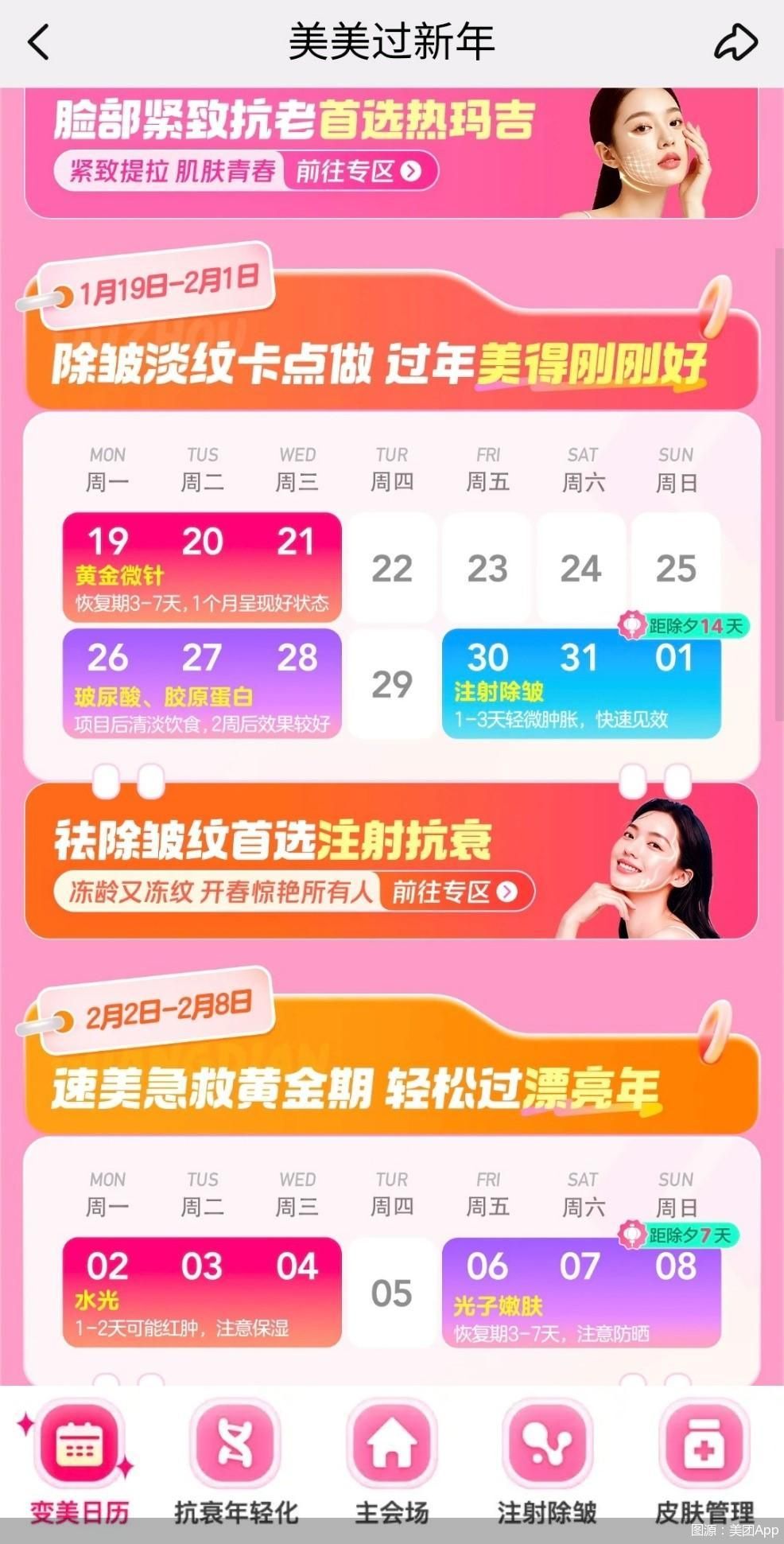
Core Insights - The medical beauty market is experiencing a surge in demand as consumers prepare for the upcoming Spring Festival, with many opting for aesthetic treatments to enhance their appearance [1][3]. Group 1: Market Trends - There has been a significant increase in user visits to medical beauty services, with Meituan reporting over a 15% year-on-year growth and nearly a 10% week-on-week increase [3]. - The demand for aesthetic treatments is primarily focused on anti-aging, wrinkle removal, and urgent skin condition improvement, with varying recovery periods influencing consumer choices [3]. - Popular treatments have shifted from longer recovery options like Thermage and Ultherapy to shorter recovery options such as hyaluronic acid injections and photorejuvenation [3]. Group 2: Company Initiatives - Meituan has launched a "Beautiful New Year" campaign, offering a 3000 yuan medical beauty voucher package and a beauty calendar to help users select appropriate treatments based on recovery times [3]. - During the Spring Festival, at least 30% of medical beauty institutions on the Meituan platform will remain open, which is a 5% increase compared to the previous year, providing convenience for users seeking urgent skin treatments [3]. - The company promotes the "Safe Beauty" initiative to ensure compliance and safety in the industry, aiming to verify over 12 million treatment instances by the end of 2025 across 2500 institutions in 140 cities [4].


拒绝上游指导价之后,新氧低价从何而来
经济观察报· 2026-01-31 04:01
Core Viewpoint - The medical beauty industry is experiencing a shift from supply scarcity to abundance, allowing institutions to negotiate better prices and providing more options for consumers [2][3][9]. Group 1: Market Dynamics - New Oxygen's "Miracle Youth" project has seen continuous sales growth for three months since its launch, despite pricing disputes with upstream suppliers [2]. - The price of "Miracle Youth" products is significantly lower than the manufacturer's suggested retail price, with some products priced at 60% less than the official price [2][5]. - The increase in the number of products available in the market has provided institutions with more choices, reducing reliance on single suppliers [3][9]. Group 2: Competitive Landscape - The market for "Miracle Youth" products, specifically the PLLA facial filler, has seen multiple companies approved for production, increasing competition [5]. - New Oxygen's pricing strategy has led to conflicts with suppliers, who are concerned about the disruption of established pricing structures [6]. - The number of approved products in the PLLA category is expected to grow, with 11 products already approved and nearly 20 more in the pipeline [9]. Group 3: Business Strategy - New Oxygen aims to leverage its scale by expanding its number of clinics and increasing treatment volumes, which enhances its negotiating power with suppliers [6][7]. - The company plans to open at least 35 new clinics by 2026, with a target of increasing the number of doctors and nursing staff significantly [7]. - Despite ongoing losses due to expansion, New Oxygen's strategy focuses on achieving profitability by optimizing operations and offering a wider range of products at different price points [11].


新氧与多上游厂商发起青春甄品联盟 2026年目标是单季度盈利
Zheng Quan Ri Bao Wang· 2026-01-30 14:12
Core Insights - Beijing Xinyang Technology Co., Ltd. has launched the Youth Selection Alliance with 14 upstream manufacturers to achieve mutual benefits through collaboration in pricing, supply, training, and product traceability [1] - Xinyang has partnered with Sota China to ensure independent traceability for each Thermage treatment head, offering a "tenfold compensation" guarantee for non-compliant equipment [1] - The Chinese medical aesthetics market has reached a scale of over 100 billion yuan, growing at a compound annual growth rate of 22.6%, but faces challenges such as high costs and inconsistent service quality [1] Company Developments - Since 2021, Xinyang has invested 1 billion yuan to build a supply chain system, establishing 9 medical device sales companies and a network of warehouses to enhance product supply and ensure safety and transparency [2] - Xinyang's Youth Clinics have opened 50 stores across 16 cities, aiming to be the leading light medical aesthetics chain by September 2025, with a target of 1 million treatments completed by January 2026 [2] - The CEO of Xinyang emphasizes a focus on user experience, standardized medical delivery, a robust supply chain, and digital operations to enhance service transparency [2] Future Goals - Xinyang aims for quarterly profitability by 2026 while continuing to invest in its infrastructure and improving gross margins through a diverse product offering [3] - The company plans to adhere to a "conservative selection" principle for new products in the fields of light therapy, water injection, and health, with a goal to open 35 new stores and increase the number of doctors to 500 and nursing staff to 1,000 by the end of 2026 [3]
拒绝上游指导价之后,新氧低价从何而来
Jing Ji Guan Cha Wang· 2026-01-30 13:18
Core Viewpoint - New Oxygen Group is successfully transitioning from an online medical beauty platform to a chain of offline medical beauty clinics, with its flagship product, the Miracle Youth Needle, showing significant sales growth despite pricing disputes with upstream suppliers [2][5]. Group 1: Business Model and Pricing Strategy - New Oxygen's business model focuses on large-scale procurement and low-margin sales, allowing it to offer prices significantly below manufacturer guidance, such as 5,999 yuan for a product with a manufacturer price of 16,800 yuan [2][4]. - The company has expanded its clinic presence to 50 locations across 16 cities, leveraging its scale to negotiate better prices with suppliers [3][6]. - The Miracle Youth Needle series has seen treatment volumes exceed 8,600 by December 2025, a threefold increase since September [5]. Group 2: Market Dynamics and Supplier Relations - The medical beauty industry is shifting from a supply-scarce to a supply-abundant phase, providing institutions with more options and negotiating power against suppliers [3][8]. - New Oxygen's pricing strategy has led to tensions with suppliers, who are concerned about the disruption of established pricing structures [5][6]. - The company maintains that its low prices do not come at the expense of upstream profits, as it aims for mutually beneficial relationships with suppliers [6][9]. Group 3: Future Plans and Financial Goals - New Oxygen plans to open at least 35 new clinics in 2026, with an increase in medical staff to 500 doctors and 1,000 nursing personnel by the end of the year [7]. - The company aims to achieve overall profitability by 2026 through improved operational efficiency and a diversified product offering [9][10]. - Despite ongoing losses due to expansion, New Oxygen is focused on optimizing its business model to enhance gross margins while continuing to provide competitive pricing [9].

爱美客披露AestheFill产品代理权纠纷新进展
Zheng Quan Ri Bao Zhi Sheng· 2026-01-30 12:43
Core Viewpoint - The arbitration decision by the Shenzhen International Arbitration Court has lifted the sales restrictions on AestheFill products for REGEN Biotech, Inc., a subsidiary of Aimeike, thereby facilitating the company's market expansion in China [1][2]. Group 1: Arbitration Decision - REGEN Biotech received a decision from the Shenzhen International Arbitration Court on January 29, which revoked a previous temporary measure that restricted its ability to sell AestheFill products in China [1]. - The decision confirms that REGEN's subsidiary, LIZHEN (Xiamen) Aesthetic Medical Technology Co., Ltd., retains the sales rights for AestheFill products in mainland China [2]. Group 2: Strategic Implications - The revocation of the temporary measures not only protects Aimeike's rights to sell AestheFill products in China but also accelerates the product's market deployment [2]. - Aimeike demonstrates a strategic capability of operating within legal frameworks while expanding its market presence, which is crucial for maintaining shareholder interests [2]. Group 3: Product and Market Development - Aimeike has established a robust sales network in the Chinese medical aesthetics market, which will enhance the product matrix and channel synergy with the introduction of AestheFill [3]. - The AestheFill and PowerFill products have accumulated years of international safety and efficacy data, providing a platform for Aimeike's international market expansion [3]. Group 4: Industry Trends - As the Chinese medical aesthetics market transitions to high-quality and standardized development, companies with comprehensive product matrices and strong R&D capabilities will continue to enjoy structural advantages [4]. - The recent legal victory for Aimeike underscores the importance of compliance in ensuring sustainable development within the increasingly regulated medical aesthetics industry [4].
从卖方到买方市场,医美行业迈入成熟竞争新阶段
2 1 Shi Ji Jing Ji Bao Dao· 2026-01-30 11:34
Core Insights - The domestic medical beauty industry is undergoing a structural transformation in 2025, shifting from a "seller's market" to a "buyer's market" due to an increase in the supply of upstream products [1] - The approval of 52 new Class III medical device registrations in 2025 indicates a significant change in the supply-demand relationship within the industry [1] - Upstream manufacturers are compelled to adjust their competitive strategies, focusing on technological innovation, product iteration speed, and commercialization capabilities [1][4] Upstream Manufacturers - The competition among upstream manufacturers is intensifying as the medical beauty market continues to expand and diversify, with the industry size surpassing 300 billion yuan [3] - The light medical beauty market is expected to grow at a compound annual growth rate of over 20% in the next five years, becoming the mainstream segment [3] - Hyaluronic acid, botulinum toxin, collagen, and regenerative materials are projected to dominate the injection materials market in 2024, with respective market shares of 36%, 29%, 19%, and 16% [3] Product Supply Expansion - In 2025, 25 new Class III medical device registrations for hyaluronic acid products were approved, alongside approvals for collagen products, youth needles, and new materials like agarose and calcium phosphate [4] - Manufacturers are shifting from a "follow the trend" model to focusing on product innovation and expanding new indications, particularly in women's health-related aesthetics [4][5] Competitive Landscape - The competition is expected to transition from merely obtaining licenses to a focus on core technology, research efficiency, and understanding end-user needs [5] - The relationship between upstream manufacturers and downstream medical beauty institutions is evolving into a mutually beneficial partnership rather than a zero-sum game [6] Downstream Institutions - The approval of 52 new Class III medical device registrations has provided downstream institutions with greater product selection and negotiating power with upstream manufacturers [6] - New Oxygen's introduction of competitively priced products has sparked controversy among upstream manufacturers, highlighting the ongoing price competition in the market [6] Market Dynamics - Public hospitals are increasingly entering the medical beauty sector, with 203 hospitals opening or establishing medical beauty departments in 2025, a 229% increase from the previous year [8] - Major internet platforms like Meituan and Tmall are leveraging their traffic advantages to enhance the medical beauty sector, intensifying market competition [8] - The future of the medical beauty industry is expected to be characterized by a diverse and competitive landscape, where trust and professional credibility are crucial for consumer acceptance [8]

医美加入“春节变美三件套”,美团医美节前迎消费高峰
Nan Fang Du Shi Bao· 2026-01-30 08:33
Core Insights - The medical beauty market is experiencing a surge in demand as consumers prepare for the upcoming Spring Festival, with many opting for aesthetic treatments to enhance their appearance [1][2]. Group 1: Market Trends - There is a notable shift in consumer behavior, with traditional beauty treatments being supplemented by light medical beauty procedures, forming a new "Spring Festival beauty package" [1]. - Meituan's data indicates a more than 15% year-on-year increase in user visits to medical beauty services, with a nearly 10% week-on-week growth, reflecting heightened market activity [1]. - The demand is primarily focused on anti-aging, wrinkle removal, and skin emergency treatments, with varying popularity based on recovery times [1]. Group 2: Treatment Popularity - Treatments like Thermage and Ultherapy peaked in early January but have seen a gradual decline, while hyaluronic acid, Botox, and photorejuvenation have been on the rise recently [1]. - Meituan has launched a "Beautiful New Year" campaign, offering a 3000 yuan medical beauty voucher package and a beauty calendar to help users choose suitable treatments [1]. Group 3: Operational Insights - During the Spring Festival, at least 30% of medical beauty institutions on the Meituan platform will remain open, an increase of about 5 percentage points from the previous year, providing convenience for users seeking treatments [2]. - Meituan is promoting the "Safe Beauty" initiative to ensure compliance and safety in the industry, aiming to have over 12 million verified treatments by the end of 2025, covering 2500 institutions across 140 cities [3].
新氧CEO金星:2026年公司经营目标是实现单季度集团整体盈利
Xin Lang Cai Jing· 2026-01-30 06:43
Core Insights - New Oxygen has announced several strategic initiatives, including the establishment of a youth product alliance with 14 upstream manufacturers and a strategic partnership with Sotada [1] - The company plans to accelerate its offline expansion and recruit medical staff, with a goal of adding 35 new stores throughout the year [1] - By the end of 2026, the number of doctors is expected to increase to 500, and nursing staff to 1000 [1] Operational Metrics - The CEO emphasized that the core operational metric over the past two years has been "scale," which is essential for supply chain advantages and brand customer acquisition [2] - By 2026, the company aims to have 50 stores, serving 50,000 patients per month and achieving 110,000 treatment sessions [2] - The company has introduced a new operational metric focused on improving gross profit margin, alongside maintaining user satisfaction [2] Market Dynamics - Despite previous conflicts with some upstream brands, the company has seen rapid growth in its youth product category, indicating that these issues have not significantly impacted its business [2] - The regulatory environment has changed, with 52 new medical device class III certifications issued in the past year, which is expected to increase the number of medical beauty manufacturers in China significantly [2] - The CEO predicts that the market will evolve to have thousands of manufacturers, providing ample partnership opportunities and reducing competitive barriers [2] Financial Strategy - In 2025, the company plans to open 31 new stores while maintaining 19 existing ones, which will lead to increased expenditures [2] - By 2026, the company expects to have 50 old stores and 35 new ones, allowing older stores to support new ones financially [2] - The company has a secure cash reserve and aims to achieve overall profitability in a single quarter this year [3]
投资若羽臣赚了9.7亿元后 朗姿股份老板还在质押股票融资
Guo Ji Jin Rong Bao· 2026-01-29 15:18
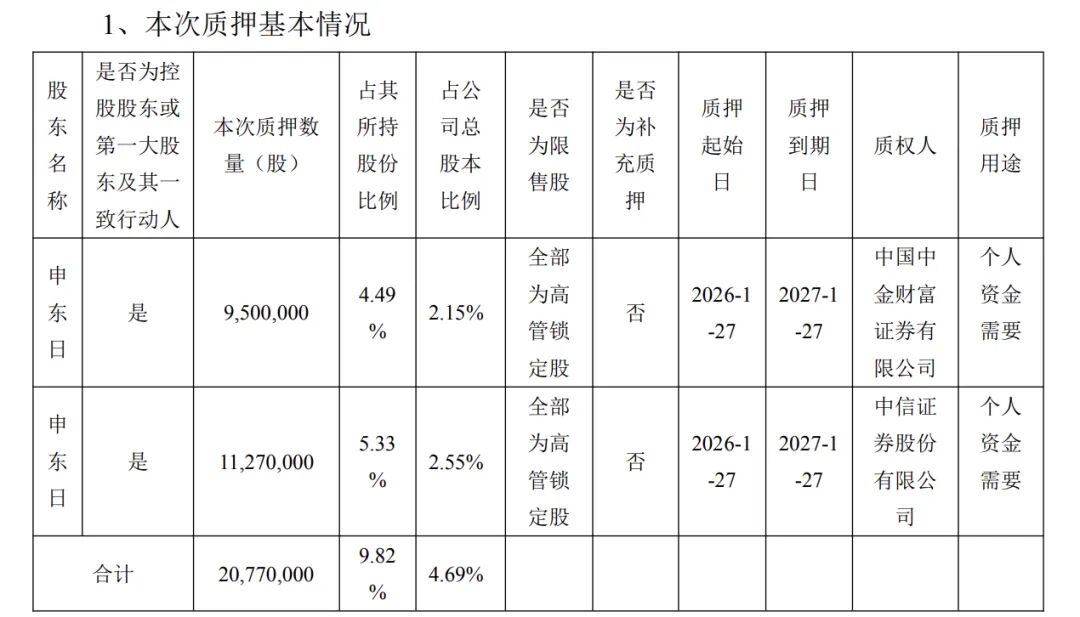
Core Viewpoint - The controlling shareholder of Langzi Co., Ltd., Shen Dongri, has pledged 20.77 million shares of the company due to personal funding needs, raising concerns about the company's financial stability and operational performance [2][4]. Share Pledge Details - Shen Dongri pledged 9.5 million shares to China International Capital Corporation and 11.27 million shares to CITIC Securities, with the pledge starting on January 27, 2026, for one year [2][3]. - The pledged shares represent 36.61% of Shen's total holdings and 17.5% of the company's total equity [4]. Financial Performance - Langzi Co., Ltd. expects a net profit of 900 million to 1.05 billion yuan for 2025, a year-on-year increase of 245.25% to 302.8%, primarily due to investments in the listed company Ruoyuchen [4]. - The company reported a revenue of 4.328 billion yuan for the first three quarters of 2025, remaining stable year-on-year, while the net profit excluding non-recurring items is projected to be between 220 million and 290 million yuan, reflecting a modest increase of 1.09% to 33.25% [5]. Business Segment Performance - The medical beauty segment generated approximately 2.237 billion yuan in revenue, a year-on-year increase of 2.49%, but the corresponding net profit decreased by 33.49% to 77.198 million yuan [6]. - The women's clothing segment achieved revenue of 1.407 billion yuan, with a slight net profit increase of 1.62% to 99.143 million yuan, while online sales grew by 22.55% [6]. - The infant and child segment reported revenue of 674 million yuan, with net profit declining significantly compared to the previous year [6]. Inventory and Financial Health - As of September 2025, the company's inventory for women's clothing reached approximately 630 million yuan, a 13.84% increase from the end of 2024, indicating rising inventory levels [6]. - The company faces financial pressure, with cash reserves of 505 million yuan insufficient to cover short-term borrowings of 1 billion yuan [10]. Strategic Moves - Langzi Co., Ltd. is accelerating its investment in the medical beauty sector, including a recent acquisition of a 67.5% stake in a cosmetic surgery hospital for 92.475 million yuan [7][8].

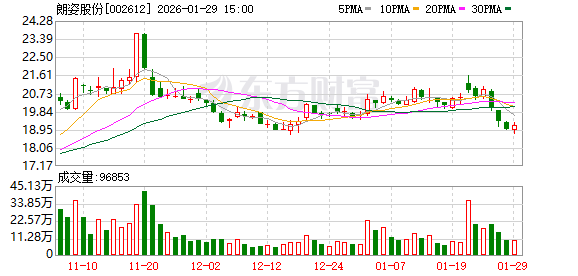
投资若羽臣赚了9.7亿元后,朗姿股份老板还在质押股票融资
Guo Ji Jin Rong Bao· 2026-01-29 15:13
Core Viewpoint - The controlling shareholder of Langzi Co., Ltd. has pledged 20.77 million shares due to personal funding needs, raising concerns about the company's financial stability and operational performance [1][3]. Share Pledge Details - The pledged shares include 9.5 million shares to China International Capital Corporation and 11.27 million shares to CITIC Securities, with a pledge period starting from January 27, 2026, for one year [1][2]. - The total pledged shares represent 36.61% of the shareholder's holdings and 17.5% of the company's total equity [3]. Financial Performance - Langzi Co., Ltd. expects a net profit of 900 million to 1.05 billion yuan for 2025, a significant increase of 245.25% to 302.8% year-on-year, primarily due to investment gains from Ruoyuchen [6]. - The company's revenue for the first three quarters of 2025 was 4.328 billion yuan, remaining stable compared to the previous year, while the net profit excluding non-recurring items decreased by 4.11% [6][7]. Business Segments - The medical beauty segment generated approximately 2.237 billion yuan in revenue, a 2.49% increase year-on-year, but the corresponding net profit decreased by 33.49% [7]. - The women's clothing segment achieved revenue of 1.407 billion yuan, with a slight net profit increase of 1.62% [7]. - The children's wear segment contributed 674 million yuan in revenue, showing a decline compared to the previous year [7]. Inventory and Cash Flow - As of September 2025, the company's inventory for women's clothing reached approximately 630 million yuan, a 13.84% increase from the end of 2024 [7]. - The company's cash flow from operating activities decreased by 1.87% to 359 million yuan [6]. Strategic Moves - Langzi Co., Ltd. is accelerating its investment in the medical beauty sector, including a recent acquisition of a 67.5% stake in a cosmetic surgery hospital for 92.475 million yuan [8][9]. - The company controls four comprehensive hospitals and two outpatient departments, with plans to integrate these medical beauty institutions into its financial statements [9]. Financial Constraints - As of September 2025, the company's cash reserves were 505 million yuan, insufficient to cover short-term borrowings of 1 billion yuan [11].