支付

Search documents
开联通支付被罚没超3843万元:未能确保交易信息真实、完整、可追溯等
Xin Lang Cai Jing· 2026-01-21 10:08
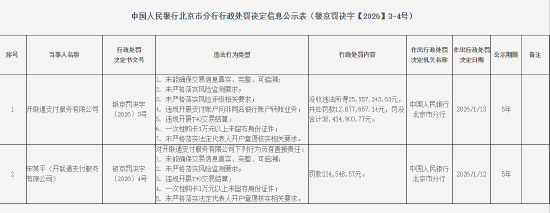
1月21日金融一线消息,中国人民银行北京市分行发布行政处罚决定信息显示,开联通支付服务有限公 司(以下简称"开联通支付")因七项业务违规,被没收违法所得25557243.63元,并处罚款12877657.14 元,罚没合计38434900.77元。 1月21日金融一线消息,中国人民银行北京市分行发布行政处罚决定信息显示,开联通支付服务有限公 司(以下简称"开联通支付")因七项业务违规,被没收违法所得25557243.63元,并处罚款12877657.14 元,罚没合计38434900.77元。 具体来看,开联通支付违规行为包括:未能确保交易信息真实、完整、可追溯;未严格落实风险监测要 求;未严格落实风险评级相关要求;违规开展支付账户向非同名银行账户转账业务;违规开展T+0交易 结算;一次性购卡1万元以上未留存身份证件;未严格落实法定代表人开户意愿核实相关要求。 同时,宋某平对其中部分违法行为负有直接责任,被罚款224548.57元。 | | | | 中国人民银行北京市分行行政处罚决定信息公示表(银京罚决字【2026】 3-4号) | | | | | | | --- | --- | --- | --- | -- ...

空中云汇收购韩国持牌支付公司 Paynuri 加速亚太业务布局
Zheng Quan Shi Bao Wang· 2026-01-21 02:13
Core Insights - Airwallex has acquired South Korean licensed payment company Paynuri, enhancing its capabilities in the Korean market with payment gateway, prepaid electronic payment tools, and foreign exchange qualifications [1] - Following its Series G funding round, Airwallex's valuation reached $8 billion, marking a 30% increase from the previous round, with the acquisition being a strategic move post-funding [1] - The company aims to utilize the new funding to accelerate its expansion in key markets like South Korea, establishing compliant and secure financial infrastructure [1] Group 1 - Airwallex will enable Korean businesses to manage global corporate accounts, global acquiring, and global expenditure management through a unified platform [2] - The initial products to be launched in the Korean market include global corporate accounts and acquiring services, with more products expected to roll out in 2026 [2] - The company aims to provide efficient cross-border solutions for Korean enterprises, supporting their international market expansion [2] Group 2 - The acquisition is expected to optimize the financial business environment in South Korea, benefiting both local and global companies operating in the region [3] - Airwallex holds 80 licenses and permits across North America, Europe, the Middle East, and Asia-Pacific, making it one of the most comprehensive financial service infrastructures globally [3] - In 2025, Airwallex's revenue and transaction volume in the Asia-Pacific region are projected to grow by 85% and 71% respectively, with annual global revenue exceeding $1.2 billion and annualized transaction volume reaching $266 billion [3] Group 3 - Airwallex plans to expand its local operations team in South Korea, expecting to increase the team size to approximately 20 by the end of 2026 [4]
跨境联通 无缝接轨:银联如何织就一张全球支付网络
Xin Hua Wang· 2026-01-21 01:30
Group 1 - The core viewpoint of the articles emphasizes UnionPay's evolution from a service primarily for Chinese cardholders to a global payment network, showcasing its commitment to expanding its international presence and adapting to the mobile payment trend [1][2][4]. Group 2 - UnionPay's internationalization began in 2004 in Hong Kong, aiming to address the payment challenges faced by Chinese travelers abroad, and has since expanded to cover 183 countries and regions with over 75 million merchants accepting UnionPay [2]. - The establishment of UnionPay International in 2012 marked a significant step in its global strategy, leading to a comprehensive product matrix that includes mobile payment solutions, enhancing its competitive edge [2][3]. - UnionPay has issued over 200 million cards in 83 overseas markets, with a notable penetration rate in the Asia-Pacific region, and has launched over 200 cooperative wallets in 37 countries [2][3]. Group 3 - UnionPay employs a dual-track strategy for market expansion, utilizing G2G (government-to-government) models in regulated markets and N2N (network-to-network) models in mature commercial markets to facilitate efficient connections with local payment networks [3]. - The company is also involved in building a new "four-party model" open ecosystem, acting as a hub connecting various stakeholders in the payment industry, exemplified by projects like the QR code interoperability between China and Indonesia [3][4]. Group 4 - UnionPay's role has evolved from a "builder" of payment infrastructure to an "enabler" of industry standards, exporting its technology and standards to enhance digital payment capabilities in countries like Laos and Thailand [4]. - The company is actively participating in national infrastructure projects, such as the upcoming cross-border QR code unified gateway set to launch in 2025, which aims to improve cross-border payment efficiency [3][4]. Group 5 - UnionPay's services cater to both individual consumers and businesses, offering a range of products including standard credit and debit cards, as well as specialized cards for cross-border tourists and students [5][6]. - The introduction of mobile payment tools like UnionPay Mobile Pay and QR code wallets allows cardholders to enjoy convenient payment services in over 100 countries [6]. Group 6 - To enhance the payment experience for foreign visitors in China, UnionPay has launched products like the "Jinxiu Zhonghua Card" and the "Nihao China" app, which integrates various services to facilitate seamless transactions [7]. - UnionPay is also promoting the integration of foreign wallets into the Chinese payment ecosystem, allowing users to pay using local payment habits, which has shown significant growth in transaction volumes [7]. Group 7 - UnionPay is positioning itself as a digital bridge connecting different currencies, payment habits, and cultures, contributing to a more open and inclusive global payment ecosystem [8]. - The company's development practices highlight that the competitiveness of a payment network in the digital age relies on both the breadth of coverage and the depth of ecosystem connections [8].
MasterCard (NYSE: MA) Price Target and Investment Insights
Financial Modeling Prep· 2026-01-20 21:14
Core Insights - MasterCard is a leading player in the global payments industry, providing a variety of financial transaction services and competing with major companies like Visa and American Express [1] Price Target and Market Outlook - Truist Financial has set a new price target of $609 for MasterCard, indicating a potential price increase of approximately 14.02% from its current price of $534.12, reflecting a more conservative outlook compared to the previous target of $630 [2][6] Institutional Holdings and Investor Sentiment - Dynasty Wealth Management LLC has reduced its holdings in MasterCard by 22.7%, selling 2,757 shares, which leaves the firm with 9,363 shares valued at around $5.3 million, suggesting a strategic reallocation of assets [3] - Other hedge funds, including LGT Financial Advisors LLC, Evolution Wealth Management Inc., and IMG Wealth Management Inc., have acquired new positions in MasterCard, with investments of $25,000, $29,000, and $31,000 respectively, indicating varied investor sentiment [4][6] Stock Performance - MasterCard's stock price is currently around $534.39, reflecting a decrease of about 0.95% or $5.10, with a trading range between a low of $529.53 and a high of $536.09 during the day; over the past year, the stock has reached a high of $601.77 and a low of $465.59, with a market capitalization of approximately $483.1 billion [5]

支付互联赋能全球协同 银联二维码生态聚力谱新篇
Shang Hai Zheng Quan Bao· 2026-01-20 18:53
Core Insights - The World Economic Forum emphasizes the importance of collaborative models for global cooperation, with UnionPay positioning itself as a key player in global payment services through a new "four-party model" and QR code interoperability [1] Group 1: Cross-Border Payment Trends - The deepening of global economic integration has led to increased demand for efficient, convenient, and secure cross-border payment services, particularly in the context of the Belt and Road Initiative [2] - QR code payments are becoming the mainstream payment method in emerging markets due to their low cost and ease of promotion, with significant adoption in Southeast Asia, Brazil, and Turkey [2] Group 2: UnionPay's Cross-Border Payment Strategy - UnionPay's approach to cross-border QR code interoperability is driven by a combination of policy alignment, innovative models, and technological empowerment [3] - The company has introduced a dual-track mechanism of Government-to-Government (G2G) and Network-to-Network (N2N) cooperation to facilitate payment standard recognition and system integration in various markets [3] Group 3: Consumer Experience and Market Expansion - The core value of payment interoperability is reflected in enhanced consumer experiences, allowing for seamless cross-border transactions without the need for currency exchange or unfamiliar payment tools [4][5] - UnionPay has established QR code interoperability partnerships in approximately 50 countries, with significant growth in cross-border payment volumes, evidenced by a 124% increase in domestic users' transactions abroad and a 100% increase in foreign users' transactions in China in 2025 [5] Group 4: Future Outlook - UnionPay aims to strengthen its global acceptance network to support dual circulation in domestic and international markets, focusing on regions like Southeast Asia, Central Asia, and Africa [6] - The company plans to accelerate the development of a new "four-party model" for cross-border payments, integrating quality resources across the payment industry to foster an open and collaborative global payment ecosystem [6]
富友支付第四次递表港交所 11年7次冲击IPO
Zhong Guo Jing Ying Bao· 2026-01-20 16:20
Core Viewpoint - Shanghai Fuyou Payment Service Co., Ltd. has submitted its fourth listing application to the Hong Kong Stock Exchange, aiming to capitalize on its position as a licensed third-party payment institution in China's digital payment market [1][2]. Company Overview - Fuyou Payment was established in 2011 and holds five types of licenses, including prepaid cards, internet payment, bank card acquiring, fund payment, and cross-border payment, making it one of the few fully licensed third-party payment institutions in the industry [1]. - The company ranks eighth among comprehensive digital payment service providers in China with a market share of approximately 0.8% and fourth among independent comprehensive digital payment service providers with a market share of about 4.5% [1]. Market Context - According to Frost & Sullivan, the total TPV (Total Payment Volume) of China's comprehensive digital payment service market is projected to reach RMB 268.6 trillion in 2024, with the top ten comprehensive digital payment institutions accounting for around 82.0% of the total market share [1]. - Fuyou Payment holds the first position in the aggregation acquiring market by transaction volume, with a market share of approximately 15.1% [1]. Financial Performance - The revenue figures for Fuyou Payment from 2022 to the first ten months of 2025 are as follows: RMB 1.142 billion, RMB 1.5 billion, RMB 1.634 billion, and RMB 1.307 billion, respectively [2]. - Profit figures for the same periods are RMB 71.17 million, RMB 92.98 million, RMB 84.33 million, and RMB 109 million, respectively [2]. - The merchant acquiring business has consistently been the primary revenue source, contributing over 80% of total revenue for several years [2]. - The gross margins for comprehensive digital payment services during this period were 25.6%, 22.1%, 22.2%, and 22.0%, while digital commercial solutions had gross margins of 84.4%, 76.5%, 75.2%, and 70.1% [2]. Listing Process - The submission of the listing application is just the initial step, with subsequent requirements including passing the Hong Kong Stock Exchange hearing and completing the overseas issuance listing filing with the regulatory authority [2].
十年坎坷上市路!富友支付第四次递表港交所,收单服务占比超八成
Bei Jing Shang Bao· 2026-01-20 15:10
这家支付机构上市进程再现新动作。1月20日,北京商报记者注意到,港交所官网信息披露页面显示,上海富友支付服务股份有限公司(以下简称"富友支 付")日前再度向港交所递交招股书,中信证券、申万宏源香港为其联席保荐人。 自2015年开始,富友支付先后多次在A股、港股两地发起上市冲击,本次招股书更新也是富友支付第四次向港交所递表。从最新营业情况来看,2025年前10 个月,富友支付营业收入小幅回落,但净利润同比增幅超过70%,同时,公司不可避免地存在业务类型相对单一的问题。在多次"闯关"后,叠加支付行业市 场环境的变化,有分析人士指出,富友支付上市成功概率较此前有所提升,后续公司的合规性、盈利稳定性以及未来转型发展方向都是关注重点。 第四次向港交所递表 1月18日,富友支付向港交所递交新一版招股书,引发市场广泛关注。 综合人民银行官网、天眼查等公开信息来看,富友支付成立于2011年7月,同年12月获得人民银行颁发的支付牌照,最初业务许可范围为全国范围内的互联 网支付、银行卡收单。2016年8月,在第一次牌照续展前,富友支付新增福建省、江苏省、上海市、浙江省范围内的预付卡发行与受理业务,银行卡收单范 围则由全国缩减至除 ...

“先买后付”的消费新模式快速兴起,有怎样运行模式?需提示哪些潜在风险?
Yang Guang Wang· 2026-01-20 02:19
Core Viewpoint - The "Buy Now, Pay Later" (BNPL) payment model has gained popularity, providing convenience to consumers but also leading to potential risks and disputes regarding payment amounts and terms [1][5]. Group 1: Consumer Complaints and Issues - Consumers have reported unexpected changes in their default payment methods to "Buy Now, Pay Later," leading to confusion over actual charges and additional fees [1][2]. - A specific case involved a consumer who experienced discrepancies between the advertised price and the final amount charged, resulting in a dispute with both the merchant and the platform [2][3]. - Another consumer found that using BNPL for travel bookings resulted in unexpected loan-like charges, including interest and late fees, rather than direct deductions from their account [3][4]. Group 2: Impact on Consumer Behavior - The BNPL model has been noted to increase consumer spending, with some merchants reporting over a 30% increase in sales after adopting this payment option [3][5]. - However, it has also led to irrational spending behaviors, as consumers may lose track of their total expenditures, leading to financial strain when payments are deducted unexpectedly [3][6]. Group 3: Regulatory and Consumer Rights Concerns - Experts have highlighted the need for better regulation of the BNPL model to ensure consumer rights are protected, emphasizing the importance of clear communication regarding payment terms and potential risks [5][6]. - There is a call for platforms to provide significant notifications about the implications of using BNPL, including the possibility of accruing interest and fees, to enhance consumer awareness and choice [6][7]. - The balance between promoting consumer spending and ensuring adequate regulatory oversight is crucial to mitigate risks associated with this payment model [7].
2025年支付机构备付金明显增长
Bei Jing Shang Bao· 2026-01-20 00:57
Core Insights - The payment reserve fund data for 2025 shows a significant increase, with non-financial institution deposits reaching 25,260.22 billion yuan by December, up 135.34 billion yuan from November [1] - The payment reserve fund has remained above 25 trillion yuan for five consecutive months since August 2025, indicating a stable recovery in the payment industry [2] Group 1: Payment Reserve Fund Trends - In 2025, the reserve fund maintained a level above 25 trillion yuan for seven months, with an average monthly level significantly higher than in 2024 [2] - The total reserve fund balance increased by 1,108.64 billion yuan compared to the end of 2024, reflecting a fluctuating growth state in the payment institutions [2] - The changes in core data indicate a stabilization in transaction activity within the payment industry, driven by a recovery in the consumer market [2] Group 2: Regulatory and Market Dynamics - The People's Bank of China has implemented strict management of the reserve fund, with at least four payment institutions penalized for violations in 2025 [3] - The new M1 statistical criteria include non-bank payment institution customer reserve funds, enhancing the liquidity of these funds [3] - Expectations for 2026 suggest that traditional consumption and e-commerce peak seasons will be critical for reserve fund performance, with significant increases anticipated during the Spring Festival and promotional events [3]
评级新规正式施行倒计时!新年首张支付千万罚单落袋银盛支付
Nan Fang Du Shi Bao· 2026-01-19 13:07
Core Viewpoint - Yinsheng Payment Service Co., Ltd. has been fined approximately 15.84 million yuan for three major violations in the payment settlement sector, marking the third time the company has received a fine of over 10 million yuan [2][4][6]. Group 1: Violations and Penalties - The violations include breaches of merchant management regulations, clearing management regulations, and account management regulations, which are interconnected and can lead to systemic risks [4][5]. - The penalties imposed include a warning and a fine of 15,841,686.57 yuan for the company, and a fine of 610,000 yuan for the then-chairman Chen [3][4]. - This fine is part of a pattern, as the company has received multiple fines over the years, with three fines exceeding 10 million yuan since 2017 [6][10]. Group 2: Regulatory Context - The violations highlight critical issues in the payment business, particularly in anti-money laundering and merchant management compliance, as mandated by the Non-Financial Institution Payment Service Management Measures [4][10]. - The regulatory framework emphasizes that payment institutions must not outsource their business and must verify customer identities to prevent illegal activities [5][10]. - The upcoming implementation of the Non-Bank Payment Institution Classification Rating Management Measures in February 2026 will introduce a more precise regulatory approach, focusing on various aspects of compliance and risk management [12][13]. Group 3: Industry Implications - The repeated fines faced by Yinsheng Payment reflect a broader trend in the payment industry, where regulatory scrutiny is increasing, and penalties for non-compliance are becoming more common [11][12]. - Analysts suggest that the company must enhance its compliance management system and establish comprehensive risk monitoring mechanisms to align with regulatory expectations [10]. - The new rating system will incentivize proactive risk management, shifting the focus from reactive compliance to preventive measures [13].