
智能穿戴

Search documents
【西街观察】儿童手表“社交化”擦边商业伦理
Bei Jing Shang Bao· 2025-11-13 14:26
Core Viewpoint - The recent controversy surrounding the "invisible social" features of children's smartwatches, particularly the Xiaotianzi phone watch, raises significant concerns about the appropriateness of social functions for child users, highlighting the potential for gray market activities such as account trading and social media manipulation [1][2]. Industry Overview - The children's smartwatch market has seen rapid growth, with annual sales exceeding 10 million units and a market value in the hundreds of billions of yuan, primarily focusing on safety, real-time communication, and precise location tracking [1]. - The shift towards social features in products designed for children deviates from the original intent of promoting safety and could lead to negative implications for child education and product logic [1]. Ethical Considerations - The introduction of social functionalities in children's products can create a distorted supply-demand chain, fostering inappropriate user demands and leading to the emergence of a chaotic gray supply market [2]. - Companies must exercise caution when targeting the underage market, as the desire for social comparison and self-presentation can pose risks to children's development [2]. Technological Risks - The integration of advanced technologies, such as AI, into children's products must be approached with care, as even adults struggle to discern the accuracy of AI outputs, making it inappropriate to expose children to potentially misleading information [2]. - The focus on precision and safety should remain paramount in children's products, and companies should prioritize ethical considerations over profit motives [2].
广发银行东莞分行:千万级信贷精准滴灌,金融助力体育产业发展
2 1 Shi Ji Jing Ji Bao Dao· 2025-11-07 12:09
Group 1 - The smart wearable market is experiencing a new growth wave driven by the ongoing fitness craze and major sports events [4] - A Dongguan-based smart wearable company, recognized as a national-level technology SME, focuses on technological innovation to provide high-performance health products [3] - The company faces funding challenges for technological upgrades and capacity expansion despite the increasing demand for its smart devices [3] Group 2 - The People's Bank of China and other departments issued guidelines to enhance financial support for the sports industry, aiming to build a multi-layered financial product system [2] - Guangfa Bank's Dongguan branch is actively providing customized financial services to high-growth tech companies in the sports health sector, enhancing their development capabilities [2][3] - Guangfa Bank has provided nearly 37 million yuan in credit support to the smart wearable company, facilitating the introduction of advanced production equipment and improving manufacturing capabilities [3]

智动力:已经研发出双幕AR眼镜
Zheng Quan Shi Bao Wang· 2025-11-06 11:11
Core Viewpoint - The company, Zhihui Power (智动力), is advancing in the AR glasses market by developing its own dual-screen AR glasses named "Tianying" and collaborating with strategic partners [1] Group 1: Company Developments - Zhihui Power has invested in and partnered with the eyewear solution provider, Montong Intelligent, and is collaborating with Hangzhou Lingxi Micro Light [1] - The company has developed its own dual-screen AR glasses using 2D full-color waveguide technology, which offers a larger field of view and clearer colors compared to similar products [1] Group 2: Product Features - The AR glasses "Tianying" utilize 2D full-color waveguide technology and the company is also working on a full-color diffraction waveguide solution for AR glasses [1]

比依股份:公司已在中意智慧家电产业园铺设AR眼镜整机线体
Zheng Quan Ri Bao· 2025-11-05 11:41
Core Insights - Biyi Co., Ltd. has established a strategic partnership with LiPai Guangjing to enhance its capabilities in the micro-display and optical waveguide sectors, which are crucial for AI/AR glasses [2] - The company has set up an AR glasses assembly line in the China-Italy Smart Home Industrial Park and is moving towards small-batch verification and market collaboration for its smart wearable products [2] Company Developments - Biyi Co., Ltd. is leveraging its manufacturing capabilities to push forward the development of smart wearable products [2] - The strategic cooperation with LiPai Guangjing aims to integrate assembly processes and technology advantages to strengthen product offerings in the AI/AR market [2]

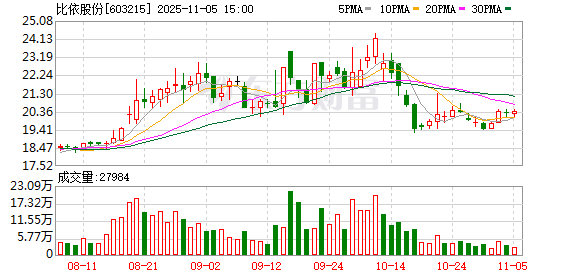
比依股份(603215.SH):已在中意智慧家电产业园铺设AR眼镜整机线体
Ge Long Hui· 2025-11-05 07:34
Core Viewpoint - Biyi Co., Ltd. (603215.SH) has established a strategic partnership with Li Pai Guang Jing to enhance its capabilities in the micro-display and optical waveguide sectors, which are crucial for AI/AR glasses [1] Group 1: Company Developments - Biyi Co., Ltd. has laid out an assembly line for AR glasses in the Sino-Italian Smart Home Industrial Park [1] - The company aims to advance its smart wearable products from small-batch verification to market collaboration [1] - The strategic cooperation with Li Pai Guang Jing focuses on integrating assembly capabilities with technological advantages in micro-displays [1] Group 2: Industry Insights - The partnership is positioned to leverage technological strengths in the AI/AR glasses market, indicating a growing trend in smart wearable technology [1] - The collaboration highlights the importance of component manufacturing in the development of advanced wearable devices [1]
比依股份:已在中意智慧家电产业园铺设AR眼镜整机线体
Ge Long Hui· 2025-11-05 07:34
Core Viewpoint - Biyi Co., Ltd. (603215.SH) is leveraging its technological advantages in micro-displays and optical waveguides to provide key components for AI/AR glasses, indicating a strategic focus on the smart wearable market [1] Group 1: Company Developments - The company has established an AR glasses assembly line in the China-Italy Smart Home Industrial Park [1] - A strategic cooperation intention has been reached with Li Pai Guang Jing through its wholly-owned subsidiary, Zhejiang Biyi Intelligent Manufacturing Technology Co., Ltd. [1] - The collaboration aims to advance the company's smart wearable products from small-batch verification to market cooperation [1]
吉利汽车回应改造原上汽通用北盛工厂(三期);“深圳造”智能戒指全球销量第二丨智能制造日报
创业邦· 2025-11-05 03:18
Group 1 - Geely Auto is actively exploring various capacity expansion plans to meet the increased demand for Geely Galaxy, without building new factories or expanding existing ones [2] - Japanese auto parts suppliers are seeking to integrate into China's automotive supply chain as the market share of Japanese cars declines, highlighting the urgency for collaboration with Chinese automakers [2][3] - Shenzhen-based JiuZhi Technology's RingConn smart ring has achieved global sales of over 150,000 units, ranking second in the smart ring market, with a user growth rate exceeding 100% year-on-year [3] Group 2 - The robotics industry has seen a revenue growth of 29.5% year-on-year in the first three quarters, with industrial robot production reaching 595,000 units and service robot production at 13.5 million units, surpassing the total expected for 2024 [3] - The performance and quality of robotic products have significantly improved, with successful development of high-performance industrial robots filling gaps in the high-end market [3] - Key components for robots, such as precision reducers and high-performance servo systems, are continuously achieving breakthroughs, enhancing the overall capability of the robotics sector [3]


财信证券晨会纪要-20251105
Caixin Securities· 2025-11-04 23:33
Group 1 - The bond market overview indicates a slight increase in yields for both 1-year and 10-year government bonds, with the 1-year yield rising by 0.34 basis points to 1.39% and the 10-year yield increasing by 0.40 basis points to 1.80% [13] - The Chinese logistics industry experienced a slight decline in the logistics prosperity index, which fell by 0.5 percentage points to 50.7 in October, although overall demand remains in the expansion zone [15] - The third quarter of 2025 saw a slowdown in the growth rate of China's smart watch and wristband market, with sales growth dropping to 6.7% year-on-year, while the total sales for the year are expected to increase by approximately 24% [26] Group 2 - The company "指南针" (300803.SZ) announced the termination of its plan to issue shares to specific investors for the year 2022, which was intended to raise up to 290.458 million yuan [29][30] - "湖南白银" (002716.SZ) reported progress on its share repurchase plan, with a total repurchase amount between 92.6006 million yuan and 123.2406 million yuan, having repurchased 17.55 million shares at prices ranging from 4.47 yuan to 6.74 yuan [32]
探营上海馆:以“AI赋能,种草新消费”,100多件新品将集中亮相
Di Yi Cai Jing· 2025-11-04 12:21
Core Viewpoint - The Shanghai Pavilion at the 8th China International Import Expo showcases the theme "AI Empowerment, Cultivating New Consumption," highlighting innovations in the construction of an international consumption center city through intelligent presentations and sustainable design [2]. Group 1: Brand Story - The "Brand Story" section focuses on brand economy and the launch economy, emphasizing the internationalization of local brands and the debut of international brands, showcasing how commercial brands contribute to the quality upgrade of the consumption sector [5]. - Notable exhibits include the "Blooming Secret Realm" jewelry from the century-old brand Lao Feng Xiang, which previously impressed at Milan Fashion Week [5]. - The pavilion features a dialogue and collaboration between Chinese and international brands, including LEGO's skyline exhibit of Shanghai [11]. Group 2: Consumption Innovation - The "Consumption Innovation" section addresses trends in personalized, emotional, and health-related consumption, showcasing AI's role in enhancing service and digital consumption [15]. - The "Silver Economy" area features a home care robot developed by Zhineng Technology [15]. - The "Children's Economy" area displays AI toys designed for emotional regulation and educational companionship, such as the Fuzozo doll and the chess-playing robot from SenseTime [17]. - The "Youth Economy" area highlights original IP incubation companies like Bilibili and showcases their latest animation generation model [18]. - The "Pet Economy" area features lifestyle products from the brand VETRESKA, including a cactus-shaped cat climbing frame [20]. Group 3: Experience Consumption - The third section explores the potential for consumption growth by breaking physical boundaries and creating new experience consumption scenarios through cultural tourism and night economy themes [22]. - The Shanghai Museum presents a "Mini version of the Egyptian Gods" scene, representing cultural IP [22]. - The "INS New Paradise" scene represents the night economy, featuring live DJ performances and dancing robots [23].


推动新技术新产品规模化商业化应用 场景培育开放政策即将出台
Xin Hua Wang· 2025-11-04 02:09
Core Insights - The Chinese government is set to accelerate the cultivation of application scenarios and the opening of related policy documents to promote the large-scale commercialization of new technologies and products, aiming to create a favorable innovation ecosystem [1][3] Group 1: Policy Initiatives - The State Council's recent meeting emphasized leveraging China's vast market and diverse application scenarios to prioritize new fields and high-value scenarios for innovation [1][3] - The government plans to implement demonstration actions for large-scale applications of new technologies and products, particularly in emerging industries like commercial aerospace and deep-sea technology [3][4] Group 2: Current Progress - Significant advancements in scenario-based open innovation have been made, with platforms like the National New Generation Artificial Intelligence Open Innovation Platform being established to enhance corporate innovation capabilities [2] - Emerging industries such as autonomous driving, virtual reality, and smart healthcare are witnessing the rise of new technologies and products [2] Group 3: Challenges and Recommendations - Experts highlight that scenario-based open innovation is still in its early stages, facing systemic barriers that hinder the establishment of standards and regulatory frameworks [2][4] - There is a need for effective institutional design and policy support to facilitate the development of new scenarios, ensuring a balance between innovation and regulatory safety [4]