
装备制造业

Search documents
2025年12月经济数据点评:经济完成5%目标的结构性亮点与制约
Zhong Cheng Xin Guo Ji· 2026-01-23 08:10
Economic Performance - The economy achieved a growth target of 5% for 2025, with a GDP growth rate of 5.0% for the year, maintaining stability despite challenges[8] - Final consumption contributed over 52% to GDP growth, indicating effective policies to boost consumer spending[10] - Industrial production showed strong performance with an industrial added value growth rate of 5.9%, the highest in four years[10] Investment Trends - Fixed asset investment experienced a historical decline of 3.8%, marking the first annual negative growth[12] - Infrastructure investment faced challenges, with a significant drop in new special bonds allocated for infrastructure projects, totaling only 2.66 trillion yuan compared to 3.14 trillion yuan the previous year[13] - Real estate investment fell to a record low of -17.2%, reflecting ongoing weaknesses in the sector[15] Consumer Behavior - Retail sales growth for 2025 was only 3.7%, with December showing a low of 0.9%, the lowest level outside of pandemic periods[10] - Service consumption remained resilient, growing at 5.5%, supported by travel and entertainment demand during peak seasons[10] - The consumer price index (CPI) remained stable, with inflation pressures under control, indicating a manageable economic environment[4] External Factors - Export growth remained robust, with December exports exceeding expectations despite high base effects from the previous year[5] - The trade surplus reached 118.89 billion USD in December, reflecting strong external demand[24] - The economic outlook for 2026 anticipates a growth rate of around 4.8%, supported by new projects and resilient external demand[22]
29城GDP超万亿:大连成东北首个GDP万亿城市
Di Yi Cai Jing· 2026-01-23 06:02
Core Insights - Dalian has become the first city in Northeast China to surpass a GDP of 1 trillion yuan, achieving a total GDP of 1,002.1 billion yuan in 2025, reflecting a year-on-year growth of 5.7% at constant prices [1] Economic Performance - The primary industry in Dalian contributed an added value of 66.54 billion yuan, growing by 3.6% year-on-year [1] - The secondary industry saw an added value of 353.25 billion yuan, with a growth rate of 7.7% [1] - The tertiary industry achieved an added value of 580.42 billion yuan, marking a growth of 4.8% [1] Industrial Growth - In the previous year, Dalian's industrial output value increased by 11.7% year-on-year, which is an improvement of 4.1 percentage points compared to the previous year [1] - Key industries such as petrochemicals grew by 8.9%, while equipment manufacturing surged by 15.4%, with the railway and shipbuilding sector experiencing a remarkable growth of 57.5% and the automotive industry growing by 19.5% [1] - High-tech manufacturing also saw a growth of 13.9%, with computer and office equipment manufacturing skyrocketing by 78.2% and pharmaceutical manufacturing increasing by 30.9% [1] Product Output - Dalian reported significant increases in product output, with chemical raw materials, integrated circuit wafers, and liquid crystal displays growing by 26.1%, 19.1%, and 3.0% respectively [1] Additional Information - Wenzhou, located in Zhejiang Province, has also joined the "GDP trillion club" alongside Dalian [1]
29座城市GDP超万亿:大连成东北地区首个GDP万亿城市
Di Yi Cai Jing· 2026-01-23 05:05
Group 1 - The core viewpoint of the articles is that the number of cities in China with a GDP exceeding 1 trillion yuan has increased to 29, with Dalian and Wenzhou being the latest additions to this group [1][2][4] - Dalian's GDP is projected to reach 1,000.21 billion yuan by 2025, with a year-on-year growth of 5.7%, driven by increases in all three major industries: primary (3.6%), secondary (7.7%), and tertiary (4.8%) [1] - In 2022, Dalian's industrial output value grew by 11.7%, with significant growth in key sectors such as petrochemicals (8.9%), equipment manufacturing (15.4%), and high-tech manufacturing (13.9%) [1] Group 2 - Wenzhou is expected to surpass a GDP of 1 trillion yuan by 2025, supported by its unique external resources and efforts to revitalize traditional industries while fostering new ones [3] - The development of transportation infrastructure in Zhejiang, including high-speed rail, has enhanced Wenzhou's access to educational and technological resources, further supporting its economic growth [3] - Shanghai and Beijing are projected to maintain their positions as major economic centers, with GDPs of 5.67 trillion yuan and 5.21 trillion yuan respectively by 2025, both showing a growth rate of 5.4% [4]
大连2025年地区生产总值同比增长5.7%,成为东北地区首个GDP突破万亿元城市
Zheng Quan Shi Bao Wang· 2026-01-23 04:59
Economic Overview - In 2025, Dalian's GDP reached 1,000.21 billion yuan, marking a year-on-year growth of 5.7% at constant prices, making it the first city in Northeast China to surpass a GDP of one trillion yuan [1] - The city aims for steady progress while fully implementing new development concepts and focusing on six construction goals [1] Industry Performance - Dalian's industrial added value for large-scale enterprises grew by 11.7% year-on-year, an increase of 4.1 percentage points from the previous year [2] - The mining industry saw a remarkable growth of 72.7%, while manufacturing increased by 12.1% [2] - Key sectors such as petrochemicals and equipment manufacturing grew by 8.9% and 15.4%, respectively, with the railway and shipbuilding sector experiencing a significant increase of 57.5% [2] - High-tech manufacturing grew by 13.9%, with computer and office equipment manufacturing soaring by 78.2% [2] Service Sector Growth - The service sector's added value increased by 4.8% year-on-year, showing a slight improvement from the previous year [3] - Key areas such as postal and telecommunications services reported growth rates of 12.6% and 12.7%, respectively [3] - The logistics and warehousing sector, along with cultural and entertainment services, also maintained double-digit growth rates [3] Investment Trends - Manufacturing investment saw a modest increase of 2.8%, while infrastructure investment declined by 11.9% [3] - Investment in industrial technology upgrades rose by 14.5%, indicating a focus on modernization [3] - Private investment, however, faced a decline of 14.1%, reflecting challenges in the investment landscape [3] Overall Economic Performance - Dalian's economy remained stable in 2025, achieving new results in high-quality development, with major expected goals of the 14th Five-Year Plan being met [4]
21评论丨GDP140万亿意味着什么?
2 1 Shi Ji Jing Ji Bao Dao· 2026-01-22 23:10
Economic Growth and Structure - In 2025, China's GDP is projected to reach 140,187.9 billion yuan, with a growth rate of 5.0% year-on-year at constant prices, reflecting a resilient economic performance amid external uncertainties and domestic challenges [1] - The contribution rate of China to global economic growth remains stable at around 30%, highlighting its role as a stabilizing force in the world economy [1] Structural Improvements - The transition from old to new growth drivers is ongoing, with the tertiary sector's value-added increasing by 5.4%, particularly driven by the information transmission, software, and IT services sector, which grew by 11.1% [2] - High-tech manufacturing and equipment manufacturing saw value-added growth rates of 9.4% and 9.2%, respectively, significantly outpacing the average growth rate of large-scale industries [2] - Exports of high-tech products increased by 13.2%, contributing to a 9.4% growth in high-tech industry value-added, indicating a strong correlation between export performance and industrial growth [2] Income Structure and Challenges - The income structure is improving, with per capita disposable income growing by 5.0%, aligning with GDP growth, and per capita wage income increasing by 5.3% [3] - Despite positive trends, challenges remain, including external demand uncertainties, persistent supply-demand imbalances, and issues related to private investment and local debt [3] Policy Recommendations - To enhance internal demand, it is essential to address consumption bottlenecks, stabilize the real estate market, and improve the social security system and income distribution mechanisms [4] - Fiscal policies should focus on effectively utilizing new "old-for-new" policies and long-term bonds to invest in key areas such as new infrastructure and regional development [4] - Monetary policy should maintain a moderately loose stance to lower financing costs and support economic operations, while deep structural reforms should be a continuous focus for sustainable growth [4]
16年规模第一,中国制造当更强
Jing Ji Ri Bao· 2026-01-22 21:58
Core Insights - China's manufacturing sector is expected to maintain its position as the world's largest for 16 consecutive years, with a complete industrial system becoming increasingly evident [1][2] - The transition of Chinese manufacturing towards high-end, intelligent, and green production is a key focus for upgrading and enhancing quality and efficiency [1][3] Manufacturing Scale - China's manufacturing value added has been the highest globally since 2010, accounting for nearly 30% of global manufacturing value added, significantly surpassing other countries [1] - Among 504 major industrial products worldwide, China leads in the production of most, including basic materials like steel and cement, as well as high-end equipment like industrial robots and electric vehicles [1] Industrial System Completeness - China is the only country with a complete industrial classification system recognized by the United Nations, covering 41 major industrial categories and ensuring a stable and efficient production chain [2] - This comprehensive industrial system enhances China's ability to respond quickly to diverse global market demands [2] High-end Manufacturing - High-end manufacturing is crucial for addressing weaknesses in core technologies and components, enhancing the quality and technology level of Chinese products, and extending into higher value chains [2] - By 2025, the value added of major equipment manufacturing and high-tech manufacturing is projected to grow by 9.2% and 9.4% respectively, increasing their share of total industrial output [2] Intelligent Manufacturing - Intelligent manufacturing, driven by AI, big data, and industrial internet technologies, allows China to compete on equal footing with developed countries [3] - China's advantages in new information technologies and extensive application scenarios position it well for leadership in intelligent manufacturing [3] Green Manufacturing - The shift towards green manufacturing focuses on low-carbon technologies and circular economies, addressing sustainability challenges and creating new growth opportunities [3] - By 2025, the production of new energy vehicles is expected to exceed 16 million units, maintaining global leadership for 11 consecutive years, alongside rapid growth in green products like wind turbines [3] Conclusion - China's sustained position as the world's largest manufacturing nation serves as a foundation for its ongoing transition towards a more advanced manufacturing powerhouse [3]
【海报】一组数据勾勒中国经济“向新向优”曲线
Zhong Guo Jing Ji Wang· 2026-01-22 06:55
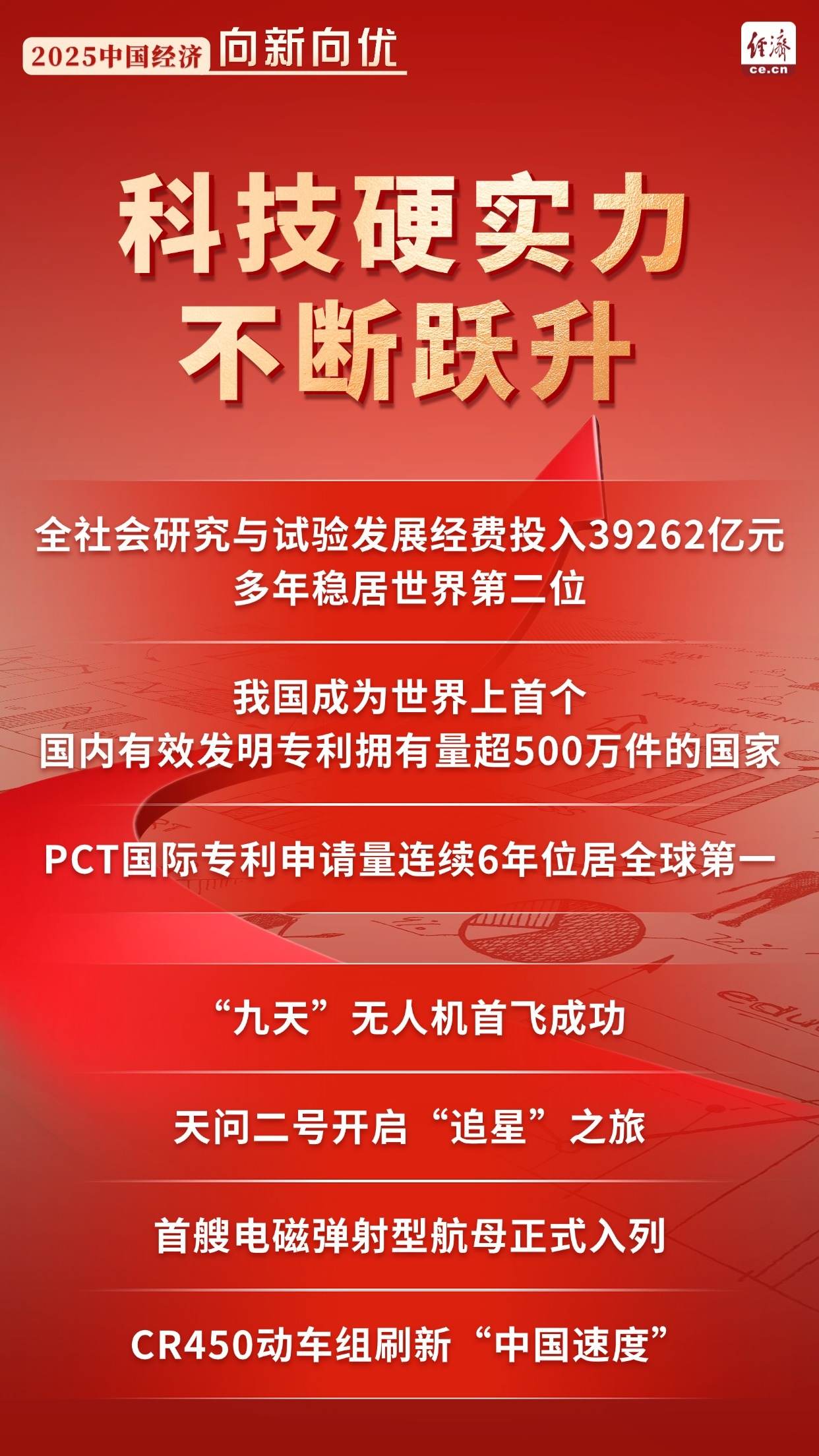
Group 1 - The core viewpoint highlights that by 2025, China has made significant progress in innovation-driven development, industrial upgrading, digital empowerment, and green transformation, leading to a more quality-driven and sustainable economic growth [1] Group 2 - The added value of high-tech manufacturing and equipment manufacturing industries accounted for 36.8% and 17.1% of the total industrial added value, respectively [6] - The production of civilian drones and industrial robots increased by 37.3% and 28% year-on-year [6] - The integration of industrial internet applications has fully covered 41 major industrial categories [6] Group 3 - The added value of the digital product manufacturing industry grew by 9.3% year-on-year [9] - The information transmission, software, and information technology service industries saw an increase of 11.1% [9] - New consumption models and scenarios have accelerated expansion, driving online retail sales up by 8.6% [9] Group 4 - The construction of new infrastructure, including 5G, gigabit optical networks, and the Internet of Things, is progressing in an orderly manner [10] - The clean energy generation from hydropower, nuclear power, wind power, and solar energy increased by 8.8% year-on-year [13]

12月宏观数据点评:旧动能收缩,新动能暂未能支撑宏观增长
Yintai Securities· 2026-01-22 02:50
Economic Growth - In Q4 2025, GDP growth was 4.5%, with an annual GDP of 14,018.79 billion yuan, achieving a target growth of around 5%[12] - The contribution to GDP growth from final consumption expenditure was 2.6%, while net exports contributed 1.64%[12] Industrial Production - In December, industrial added value grew by 5.2% year-on-year, with an annual growth of 5.9%[16] - High-tech manufacturing and equipment manufacturing saw added value growth of 9.4% and 9.2%, respectively, exceeding the overall industrial growth by 3.5 and 3.3 percentage points[16] Fixed Asset Investment - National fixed asset investment in 2025 was 485,186 billion yuan, down 3.8% year-on-year, with private investment declining by 6.4%[19] - Infrastructure investment fell by 1.48%, marking the worst performance in a decade, while manufacturing investment saw a slight increase of 0.6%[19] Real Estate Market - Real estate development investment in 2025 decreased by 17.2%, the largest decline since the pandemic, with new construction area down by 20.4%[33] - New residential sales area fell by 8.7%, and sales revenue dropped by 12.6% year-on-year[33] Consumer Spending - In December, retail sales of consumer goods grew by only 0.9%, the lowest monthly increase of the year, with an annual growth of 3.7%[49] - Retail sales excluding automobiles increased by 4.4%, while online retail sales of physical goods rose by 5.2%[49] Price Trends - In December, the Consumer Price Index (CPI) rose by 0.8% year-on-year, while the Producer Price Index (PPI) fell by 2.6% for the year[54] - Food prices significantly contributed to the CPI increase, with fresh fruit prices recovering to a year-on-year growth of 4.4% in December[57]
科技创新和产业创新深度融合 工业和信息化发展呈现新特点
Jin Rong Shi Bao· 2026-01-22 02:07
Group 1: Industrial Growth and Manufacturing - In 2025, the industrial added value of large-scale industries is expected to grow by 5.9% year-on-year, with the manufacturing sector maintaining a stable share of GDP, and the manufacturing scale likely to remain the largest globally for 16 consecutive years [1] - The added value of equipment manufacturing and high-tech manufacturing is projected to increase by 9.2% and 9.4% year-on-year, respectively, surpassing the growth rate of large-scale industries by 3.3 and 3.5 percentage points [1] - The added value of industries such as integrated circuits and electronic materials is expected to grow by 26.7% and 23.9% year-on-year, with industrial robot production increasing by 28% and new energy vehicle sales reaching 16.49 million units, a year-on-year increase of 28.2% [1] Group 2: Robotics and AI Development - The humanoid robot industry is anticipated to see significant innovation and iteration, with over 140 domestic companies and more than 330 humanoid robot products expected to be released by 2025, marking it as the year of mass production for humanoid robots [2] - The focus will be on continuous technological innovation and iteration in humanoid robots, enhancing safety standards, and building a supportive ecosystem for the industry [2] Group 3: Digital Industry Growth - By the end of 2025, the revenue from China's digital industry is projected to reach approximately 38.3 trillion yuan, with profits of 3.1 trillion yuan, representing cumulative growth of about 39.5% and 48.4% since 2020 [3] - Key provinces contributing to this growth include Guangdong, Jiangsu, Beijing, and others, which together account for over 90% of the national digital industry revenue growth [3] Group 4: Consumer Goods Industry Development - The added value of the consumer goods industry is expected to grow by 3.7% year-on-year in 2025, accounting for 26.1% of the total industrial output [4] - Various promotional activities will be organized to stimulate consumption, including the "Foodie Season" and "Elderly Care Shopping Season," alongside the release of numerous innovative products [4] Group 5: Support for SMEs - The added value of small and medium-sized enterprises (SMEs) in large-scale industries is projected to grow by 6.9% year-on-year in 2025, with a continuous expansion in the SME export index [5] - The government aims to enhance the development environment for SMEs, focusing on policy support, quality improvement, and fostering specialized and innovative enterprises [6][7]
2025中国经济答卷丨“压舱石”作用凸显 工业经济锻造发展新动能
Xin Hua She· 2026-01-22 01:39
Core Viewpoint - By 2025, China's industrial added value is expected to grow by 5.9% year-on-year, with the manufacturing sector likely to maintain its position as the world's largest for 16 consecutive years, contributing over 40% to economic growth, thus playing a significant "ballast" role in the economy [1] Group 1: Industrial Economic Development - The overall industrial and information technology development in China in 2025 is characterized by four aspects: stability, progress, new momentum, and vitality [2] - The stability of the industrial economy is reinforced by the introduction of a new round of ten key industry growth support plans, effectively promoting steady growth [2] - The value added of major equipment manufacturing and high-tech manufacturing industries increased by 9.2% and 9.4% year-on-year, respectively, outpacing the overall industrial growth by 3.3 and 3.5 percentage points [2] - The production of industrial robots increased by 28% year-on-year, and investment in industries such as aerospace and aviation equipment manufacturing achieved double-digit growth [2] Group 2: Future Industrial Strategy - The Ministry of Industry and Information Technology plans to implement actions to develop and strengthen emerging industries, creating new momentum for economic growth [4] - The focus will be on the large-scale application of new technologies, products, and scenarios in manufacturing, as well as establishing national demonstration bases for emerging industry development [4] - The integration of artificial intelligence into over 70% of business scenarios in leading factories is a strategic move to enhance future manufacturing competitiveness [4] Group 3: Support for Small and Medium Enterprises - In 2025, the added value of small and medium-sized enterprises (SMEs) in the industrial sector is expected to grow by 6.9%, with the SME export index remaining in the expansion range for 21 consecutive months [6] - The Ministry of Industry and Information Technology will continue to improve the policy and regulatory framework to promote high-quality development of SMEs [6] - A three-year action plan will be implemented to cultivate specialized and innovative SMEs, enhancing the support mechanism for their growth [6]