
货币金融服务

Search documents
“数”说中国经济运行稳中向好韧性强 稳投资、促消费政策持续落地
Yang Shi Wang· 2025-06-30 06:41
Group 1 - The manufacturing Purchasing Managers' Index (PMI) in China rose for two consecutive months, indicating a continuous improvement in manufacturing sentiment [2][4] - In June, the manufacturing PMI reached 49.7%, an increase of 0.2 percentage points from the previous month, signaling a stable expansion in production activities [2][4] - The new orders index returned to the expansion zone at 50.2%, reflecting a stable expansion in both supply and demand within the manufacturing sector [4][6] Group 2 - The non-manufacturing sector continued to expand, with the business activity index showing a slight increase while remaining in the expansion zone [8] - Key industries such as telecommunications, financial services, and insurance reported business activity indices above 60%, indicating robust growth in these sectors [8] - The construction industry, particularly civil engineering, maintained a high business activity index above 55% for three consecutive months, driven by increased investment activities [10] Group 3 - The resilience of the Chinese economy is highlighted by the strong internal momentum and stable production operations, with the PMI serving as a crucial leading indicator [12][14] - Despite short-term fluctuations due to external factors, the overall economic growth remains stable, supported by ongoing policies aimed at boosting investment and consumption [14]

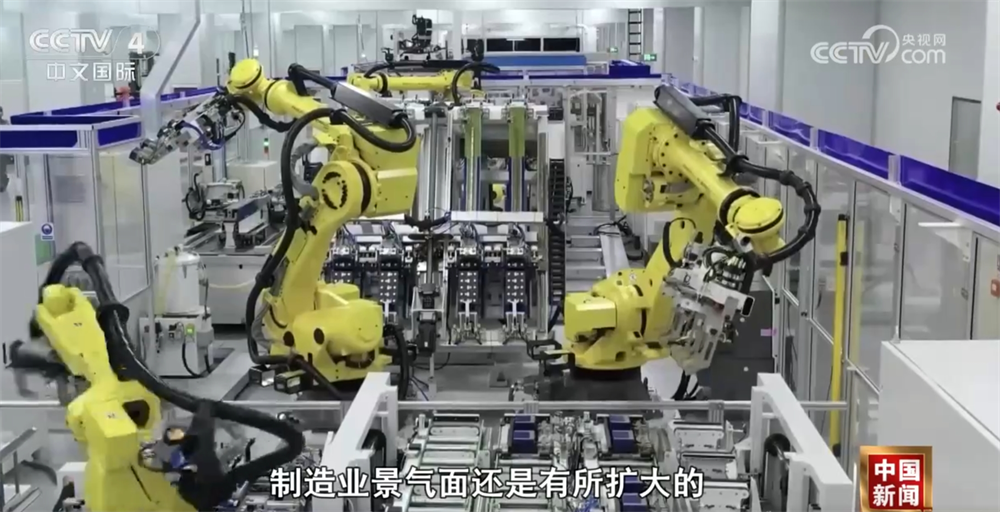
上半年我国经济运行稳中向好 韧性增强
Yang Shi Wang· 2025-06-30 06:34
Core Viewpoint - The Purchasing Managers' Index (PMI) for China's manufacturing and non-manufacturing sectors shows signs of recovery and expansion, indicating improved economic resilience in June 2023 [1][10]. Manufacturing Sector - In June, China's manufacturing PMI reached 49.7%, an increase of 0.2 percentage points from the previous month, marking two consecutive months of growth [3]. - The new orders index rose to 50.2%, returning to the expansion zone after being below 50% for two months, reflecting improved supply and demand conditions in the manufacturing sector [3]. - The Vice President of the China Logistics and Purchasing Federation noted that the implementation of various policies has contributed to the gradual improvement in both supply and demand in manufacturing [3]. Non-Manufacturing Sector - The non-manufacturing business activity index for June was 50.5%, up 0.2 percentage points from the previous month, indicating continued expansion and a faster pace of growth [6]. - Key industries such as telecommunications, financial services, capital market services, and insurance reported business activity indices above 60%, suggesting robust growth in these sectors [6]. Overall Economic Performance - The overall economic performance in the first half of 2023 shows a trend of stability and improvement, with the PMI indicating strong resilience despite fluctuations [10]. - The non-manufacturing business activity index has consistently remained above 50% throughout the year, indicating stable expansion in non-manufacturing activities [10].
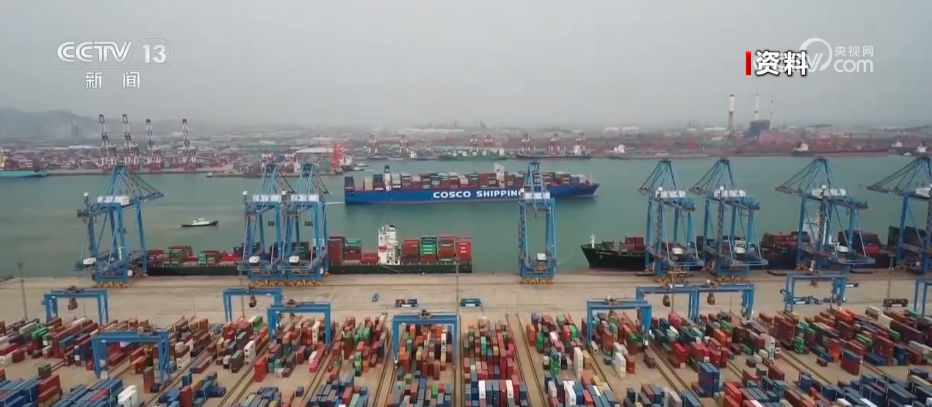
49.7%、50.5%,改善、扩张!从6月份“指数”透视中国经济发展亮点
Yang Shi Wang· 2025-06-30 03:51
Group 1 - The manufacturing Purchasing Managers' Index (PMI) in China for June is reported at 49.7%, indicating a 0.2 percentage point increase from the previous month, suggesting continued improvement in manufacturing sentiment [1] - Among the 21 surveyed industries, 11 are in the expansion zone, an increase of 4 from the previous month, reflecting a broader improvement in manufacturing conditions [3] - The production index and new orders index stand at 51% and 50.2%, respectively, both showing increases of 0.3 and 0.4 percentage points from last month, indicating a recovery in production activities and market demand [3] Group 2 - Key sectors such as equipment manufacturing, high-tech manufacturing, and consumer goods have maintained PMIs in the expansion zone for two consecutive months, with production and new orders indices above 53% [5] - The PMI for high-energy-consuming industries, while still below the critical point, has shown signs of recovery this month [5] - The overall manufacturing PMI and its sub-indices reflect a rebound trend, indicating that internal economic momentum is gradually being released and resilience in economic growth is strengthening [7] Group 3 - The non-manufacturing business activity index for June is reported at 50.5%, a 0.2 percentage point increase from the previous month, indicating continued expansion in the non-manufacturing sector [8] - The service sector's performance remains stable, with financial services, capital market services, and insurance industries showing business activity indices above 60%, indicating rapid growth in these areas [8] - The construction sector, particularly civil engineering, has seen a significant rebound, with business activity indices remaining above 55% for three consecutive months, reflecting robust progress in infrastructure projects [8][10]
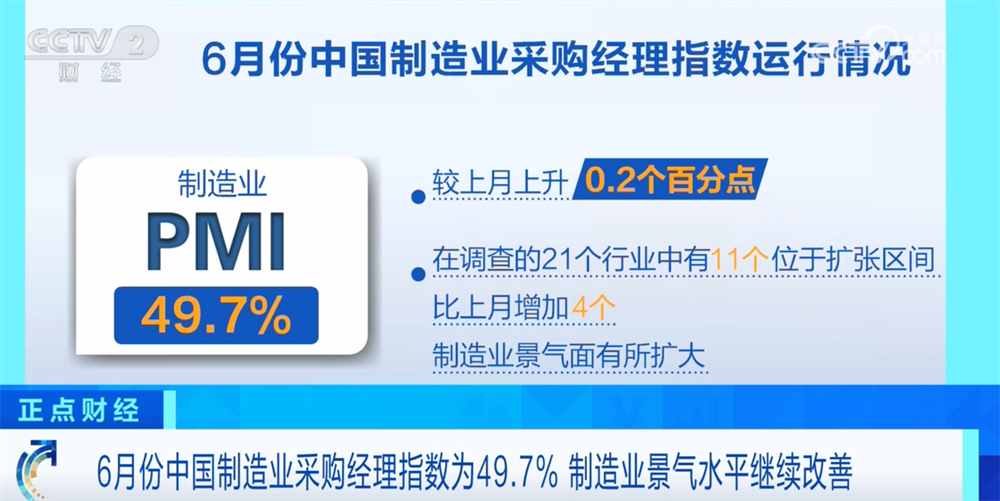
刚刚发布,49.7%!
天天基金网· 2025-06-30 03:29
Group 1: Manufacturing PMI Overview - In June, the Manufacturing Purchasing Managers' Index (PMI) was 49.7%, an increase of 0.2 percentage points from the previous month, indicating continued improvement in manufacturing sentiment [1][18] - The production index was 51.0%, up 0.3 percentage points, suggesting accelerated production activities in manufacturing [2][19] - The new orders index rose to 50.2%, an increase of 0.4 percentage points, indicating improved market demand [3][19] Group 2: Manufacturing Sub-indices - The raw materials inventory index was 48.0%, up 0.6 percentage points, indicating a continued narrowing of the decline in raw material inventory levels [3][19] - The employment index decreased to 47.9%, down 0.2 percentage points, reflecting a slight decline in employment sentiment within manufacturing [3][19] - The supplier delivery time index was 50.2%, an increase of 0.2 percentage points, indicating faster delivery times from suppliers [3][19] Group 3: Non-Manufacturing PMI Overview - The non-manufacturing business activity index was 50.5%, up 0.2 percentage points, indicating continued expansion in the non-manufacturing sector [6][22] - The construction industry business activity index rose to 52.8%, an increase of 1.8 percentage points, indicating accelerated expansion in construction activities [7][23] - The service industry business activity index was 50.1%, a slight decrease of 0.1 percentage points, indicating stability in the service sector [7][23] Group 4: Non-Manufacturing Sub-indices - The new orders index for non-manufacturing was 46.6%, up 0.5 percentage points, indicating a slight recovery in market demand [10][22] - The input prices index was 49.9%, up 1.7 percentage points, indicating stable input prices for non-manufacturing activities [10][22] - The business activity expectation index was 55.6%, down 0.3 percentage points, indicating continued optimism among non-manufacturing enterprises [11][22] Group 5: Comprehensive PMI Overview - The comprehensive PMI output index was 50.7%, an increase of 0.3 percentage points, indicating an overall acceleration in production and business activities [16][24] - The manufacturing production index and non-manufacturing business activity index were 51.0% and 50.5%, respectively, contributing to the overall expansion [24][18]

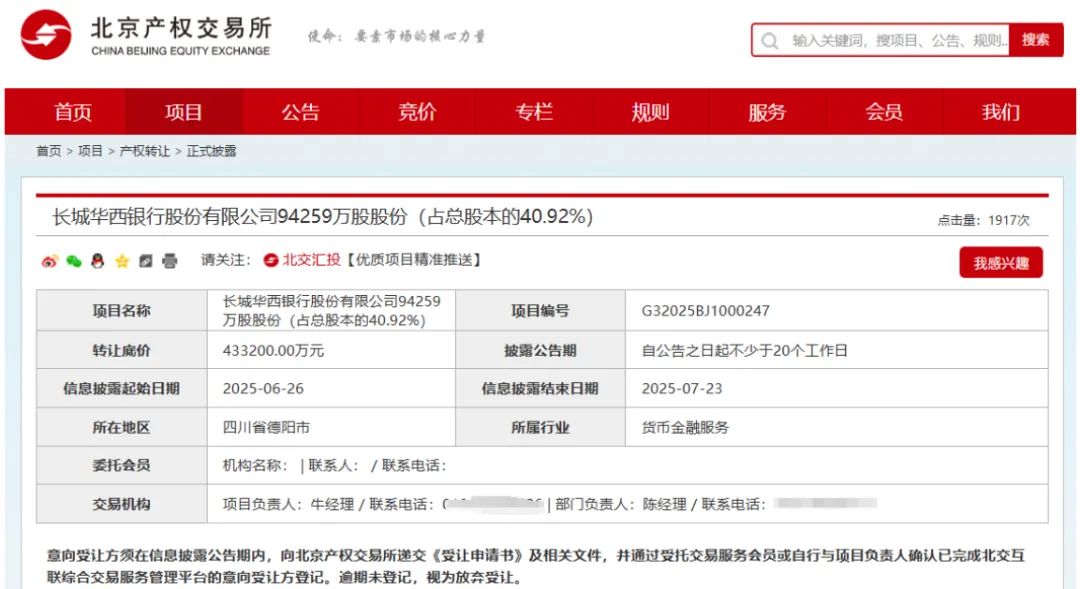
又一银行股权被转让
Zhong Guo Ji Jin Bao· 2025-06-27 10:51
Core Viewpoint - The transfer of 40.92% equity in Changcheng Huaxi Bank aims to localize shareholders and introduce quality strategic investors [1][3][5] Group 1: Equity Transfer Details - Changcheng Huaxi Bank's 94,259,000 shares, representing 40.92% of total equity, are being offered for transfer at a base price of 4.332 billion yuan [2][3] - The transfer is initiated by the second-largest shareholder, China Great Wall Asset Management Co., Ltd., along with its concerted action partner, Deyang State-owned Assets Management Co., Ltd. [3] - The transfer has been approved by the shareholders' meeting of Great Wall Asset and has received approval from the Ministry of Finance [3] Group 2: Company Background and Financials - Changcheng Huaxi Bank was established in 1998 and was renamed in 2016 after introducing Great Wall Asset as a strategic investor [4] - As of the end of 2024, the bank's total assets reached 151.181 billion yuan, with total liabilities of 140.673 billion yuan and deposits of 109.663 billion yuan [6] - The bank's net interest margin has declined from 1.6% in 2022 to 1.28% in 2024, while the non-performing loan ratio has increased from 1.8% to over 2% during the same period [6] Group 3: Strategic Intentions - The equity transfer is part of a broader strategy to comply with regulatory requirements and enhance the bank's local and professional development [5] - The new investors must possess strong financial health and a track record of profitability, aligning with national regulatory standards for bank shareholders [5]

央行将设立数字人民币国际运营中心,潘功胜公开演讲提及稳定币
Hua Xia Shi Bao· 2025-06-18 12:14
Core Viewpoint - The establishment of the Digital Renminbi International Operation Center is a significant step towards enhancing the internationalization of the Renminbi and promoting cross-border payment and trade development, particularly benefiting Shanghai's financial market [2][4][7]. Group 1: Digital Renminbi Development - The Digital Renminbi pilot program was officially launched by the People's Bank of China at the end of 2019, following a gradual approach that includes domestic and international scenarios [3]. - As of the end of 2024, the Digital Renminbi pilot has covered 26 cities across 17 provinces, reaching one-fifth of the national population [3]. - Different cities like Suzhou, Shenzhen, and Shanghai have focused on various innovative applications of the Digital Renminbi, such as smart contracts and cross-border payment innovations [3][4]. Group 2: Financial Reform Initiatives - In addition to the Digital Renminbi International Operation Center, eight financial opening measures were announced, including comprehensive reforms for offshore trade financial services in Shanghai [5]. - The Shanghai International Financial Center aims to enhance cross-border financial service convenience, supporting the Digital Renminbi pilot banks in participating in multilateral central bank digital currency bridge projects [5]. Group 3: Cross-Border Payment Focus - Hong Kong is identified as the largest offshore Renminbi business hub, handling approximately 80% of global offshore Renminbi payment amounts [6]. - The establishment of the Digital Renminbi International Operation Center is seen as a strategic move to enhance cross-border payment efficiency and reduce costs significantly [6][7]. - The use of emerging technologies like blockchain and smart contracts is expected to reshape traditional payment systems and improve cross-border payment processes [7]. Group 4: Challenges and Considerations - While the Digital Renminbi International Operation Center presents opportunities, it also faces challenges in collaboration with other countries' central banks and standardization of technology [8].


交通银行: 国泰海通证券股份有限公司、中信建投证券股份有限公司关于交通银行向特定对象发行A股股票之上市保荐书
Zheng Quan Zhi Xing· 2025-06-18 11:19
Group 1 - The core point of the news is that Bank of Communications Co., Ltd. is issuing A-shares to specific investors to raise up to RMB 120 billion to supplement its core tier one capital [24][25][26] - The issuance will involve the Ministry of Finance, China National Tobacco Corporation, and China Shuangwei Investment Co., Ltd. as the main subscribers [24][26] - The issuance price is set at RMB 8.71 per share, which is 80% of the average trading price over the previous 20 trading days [25][26] Group 2 - The total assets of Bank of Communications reached RMB 14,900,717 million, with total liabilities of RMB 13,745,120 million and total equity of RMB 1,155,597 million as of the latest reporting period [3] - The bank's operating income for 2024 is projected to be RMB 259,826 million, with a net profit of RMB 94,229 million [3] - The non-performing loan ratio has improved to 1.31%, with a provision coverage ratio of 201.94% [5][3] Group 3 - The bank's main business includes absorbing public deposits, issuing loans, and conducting domestic and international settlements [2] - The bank operates under the financial services industry, specifically in monetary financial services [2] - The bank's registered capital is RMB 74,262,726,645 [1]


全球货币支付断崖:美元涨至49.07%,欧元降到21.58%,那人民币呢
Sou Hu Cai Jing· 2025-06-13 08:27
Core Viewpoint - The recent interest rate cuts by the Federal Reserve have led to significant volatility in the U.S. stock market, highlighting the dominance of the U.S. dollar in the global economic landscape [1][5][9]. Group 1: U.S. Dollar Dominance - The U.S. dollar maintains a commanding position in global payments, accounting for 49.07% of the market, far ahead of the euro at 21.58% and the Chinese yuan at 4.69% [3][11][14]. - The historical roots of the dollar's dominance can be traced back to World War II, when the U.S. established a strong financial position by accumulating gold and later linking the dollar to oil [7][9]. - The U.S. government benefits from the dollar's status, allowing it to issue large amounts of debt and maintain fiscal deficits without facing the same risks as other countries [5][9]. Group 2: Challenges to Dollar Dominance - Many countries are actively pursuing de-dollarization to reduce reliance on the U.S. dollar, with a growing consensus on the need for a more diversified currency payment system [9][16]. - The euro, once a strong competitor to the dollar, has seen its global payment share decline due to economic challenges within the Eurozone and geopolitical tensions [11][14]. - The rise of the yuan in international payments signals a shift towards greater currency diversification, supported by China's economic growth and increased global trade partnerships [14][16].

加速人民币国际化:破局美元信用危机的战略窗口|政策与监管
清华金融评论· 2025-06-10 10:31
Core Viewpoint - The current instability of the US dollar's credit foundation presents a historical opportunity for the internationalization of the Renminbi (RMB), as the traditional safe asset status of US Treasury bonds is being questioned due to the Federal Reserve's promotion of stablecoin issuance [1][2]. Group 1: Current Global Financial Landscape - China, as the world's largest trading nation and second-largest economy, contributes nearly 30% to global manufacturing output, yet the RMB's share in global payments remains around 4% [2]. - The RMB's share in cross-border trade settlements has increased from 18% in 2022 to 30% in Q1 2024, while its share in global official foreign exchange reserves is only about 2.4% [2][3]. - The mismatch between China's economic strength and the RMB's international status has created significant challenges for Chinese enterprises, particularly in terms of pricing and financial security [4]. Group 2: Challenges Faced by Chinese Enterprises - Chinese enterprises face three main pressures due to their reliance on US dollar settlements: increased exchange rate risks, financing constraints, and clearing obstacles [4]. - The RMB's internationalization is primarily driven by private enterprises, with Southeast Asia being a key battleground, but its use remains limited to trade settlements rather than capital and financial accounts [4][5]. Group 3: Structural Contradictions in RMB Internationalization - There are four main contradictions hindering RMB internationalization: the mismatch between economic strength and currency status, the dominance of trade settlements over capital account transactions, the separation of onshore market size from offshore pricing power, and the reliance on the US dollar system amidst a demand for "de-risking" [5][6]. Group 4: Strategic Recommendations for RMB Internationalization - To address these contradictions, a five-year action plan focusing on "institutional opening" is recommended, which includes expanding cross-border financial services, enhancing regional currency cooperation, and upgrading financial infrastructure [8][9]. - Specific strategies include increasing the issuance of Panda bonds, promoting RMB pricing in regional trade, and enhancing the resilience of the RMB payment system [9][10]. Group 5: Quantitative Goals and Policy Support - Clear quantitative goals for RMB internationalization by 2025-2030 include increasing its global payment share from 3.79% to over 6%, raising its share in global foreign exchange reserves from 2.4% to 5%, and expanding the offshore RMB liquidity pool from 1.5 trillion to 5 trillion [16]. - Multi-departmental collaboration is essential for policy support, focusing on macro-prudential management, optimizing the yield curve, and embedding RMB settlements in trade agreements [16][17].
【专家观点】加速人民币国际化:破局美元信用危机的战略窗口
Xin Hua Cai Jing· 2025-06-09 09:03
Core Viewpoint - The article discusses the strategic opportunity for accelerating the internationalization of the Renminbi (RMB) amid the weakening credibility of the US dollar, highlighting the mismatch between China's economic strength and the current status of the RMB in global finance [1][2]. Group 1: Current State of RMB Internationalization - Despite being the world's largest trading nation and the second-largest economy, China's RMB accounts for only about 4% of global payments and 2.4% of global foreign exchange reserves [1][2]. - The share of RMB in cross-border trade settlements has increased from 18% in 2022 to 30% in the first quarter of 2024, while capital account RMB receipts have reached 73% [1][2]. - The reliance on the US dollar for overseas investments and trade exposes Chinese enterprises to significant risks, including exchange rate volatility and limited access to RMB financing [2][3]. Group 2: Structural Contradictions - There exists a contradiction between China's economic strength, which accounts for approximately 18% of the global economy, and the RMB's international share of less than 3% [4]. - The RMB's dominance in trade settlements contrasts with its weakness in capital account transactions, where the depth and liquidity remain insufficient [4][5]. - The separation of onshore market size and offshore pricing power leads to a loss of pricing authority for the RMB, necessitating a strengthening of onshore market influence [5][6]. Group 3: Strategic Recommendations - A five-year action plan is proposed to enhance RMB internationalization, focusing on three pillars: capital account opening, regional anchor currency development, and upgrading financial infrastructure [6][7]. - The plan includes expanding the issuance of Panda bonds and RQFII, as well as developing RMB-denominated futures to manage dollar volatility risks [6][9]. - Establishing a robust payment and clearing network to mitigate risks associated with reliance on the US dollar payment system is essential [10][11]. Group 4: Quantitative Goals and Policy Support - The article sets clear quantitative targets for RMB internationalization by 2030, including increasing the global payment share from 3.79% to over 6% and the foreign exchange reserve share from 2.4% to 5% [12][14]. - It emphasizes the need for coordinated policy support across various departments to enhance the RMB's role as a global currency [13][14]. - The successful implementation of these strategies could position the RMB as the third-largest reserve currency globally, aligning its status with China's economic power [13][14].