文旅

Search documents
31省份消费三季报:西部发力 服务、乡村消费“上分”
2 1 Shi Ji Jing Ji Bao Dao· 2025-10-31 16:40
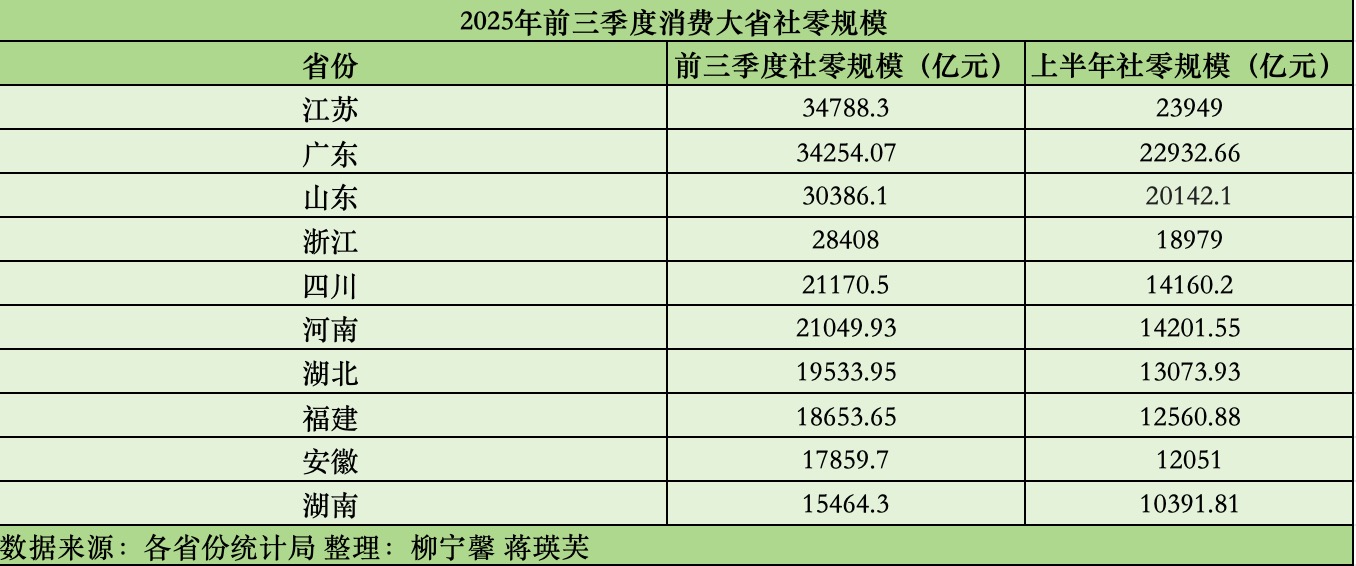
Core Insights - The growth of service consumption outpaces that of goods consumption, and rural consumption growth exceeds urban consumption, indicating significant optimization in China's consumption structure [1][9][15] - In the first three quarters, final consumption expenditure contributed 53.5% to economic growth, an increase of 9 percentage points compared to the previous year [1] - The total retail sales of consumer goods reached 36,587.7 billion yuan, with a year-on-year growth of 4.5% [1] Consumption Growth by Region - Jiangsu, Guangdong, and Shandong are the only provinces with retail sales exceeding 30,000 billion yuan, with figures of 34,788.3 billion yuan, 34,254.07 billion yuan, and 30,386.1 billion yuan respectively [6][7] - Hainan leads the nation with an 8.6% growth rate, followed by Inner Mongolia at 7.2%, and several provinces in central and western China also show strong growth [4][5] Changes in Consumption Structure - The consumption structure is shifting, with significant growth in spending on daily necessities, education, culture, and entertainment services [3][9] - The "old-for-new" policy has effectively stimulated consumption, particularly in home appliances and new energy vehicles, with notable growth rates in Inner Mongolia and Shanxi [5][9] Rural vs Urban Consumption - Rural consumption growth is outpacing urban consumption, with Jiangsu's rural consumption growth exceeding urban by 1.4 percentage points, and Guizhou by 1.7 percentage points [14][15] - The shift from basic to improved consumption in rural areas is driven by the "old-for-new" policy and the enhancement of consumption infrastructure [14][16] Policy Implications - The "14th Five-Year Plan" emphasizes boosting consumption and enhancing public service spending to increase residents' consumption capacity [8][14] - Future expansion of county-level markets is expected to support rural consumption as a new growth curve for national retail sales [16]

西藏前三季度GDP增长7.1% 多项经济指标增速位居全国前列
Zhong Guo Xin Wen Wang· 2025-10-31 13:33
Core Points - Tibet's GDP for the first three quarters reached 207.006 billion yuan, with a year-on-year growth of 7.1%, surpassing the national average by 1.9 percentage points, indicating a stable and progressive economic performance [1][3]. Economic Indicators - Industrial value added for large-scale enterprises grew by 12.5%, maintaining the highest growth rate in the country for eight consecutive months [3]. - Fixed asset investment increased by 18.6%, leading the nation for four months, significantly supporting economic stability [3]. - General public budget revenue was 23.275 billion yuan, up 14.2%, while expenditures reached 225.797 billion yuan, growing by 13.0%, both ranking first nationally [3]. - Total electricity consumption was 12.45 billion kWh, reflecting a 13.4% increase, indicating rising economic activity [3]. Social and Consumer Trends - Per capita disposable income for residents was 23,357 yuan, with a growth rate of 7.3%, exceeding the national average by 2.2 percentage points [3]. - The retail sales of consumer goods totaled 76.846 billion yuan, showing a year-on-year increase of 4.5%, indicating a steady recovery in the consumer market [3]. - The tourism sector thrived, with 63.7073 million domestic and international visitors, a growth of 11.2%, and total tourism expenditure reaching 73.673 billion yuan, up 9.9% [3]. Future Outlook - Tibet plans to continue implementing the decisions of the central government, focusing on stabilizing employment, businesses, markets, and expectations to promote high-quality economic development [4].
曲江文旅三季度归母净利润同比下降277%
Zhong Guo Jing Ying Bao· 2025-10-31 12:51
Core Insights - Qujiang Cultural Tourism reported significant financial losses despite being located in a resource-rich tourism area in Xi'an [1] Financial Performance - For the first three quarters of 2025, the company achieved total operating revenue of 738 million yuan, a year-on-year decrease of 30.68% [1] - The net profit attributable to shareholders was -24.84 million yuan, an increase of 86.26% year-on-year [1] - The net profit excluding non-recurring items was -83.20 million yuan, an increase of 54.68% year-on-year [1] Quarterly Results - In the third quarter of 2025, the company's main revenue was 206 million yuan, a year-on-year decrease of 29.98% [1] - The net profit attributable to shareholders for the third quarter was -10.96 million yuan, a year-on-year decrease of 277.01% [1] - The net profit excluding non-recurring items for the third quarter was -12.46 million yuan, a year-on-year decrease of 350.09% [1] Financial Ratios and Metrics - The company's debt ratio stood at 76.61% [1] - Investment income was reported at 3.89 million yuan, while financial expenses amounted to 29.15 million yuan [1] - The gross profit margin was recorded at 10.32% [1] Shareholder Information - As of September 30, 2025, the number of shareholders was 40,900, a decrease of 1,946 shareholders from the previous period, representing a reduction of 4.54% [1]

五部门:打造数字赋能文旅、体育、数字消费等新型数字生活场景 推动人工智能在消费场景应用
Mei Ri Jing Ji Xin Wen· 2025-10-31 02:58
Core Viewpoint - The National Development and Reform Commission, along with four other departments, has issued an action plan to deepen the development of smart cities and promote comprehensive digital transformation, focusing on enhancing quality of life through digital empowerment in various sectors [1] Group 1: Digital Empowerment in Various Sectors - The plan emphasizes the development of new digital life scenarios in cultural tourism, sports, and digital consumption, leveraging artificial intelligence in consumer applications [1] - It aims to innovate the application of digital technologies in cultural tourism content creation, scene generation, and guided tours [1] - The initiative includes the revitalization of cultural heritage such as museums, ancient texts, and historical buildings through digital means [1] Group 2: Infrastructure and Facility Upgrades - There is a push for the digital transformation of sports venues and cultural facilities, promoting shared use of fitness spaces [1] - Traditional commercial areas are encouraged to undergo digital upgrades, creating smart stores and AI product experience shops as new consumption scenarios [1] - The plan supports the development of innovative applications for carbon footprint accounting and carbon trading in qualified regions [1] Group 3: Credit Service System - The action plan advocates for the establishment of a cross-domain credit service system in cities, facilitating credit certification for services such as healthcare and transportation, enabling seamless user experiences [1]
四川扎实推进文化遗产保护传承工作——赓续历史文脉 绘就时代新篇
Si Chuan Ri Bao· 2025-10-31 02:49
Core Viewpoint - Sichuan is actively promoting the protection and utilization of cultural heritage, with a series of conferences and forums aimed at discussing and enhancing cultural heritage preservation and innovation [1][2]. Group 1: Cultural Heritage Protection Initiatives - Sichuan prioritizes cultural heritage protection through systematic legislation, policy support, and talent development, achieving significant progress in recent years [2][3]. - The introduction of laws such as the "Sichuan Provincial World Heritage Protection Regulations" and the "Sichuan Provincial Intangible Cultural Heritage Regulations" has established a comprehensive protection system [2]. - The "Chengdu Model" for cultural heritage protection, which integrates archaeological exploration into land transfer processes, has been recognized as a national innovation [3]. Group 2: Integration with Urban Development - Sichuan is exploring ways to integrate cultural heritage protection with urban construction and economic development, launching pilot projects to support comprehensive heritage protection [3][4]. - The establishment of cultural ecological protection zones aims to balance the preservation of intangible cultural heritage with socio-economic development [4]. Group 3: Cultural Heritage Transmission and Innovation - Sichuan is committed to the creative transformation and innovative development of traditional culture, establishing research institutes and promoting cultural activities to enhance public engagement [5][6]. - The use of digital technologies, such as AR and VR, is being employed to bring cultural heritage to life, enhancing visitor experiences at various cultural sites [6][7]. Group 4: Economic Impact and Tourism Development - Cultural heritage is being transformed into quality tourism resources, with significant revenue generated from ticket sales and cultural products [8]. - In 2024, ticket and cultural product revenues from the Sanxingdui Museum are projected to reach 3.3 billion and 200 million respectively, highlighting the economic potential of cultural heritage [8]. Group 5: Global Cultural Exchange - Sichuan's cultural heritage is being showcased internationally, with events planned in various countries to promote cultural exchange and understanding [9]. - The global reach of Sichuan's cultural products, such as the Zigong Lanterns, demonstrates the province's role in spreading Chinese culture worldwide [9]. Group 6: Future Directions - Sichuan aims to continue enhancing cultural heritage protection efforts, contributing to the province's development and cultural identity [10].
郑州“硬核”举措力推演艺赛事经济高质量发展
Zheng Zhou Ri Bao· 2025-10-31 01:05
Core Viewpoint - Zhengzhou is actively promoting its performing arts and sports events economy as a new consumption trend and a way to showcase the city's charm, with new initiatives and achievements being introduced to enhance high-quality development in this sector [1] Group 1: Policy Initiatives - Zhengzhou will introduce reward policies to support the high-quality development of the performing arts and sports events economy, including up to 3 million yuan for large-scale performances with over 5,000 attendees based on ticket sales and audience structure [2] - Ticketing platforms can receive up to 2 million yuan based on annual ticket revenue, while venues can earn up to 1.2 million yuan based on the number of events hosted [2] - High-level international events can receive subsidies of up to 3 million yuan, national events up to 2 million yuan, and self-branded events up to 1 million yuan [2] Group 2: Consumer Engagement - The city is launching exclusive discounts for audiences attending events, valid from one day before to one day after the event, applicable in restaurants, hotels, and tourist attractions [3] - Over 150 dining and accommodation businesses, 37 star-rated hotels, and nearly 30 A-level scenic spots are participating, with 14 scenic spots offering free admission [3] - Plans include a special "fan package" for concert-goers, featuring local cultural gifts and electronic discount vouchers from partner businesses [3] Group 3: Sports Events Development - As a pilot city for promoting sports consumption and event economy, Zhengzhou aims to enhance its influence by introducing 2-3 high-level international or national events annually, focusing on major sports leagues [4] - The city plans to organize at least 1,000 community fitness events each year and 45 youth sports events, while encouraging districts to create unique events [4] - Initiatives will link sports events with tourism and commerce, creating a comprehensive experience for attendees [4] Group 4: Venue Impact - The Zhengzhou Olympic Sports Center has become a key destination for tourists, hosting over 90% of the city's concerts and significantly boosting related industries [5] - Since 2023, the center has hosted over 90 large-scale events, attracting more than 1.5 million attendees, with 80% from outside the city, generating nearly 10 billion yuan in consumption [5] - The center has also hosted over 10 major international and domestic sports events, establishing itself as a top-tier venue in the country [5]
多领域齐发力,连云港服务业“十四五”提质增效
Sou Hu Cai Jing· 2025-10-30 23:13
Core Viewpoint - The service industry is a crucial component of the national economy, serving as a major channel for employment, an accelerator for domestic demand, and a new engine for economic growth. Since the beginning of the 14th Five-Year Plan, Lianyungang has focused on key areas such as transportation, e-commerce, technology, and cultural tourism to enhance the quality and scale of its service industry, thereby supporting high-quality economic development [3]. Group 1: Economic Performance - During the 14th Five-Year Plan, Lianyungang has prioritized the expansion and quality improvement of the service industry as a core strategy for optimizing the structure of its three industries, contributing to steady economic growth. By 2024, the added value of the tertiary industry is expected to reach 2,144.6 billion yuan, accounting for 46% of GDP, with a continuous increase in its contribution to economic growth [4]. - The revenue of key industries in the regulated service sector surpassed 583.3 billion yuan, marking a year-on-year growth of 16.1%, indicating a steady expansion of the overall scale [4]. Group 2: Transportation Network - Lianyungang has been enhancing its comprehensive transportation network, solidifying its position as an international transportation hub between Asia and Europe. The city has developed a multi-modal transport system covering water, land, air, and rail [5]. - The port capabilities have significantly improved with the completion of various large-scale facilities, including 300,000-ton channels and terminals, while the total length of national and provincial highways has reached 942 kilometers [6]. Group 3: E-commerce Development - Lianyungang has actively cultivated its e-commerce market, leading to a significant increase in online sales, which are projected to exceed 121.3 billion yuan in 2024. The city has established itself as a national leader in various sectors, including clothing and seafood [7]. - The cross-border e-commerce sector has also seen robust growth, with over 5,000 operating entities and the establishment of multiple cross-border e-commerce industrial parks [7]. Group 4: Technological Innovation - The city has focused on building platforms for innovation, resulting in a significant increase in high-tech enterprises and innovation platforms. By now, there are 790 high-tech companies and 2,277 technology-based SMEs in Lianyungang [8]. - The establishment of various research and innovation centers has enhanced the city's technological capabilities, supporting the differentiated and specialized development of the service industry [8]. Group 5: Financial Sector - Lianyungang's financial sector has diversified, with 156 financial institutions and a growing number of listed companies. By the end of 2024, the total deposits and loans in financial institutions are expected to reach 5,937.57 billion yuan and 7,853.2 billion yuan, respectively [9]. - The financial ecosystem has improved, with effective risk control measures leading to a reduction in non-performing loans, ensuring a stable financial environment for economic development [10]. Group 6: Cultural and Tourism Integration - The city has leveraged its natural and cultural resources to enhance its tourism offerings, resulting in a significant increase in tourist numbers and revenue. In 2024, Lianyungang is expected to receive 55.86 million domestic and international tourists, generating a total tourism revenue of 71.5 billion yuan [11]. - The quality of tourism services has improved, with several attractions achieving national recognition, contributing to the city's image as a vibrant cultural and tourism destination [11]. Group 7: Future Outlook - Looking ahead to the 15th Five-Year Plan, Lianyungang aims to continue fostering new service industry formats and expanding new scenarios, injecting sustained momentum into the development of a modern coastal city [12].


“世界市长对话·景德镇暨二〇二五景德镇论坛”近日召开 透过对话看千年瓷都活力澎湃
Ren Min Ri Bao· 2025-10-30 22:22
Core Insights - The "World Mayors Dialogue: Jingdezhen and the 2025 Jingdezhen Forum" recently took place in Jingdezhen, China, gathering mayors and representatives from various countries to discuss cultural and urban development through ceramics [1][5] Group 1: Cultural Heritage and Urban Development - Jingdezhen is integrating ceramic elements into urban infrastructure, enhancing cultural significance and providing a model for other cities in cultural preservation and innovation [2][3] - The city is committed to protecting its ceramic cultural heritage, with projects focused on preserving historical kiln sites and neighborhoods, creating a cultural landscape centered around ceramics [2] Group 2: Cultural and Tourism Integration - Jingdezhen is promoting the development of its ceramic tourism industry by emphasizing traditional craftsmanship and increasing the artistic value of ceramic products [4] - The city hosts events like the Jingdezhen Ceramic Spring and Autumn Fair, attracting thousands of artists and fostering a vibrant creative community [4] Group 3: International Cultural Exchange - The forum highlighted the importance of cultural exchange, with participants discussing how ceramics can serve as a medium for international dialogue and cooperation [5][6] - Jingdezhen has established partnerships with numerous cities worldwide, promoting ceramic culture and facilitating economic development through enhanced logistics and online commerce [6]
成都“立园满园”一周年:税力量如何浇灌出产业生态“满园春色”?
Mei Ri Jing Ji Xin Wen· 2025-10-30 15:19
Core Insights - Chengdu's industrial parks are undergoing a high-quality development initiative, emphasizing comprehensive system reforms and the "full park" action to enhance economic vitality through tax incentives and services [1][2]. Tax Services and Innovations - The Chengdu tax authority has implemented specialized tax services, ensuring that policies are effectively communicated to enterprises, leading to a new norm of "policy finding enterprises" [1][2]. - Over the past year, tax service windows have been relocated closer to enterprises, enabling a "no need to leave the park" approach for tax-related matters, thus creating a more efficient tax ecosystem [1][2]. - The "credit for funds" initiative has allowed over 52,000 enterprises to secure more than 45.1 billion yuan in credit based on their tax credit ratings, showcasing the financial support provided through "bank-tax interaction" [1]. Support for Specific Industries - The tax department has tailored its services to various sectors, such as agriculture and cultural tourism, helping enterprises like the tea garden in Dujiangyan to thrive through targeted tax policy support [2][7]. - In the Wuhou District, the Chengdu Music Cultural Park has seen a 45% increase in registered music enterprises and a 47.7% rise in revenue for large-scale music companies, attributed to the tax authority's dedicated support [3]. Enhanced Service Models - Chengdu's tax authority has adopted a multi-faceted service model, including the establishment of "service micro-halls" and "tax service stations" within industrial parks to provide comprehensive support [4][5]. - The introduction of a "remote virtual window" service has allowed enterprises to access professional tax services without needing to visit physical offices, significantly improving service efficiency [5]. Continuous Improvement and Future Outlook - The Chengdu tax authority is committed to ongoing enhancements in tax services, aiming to create a more favorable business environment and support the sustainable development of industrial parks [8]. - The focus on integrating tax services with broader economic development goals is expected to yield significant benefits for enterprises, fostering a robust industrial ecosystem in Chengdu [8].
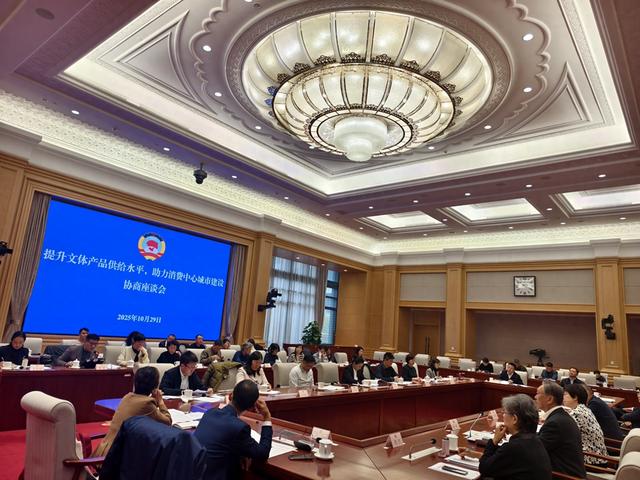
北京政协委员建议:从“1米高度”建设儿童友好型旅游城市
Bei Jing Ri Bao Ke Hu Duan· 2025-10-30 10:20
Core Viewpoint - The discussion focuses on enhancing the supply of cultural and sports products to support the development of consumer-centric cities, with an emphasis on creating child-friendly tourism environments in Beijing [1]. Group 1: Children's Cultural and Sports Projects - The potential of children's cultural and sports projects is significant, as evidenced by a 13.1% year-on-year increase in visitor numbers (184,000) and a 35.2% increase in consumption (9.21 million yuan) during the recent Dragon Boat Festival [3]. - There is a need to improve the current children's tourism product system in Beijing, which is currently underdeveloped and lacks diversity, with existing family-friendly attractions primarily focused on amusement facilities [3]. - Recommendations include integrating child-friendly tourism development into Beijing's 14th Five-Year Plan for cultural tourism, creating a diverse range of children's tourism products, and establishing guidelines for child-friendly tourism space [3]. Group 2: Sports Event Consumption - Suggestions were made to activate mid-tier sports event consumption by transforming suburban areas into competition venues, such as creating cycling and winter sports routes, and launching a series of weekend sports events in Beijing [4]. - The proposal includes developing a "Beijing Events Pass" app to facilitate participation in events and promote local agricultural products, thereby extending the economic impact of events beyond a single day [4]. Group 3: Emerging Sports Industry - Emerging sports industries like surfing, climbing, e-sports, and VR/AR are gaining popularity among younger demographics and are seen as key drivers for upgrading sports consumption [5]. - Recommendations include enhancing the supply of emerging sports products, establishing a comprehensive sports activity guide, and repurposing urban spaces for new sports facilities [5]. - The establishment of a unified cultural and sports space resource platform is suggested to optimize the use of various urban spaces for cultural and sports activities [5].