
公用事业

Search documents
欧洲股市因关税不确定性再现而下跌 诺和诺德股价重挫
Xin Lang Cai Jing· 2026-02-23 17:24
Group 1 - European stock markets declined, with the Stoxx 600 index closing down 0.5%, driven by losses in financial services, media, and tourism sectors, while personal care and utilities outperformed the market [1] - Novo Nordisk's stock plummeted after its new weight-loss injection drug underperformed compared to a competing product from Eli Lilly in a recent trial [1] - The European Parliament's major political groups announced a suspension of legislative work to approve the US-EU trade agreement following the US Supreme Court's overturning of Trump's global tariff measures, leading to new global tariffs announced by Trump [1] Group 2 - KBC Securities' global equity head noted that the current options seem limited and less impactful, which could be beneficial for consumer stocks, but concerns remain about market participants' willingness to endure upcoming volatility from tariff news [3] - Investors are already grappling with worries over high valuations and the disruptive impact of artificial intelligence, with tariff-related news adding complexity to the market landscape [3] - Significant upcoming events include Trump's State of the Union address and Nvidia's earnings report, with potential for increased volatility in software stocks following the release of Anthropic's new model [3]


转债事件点评:把握春季行情下半场
GUOTAI HAITONG SECURITIES· 2026-02-23 13:08
Core Insights - The report suggests adopting a "steady first, with growth in mind" approach to maintain gains in the second half of the spring market and to reserve space for future positioning [2][15] - The spring market of 2026 began on December 17, 2025, driven by favorable policies and early capital allocation, leading to a strong performance in the A-share market, with the Shanghai Composite Index achieving 17 consecutive days of gains [9][13] - The convertible bond market experienced rapid growth followed by volatility, with median prices and conversion premiums reaching historical highs, indicating a significant reduction in the safety cushion of bonds [9][10] Market Trends - Historical data from 2017 to 2025 indicates that the market typically experiences a "rise then fall" pattern from the Spring Festival to the National People's Congress (NPC) [13][14] - The report highlights that during the period from the Spring Festival to the NPC, the market is likely to see a "spring surge," with small-cap growth stocks outperforming, particularly in TMT and high-end manufacturing sectors [13][14] - As the NPC approaches, the market may shift towards defensive sectors like pharmaceuticals and utilities, with high valuations in convertible bonds facing potential compression due to stock adjustments [13][14] Investment Strategy - The report recommends a balanced investment strategy, transitioning from aggressive profit-seeking to balancing returns and risks as the market moves into the NPC and Q1 earnings preview phase [15] - It emphasizes the importance of selecting convertible bonds with solid performance and reasonable pricing, while also considering high-quality, high-priced convertible bonds with clear growth prospects [15] - The report identifies sectors such as AI computing, semiconductors, non-ferrous metals, and post-cycle industries like consumption and real estate as favorable for convertible bonds due to improving supply-demand dynamics and favorable policy catalysts [15]
国企股涨幅榜点评:天业节水以22.22%的涨幅位居榜首
Jin Tou Wang· 2026-02-20 11:56
Group 1 - The top-performing stock among state-owned enterprises is Tianye Water Conservation, with a price increase of 22.22% [1] - On February 20, Tianye Water Conservation opened at HKD 0.248, reached a high of HKD 0.248, and closed at HKD 0.231 [1] - The stock's previous closing price was HKD 0.189, indicating a significant rise [2] Group 2 - The second highest increase was Shanghai Qingpu Fire Protection, with a price increase of 20.00%, closing at HKD 15.000 [2] - Tianjie Environment ranked third with a 12.17% increase, closing at HKD 2.120 [2] - Other notable performers include China Railway with an 8.48% increase, and Binhai Teda Logistics with a 7.69% increase [2]

策略师吹响“集结号”:欧股涨势已触及“天花板” 部分基金经理仍“超配欧洲”
智通财经网· 2026-02-20 11:53
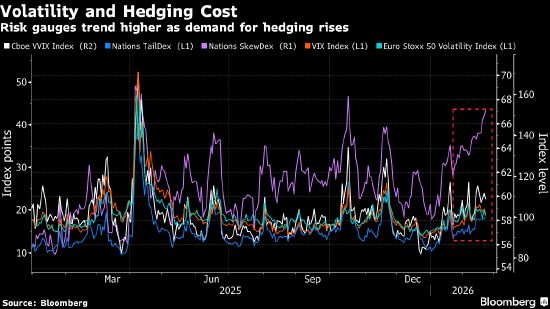
智通财经APP获悉,根据一项调查,尽管现在才刚步入3月,但策略师们认为,本周欧洲股市创下的历 史新高已是投资者今年能盼到的最好光景。调查显示,17位策略师的预测中值认为,欧洲斯托克600指 数2026年收官时将较周三创下的630点历史收盘高点基本持平。策略师们表示,支撑该地区股市的顺风 因素大多已兑现,而对企业盈利实现两位数增长的预期似乎要求过高。 好消息是,很少有策略师预测会出现大幅下跌,因为政府支出和低利率预计将提振欧洲经济。汇丰控股 仍是最大的多头,其目标点位为670点,意味着仍有近7%的上涨空间。只有TFS Derivatives和美国银行 两家策略师认为存在10%或更大跌幅的风险。 除泡沫时期或衰退期外,这已接近历史上的最高估值水平。与此同时,市场对季度财报的期望值,尤其 是对下半年财报的期望值,已经高到了令人担忧失望情绪会出现的地步。 法国兴业银行策略师罗兰·卡洛扬表示:"我们仍认为2026年实现两位数盈利增长的预期存在风险,尤其 是在下半年。这可能会将股指略微推低至当前水平以下,尤其是考虑到市场目前正以较高的估值倍数来 消化这些高预期。"他将最新的财报季定性为积极但并不突出。 花旗集团全球及欧洲 ...
2026低价掘金指南:5元以下潜力股逻辑与机会全解析
Sou Hu Cai Jing· 2026-02-19 23:06
Core Viewpoint - The article emphasizes that stocks priced below 5 yuan are not necessarily poor investments, but rather potential opportunities that have been overlooked by the market, especially in the context of supportive policies and solid performance metrics in 2026 [1][3]. Summary by Categories Screening Criteria for Potential Stocks - The article outlines a four-part framework for identifying potential stocks under 5 yuan, which includes: 1. Excluding ST and delisting risk stocks, as per the latest regulations [3]. 2. Ensuring a price-to-earnings (P/E) ratio greater than 0 and less than 20, indicating stable profitability and undervaluation [4]. 3. Total market capitalization of at least 5 billion yuan and an average daily trading volume of at least 50 million yuan to ensure liquidity [5]. 4. Aligning with 2026 policy priorities such as long-term special bonds and infrastructure investments [6]. Promising Investment Sectors - The article identifies four key sectors that are expected to benefit from the current market conditions: 1. **Infrastructure and Power Infrastructure**: Supported by a 936 billion yuan special bond for equipment updates and infrastructure investments, with many stocks priced between 2-4 yuan and P/E ratios of 10-13 [8]. 2. **Local Banks**: Stocks of local banks priced at 2-3 yuan with P/E ratios of 5-9 and dividend yields of 4-5%, providing a stable income stream [10]. 3. **Steel and Basic Materials**: Benefiting from a recovery in manufacturing and equipment updates, with stocks priced at 2-3 yuan and P/E ratios under 20, indicating a favorable supply-demand balance [11]. 4. **Public Utilities and Port Logistics**: These stocks, often priced at 2-3 yuan, provide consistent cash flow and dividends, making them resilient investments [12]. Investment Strategy - The article advises a cautious approach to investing in low-priced stocks, emphasizing that they are not a quick path to wealth but rather a strategy for steady returns through valuation recovery and policy support [12]. - Key practical tips include diversifying investments, focusing on earnings rather than speculative concepts, and setting stop-loss limits to manage risks effectively [13][14][15].
欧洲公用事业股指数创下自2025年4月电价冲击以来的最大单日跌幅 下跌2.7%
Mei Ri Jing Ji Xin Wen· 2026-02-19 13:37
(文章来源:每日经济新闻) 每经AI快讯,2月19日,欧洲公用事业股指数创下自2025年4月电价冲击以来的最大单日跌幅,下跌 2.7%。 ...
欧洲公用事业股指数创下自2025年4月电价冲击以来的最大单日跌幅,下跌2.7%
Mei Ri Jing Ji Xin Wen· 2026-02-19 13:28
每经AI快讯,2月19日,欧洲公用事业股指数创下自2025年4月电价冲击以来的最大单日跌幅,下跌 2.7%。 ...
【美国1月工业产值创近一年最大增幅】美国工业产值1月录得近一年来最大增幅,受到公用事业和制造业产出增长的推动。美联储周三公布的数据显示,工厂、矿山和公用事业产值增长0.7%,前月数据下修为增长0.2%。占工业总产出四分之三的制造业产出增长0.6%,为2025年2月以来的最大增幅。公用事业产...
Sou Hu Cai Jing· 2026-02-18 14:46
Group 1 - The core point of the article is that the U.S. industrial output in January recorded its largest increase in nearly a year, driven by growth in utilities and manufacturing output [1] Group 2 - U.S. industrial output rose by 0.7% in January, with the previous month's data revised down to a growth of 0.2% [1] - Manufacturing output, which accounts for three-quarters of total industrial output, increased by 0.6%, marking the largest increase since February 2025 [1] - Utility output grew by 2.1%, while mining and energy extraction experienced a decline [1]
能源、必选消费和美债领涨2026!华尔街的“AI交易”被“AI颠覆”了
Hua Er Jie Jian Wen· 2026-02-14 01:49
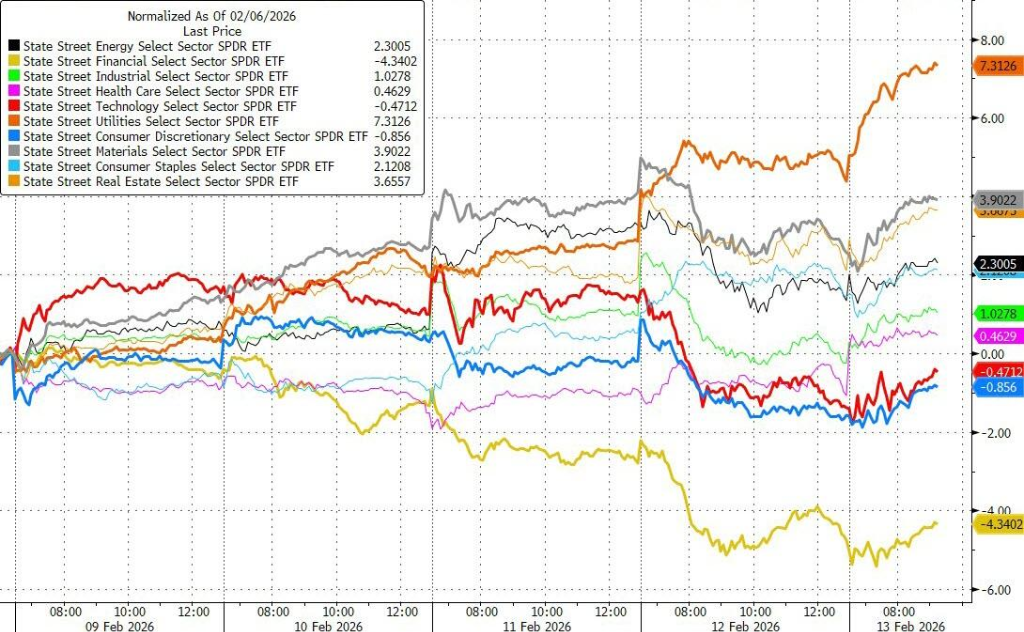
Core Viewpoint - AI, initially seen as a strong investment theme for the year, has shifted to a source of market uncertainty, particularly impacting light-asset companies that may be replaced by AI technology [1][4]. Group 1: Market Performance - The S&P 500 index experienced its worst performance since November until a rebound occurred following mild inflation data on Friday [1]. - The utility sector outperformed as a safe haven against AI impacts, while the financial sector was the worst performer of the week [2]. - Wall Street's previously confident bets have failed over six weeks, with cash allocations at a historic low and hedge levels at their lowest since 2018 [3]. Group 2: AI Impact and Investor Sentiment - Investors are questioning the return timelines on large capital expenditures by tech giants and whether remaining cash can continue to support stock buybacks [4]. - The sentiment is that more stocks have been harmed by AI than benefited, leading to concerns about potential contagion effects across sectors [4]. - The market is undergoing a repricing, particularly in the software industry, raising fears of broader impacts [4]. Group 3: Market Volatility - Two forces are exacerbating volatility in the U.S. stock market: low cash allocations and interconnected leveraged positions that can trigger widespread sell-offs [5]. - The VIX index recently surpassed the critical 20 mark, indicating rising market pressure despite not showing panic signals [6]. - The put-call ratio has surged since January, reflecting increased hedging activity among investors [9][10]. Group 4: Investment Strategy Adjustments - Despite current volatility, the S&P 500 remains near historical highs, and credit spreads are at ten-year lows, indicating that a market collapse has not yet occurred [9]. - There has been a significant inflow of $3.6 billion into ETFs tracking high shareholder return companies this month, suggesting a shift in investment focus [10].
阿维斯塔公布2026年融资计划,维持高股息政策
Jing Ji Guan Cha Wang· 2026-02-13 22:45
Core Viewpoint - Avista Corp. announces a financing plan for 2026, intending to issue long-term debt and common stock to support capital expenditures while maintaining a stable high dividend policy [1] Group 1: Business Performance - Avista's main business is highly concentrated in utilities, with Avista Utilities accounting for 97.37% of revenue, characterized by inelastic demand and predictable cash flow [2] - As of Q3 2025, the company reported a net profit of $122 million and earnings per share of $1.51, providing a solid foundation for dividends [2] Group 2: Financial Movements - The company has consistently maintained quarterly dividends, with four distributions of $0.49 per share in 2025. As of February 13, 2026, the dividend yield reached 4.56%, surpassing the industry average [3] - By issuing long-term debt, the company locks in low-interest funds for infrastructure investments, such as grid upgrades, while stable utility asset revenues support its dividend capacity, particularly in a moderate interest rate environment [3] Group 3: Industry Policy and Environment - The utility sector has long capital expenditure cycles but stable cash flow returns. Avista uses debt financing to smooth expenditure pressures, avoiding equity dilution while maintaining dividend attractiveness [4] Group 4: Executive Changes - Between December 2025 and February 2026, several directors and executives sold shares, which may reflect their assessment of the current valuation levels, but this should be evaluated in the context of the company's overall liquidity position [5]