
动力电池

Search documents
信达证券:涨价或是重要的景气主线
Xin Lang Cai Jing· 2026-01-18 07:29
Core Conclusion - The market's upward momentum has slowed down this week, with active trading funds causing turnover rates to spike, surpassing the high point of August 2025. The spring market is still in progress, and a period of sideways consolidation after excessive short-term trading is normal. Although there are indications of a short-term cooling in policy, the overall stance remains accommodative [1][5]. Market Trends - The market style is shifting, with thematic sentiment cooling and strong sectors returning to the prosperity line. In the liquidity bull market phase, the profit effect is spreading, and price increases are considered a key prosperity line. The current narrative around commodities is driven by de-globalization and supply chain restructuring, leading to a re-pricing of key resource products [1][5]. Commodity Price Dynamics - Long-term, commodity prices tend to move in tandem, even during periods of economic downturn, as seen from 1970 to 1980 when prices continued to rise until 1980. There is optimism for a new super cycle in commodity prices. In the short to medium term, the focus should be on supply constraints, with potential expansion from emerging industry demand to the recovery of traditional demand. Beneficiaries on both supply and demand sides include non-ferrous metals (precious metals, copper, aluminum, strategic metals, rare earths), new energy (new energy materials, power batteries), chemical products (phosphate chemicals, fluorine chemicals), and storage chips [1][3][6]. Supply and Demand Factors - The current commodity price cycle is primarily driven by supply chain security. On the supply side, the control of strategic resources is intensifying amid great power competition, leading to increased scarcity in key mineral sectors. On the demand side, real needs driven by the AI technology revolution, energy transition, and military spending are boosting demand for strategic metals like copper, aluminum, lithium, and rare earths. A weak dollar cycle may support the elevation of commodity price levels [2][6]. Price Movement Patterns - Historically, during a commodity price increase, there are price rotations among commodities due to their interdependencies and relationships within the supply chain. For instance, during the demand expansion-driven price increase from 2009 to 2011, copper led the rise, followed by crude oil and soybeans. In the supply constraint-driven price increase from 2016 to 2018, oil and black commodities rose first, with chemical products showing sustained price increases [2][6]. Future Outlook - There is a strong belief in the potential for a new super cycle in commodity prices. The focus for the current price increase should be on supply constraint elasticity, with expansion likely moving from emerging industry demand to the recovery of traditional demand. Key supply constraints include production capacity limits for critical resources like copper and rare earths, capacity restrictions driven by "anti-involution" policies, and supply shortages driven by high AI demand. Demand opportunities are expected to arise from the transition between new and old driving forces in sectors like new energy vehicles, photovoltaics, and AIDC [3][7].

宁德时代与川渝高竹新区签署合作协议
Xin Lang Cai Jing· 2026-01-18 00:48
Core Viewpoint - CATL has signed a cooperation agreement with the Chuan-Yu Gaozhu New District to invest 5.5 billion yuan in a power battery project, indicating a strategic move beyond traditional capacity expansion and point investments in Chongqing's automotive industry [1] Group 1 - The investment of 5.5 billion yuan is aimed at establishing a power battery project [1] - CATL's activities in Chongqing are characterized by a comprehensive approach, integrating production line collaboration within the Seres super factory [1] - The company is enhancing the energy supply of urban logistics networks and facilitating cross-regional industrial chain connections [1]

动力电池回收新规来了 有哪些重点亮点?
Yang Shi Xin Wen· 2026-01-17 04:55
Core Viewpoint - The new management measures emphasize "omni-channel, full chain, and full lifecycle" characteristics for the management of used power batteries from electric vehicles, aiming to ensure safety and environmental protection in the recycling process [1][4]. Group 1: Omni-channel Management - The management measures regulate various aspects including battery production, vehicle scrapping, battery swapping operations, and maintenance, with a focus on the "vehicle-battery integrated scrapping" system to prevent the uncontrolled flow of used batteries [1][4]. Group 2: Full Chain Responsibility - The measures clarify the responsibilities and obligations of various entities involved in the production, sales, maintenance, replacement, disassembly, recycling, and comprehensive utilization of batteries [1][4]. Group 3: Full Lifecycle Information Management - The establishment of a national information platform for tracing the lifecycle of new energy vehicle power batteries is highlighted, along with a digital identity management system for these batteries to enhance information traceability [1][7]. Group 4: Producer Responsibility - The new regulations stress the importance of safety in the recycling and comprehensive utilization of used power batteries, mandating that producers of new energy vehicles and batteries fulfill extended producer responsibilities [4][6]. Group 5: Technological Empowerment - The introduction of an information platform that includes features for information tracing, digital identity, corporate responsibility evaluation, and data analysis is a significant highlight, aiming to cover all lifecycle stages of battery information [7]. Group 6: Ecological Design and Maintenance - Battery manufacturers and new energy vehicle producers are encouraged to adopt ecological design principles, ensuring that battery components are easy to maintain and disassemble, while also providing necessary technical information for disassembly [9]. Group 7: Prohibition of "Tiered Utilization" - The new management measures explicitly prohibit the direct or processed use of used power batteries in electric bicycles and other areas restricted by laws and regulations, moving away from the previously used "tiered utilization" concept [10].

谁才是中国民企真龙头?两份榜单背后,藏着两套生存哲学
Sou Hu Cai Jing· 2026-01-16 15:59
Core Insights - The contrasting rankings of JD.com and Tencent/Alibaba highlight two distinct business philosophies in China's private sector, focusing on current revenue versus future growth potential [1][2] Group 1: Rankings and Evaluation Standards - JD.com topped the "2025 China Private Enterprises 500" list with a revenue of 1.16 trillion RMB, surpassing Alibaba and Huawei, based on a revenue-centric evaluation of 6,379 companies [4][5] - Goldman Sachs' report ranked Tencent, Alibaba, and BYD as the "Top Ten Private Enterprises," emphasizing investment value and growth potential rather than current size [7] Group 2: Business Models - JD.com adopted a heavy asset model, investing significantly in logistics and self-operated goods, which has created substantial competitive barriers despite initial losses [8][6] - In contrast, Tencent and Alibaba utilize a light asset model, focusing on technology, data, and user relationships, allowing for high profitability with lower operational costs [10][12] Group 3: Manufacturing Sector Growth - The manufacturing sector is a significant contributor to the private economy, with 66.4% of the top 500 companies being manufacturers, accounting for 68.84% of revenue and 53.21% of net profit [13][14] - Companies like BYD and CATL are leading in innovation and R&D, with substantial investments in new energy technologies [16][17] Group 4: Future Directions - The diversity in business models among private enterprises is a strength, with companies like JD.com and Tencent exploring synergies between heavy and light asset strategies [18][19] - The implementation of the "Private Economy Promotion Law" in May 2025 is expected to provide a more supportive legal environment for private enterprises [19][20] - A significant portion of the top 500 companies is focusing on digital transformation and green initiatives, with international revenue growth indicating a push towards global expansion [20]





工信部:动力电池企业、新能源汽车生产企业承担电池回收“兜底”责任
Xin Hua Cai Jing· 2026-01-16 07:41
Core Viewpoint - The "Interim Measures for the Management of Recycling and Comprehensive Utilization of Waste Power Batteries for New Energy Vehicles" outlines the responsibilities and obligations of power battery companies, new energy vehicle manufacturers, and other related enterprises in the recycling and utilization of waste power batteries [1][2]. Group 1: Responsibilities of Battery and Vehicle Manufacturers - Power battery companies and new energy vehicle manufacturers are required to enhance product ecological design and assume a "bottom-line" responsibility for recycling [1]. - Battery manufacturers must prioritize ecological design and comply with the "Automotive Power Battery Coding Rules" (GB/T 34014), providing necessary disassembly technical information [2]. - New energy vehicle manufacturers must ensure that battery components are easy to maintain and disassemble, and must publicly disclose automotive maintenance technical information [2]. Group 2: Recycling Obligations - Battery manufacturers must establish recycling service points that match their sales volume in the provincial administrative regions and disclose relevant recycling information [2]. - New energy vehicle manufacturers are also required to set up recycling service points in the city-level administrative regions where they sell vehicles, taking responsibility for the recycling and proper transfer of the batteries installed in their vehicles [2]. Group 3: Responsibilities of Other Related Enterprises - Other related enterprises, such as battery swapping service providers, vehicle maintenance companies, and scrapped vehicle recycling and dismantling enterprises, must ensure that the waste power batteries they handle are transferred to comprehensive utilization enterprises or designated recycling service points [2]. - The comprehensive utilization of waste power batteries must comply with laws, regulations, and mandatory standards related to resource utilization, environmental protection, and safety production [2]. Group 4: Penalties for Non-compliance - The "Management Measures" specify administrative penalties for non-compliance, including orders for correction, warnings, and fines for failing to deliver waste power batteries, not fulfilling recycling responsibilities, and violating coding and information reporting requirements [3].
有“锂”走遍天下,180天内十家主机厂牵手“宁王”
Feng Huang Wang· 2026-01-16 06:13
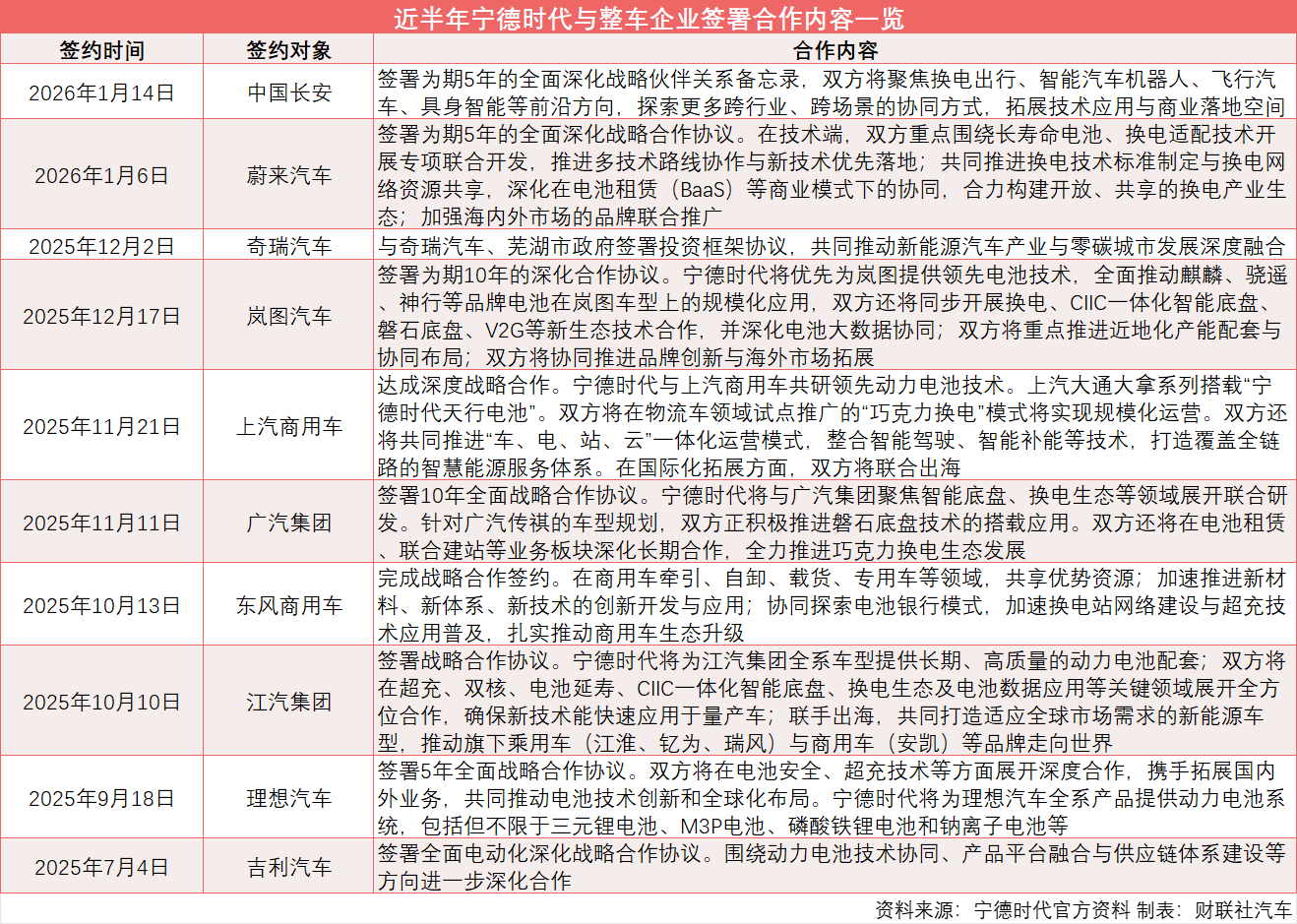
Core Insights - The article highlights the strategic partnerships between multiple automotive companies and CATL, aimed at stabilizing supply chains and enhancing competitive advantages in the context of rising lithium carbonate prices and the expanding electric vehicle market [1][4]. Group 1: Strategic Partnerships - CATL signed a five-year strategic partnership memorandum with Changan Automobile, focusing on advanced areas such as battery swapping, smart vehicles, and flying cars [1][2]. - Since the second half of last year, ten automotive companies, including Changan, have entered into long-term agreements with CATL, covering various segments like passenger cars, commercial vehicles, and intelligent technologies [1][2]. - Notable agreements include a ten-year partnership with Lantu Automotive and GAC Group, emphasizing long-term collaboration in battery technology and market expansion [1][2]. Group 2: Market Dynamics - Lithium carbonate prices have shown significant volatility, dropping to a low of 59,000 yuan/ton in June 2025 before surging to a peak of 134,500 yuan/ton by December 2025, and further rising to 174,100 yuan/ton in 2026 [3]. - The demand for electric vehicles is projected to grow, with the China Association of Automobile Manufacturers estimating production and sales of 16.62 million and 16.49 million units respectively in 2025, marking a year-on-year increase of 29% and 28.2% [3]. Group 3: Technological Collaboration - CATL is leveraging its battery technology to collaborate with automotive manufacturers on innovations such as ultra-fast charging, long-life batteries, and integrated smart chassis [4][6]. - The partnerships aim to create a shared ecosystem around battery swapping, battery-as-a-service (BaaS), and vehicle-to-grid (V2G) technologies, enhancing operational efficiency and market reach [5][6]. Group 4: Industry Transformation - By establishing deep binding relationships with automotive companies, CATL is transitioning from a battery supplier to a comprehensive energy solutions provider, solidifying its market leadership [6].
禁入电动自行车领域!六部门联合出手全链条规范废旧动力电池回收利用
证券时报· 2026-01-16 04:27
Core Viewpoint - The article discusses the implementation of the "Interim Measures for the Management of Recycling and Comprehensive Utilization of Used Power Batteries for New Energy Vehicles," which aims to establish a regulated, safe, and efficient recycling system for used power batteries in the rapidly growing new energy vehicle industry [1][2]. Group 1: Regulatory Framework - The new management measures will take effect on April 1, 2026, replacing four existing regulations to provide a new institutional framework for the development of the new energy vehicle and battery industry [1]. - The measures emphasize the importance of regulating the recycling and comprehensive utilization of used power batteries, focusing on information traceability, recycling management, and comprehensive utilization management [1][2]. Group 2: Industry Impact - The production and sales of new energy vehicles in China are projected to reach 16.626 million and 16.49 million units respectively by 2025, marking year-on-year growth of 29% and 28.2% [2]. - The volume of used power batteries is expected to exceed 1 million tons by 2030, indicating a significant increase in waste battery generation as vehicles reach the end of their lifecycle [2]. Group 3: Management Measures - The management measures include establishing a national information platform for tracing the lifecycle of power batteries, requiring manufacturers to code and label their batteries, and mandating timely reporting of relevant information through the platform [4]. - The measures also outline penalties for non-compliance, including administrative fines and corrective orders for entities that fail to meet recycling responsibilities or reporting requirements [4][5]. Group 4: Environmental and Safety Considerations - The management measures stipulate that any activities involving the comprehensive utilization of used power batteries must comply with environmental protection and safety regulations, and prohibit the use of these batteries in areas where it is legally restricted [5].
潍坊与宁德时代子公司签约背后的绿色雄心
Da Zhong Ri Bao· 2026-01-16 00:26
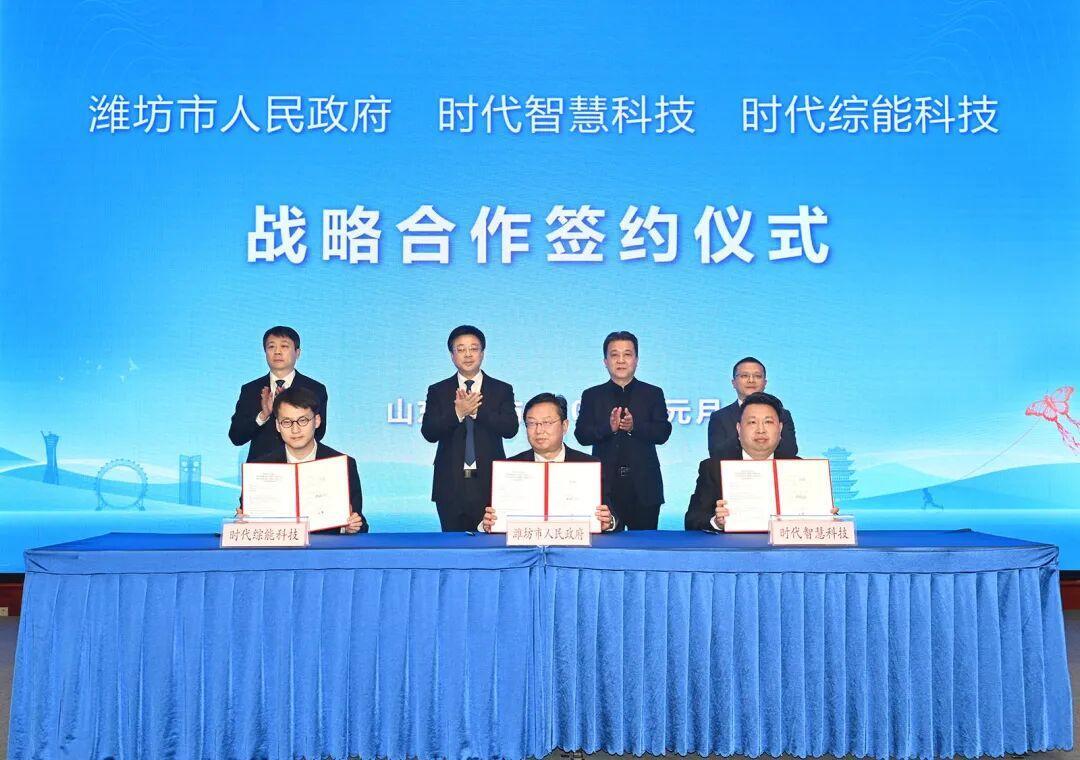
Core Viewpoint - Weifang City has signed a strategic cooperation agreement with two subsidiaries of CATL, indicating its ambition to become a significant growth pole for the northern green economy [1][3][4]. Group 1: Weifang's Development Goals - Weifang aims to achieve a GDP exceeding 1 trillion yuan and establish itself as a regional sub-center city, positioning itself as a key strategic point for economic growth in northern China [3]. - The collaboration with CATL is seen as a means to inject a "green engine" into Weifang's journey towards its trillion-yuan goal [3]. Group 2: Industry Transformation Needs - Weifang, traditionally an agricultural and industrial city, faces urgent demands for industrial structure transformation [3]. - The city is committed to implementing the national "dual carbon" strategy, with CATL's subsidiaries providing the necessary technological support and industrial momentum for this transition [3][4]. Group 3: Specific Areas of Cooperation - The cooperation will focus on five key areas: 1. New energy vehicle aftermarket services 2. Comprehensive energy services and low-carbon demonstrations 3. Innovative talent cultivation 4. Green shipping and port electrification 5. Collaborative investment attraction [3][4]. - The emphasis on "green shipping and port electrification" is particularly noteworthy, as it aligns with local resources and aims to upgrade the high-end equipment manufacturing sector [3]. Group 4: CATL's Strategic Positioning - CATL's collaboration with Weifang reflects its strategic expansion into the northern market, transitioning from a battery manufacturer to a comprehensive energy service provider [4]. - The partnership aims to create regional low-carbon demonstration projects through government-enterprise cooperation, enhancing CATL's market presence in North China [4]. Group 5: Potential Impact and Future Outlook - If successful, this cooperation model could serve as a replicable example for the green transformation of traditional industrial cities [4]. - The integration of Weifang's traditional industrial base with CATL's innovative technologies may lead to the emergence of new industrial forms, particularly in resource recycling and comprehensive energy services [4].
宁德时代锁单1200亿建产业链护城河 “资本+订单”双轮驱动巩固全球王座
Chang Jiang Shang Bao· 2026-01-15 23:54
长江商报消息●长江商报记者 沈右荣 新能源时代真正来临,行业快速发展,"宁王"宁德时代(300750.SZ,03750.HK)抛出惊人锁单量。 1月13日晚,A股公司容百科技(688005.SH)发布公告称,公司与宁德时代签署协议,自2026年第一季 度开始至2031年,公司预测合计向宁德时代供应磷酸铁锂总量约为305万吨。合同总销售金额超1200亿 元。 当晚,A股市场另一家公司富临精工(300432.SZ)也发布公告称,公司拟引进宁德时代为战略投资 者,并与其开展全方位合作。宁德时代拟出资31.75亿元认购富临精工定增,成为其重要股东。 签1200亿元采购大单、31.75亿元入股富临精工,宁德时代在下一盘大棋,以构建产业链护城河,巩固 其全球领先的市场地位。 目前,宁德时代在动力电池、储能电池领域为全球"双冠军"。2025年前三季度,宁德时代盈利490.34亿 元,逼近2024年全年水平。 锁定1200亿磷酸铁锂正极材料供应 容百科技表示,公司基本完成全球化布局,相关产品技术将除了在中国本土快速实现量产和推广,还将 借助韩国、波兰制造基地和全球化的市场布局,迅速将该产品和技术在全球范围内推广。 上述巨量订 ...

时代长安动力电池项目落地川渝高竹新区
Si Chuan Ri Bao· 2026-01-15 22:24
●项目总投资约55亿元,新建年产25GWh动力电池生产基地,建成后可为长安汽车旗下品牌提供 新能源汽车动力电池配套 ●预计今年一季度正式开工,2027年下半年正式投产。投产后预计可实现年产值约100亿元 该项目由时代长安动力电池有限公司主导投资建设,总投资约55亿元,计划用地约1000亩,新建 年产25GWh动力电池生产基地。项目立足"技术领先的新能源动力电池配套基地"定位,将导入宁 德时代最新一代电池制造工艺,推出系列前沿产品。建成后可为长安汽车旗下品牌提供新能源汽 车动力电池配套,实现核心零部件本地化供应。目前,项目已完成选址地块平场工作,预计今年 一季度正式开工,2027年下半年正式投产。投产后预计可实现年产值约100亿元,带动约2500人就 业。 "该项目是'川渝合作、双向赋能、成果共享'的示范性项目,具有链主效应和示范带动作用。"川 渝高竹新区管委会常务副主任赵冬表示,项目将吸引动力电池及上下游企业集聚,加快形成引进 一个、带动一串、辐射一片的产业集群格局, ●将吸引动力电池及上下游企业集聚,推动新区承接东部新能源汽车产业转移 本报讯(甘文颖 四川日报全媒体记者 伍力)1月14日,时代长安动力电池项 ...
