
汽车

Search documents
金融界财经早餐:聚焦央企数智化与长护险制度;福建打造“555X”产业集群;社保基金重仓股曝光;海外资本调研中国AI算力产业链;中概股、黄金大涨;蒙牛乳业利润暴增14倍(3月26日)
Jin Rong Jie· 2026-03-26 01:31
Company and Industry Insights - The total revenue of Pinduoduo for Q4 2025 reached 123.91 billion yuan, a year-on-year increase of 12%, slightly above market expectations; adjusted net profit was 26.30 billion yuan, a decrease of 12% compared to the previous year [9] - Kuaishou reported a total revenue of 142.8 billion yuan for the entire year of 2025, reflecting a year-on-year growth of 12.5%; adjusted net profit was 20.65 billion yuan, up 16.5%, with an adjusted net profit margin of 14.5% [10] - China Life Insurance achieved an operating revenue of 615.68 billion yuan in 2025, a year-on-year increase of 16.5%; net profit attributable to shareholders was 154.08 billion yuan, up 44.1% [10] - Kingsoft Office reported an operating revenue of 5.93 billion yuan for 2025, a year-on-year increase of 15.78%; net profit attributable to shareholders was 1.84 billion yuan, up 11.63% [11] - Huagong Technology's operating revenue for 2025 was 14.36 billion yuan, a year-on-year increase of 22.59%; net profit attributable to shareholders was 1.47 billion yuan, up 20.48% [11] - China Eastern Airlines announced a purchase agreement with Airbus for 101 A320NEO aircraft, with a total catalog price of approximately 15.80 billion USD, equivalent to about 1088.93 billion yuan [12] - Mengniu Dairy reported a revenue of 82.24 billion yuan for 2025, a year-on-year decrease of 7.3%; net profit attributable to equity shareholders increased by 1378.9% to 1.55 billion yuan [12] - Beijing Automotive achieved a revenue of 164.05 billion yuan in 2025, a decline of 14.8% year-on-year, with net profit attributable to equity holders dropping by 87.2% to 122.7 million yuan [13]


快讯:恒指低开0.27% 科指跌0.68% 科网股走弱 创新药概念高开 快手跌超9%
Xin Lang Cai Jing· 2026-03-26 01:25
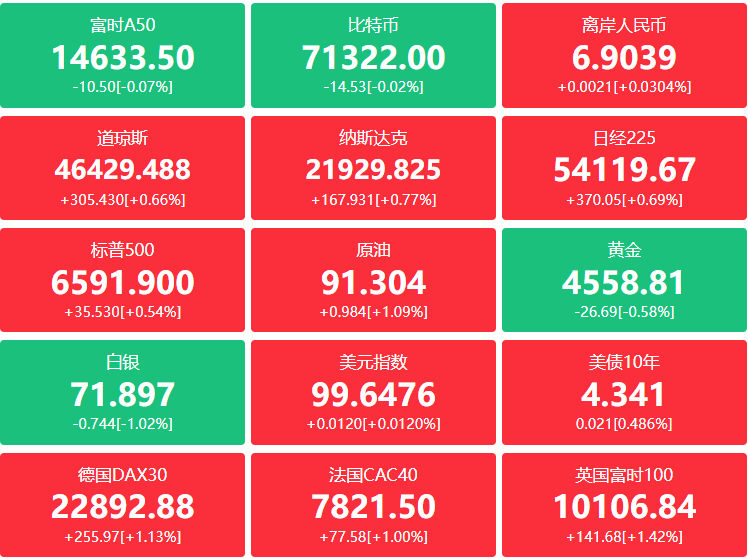
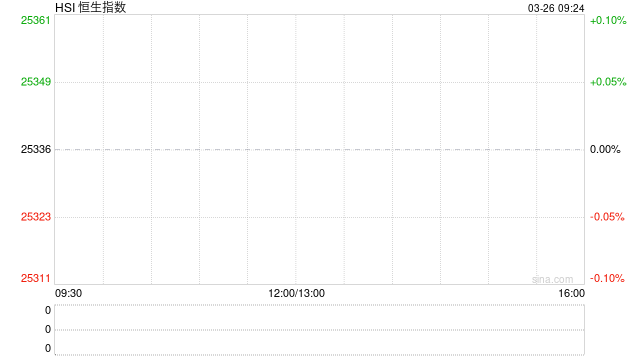
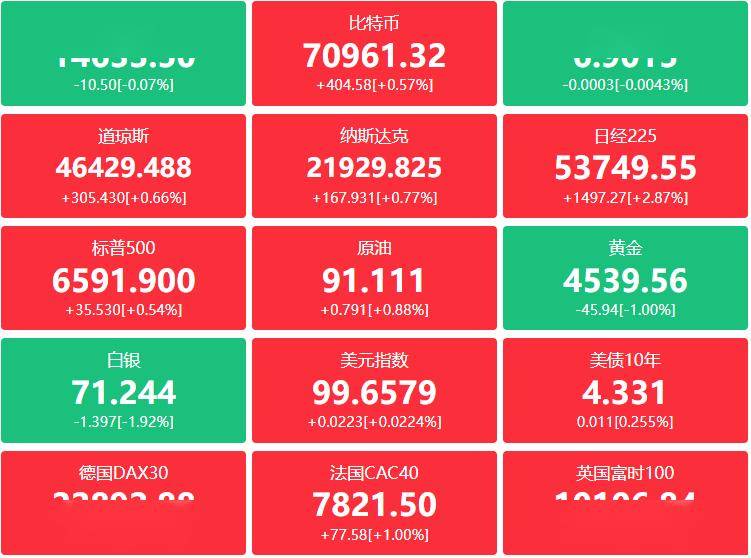
Market Overview - US stock market showed upward performance on Wednesday, with signs of easing tensions in the Middle East contributing to a positive market atmosphere, leading to gains across all three major indices [1][4] - Oil prices retreated from high levels, while the US dollar initially fell before recovering, and the yield on the US 10-year Treasury bond decreased to 4.33% [1][4] Hong Kong Stock Market - The Hong Kong stock market opened lower, with the Hang Seng Index down 0.27% at 25,267.16 points, the Hang Seng Tech Index down 0.68%, and the National Enterprises Index down 0.41% [1][4] - In the market, technology stocks showed mixed results, with JD.com rising over 2%, while Kuaishou fell over 9% and Bilibili dropped over 1% [1][4] - Innovative drug concept stocks were active, with Lepu Biopharma increasing over 6%, while some automotive stocks weakened, with NIO declining over 2% [1][4] Index Performance - Hang Seng Index: 25,267.16, down 68.79 points, -0.27% [2][5] - National Enterprises Index: 8,547.82, down 34.92 points, -0.41% [2][5] - Hang Seng Tech Index: 4,889.55, down 33.39 points, -0.68% [2][5] Technical Indicators - MACD golden cross signal formed, indicating potential upward momentum for certain stocks [2]

大疆宣传视频被曝抄袭;泡泡玛特要做家电;经济日报评论员文章:外卖大战该结束了;胖东来员工平均收入9400元丨邦早报
创业邦· 2026-03-26 00:55
Group 1 - The article discusses the end of the "takeout war," emphasizing that price wars in the food delivery industry not only affect restaurant owners but also impact the livelihoods of ordinary people. It advocates for healthy competition based on technological innovation, efficiency improvement, and service optimization rather than capital-intensive cash-burning games [2] - Five express delivery companies, including YTO Express and Jitu Express, have jointly announced a price adjustment due to rising transportation costs from increased oil prices. In Guizhou, the minimum delivery fee has been raised to 1.2 yuan per ticket, with a 0.05 yuan increase per ticket [3] Group 2 - Pinduoduo reported a total revenue of 431.8 billion yuan for the year, marking a 10% year-on-year increase, although net profit declined. This is the first financial report since the implementation of a co-chairman system [3] - Pop Mart International Group projected a revenue of 37.12 billion yuan for 2025, with a year-on-year growth of 184.7%. The company reported significant growth across all major markets, including a 748.4% increase in the Americas [3] - Haidilao announced a revenue of 43.225 billion yuan for 2025, with a 1.1% year-on-year increase. The company's takeaway business revenue grew by 111.9% [3] Group 3 - Momenta, a smart driving solution provider, has secretly submitted its IPO application to the Hong Kong Stock Exchange, with an expected valuation exceeding 100 billion yuan [8] - SpaceX is reportedly planning to raise up to 75 billion dollars in its IPO, with discussions indicating a potential valuation of over 1.75 trillion dollars [12] - Japan's average monthly salary for full-time employees reached 340,600 yen in 2025, marking a 3.1% increase from the previous year, with the gender pay gap narrowing to the smallest level on record [17]

A股头条:中远海运恢复海湾国家订舱,船舶暂不过霍尔木兹海峡;特斯拉机器人最新视频曝光,马斯克称有望在2027年实现量产
Sou Hu Cai Jing· 2026-03-25 23:54
Group 1 - The National Supercomputing Internet has launched a new token giveaway, offering users a maximum of 30 million tokens to lower the entry barrier for AI applications [1] - The Ministry of Commerce of China has initiated an investigation into Mexico's increased import tariffs on products from non-free trade partners, identifying these measures as trade investment barriers [1] Group 2 - COSCO Shipping has resumed booking services to Gulf countries, although vessels will not pass through the Strait of Hormuz, instead using land transport for deliveries [2] - Mercedes-Benz has announced the integration of a multimodal large model developed in collaboration with Tsinghua University into its new generation S-Class vehicles, marking a significant step in automotive intelligence [3] Group 3 - Tesla has revealed new details about its Optimus robot, with plans for mass production by 2027, which could significantly impact labor and manufacturing economics [5] - The U.S. stock market has shown positive movement, with major indices rising, driven by technology stocks and a general optimism regarding Middle East peace negotiations [6][7] Group 4 - Shenzhen has launched an action plan to accelerate the high-quality development of the AI server industry, aiming for significant growth in production capacity and market share by 2028 [12][13] - The State-owned Assets Supervision and Administration Commission is promoting the digital transformation of financial management in central enterprises, leveraging new technologies like big data and AI [14] Group 5 - Several companies have reported significant profit growth for 2025, including Huagong Technology with a 20% increase and Yuloka with a 92.73% increase, indicating strong performance in their respective sectors [16]

3月26日议程|国泰海通“远望又新峰”2026春季策略会
国泰海通证券研究· 2026-03-25 23:46
Group 1 - The article discusses the upcoming conference focusing on various sectors including consumer services, technology, and investment strategies, highlighting the potential for growth and innovation in these areas [5][10][18]. - Key speakers from different research departments will present insights on topics such as service consumption, product innovation in beauty, and the impact of technology on household appliances [4][6][10]. - The conference aims to address the evolving landscape of consumer behavior and market dynamics, particularly in light of recent policy changes that favor traditional consumption patterns [5][6][10]. Group 2 - The event will feature discussions on the advancements in humanoid robotics and commercial aerospace, emphasizing the integration of technology in these fields [7][9][21]. - Insights into the agricultural sector will be provided, focusing on the potential for growth amidst rising commodity prices and changing market conditions [6][10]. - The conference will also explore macroeconomic trends and their implications for asset allocation strategies, particularly in a low-interest-rate environment [15][18]. Group 3 - The article outlines the significance of multi-asset allocation strategies in navigating market volatility and achieving stable returns [12][15]. - Discussions will include the role of artificial intelligence in quantitative investment strategies and the future of various commodity markets [18][19][21]. - The conference will also cover the outlook for the automotive industry, emphasizing the importance of innovation and sustainability in future developments [23][26].

中金 • 全球研究 | 中东变局下的全球区域行业情景推演
中金点睛· 2026-03-25 23:36
Group 1: Energy Sector - The energy market is expected to experience varying impacts based on different scenarios, with oil prices potentially averaging around $80 per barrel in a mild scenario, and rising to $120 in a baseline scenario, leading to significant inflationary pressures [1][2][4] - Energy companies are projected to see their earnings per share (EPS) and valuations increase as the market adjusts to higher long-term oil price expectations, which are currently reflected below $80 per barrel [3][36] - In extreme scenarios where oil prices soar to $140-160 per barrel, the energy sector may face severe challenges, including economic recession and increased inflation, necessitating a shift towards defensive sectors [2][3][29] Group 2: Mining Sector - In a mild scenario, the mining sector may benefit moderately as the market returns to fundamental pricing, with aluminum and copper expected to see positive price movements due to improved demand expectations [27] - In a baseline scenario, rising costs from energy and raw materials will reshape pricing logic for aluminum and nickel, while gold may rise due to inflationary pressures [28] - In extreme scenarios, the mining sector could face significant downturns, with only gold likely to serve as a safe haven asset amidst a broader economic recession [29] Group 3: Pharmaceutical Sector - The pharmaceutical industry is considered a defensive sector, benefiting from a strong dollar and lower sensitivity to oil prices and inflation, making it a diversified investment option during uncertain times [3] Group 4: Semiconductor Sector - The semiconductor industry is expected to experience limited impact from rising oil prices, as the cost of raw materials and electricity constitutes a small portion of overall chip production costs [40] - However, if the geopolitical situation escalates, there may be indirect effects on demand due to macroeconomic downturns, potentially leading to revenue growth pressures [42] Group 5: Agricultural Sector - Agricultural products may face rising costs due to increased fertilizer prices linked to energy costs, with potential price increases for corn and soybeans if fertilizer prices rise significantly [37] - The geopolitical situation may also enhance expectations for biofuel alternatives, although the overall supply-demand balance for major crops remains relatively stable [38] Group 6: Chemical Sector - The chemical industry is experiencing structural disruptions due to rising energy prices and supply chain issues, with significant impacts on production costs and pricing across the entire value chain [31][34] - Regional disparities are evident, with Asia facing more direct risks due to high dependence on Middle Eastern oil and gas, while North America may benefit from higher self-sufficiency [32] Group 7: Industrial Sector - The industrial sector is under pressure from rising costs, but the overall impact is manageable, with a focus on demand-side influences that could affect profitability [50]

马斯克造芯片,黄仁勋“反对”
汽车商业评论· 2026-03-25 23:07
Core Viewpoint - Elon Musk announced the establishment of a chip factory named "Terafab" with a budget of $20-25 billion, aiming to achieve full control over Tesla's computing power and integrate the semiconductor supply chain under one roof [10][12][15]. Group 1: Project Overview - Terafab is described as the largest chip manufacturing project in history, utilizing 2nm process technology, which is currently only produced by TSMC [13]. - The factory will have two production lines: one for Tesla's automotive and robotics chips, and another for aerospace-grade D3 chips [13]. - The initial monthly wafer output target is set at 100,000, with a long-term goal of reaching 1 million wafers per month, equating to approximately 70% of TSMC's current global output [18][22]. Group 2: Strategic Importance - Terafab aims to produce 1 terawatt of computing power annually, requiring the production of 100-200 billion custom AI and storage chips for various Tesla projects [22]. - Approximately 80% of the computing power will be dedicated to space-based AI satellites, leveraging the advantages of the space environment for heat dissipation [22]. - The project is seen as a response to the limitations of external chip suppliers like TSMC and Samsung, which Musk predicts will reach capacity limits within three to four years [15][18]. Group 3: Challenges - The project faces significant challenges, including the need to procure high-NA EUV lithography machines from ASML, which are in high demand and costly [24][26]. - Tesla has a $16.5 billion multi-year contract with Samsung to produce next-generation AI chips, which is crucial for knowledge transfer before Tesla operates its own foundry [26][28]. - Recruiting a specialized team of engineers with expertise in semiconductor manufacturing processes is essential, as Tesla has no prior experience in this field [28][29]. - Musk's unconventional cleanroom theory, which suggests that traditional cleanroom standards are outdated, has raised skepticism within the semiconductor industry [29][31]. Group 4: Industry Reactions - The semiconductor industry has expressed skepticism regarding Terafab, with industry leaders like NVIDIA's CEO warning about the complexities of building advanced chip manufacturing facilities [31][33]. - Analysts believe that achieving the production capacity of TSMC will be extremely challenging for Tesla, given its lack of experience in semiconductor manufacturing [33][37]. - Despite the challenges, the announcement of Terafab has prompted the semiconductor industry to take Musk's supply chain ambitions seriously, reflecting a broader trend of companies seeking to secure their supply chains amid geopolitical tensions [38].


金融工程研究报告:油价高位:顺周期逻辑与冲击量化测算
ZHESHANG SECURITIES· 2026-03-25 14:46
- The report utilizes the input-output table data to quantify the cost structure and cost transmission capabilities of various industries, focusing on the intermediate product quadrant, which represents the demand of each economic sector for products from other sectors. The cost distribution weight for a sector is calculated by dividing the column data of the input-output table by the total input minus operating surplus for that sector[12][13][16] - A regression model is employed to measure the cost transmission capability of industries. The estimated cost and product price (PPI) series are regressed, with the regression slope serving as a proxy for cost transmission capability. To account for inventory buffering effects, the optimal lag period is determined by calculating the time-lagged correlation coefficient between cost and price series, and regression is performed at the optimal lag[16][17][18] - The cost transmission capability coefficients reveal that upstream industries such as oil, coal, and iron ore exhibit strong cost transmission capabilities due to low cost elasticity and high product price elasticity. Midstream industries like steel and chemicals also demonstrate strong cost transmission capabilities, often exceeding 1, indicating that price increases in upstream resources do not harm their profitability. In contrast, downstream industries generally have weaker cost transmission capabilities, often below 1, making them more vulnerable to raw material price increases[18][19] - The report quantifies the profit margin changes across industries under the impact of a 50% increase in oil prices. Industries with rigid downstream pricing and direct exposure to energy costs, such as gas production and supply, suffer the most. Other significantly affected industries include non-metallic mineral mining, rubber and plastic products, and printing. However, industries like chemical manufacturing and chemical fiber manufacturing benefit from strong cost transmission capabilities, which mitigate the impact of rising oil prices on their profit margins[19][20] - The average inventory turnover months of industries are calculated using industrial enterprise revenue and inventory data. The analysis finds a positive correlation between inventory turnover months and the lag in product price changes relative to cost increases. Industries with higher inventory turnover months have greater "buffering capacity," allowing them to delay price increases and absorb cost pressures for longer periods[23][24][26]
港股有好几个炸裂的消息
表舅是养基大户· 2026-03-25 13:33
Group 1 - The core viewpoint of the article discusses the unexpected surge in stock prices of major food delivery companies like Meituan, Alibaba, and JD after a government article suggested the end of the "food delivery war," which has negatively impacted market prices and CPI [1][3][4] - The article highlights the unusual timing of the market reaction, noting that the stock prices only began to rise after the article gained traction, despite being published earlier in the day [5][6] - The author believes that the article's impact is overstated, as regulatory measures regarding the food delivery industry have been ongoing since last year, and the competition will continue in a more regulated manner rather than coming to an end [8] Group 2 - Pop Mart's stock experienced a significant drop of 22.5% on the day of its earnings report, marking its largest single-day decline and turnover rate in three years [12][14] - The decline occurred in two phases: an initial drop of 15% after opening, followed by a further decline post-earnings call, attributed to lower-than-expected revenue and concerns over the company's reliance on a single IP, Labubu, which constitutes over 38% of total revenue [11][16][17] - The earnings call revealed a pessimistic outlook for future growth, with management indicating that the company has moved past its high-growth phase, which further contributed to the stock's decline [18] Group 3 - Xiaomi's stock initially fell 3.5% after its earnings report but rebounded due to the positive sentiment from the food delivery industry news, ultimately closing down only 0.5% [22] - The decline in Xiaomi's profits was primarily driven by a 30% drop in operating profit in Q4, largely due to challenges in its smartphone business, although its automotive segment has shown promise [22] - Li Auto's stock rose over 4% following a $1 billion share buyback announcement, reflecting its strategic response to competitive pressures in the new energy vehicle market [23][25] Group 4 - The article discusses the competitive landscape among new energy vehicle manufacturers, highlighting the challenges faced by Li Auto compared to its rivals NIO and Xpeng, particularly in terms of market positioning and product offerings [26][28] - Li Auto's strategy of focusing on family-oriented vehicles has become less effective due to increased competition in the SUV and MPV markets, and regulatory changes favoring pure electric vehicles have complicated its growth prospects [27][30] - The article suggests that the future of Li Auto may be uncertain, as it struggles to keep pace with competitors who have successfully launched popular models [29][30]

钢材初现去库拐点2026年3月第3周
SINOLINK SECURITIES· 2026-03-25 13:28
1. Report Industry Investment Rating No relevant content provided. 2. Core Viewpoints - The economy shows signs of growth with steel starting to see a de - stocking inflection point, and inflation persists with oil prices remaining at a high level [2][3] 3. Summary by Directory 3.1 Economic Growth: Steel Shows a De - stocking Inflection Point 3.1.1 Production: Power Plant Daily Consumption Returns to the Same Level as Last Year - Power plant daily consumption has returned to last year's level. On March 24, the average daily consumption of 6 major power - generation groups was 79.0 tons, up 8.8% from March 17. On March 19, the daily consumption of power plants in eight southern provinces was 212.2 tons, up 12.5% from March 12 [5][12] - The blast furnace operating rate continues to rise. On March 20, the national blast furnace operating rate was 79.8%, up 1.4 percentage points from March 13; the capacity utilization rate was 85.6%, up 2.6 percentage points from March 13. The blast furnace operating rate of Tangshan steel mills was 93.4%, up 1.0 percentage point from March 13 [5][18] - The tire operating rate shows weak recovery. On March 19, the operating rate of all - steel tires for trucks was 70.7%, up 0.5 percentage points from March 12; the operating rate of semi - steel tires for cars was 78.3%, up 0.5 percentage points from March 12. The recovery slope of the loom operating rate in the Jiangsu and Zhejiang regions has slowed down [5][20] 3.1.2 Demand: Steel Shows a De - stocking Inflection Point - The sales volume of commercial housing in 30 cities is weaker than last year. From March 1 - 24, the average daily sales area of commercial housing in 30 large and medium - sized cities was 22.3 square meters, up 99.4% from February, down 9.3% from March last year, down 2.6% from March 2024, and down 55.1% from March 2023 [5][26] - The retail sales of the auto market are gradually warming up. In March, retail sales decreased by 21% year - on - year, and wholesale sales decreased by 20% year - on - year [5][30] - Steel prices are oscillating strongly. On March 24, the prices of rebar, wire rod, hot - rolled coil, and cold - rolled coil changed by - 1.2%, + 0.5%, + 0.6%, and + 0.3% respectively compared with March 17. Steel has shown a de - stocking inflection point, with the inventory of five major steel products on March 20 at 1411.0 tons, down 12.3 tons from March 13 [5][37] - Cement prices have risen in many places. On March 24, the national cement price index rose 0.4% compared with March 17, with prices in the East China and Yangtze River regions rising 0.8% and 1.5% respectively [5][38] - Glass prices are oscillating at the bottom. On March 24, the active glass futures contract price was 1067 yuan/ton, down 2.6% from March 17 [5][45] - The container shipping freight rate index has ended a three - week rise. On March 20, the CCFI index rose 4.5% compared with March 13, while the SCFI index fell 0.2% [5][49] 3.2 Inflation: Oil Prices Remain at a High Level 3.2.1 CPI: Pig Prices Fall to a Record Low - Pig prices have fallen to a record low. On March 24, the average wholesale price of pork was 16.0 yuan/kg, down 1.0% from March 17. The month - on - month decline has widened [5][54] - The downward slope of the agricultural product price index has slowed down. On March 24, the agricultural product wholesale price index fell 0.7% compared with March 17. By variety, chicken (+ 2.2%) > eggs (+ 2.0%) > beef (+ 0.3%) > fruits (flat) > mutton (- 0.2%) > vegetables (- 0.2%) > pork (- 1.0%) [5][61] 3.2.2 PPI: Oil Prices Remain at a High Level - Oil prices remain at a high level. On March 24, the spot prices of Brent and WTI crude oil were 111.3 and 92.4 dollars/barrel, up 7.5% and down 4.0% respectively compared with March 17 [5][65] - Copper and aluminum prices have fallen sharply. On March 24, the prices of LME 3 - month copper and aluminum fell 6.4% and 5.7% respectively compared with March 17 [5][70] - Most industrial product prices have turned to rise. Since March, most industrial product prices have risen month - on - month, and the year - on - year decline of most industrial product prices has converged [72]