
炼油

Search documents
海南封关,背后真相到底是啥?东北人赢麻了
Sou Hu Cai Jing· 2025-12-22 11:41
Core Viewpoint - The recent news about Hainan's customs closure indicates a strategic move by the government to create a "super Singapore," focusing on institutional innovation to enhance its global competitiveness in logistics, finance, and petrochemicals [4][7]. Group 1: Strategic Intent - The intention behind Hainan's customs closure is to establish a competitive environment similar to Singapore, which has become a global logistics and financial hub through innovative policies rather than natural resources [4]. - Hainan aims to attract high-end foreign investment and gain pricing power over global commodities by enhancing product value through institutional reforms [7]. Group 2: Policy Measures - A key policy is the "30% value-added tax exemption" for processed goods, encouraging foreign companies to set up manufacturing in Hainan to avoid tariffs [10]. - Hainan's corporate income tax is set at 15%, significantly lower than the mainland's 25%, making it an attractive destination for foreign businesses [10][11]. Group 3: Economic Transformation - Hainan is expected to evolve from a tourism-focused economy to a major processing trade hub, competing for global capital, technology, and talent [14]. - The region will likely become a logistics center for imports such as Australian beef and Chilean cherries, enhancing its role in global supply chains [14]. Group 4: Impact on Local Economy - The closure will lead to lower prices for imported goods, benefiting local consumers with access to global products at competitive rates [15]. - The demand for high-end services, particularly in healthcare and education, is anticipated to rise, mirroring trends seen in Singapore [15]. Group 5: Demographic Changes - Hainan's population is projected to grow from 10 million to 15 million, driven by an influx of talent and investment, altering the dynamics of real estate and local markets [16].


丹格特炼油厂建第二条生产线
Zhong Guo Hua Gong Bao· 2025-12-22 03:32
此外,就第二条生产线建设,丹格特集团与印度工程公司(EIL)在印度孟买签署了谅解备忘录。EIL作为 项目管理顾问(PMC)及工程采购施工管理顾问(EPMC)的合作伙伴,参与该炼油厂扩建项目,同时助力 丹格特集团化肥厂的扩建项目,该项目与炼油厂的扩建同步进行。 丹格特炼油厂第一条生产线产能为每日65万桶,第二条生产线预计产能约为每日75万桶。该炼油厂生产 的汽油、柴油、航空煤油和聚丙烯均符合欧5排放标准。 中化新网讯近日,尼日利亚丹格特石油炼制和石化公司宣布,公司已选择霍尼韦尔(美国)作为其合作伙 伴,开始新建第二条生产线。该项目由霍尼韦尔提供先进技术、服务、专有催化剂和设备,计划在2028 年前将其炼油能力翻一番。 报道称,通过采用霍尼韦尔的炼油和石化工艺技术,将降低生产成本、提高效率并增加产量,使其日产 量从65万桶提升至140万桶。此举将使丹格特炼油厂成为全球最大的单体炼油厂。丹格特炼油厂将获得 霍尼韦尔UOP公司的Oleflex技术许可,利用该技术催化丙烷脱氢,预计年产丙烯75万吨,从而将塑料制 品主要原料聚丙烯的年总产量提升至240万吨。 ...
700艘影子船队浮出水面!乌克兰打响能源绞杀战,俄罗斯炼油厂成靶子
Sou Hu Cai Jing· 2025-12-21 19:49
Core Insights - The conflict between Ukraine and Russia has evolved into a new phase where energy infrastructure has become a primary target, indicating a shift from traditional warfare to strategic energy warfare [1][8] - Ukraine's recent sanctions on over 700 oil tankers linked to Russia highlight the importance of disrupting Russia's oil supply, which generates significant revenue for its military operations [1][5] Group 1: Energy Infrastructure Attacks - Ukraine's strike on the Slavyansk oil refinery, which has an annual processing capacity of 3 million tons, directly supports Russian military operations by supplying fuel [3] - The destruction of oil facilities has led to a 15% reduction in Russia's processing capacity, forcing the military to source fuel from the civilian market, thereby increasing domestic oil prices [3][8] - Russia has retaliated with extensive airstrikes on Ukrainian power facilities, aiming to disrupt the electricity supply necessary for Ukraine's military production [3][6] Group 2: Shadow Fleet and Sanctions - A "shadow fleet" of over 1,400 oil tankers has emerged to circumvent Western sanctions, transporting approximately 2 million barrels of oil daily and generating around $150 million in revenue for Russia [5] - The 700 tankers sanctioned by Ukraine are integral to this network, often using complex ownership structures to evade detection and sanctions [5][6] - Recent EU sanctions aim to cut off insurance and port services for these tankers, attempting to disrupt the logistics of oil transport [5] Group 3: Economic Implications - The ongoing energy conflict has resulted in a 40% loss of Ukraine's power generation capacity, with extensive repairs needed after large-scale attacks [8] - Fluctuations in international oil prices due to shipping risks and Russian production issues have led to increased costs in the global energy insurance market [8] - Both sides are engaged in a high-stakes gamble, with Ukraine relying on Western support for energy needs and Russia maintaining oil exports through the shadow fleet [8]
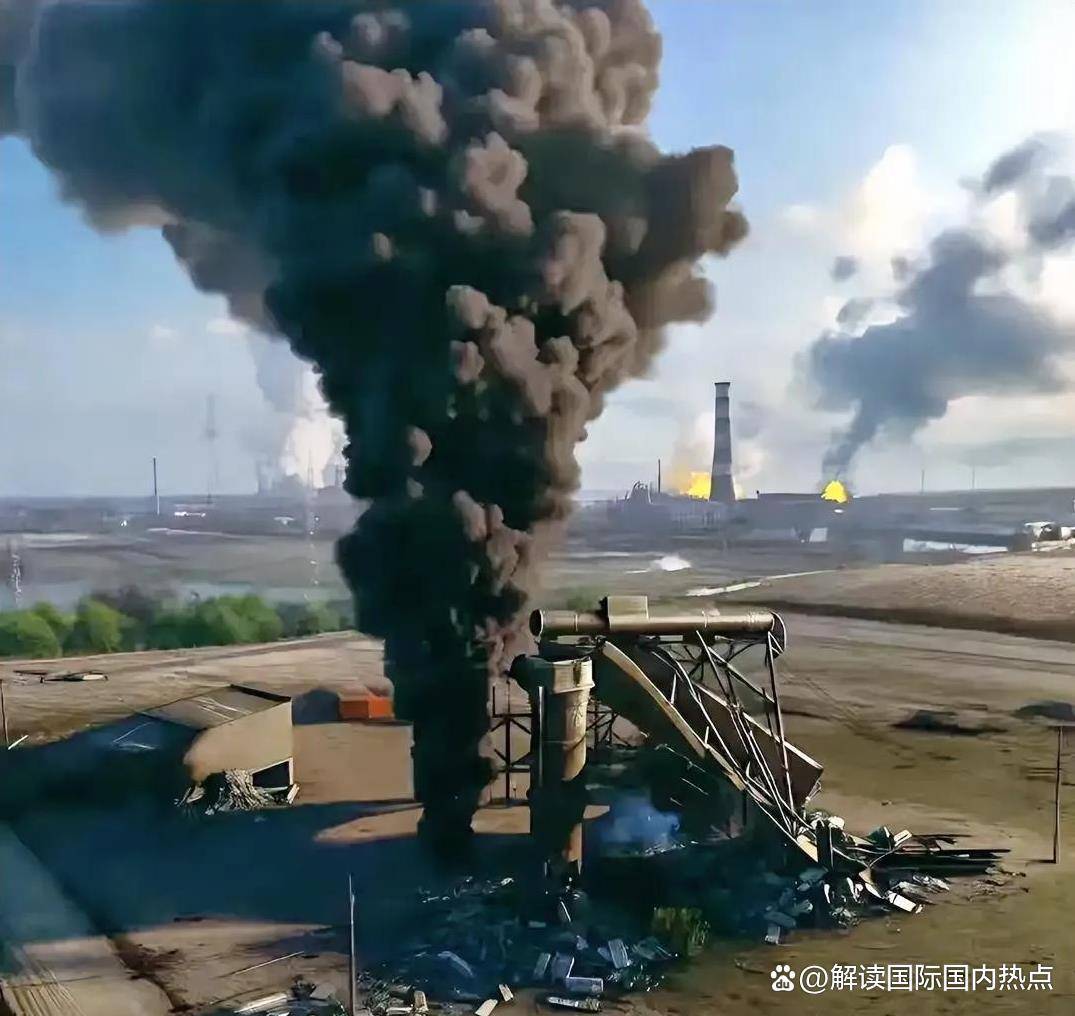
海南封关有个国家急了?绕过马六甲,祭出洋浦港直航大
Sou Hu Cai Jing· 2025-12-20 20:57
Core Viewpoint - Hainan's opening of its customs on December 18 marks a significant milestone in China's economic history, with 86 countries now eligible for visa-free entry and 6,600 tax items subject to "zero tariffs" [1][2]. Group 1: Hainan's Economic Potential - Hainan is positioned as a new economic hub, potentially challenging Singapore's dominance in the region [2][3]. - The island's strategic location and policies aim to attract international trade and tourism, leveraging its vast consumer market of 1.4 billion people [22][40]. - Hainan's development includes establishing 85 international flight routes, creating a "4-hour flight circle" that connects major Asian cities [23]. Group 2: Comparison with Singapore - Singapore's geographical advantage as a key maritime hub has historically allowed it to dominate trade routes, but Hainan's new policies may disrupt this balance [7][19]. - Hainan's tax incentives, such as a corporate tax rate of 15% compared to Singapore's 17%, could attract businesses looking to capitalize on lower operational costs [25][27]. - The "front store, back factory" model in Hainan allows for direct access to the Chinese market, which Singapore lacks due to its reliance on external markets [29][30]. Group 3: Future Opportunities - The opening of Hainan is expected to create new opportunities in cross-border e-commerce, re-export trade, and luxury services, positioning it as a bridge between China and the global market [45][47]. - The enhanced consumer experience in Hainan, such as immediate product pickup from duty-free stores, is likely to stimulate demand for luxury goods and services [36][44]. - Hainan's strategic initiatives may lead to a shift in global economic centers towards the East, particularly favoring China [47].
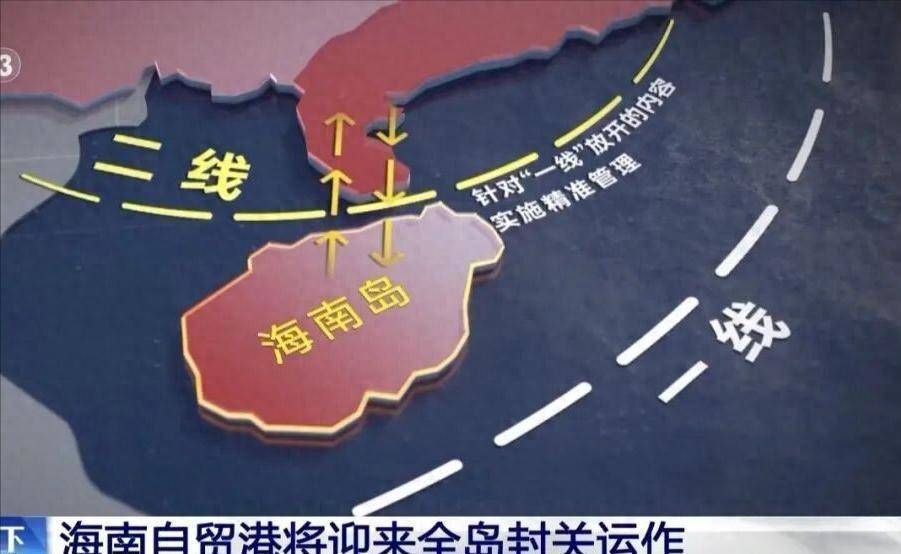
大炼化周报:冬季下游备货需求步入尾声,涤纶长丝小幅累库-20251220
Xinda Securities· 2025-12-20 14:26
Investment Rating - The report does not explicitly state an investment rating for the petrochemical industry, but it provides insights into price trends and market conditions that could influence investment decisions. Core Insights - The report highlights that the downstream stocking demand for winter is nearing its end, with polyester filament experiencing slight inventory accumulation [1]. - Domestic key refining project price spread is reported at 2540.74 CNY/ton, with a week-on-week increase of 7.17 CNY/ton (0.28%), while the international price spread is at 1303.62 CNY/ton, showing a decrease of 27.50 CNY/ton (-2.07%) [2][3]. - Brent crude oil's average price for the week ending December 19, 2025, is noted at 60.08 USD/barrel, reflecting a week-on-week decline of 3.10% [2]. Refining Sector Summary - The report discusses geopolitical factors affecting oil prices, including negotiations between Ukraine and the U.S. and sanctions on Venezuelan oil, which have led to fluctuations in international oil prices [2]. - Domestic refined oil prices have slightly decreased, with improvements in price spreads. The average prices for diesel, gasoline, and aviation kerosene are reported as 6625.29 CNY/ton, 7641.71 CNY/ton, and 5800.48 CNY/ton, respectively [15]. - The report notes that the chemical sector has seen a general decline in chemical prices, with some products experiencing smaller declines relative to cost, leading to improved price spreads [2]. Chemical Sector Summary - In the polyester sector, the report indicates that the price of PX and MEG has slightly decreased, while PTA prices remain stable. The overall price trend in the polyester industry is downward due to weak demand and increased production capacity [2]. - The report mentions that the EVA market is seeing price declines as production resumes from maintenance, with the average price reported at 9778.57 CNY/ton [50]. - The report also highlights that the price of pure benzene remains stable, while styrene prices have decreased due to weak cost support, with the average price reported at 6614.29 CNY/ton [50].


多项自由贸易港核心政策在洋浦落地见效
Hai Nan Ri Bao· 2025-12-19 23:34
Core Insights - The Hainan Free Trade Port has officially commenced its full island closure, with Yangpu Port serving as a key international shipping hub and the first to implement "zero tariff" policies for imported petrochemical raw materials [2][3] - Yangpu is positioned as a model for the Hainan Free Trade Port, showcasing the potential for high-level international openness and economic development [2][3] Policy Implementation - The first batch of "zero tariff" petrochemical raw materials successfully cleared customs, marking a significant advantage for the petrochemical industry in Hainan [3] - Yangpu is developing a comprehensive industrial chain in petrochemicals, including oil products, aromatics, olefins, and new materials, leveraging the advantages of the Free Trade Port policies [3] Economic Development - The Yangpu Economic Development Zone aims to extend industrial chains and encourage enterprises to utilize "zero tariff" imports for deep processing, promoting high-end materials and food processing industries [5] - The first cumulative processing value-added duty-free business was initiated on the same day, demonstrating the collaborative potential between local companies [5][6] Port Efficiency and Innovation - The efficiency of ship registration has significantly improved, with the registration process for vessels now taking only one day [7] - As of the closure date, Yangpu Port has registered 80 vessels with a total tonnage exceeding 4.3 million, maintaining the leading position among domestic free trade zones [7] International Attraction - Siemens Energy became the first foreign enterprise registered in Yangpu after the closure, marking a significant milestone for foreign investment in Hainan [9][10] - The streamlined registration process and supportive services for foreign businesses have enhanced the attractiveness of Hainan as an investment destination [10][11]

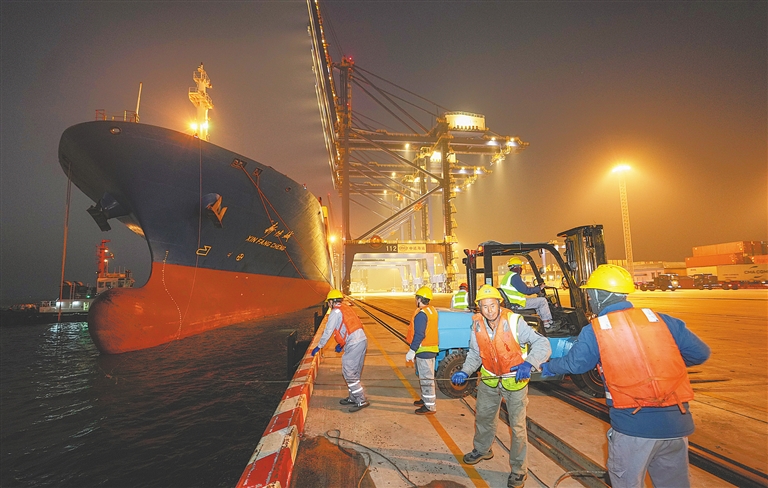
【环球财经】印尼推进B50生物柴油计划 力争2026年停止进口柴油
Xin Lang Cai Jing· 2025-12-19 14:58
Core Viewpoint - Indonesia is advancing a mandatory B50 biodiesel blending program and the development of the Balikpapan refinery project to achieve its goal of eliminating diesel imports by 2026 [1][2]. Group 1: Biodiesel Program - The Indonesian government is implementing a mandatory 50% palm oil-based biodiesel blending plan (B50) [1]. - The B50 program is expected to save approximately 179.28 trillion Indonesian Rupiah (around 107.1 billion USD) in foreign exchange expenditures by 2026 [2]. Group 2: Balikpapan Refinery Project - The Balikpapan refinery upgrade project is one of Indonesia's largest downstream energy investment projects, with key facilities entering trial or preliminary operation phases [1]. - Upon completion, the refinery's crude oil processing capacity will increase from 260,000 barrels per day to 360,000 barrels per day, significantly enhancing domestic fuel supply and reducing reliance on diesel imports [1]. Group 3: Energy Independence - Indonesia has historically depended on imported diesel and refined oil products to meet transportation, power generation, and industrial production needs due to domestic refining capacity limitations [1]. - The biodiesel initiative has saved approximately 673.73 trillion Indonesian Rupiah (around 402.6 billion USD) in foreign exchange from 2020 to 2025, strengthening national energy security and enhancing the value of the palm oil industry while driving job growth [1].

12月山东汽柴油市场震荡下跌 套利空间“汽弱柴强”
Sou Hu Cai Jing· 2025-12-19 05:47
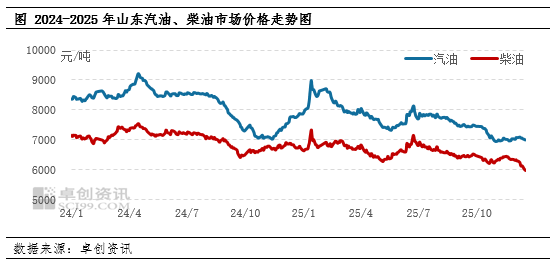
Core Viewpoint - The Shandong gasoline and diesel market experienced a downward trend in December due to increased supply and decreased demand, leading to a bearish outlook for prices [1][2][3]. Supply Analysis - In December, there were no new refinery maintenance activities in Shandong, but the supply of crude oil was ample due to the early allocation of 2026 crude oil quotas, resulting in increased operational loads at independent refineries [2]. - As of December 17, the operational load of Shandong independent refineries was 65.29%, up by 2.48 percentage points from late November, with gasoline daily production at 75,300 tons (up 5.31%) and diesel at 145,800 tons (up 4.97%) [2]. Demand Analysis - Gasoline demand was weak due to a lack of holiday support and adverse weather conditions, with a sales-to-production ratio of 86% (down 2 percentage points from November) [3]. - Diesel demand also weakened, particularly due to cold weather affecting outdoor construction and logistics, with a sales-to-production ratio of 85% (down 5 percentage points from November) [3]. Arbitrage Opportunities - Gasoline arbitrage opportunities were limited, with potential profits of 200-270 yuan/ton for shipments to regions like Guangxi and Guangdong, while Beijing offered around 140 yuan/ton [5]. - Diesel arbitrage opportunities were more favorable, ranging from 150-400 yuan/ton for shipments to various regions, including Guangxi and Beijing [6]. Market Outlook - The international crude oil market is expected to remain weak due to increased supply and reduced demand, with geopolitical factors contributing to a bearish sentiment [8]. - In January, gasoline supply-demand dynamics may show strength due to pre-Spring Festival stocking, while diesel demand is expected to remain weak, leading to a potential price increase for gasoline and a continued decline for diesel [9]. - The arbitrage space for both gasoline and diesel is anticipated to narrow, with primary trading regions remaining concentrated in Shandong and nearby provinces [10].
工艺设备一体化协同助炼化节能降耗——记基于节能降耗的原油蒸馏精准分离关键技术及其应用
Zhong Guo Hua Gong Bao· 2025-12-19 03:24
Core Viewpoint - The development of energy-saving and efficient crude oil distillation technology, specifically the "precise separation of crude oil distillation based on energy conservation," has been recognized as a significant advancement in the refining industry, leading to improved efficiency and reduced energy consumption [1][5]. Group 1: Technological Challenges - The traditional crude oil atmospheric distillation technology is energy-intensive due to high processing volumes and temperatures, with actual flash distillation efficiency being less than 75% [2][3]. - Existing technologies, such as those from Shell and KBC, face common issues of increased energy consumption and reduced quality of wax oil, highlighting the need for innovative solutions [3]. Group 2: Innovative Solutions - A research team has proposed a new mass transfer model and developed several innovative devices, including the NS distillation deep extraction device and high-efficiency composite tower plates, which significantly enhance mass transfer efficiency [4]. - The new technology has improved diesel and wax oil yields by 3% and 4-6%, respectively, while reducing system energy consumption by 20% compared to similar foreign technologies [4]. Group 3: Industrial Application and Impact - The developed technology has been implemented in 43 crude oil distillation systems across major Chinese oil companies, demonstrating significant energy savings and efficiency improvements [6]. - Over the past three years, the application of this technology in three companies has resulted in an additional sales revenue of 3.37 billion yuan and tax contributions of 850 million yuan [7].


2026年燃料油、低硫燃料油期货行情展望:估值已被重塑,静待明确驱动
Guo Tai Jun An Qi Huo· 2025-12-18 12:59
1. Report Industry Investment Rating No relevant content provided. 2. Core Views of the Report - After a year of evolution in the supply - demand pattern, the valuations of fuel oil and low - sulfur fuel oil in the Asia - Pacific region have been completely reshaped and are currently at historical lows, which basically match the current supply - demand situation. In 2026, on the premise of fully reshaped valuations and a return to a tight supply - demand balance, seasonal and sudden events will drive the market [2]. - The sanctions and geopolitical conflicts have led to a gradual decline in Russia's supply. In 2026, Latin America's supply may also change due to refinery startups. The Middle East, as the core region for global high - sulfur component supply, will continue to increase in importance. On the demand side, marine fuel and power generation can still support the valuation of high - sulfur fuel oil, but there is a certain drag from the refining end. For low - sulfur fuel oil, its consumption may have reached the bottom in recent years in 2025, indicating that the drag on the demand side may gradually weaken in 2026. In terms of supply, regions with low elasticity such as Brazil and Indonesia still dominate, and the supply changes in these regions and other regions with high elasticity will cause marginal changes in the market in the short term [2]. 3. Summary by Relevant Catalogs 3.1 Market Review - In Q1 2025, due to sanctions on Russia and drone attacks in Ukraine, there was a shortage of high - sulfur supply in Russia, leading to a continuous decline in heavy oil inventories in Singapore and Fujairah. High - sulfur prices remained strong. Meanwhile, as Q1 is the off - season for marine fuel demand, the market share of high - sulfur fuel oil continued to rise, and low - sulfur fuel oil was relatively weak both at home and abroad, causing the high - low sulfur spread to narrow rapidly to a historical low [6]. - In Q2, the seasonal demand for high - sulfur fuel oil in power generation and marine fuel was gradually realized, and the geopolitical conflict in the Middle East further strengthened the strength of the high - sulfur market. High - sulfur prices and cracking reached their annual highs. However, later, the strength comparison between high - and low - sulfur fuel oil began to change. With the easing of geopolitical conflicts and the full pricing of Russia's supply shortage, the factors supporting the high valuation of high - sulfur fuel oil gradually disappeared. On the low - sulfur side, the centralized maintenance of some major production areas and the adjustment of the yield of gasoline, diesel, and low - sulfur fuel oil by domestic refineries jointly promoted the strengthening of low - sulfur fuel oil at home and abroad. From the end of Q2, the high - low sulfur spread stopped narrowing and rebounded in Q3 [6]. - At the end of the year, the continuous decline in crude oil prices drove down the price center of the entire fuel oil market. The high export volume of fuel oil from the Middle East and the intermittent supply shortage of low - sulfur fuel oil led to a more obvious decline in high - sulfur fuel oil in the Singapore market, and the high - low sulfur spread remained at the annual high [6]. 3.2 Global Refining Industry Review and Outlook 3.2.1 Global Refined Oil Demand - The demand for global refined oil shows a trend of "new replacing old". Traditional consumption areas such as China and the United States are losing their driving force for global demand growth, while emerging consumption areas such as India and Southeast Asia are becoming new growth drivers. The structural contradictions between different regions or different oil products may be more obvious than the total contradictions and are more likely to break the balance [9][10]. - Seasonal consumption is still an important anchor for demand changes, but it is increasingly affected by sudden events. In 2026, the impact of various sudden events on seasonality needs to be closely monitored [11]. 3.2.2 Global Refining Capacity Changes and Outlook - In H1 2025, due to sanctions, trade wars, and geopolitical conflicts, the refining capacity in some regions declined. However, the rise in the prices of refined oil products gradually repaired refinery profits, and the operating rate rebounded from the bottom. In Q3, the traditional refining maintenance season led to an increase in supply shortages and an upward movement in production profits [32]. - In 2026, traditional refining countries and regions need stable refining profits to maintain a stable operating rate. Russia's production decline is mainly due to sanctions and geopolitical conflicts. The Middle East and India will play an important role in ensuring the stable production of global refined oil, but they also face some challenges such as geopolitical conflicts and sanctions [35][36]. - The rapid increase in refining capacity utilization in H2 2025 may lead to short - term supply surpluses in 2026, causing prices and spreads to fall rapidly from high levels [37]. 3.2.3 Summary - The demand for global refined oil is in a situation of "new replacing old", and seasonality is still the core factor determining demand realization. However, the impact of sudden events on demand needs to be noted. On the supply side, the global refining industry needs to maintain stability in multiple dimensions to ensure a certain capacity utilization rate. The situation at the end of 2025 may reverse in 2026, and uncertainty is the most prominent feature of the current global refined oil market [60]. 3.3 High - Sulfur Fuel Oil 3.3.1 Supply - The supply of high - sulfur fuel oil is characterized by "low elasticity and high concentration". Russia's supply is affected by drone attacks and sanctions, and there may be a reduction in exports of 200 - 300 million tons in 2026. The new Dos Bocas refinery in Mexico may reduce the export of heavy components, and Venezuela's supply is also restricted by sanctions [61][62][64]. - The Middle East will play a decisive role in the global high - sulfur fuel oil market. Its supply is relatively stable, and its export direction can be judged by trade arbitrage economics. In 2026, the recovery of Russia's exports will be a marginal variable for the Asia - Pacific market, and attention should be paid to the possible westward flow of Middle East supplies [65][66]. 3.3.2 Demand - The market share of high - sulfur fuel oil in the marine fuel market continues to increase due to the growth of desulfurization tower installations and the postponement of the IMO's net - zero framework. In the power generation field, high - sulfur fuel oil has an advantage in calorific value cost, but its demand is affected by natural gas supply and climate [71]. - The refining demand for high - sulfur fuel oil in China and India has declined in recent years. In 2026 Q1, the refining demand in these two countries may continue to be weak due to factors such as weakened refining profits and sanctions on Russian fuel oil [74]. 3.4 Low - Sulfur Fuel Oil 3.4.1 Supply - The supply of low - sulfur fuel oil in the Asia - Pacific region has a diversified pattern with an increasing concentration. Regions with low elasticity such as Brazil, Indonesia, and Kuwait dominate, and their supply changes will have a significant impact on the market. In addition, regions with high elasticity such as the Dangote refinery in Nigeria and European arbitrage goods also need attention [95][96][98]. - In China, the production of low - sulfur fuel oil is affected by the profit difference between low - sulfur fuel oil and refined oil. In 2026, if the cracking of refined oil at home and abroad does not significantly shrink or the cracking of low - sulfur fuel oil does not significantly strengthen, the domestic production of low - sulfur fuel oil may remain at a monthly average of about 1 million tons [99][101]. 3.4.2 Demand - The demand for low - sulfur fuel oil has been under pressure in the past, but there are some marginal changes. In the marine fuel field, the squeezing effect of high - sulfur fuel oil on low - sulfur fuel oil may have reached its limit. In the power generation field, low - sulfur fuel oil still has a certain rigid demand. The refining demand for low - sulfur fuel oil is mainly affected by refining profits [117][118][123]. 3.5 Conclusion and Investment Outlook 3.5.1 Supply - Demand Balance - In 2026, the change in the supply - demand balance of fuel oil may still come from the supply side. For high - sulfur fuel oil, attention should be paid to whether the supply decline in Russia and Latin America can be filled by the Middle East. For low - sulfur fuel oil, attention should be paid to the production and export volume of regions with large shares and low production elasticity, as well as the supply changes in regions with high elasticity [136]. 3.5.2 Investment Outlook - In 2026, the cracking and spread of fuel oil may continue to decline in Q1 due to the traditional off - season and high inventories. However, the Contango structure of the fuel oil market may provide better upward momentum for the near - month contracts in Q2, especially for high - sulfur fuel oil [137][138]. - The 20 - 100 US dollars/ton range of the high - low sulfur spread in 2025 can be used as a reference for trading in 2026. If overseas refineries resume production and China's refined oil production decreases in Q1, the high - low sulfur spread may decline [139].