钾肥

Search documents
农化行业:2025年9月月度观察:钾肥库存维持低位,磷酸铁开工率提升,草甘膦持续涨价-20251015
Guoxin Securities· 2025-10-15 15:36
Investment Rating - The report maintains an "Outperform" rating for the agricultural chemical industry [6][9]. Core Views - The potassium fertilizer supply and demand remain tight, with international prices staying high. China's potassium chloride production is expected to decrease by 2.7% in 2024, while imports are projected to reach a historical high of 12.633 million tons, a year-on-year increase of 9.1% [1][24]. - The phosphoric chemical industry is expected to maintain a high price level due to the scarcity of resources and increasing demand from new applications such as lithium iron phosphate [2][5]. - The pesticide sector is anticipated to see a recovery in demand, driven by increased agricultural planting areas in South America and a rebound in inventory replenishment [4][8]. Summary by Sections Potassium Fertilizer - The domestic potassium chloride port inventory as of September 2025 is 1.7292 million tons, a decrease of 135.6 thousand tons year-on-year, representing a decline of 43.95% [1][26]. - The average market price for potassium chloride in China at the end of September is 3,237 yuan/ton, a month-on-month decrease of 1.43% but a year-on-year increase of 34.82% [1][41]. - Key recommendation includes focusing on "Yaji International," with expected potassium chloride production of 2.8 million tons in 2025 and 4 million tons in 2026 [4][48]. Phosphoric Chemicals - The domestic supply-demand balance for phosphate rock is tight, with the market price for 30% grade phosphate rock in Hubei at 1,040 yuan/ton and in Yunnan at 970 yuan/ton, both stable month-on-month [2][50]. - The report highlights the long-term price stability of phosphate rock due to declining grades and increasing extraction costs, with a market price of 900 yuan/ton maintained for over two years [2][5]. - Recommended companies include "Yuntianhua" and "Xingfa Group," which have rich phosphate reserves [5]. Pesticides - The pesticide sector is expected to recover as the "Zhengfeng Zhijuan" three-year action plan is initiated, with a significant increase in demand due to rising agricultural planting areas in South America [4][8]. - The price of glyphosate has been on the rise, reaching 27,700 yuan/ton by October 14, an increase of 4,500 yuan/ton since April, representing a 19.40% rise [4][8]. - Key recommendations include "Yangnong Chemical" and "Lier Chemical," which are positioned to benefit from the recovery in pesticide prices [8].


申万宏源:25Q3淡季叠加成本走高 周期品价差回落 化工盈利季节性承压
智通财经网· 2025-10-15 07:29
Core Insights - The report from Shenwan Hongyuan indicates that in Q3 2025, traditional seasonal downturns in downstream sectors led to a high retreat in chemical prices, while energy prices showed a month-on-month increase, with strong demand in sub-sectors like agrochemicals supporting performance [1] Industry Overview - In Q3 2025, the average weighted EPS for tracked mainstream chemical companies is expected to be 0.25 yuan, reflecting a year-on-year increase of 24.93% but a slight quarter-on-quarter decline [2] - Key sub-sectors with significant year-on-year net profit growth include pesticides, phosphate chemicals, potash fertilizers, fluorochemicals, civil explosives, semiconductor materials, display materials, catalytic materials, and modified plastics [2] - The agrochemical sector, particularly pesticides and phosphate fertilizers, is expected to perform well due to strong demand and the issuance of export quotas for phosphate and nitrogen fertilizers [2] Company Performance Forecasts - Wanhua Chemical is projected to achieve a net profit of 3 billion yuan in Q3 2025, showing a year-on-year increase of 3% but a quarter-on-quarter decrease of 1% [2] - Hualu Hengsheng's net profit is expected to be 800 million yuan, reflecting a year-on-year decrease of 3% and a quarter-on-quarter decrease of 7% [2] - Baofeng Energy's Inner Mongolia project is anticipated to yield a net profit of 3.2 billion yuan, marking a year-on-year increase of 160% but a quarter-on-quarter decrease of 2% [2] Sector-Specific Insights - The fluorochemical sector is expected to see strong support from supply-side factors, with companies like Juhua Co. projected to achieve a net profit of 1.25 billion yuan in Q3 2025, a year-on-year increase of 196% [4] - The tire sector is gradually recovering from tariff impacts, with Sailun Tire expected to report a net profit of 1.05 billion yuan, reflecting a year-on-year decrease of 4% but a quarter-on-quarter increase of 33% [5] - In the agricultural sector, potash fertilizer companies like Salt Lake Industry are projected to achieve a net profit of 2 billion yuan, a year-on-year increase of 115% [6] New Materials and Semiconductor Sector - The domestic semiconductor industry is steadily advancing in localization, with companies like Yake Technology expected to report a net profit of 275 million yuan, a year-on-year increase of 20% [8] - New energy materials are forecasted to show mixed results, with companies like Xinzhou Bang expected to achieve a net profit of 240 million yuan, a year-on-year decrease of 16% [8] Food and Feed Additives - Companies in the food and feed additives sector are expected to experience varied performance, with Jinhe Industrial projected to report a net profit of 60 million yuan, a year-on-year decrease of 63% [9]

东方铁塔归母净利润预增最高93%
Zhong Guo Hua Gong Bao· 2025-10-15 03:12
Core Viewpoint - Dongfang Tower expects a significant increase in net profit for the first three quarters of 2025, driven by stable potash fertilizer production and rising prices [1] Company Summary - Dongfang Tower forecasts a net profit attributable to shareholders between 750 million to 900 million yuan, representing a year-on-year growth of 60.83% to 93% compared to 466 million yuan in the same period last year [1] - The company's net profit after deducting non-recurring items is projected to be between 730 million to 880 million yuan, with a year-on-year increase of 58.60% to 91.19% [1] Industry Summary - The global potash fertilizer market is expected to recover in 2025, with potash prices driven up by various factors, including a significant increase in the contract price in China, which is set at 346 USD per ton, a 27% rise from the previous year [1] - The price increase is attributed to profound changes in the global supply-demand landscape, with major producers like Uralkali and Belaruskali reducing output due to maintenance plans, leading to an expected annual capacity reduction of over 1.6 million tons [1] - Global potash consumption is anticipated to rise to 74.3 million tons, with Asia and South America accounting for over 60% of the demand [1]

亚钾国际跌2.06%,成交额2.12亿元,主力资金净流出1418.15万元
Xin Lang Zheng Quan· 2025-10-15 02:50
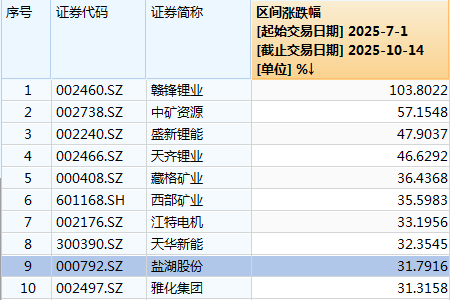
Core Viewpoint - Yara International's stock price has shown significant growth this year, with a year-to-date increase of 100.64%, indicating strong market performance and investor interest [1][2]. Company Overview - Yara International, established on October 27, 1998, and listed on December 24, 1998, is based in Guangzhou, China. The company specializes in grain trading, international shipping and logistics, and the mining, production, and sales of potassium salts [1]. - The main revenue sources for Yara International are potassium chloride (97.54%), brine (1.24%), and other products (1.22%) [1]. Financial Performance - For the period from January to June 2025, Yara International reported a revenue of 2.522 billion yuan, representing a year-on-year growth of 48.54%. The net profit attributable to shareholders was 855 million yuan, showing a remarkable increase of 216.64% [2]. - As of June 30, 2025, the company had a total of 26,500 shareholders, an increase of 8.88% from the previous period. The average circulating shares per shareholder decreased by 8.15% to 30,593 shares [2]. Shareholder and Dividend Information - Since its A-share listing, Yara International has distributed a total of 85.8774 million yuan in dividends, with no dividends paid in the last three years [3]. - As of June 30, 2025, the top ten circulating shareholders included Hong Kong Central Clearing Limited as the fifth-largest shareholder with 13.8236 million shares, and new entrants such as Southern CSI 500 ETF and Southern Xingrun Value One-Year Holding Mixed A [3].
【光大研究每日速递】20251015
光大证券研究· 2025-10-15 00:41
Group 1: Macroeconomic Insights - In September 2025, China's exports grew by 8.3% year-on-year, driven by strong demand from non-US economies, capacity relocation, and a low base effect from the previous year [4] - The export growth is expected to continue, supported by non-US economies and potential "export rush" due to high uncertainty in China-US trade relations [4] - The high export growth rate in October 2024 may exert pressure on year-on-year comparisons in the coming months [4] Group 2: Industry Performance - In September 2025, the capacity utilization rate of electrolytic aluminum reached a historical high, indicating a robust performance in the metal cycle sector [5] - The steel sector is anticipated to recover to historical average profit levels due to government policies aimed at phasing out outdated capacity [5] Group 3: Company-Specific Developments - China Jinmao (0817.HK) reported a signed sales amount of 9.8 billion yuan in September 2025, with a total of 80.69 billion yuan for the first nine months of 2025 [7] - Salt Lake Co. (000792.SZ) expects a net profit of 4.3 to 4.7 billion yuan for the first three quarters of 2025, representing a year-on-year growth of 36.9% to 49.6% [8] - Honglu Steel Structure (002541.SZ) signed new orders worth 22.267 billion yuan in the first three quarters of 2025, with a 1.6% year-on-year increase [9] - Zhongchong Co. (002891.SZ) achieved a revenue of 1.43 billion yuan in Q3 2025, reflecting a year-on-year growth of 15.9%, although net profit decreased by 6.6% due to reduced investment income [9]

三季度净利预计翻倍,盐湖股份全年盈利有望突破60亿
2 1 Shi Ji Jing Ji Bao Dao· 2025-10-14 10:41
Core Viewpoint - After hitting a low in profit growth in the first quarter, Salt Lake Co., Ltd. (000792.SZ) has begun to release its performance on a quarterly basis, with significant profit increases expected in the upcoming quarters [1][3]. Financial Performance - The company forecasts a net profit attributable to shareholders of between 4.3 billion to 4.8 billion yuan for the first three quarters, with the third quarter expected to yield 1.8 billion to 2.2 billion yuan, representing a year-on-year increase of 93.77% to 136.83% [3][4]. - Quarterly net profits for the first three quarters are reported as 1.145 billion yuan, 1.375 billion yuan, and an estimated 1.8 billion to 2.2 billion yuan [8]. Market Dynamics - The price of potassium fertilizer, the company's main product, has been rising due to supply constraints from Russia and Belarus, coupled with seasonal demand increases in major agricultural regions [7]. - The ex-factory price of potassium chloride (60% powder) in Qinghai is reported to have risen from 2,550 yuan/ton at the end of 2024 to 3,200 yuan/ton in mid-July, stabilizing around 3,100 yuan/ton since then [7]. Sales and Production Capacity - The company has a current production capacity of 5 million tons of potassium chloride per year, with sales in the first three quarters totaling 2.86 million tons, indicating potential for increased sales in the fourth quarter [11]. - Forecasts suggest that fourth-quarter potassium chloride sales could range from 1.64 million to 2.14 million tons, a significant increase from 1.08 million tons in the third quarter [11]. Lithium Production - The company recently launched a new integrated lithium salt project with a capacity of 40,000 tons per year, which is expected to produce 3,000 tons of lithium carbonate this year [12][13]. - The new lithium capacity is fully owned by the company, allowing it to retain all profits generated from this production [13]. Future Outlook - The overall profit growth trend is expected to continue into the fourth quarter, supported by favorable potassium prices and potential increases in sales volume [9][10]. - The lithium market is anticipated to recover, with historical price fluctuations indicating significant potential for profit increases in the future [14].

盐湖股份(000792):氯化钾价升业绩超预期,4万吨/年锂盐一体化项目投料试车:——盐湖股份(000792.SZ)2025年前三季度业绩预告点评
EBSCN· 2025-10-14 06:35
Investment Rating - The report maintains a "Buy" rating for the company [5] Core Views - The company is expected to achieve a net profit attributable to shareholders of 4.3 to 4.7 billion yuan for the first three quarters of 2025, representing a year-on-year growth of 36.9% to 49.6% [1] - The significant increase in potassium chloride prices due to global supply constraints has positively impacted the company's performance, leading to an expected net profit of 1.8 to 2.2 billion yuan for Q3 2025, a year-on-year increase of 93.8% to 136.8% [2] - The company has successfully entered the trial production phase of its 40,000 tons/year lithium salt integration project, which is expected to enhance its lithium salt supply capacity [3] Summary by Sections Financial Performance - For Q3 2025, the company reported a potassium chloride production of 1.276 million tons, a 2.5% increase year-on-year, and sales of 1.083 million tons, a 16.6% increase year-on-year [2] - The average selling price of potassium chloride in Q3 2025 increased by 23.9% year-on-year and 7.5% quarter-on-quarter [2] - The company’s lithium carbonate production in Q3 2025 was 11,600 tons, a decrease of 2.8% year-on-year, while sales increased by 35.4% year-on-year [2] Profit Forecast and Valuation - The report projects the company's net profit attributable to shareholders for 2025 to be 6.149 billion yuan, with subsequent years expected to be 6.648 billion yuan in 2026 and 7.337 billion yuan in 2027 [4] - The report adjusts the profit forecast upwards due to the anticipated sustained high prices of potassium chloride [3] Key Financial Metrics - The company’s revenue for 2025 is estimated at 16.238 billion yuan, with a growth rate of 7.29% [4] - The projected EPS for 2025 is 1.16 yuan, with a P/E ratio of 19 [4][10]
反攻号角吹响!化工ETF(516020)上探1.68%,资金连续埋伏!
Xin Lang Ji Jin· 2025-10-14 02:22
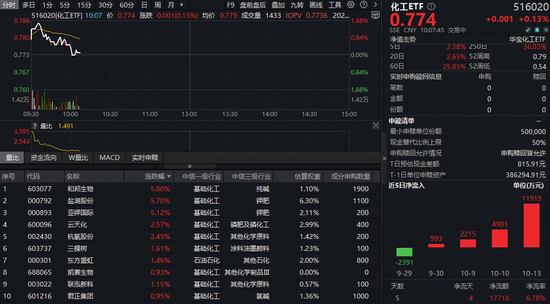
Group 1 - The chemical sector showed a strong rebound on October 14, with the Chemical ETF (516020) initially rising by 1.68% before settling at a 0.13% increase at the time of reporting [1] - Key stocks in the sector, including pure soda, potash, phosphate fertilizers, and phosphate chemicals, saw significant gains, with companies like Hebang Bio and Yilong Co. rising over 5% [1] - The Chemical ETF (516020) attracted substantial investment, with a net inflow of 119 million yuan on the previous day and a total net subscription exceeding 200 million yuan over four consecutive trading days [1][3] Group 2 - Tianfeng Securities highlighted stable demand in the basic chemical industry, with a focus on sub-industries such as sucralose, pesticides, MDI, and amino acids, while also noting the impact of domestic demand on mitigating tariff shocks [3] - Despite a 5.5% year-on-year decline in profits for the chemical raw materials and products manufacturing industry from January to August, certain products like hydrogen peroxide and hydrofluoric acid experienced price increases [3] - The Chemical ETF (516020) is currently at a relatively low price-to-book ratio of 2.36, indicating a favorable long-term investment opportunity [3] Group 3 - Dongfang Securities indicated a positive long-term outlook for the petrochemical industry, suggesting that recent policy adjustments could lead to a new phase of high-quality development [4] - Zhongyuan Securities recommended focusing on sectors benefiting from supply-side improvements, such as pesticides and organic silicon, while also considering potassium and phosphate fertilizers in the context of potential interest rate cuts by the Federal Reserve [4] - The Chemical ETF (516020) provides an efficient way to invest in the chemical sector, with nearly 50% of its holdings in large-cap leading stocks [4][5]


能否抄底?化工ETF(516020)跌超3%,近3日吸金超8000万元!机构:行业整体格局向好
Xin Lang Ji Jin· 2025-10-13 05:24
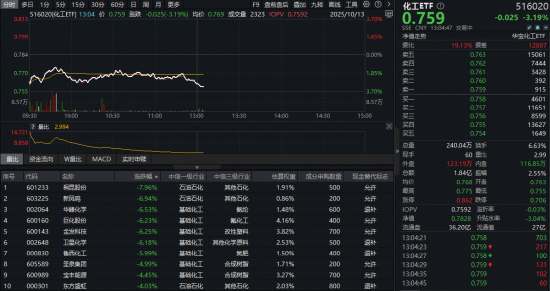
Group 1 - The chemical sector experienced a significant pullback on October 13, with the chemical ETF (516020) declining by 3.19% [1][2] - Key stocks in the sector, including Tongkun Co., Ltd., fell over 7%, while several others like Xin Fengming and Huafeng Chemical dropped more than 6%, negatively impacting the overall sector performance [1][2] - The chemical ETF has seen a capital inflow of over 80 million yuan in the last three trading days, indicating renewed interest from investors [1][2] Group 2 - The chemical industry is currently at a historical low in terms of profitability and valuation, with a profit margin of 4.14% for the chemical raw materials and products sector as of August 2025 [3] - The price-to-book ratio for the chemical ETF (516020) is at 2.4 times, which is in the 41.57 percentile of the last decade, suggesting a favorable long-term investment opportunity [3] - The construction of new projects in the basic chemical sector has seen a decline for three consecutive quarters, confirming a supply turning point and indicating a potential improvement in the industry landscape [4] Group 3 - Investment strategies suggest focusing on sectors with significant profit elasticity, such as pesticides, organic silicon, and polyester filament, which are expected to benefit from supply-side improvements [4] - The chemical ETF (516020) tracks the CSI segmented chemical industry index, covering various sub-sectors and concentrating nearly 50% of its holdings in large-cap stocks like Wanhua Chemical and Salt Lake Industry [4] - Investors can also consider the chemical ETF linked funds (A class 012537/C class 012538) for exposure to the chemical sector [4]



藏格矿业子公司藏格钾肥取得采矿许可证;赣锋锂业称拥有固态电池一体化布局
Mei Ri Jing Ji Xin Wen· 2025-10-10 14:47
Group 1: Cangge Mining (藏格矿业) - Cangge Mining's subsidiary, Golmud Cangge Potash Fertilizer Co., Ltd., has obtained the property rights certificate and mining license for the Chaka Salt Lake potash and magnesium mine, covering an area of 724.3493 square kilometers [1] - The mining rights will support long-term potash development, stabilize potassium chloride supply, and contribute to national food security while clarifying the legal basis for lithium resource development [1] - This acquisition enhances the company's core competitiveness by maximizing resource value through the comprehensive utilization of co-mined minerals such as lithium and boron [1] Group 2: Ganfeng Lithium (赣锋锂业) - Ganfeng Lithium has reported a significant stock price fluctuation, with a cumulative increase of over 20% in three consecutive trading days, indicating abnormal trading activity [2] - The company claims to have a complete integrated layout for solid-state batteries and commercial capabilities, with developments in key areas such as sulfide electrolytes and lithium metal anodes [2] - Ganfeng Lithium has launched high-energy density batteries suitable for low-altitude economy applications, achieving energy densities between 320Wh/kg and 550Wh/kg, and has established partnerships with well-known drone and eVTOL companies [2] Group 3: Guiguan Electric Power (桂冠电力) - Guiguan Electric Power reported a total power generation of 31.848 billion kWh in the first three quarters of 2025, representing a year-on-year increase of 14.89% [3] - The growth in power generation is primarily driven by an increase in hydropower generation, which rose by 21.93%, and a significant expansion in renewable energy capacity [3] - The company is well-positioned in the new power system construction due to its hydropower resource advantages and renewable energy layout, although it must remain vigilant regarding water flow fluctuations and changes in renewable energy consumption policies [3]