电子

Search documents
金融工程日报:沪指12连阳重返4000点,刷新近33年以来连阳记录-20260105
Guoxin Securities· 2026-01-05 14:07
- No quantitative models or factors were mentioned in the provided content
银河证券北交所日报-20260105
Yin He Zheng Quan· 2026-01-05 14:01
Core Insights - The North Exchange 50 index increased by 1.80% to close at 1,466.42 points on January 5, 2026, with a trading volume of 211.38 billion yuan and a turnover rate of 3.16% [1][2][5] - The overall valuation of the North Exchange is at 46.72 times earnings, which is higher than the valuations of the ChiNext and Sci-Tech Innovation Board [1][8][9] - The most significant sector gains were seen in the oil and petrochemical (+6.0%), pharmaceutical and biological (+4.5%), home appliances (+4.3%), and communications (+3.7%) sectors [1][2] Trading Performance - On January 5, 2026, the North Exchange had a total market capitalization of 884.47 billion yuan, with 396.77 billion shares listed, of which 253.27 billion were tradable [1] - The trading activity showed a recovery compared to the previous week, with an average daily trading volume of 194.04 billion yuan [1] Sector Analysis - The highest average price-to-earnings (P/E) ratios among sectors on the North Exchange were in non-ferrous metals (108.9), home appliances (82.5), and communications (80.1) [1][8] - The majority of industries on the North Exchange experienced gains, with notable declines in the automotive (-0.9%) and transportation (-0.3%) sectors [1][2] Stock Performance - Among the top gainers, Beiyikang (29.98%), Kaide Quartz (22.36%), and Jinhao Medical (20.03%) led the market [1][6] - Conversely, Tianming Technology (-15.03%), Jiaxian Co. (-10.33%), and Lifang Holdings (-8.46%) were the largest decliners [1][7] Valuation Trends - The North Exchange's overall valuation has shown an increase, with the P/E ratio at 46.72 times, indicating a higher valuation compared to the ChiNext (44.40 times) [1][9] - The valuation trends indicate a consistent premium of the North Exchange over the ChiNext, reflecting investor confidence in the listed companies [1][9]
“好邻居金不换!”李在明携韩商业天团访华,呼吁制造业创新合作
2 1 Shi Ji Jing Ji Bao Dao· 2026-01-05 13:48
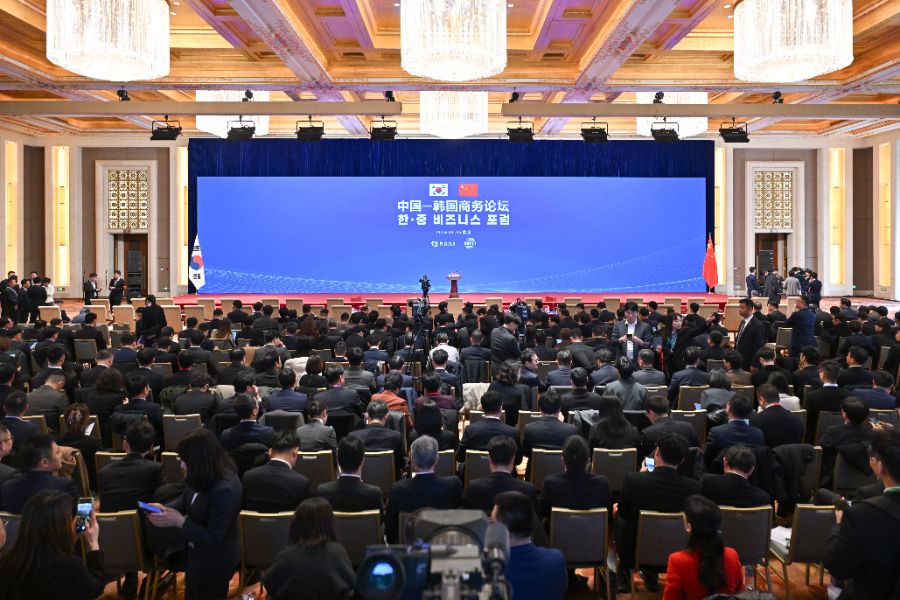
Group 1: Economic Cooperation - The bilateral trade volume between China and South Korea has increased from $6.5 billion at the time of diplomatic relations in 1992 to $272.9 billion in 2024, with China being South Korea's largest trading partner [2] - The forum highlighted three main topics for discussion: manufacturing innovation, supply chain cooperation, and consumer goods market [3] - The two countries aim to deepen cooperation in emerging fields such as artificial intelligence, biopharmaceuticals, green industries, and the silver economy, as part of the ongoing negotiations for the second phase of the China-South Korea Free Trade Agreement [5] Group 2: Cultural and Service Industry Collaboration - There is a growing interest in cultural exchanges, with popular travel experiences like "Seoul Cultural Tours" and "K-Beauty Experiences" among Chinese youth, and "Shanghai Weekend Trips" favored by South Korean youth [6] - The collaboration in content industries, gaming, performances, and cultural platforms is expected to strengthen ties between manufacturing, consumer investment, and new market exploration [6] - Despite rising competition in certain industries, representatives believe that the strategic and mutual benefits of cooperation between the two countries remain unchanged [6] Group 3: Government Support and Future Outlook - The South Korean government is committed to enhancing cooperation with China to provide a favorable environment for businesses and expand cooperation channels [2][6] - The visit of President Yoon signifies a significant diplomatic achievement, aiming to restore comprehensive relations and plan for the future of bilateral ties over the next 30 years [3][4] - The emphasis on mutual respect and understanding in government communications is seen as crucial for the ongoing development of China-South Korea relations [4][5]

金融工程定期:港股量化:2025全年组合收益50%,1月组合增配有色
KAIYUAN SECURITIES· 2026-01-05 13:12
Quantitative Models and Construction Methods Model Name: Hong Kong Stock Connect CCASS Preferred 20 Portfolio - **Model Construction Idea**: The model uses Hong Kong Stock Exchange CCASS data to track and replicate the monthly holdings of individual brokers, selecting high-performing brokers and their top holdings to construct a portfolio[4][34] - **Model Construction Process**: 1. **Broker Selection**: At the end of each month, all brokers are ranked based on their standardized excess Sharpe ratio and monthly win rate, and the top N brokers are selected to form a pool of high-performing brokers[34] 2. **Stock Selection**: Funds are equally allocated to the N brokers, and their latest holdings are aggregated. The top M stocks by weight are retained and equally weighted to form the portfolio[34] 3. **Parameters**: N = 10 (number of brokers), M = 20 (number of stocks)[34] - **Model Evaluation**: The model has shown strong performance with high excess returns and Sharpe ratios, indicating its effectiveness in selecting high-performing stocks[34][36] Model Backtesting Results Hong Kong Stock Connect CCASS Preferred 20 Portfolio - **December 2025 Performance**: Portfolio return of 0.91%, Hang Seng Index return of -0.88%, excess return of 1.79%[36] - **Annual Performance 2025**: Portfolio return of 49.9%, annualized excess return of 17.8%[36] - **Full Period Performance (2020.1~2025.12)**: Annualized excess return of 20.0%, excess Sharpe ratio of 2.52[36] Quantitative Factors and Construction Methods Factor Name: Excess Sharpe Ratio and Monthly Win Rate - **Factor Construction Idea**: These factors are used to evaluate and rank brokers based on their risk-adjusted returns and consistency in generating positive returns[34] - **Factor Construction Process**: 1. **Excess Sharpe Ratio**: Calculated as the ratio of excess return to excess volatility for each broker[34] 2. **Monthly Win Rate**: The proportion of months in which the broker's portfolio outperforms the benchmark[34] 3. **Standardization**: Both factors are standardized and equally weighted to form a composite score for ranking brokers[34] - **Factor Evaluation**: These factors effectively identify brokers with superior risk-adjusted performance and consistency, contributing to the overall success of the portfolio[34] Factor Backtesting Results Excess Sharpe Ratio and Monthly Win Rate - **Top Brokers Performance**: - **Phillip Securities (Hong Kong)**: Annualized excess return of 10.4%, excess Sharpe ratio of 1.73, monthly win rate of 73.61%[35] - **GF Securities**: Annualized excess return of 12.9%, excess Sharpe ratio of 1.29, monthly win rate of 79.17%[35] - **Grand Partners Securities**: Annualized excess return of 18.1%, excess Sharpe ratio of 1.65, monthly win rate of 73.61%[35] Portfolio Holdings for January 2026 - **Top Holdings**: - **Tencent Holdings (0700.HK)**: PEttm 22.9, ROEttm 4.7%, Market Cap 54630.2 billion HKD[40] - **Xiaomi Corporation (1810.HK)**: PEttm 21.2, ROEttm 5.1%, Market Cap 10236.6 billion HKD[40] - **SMIC (0981.HK)**: PEttm 118.5, ROEttm 0.9%, Market Cap 7006.8 billion HKD[40] - **Hong Kong Exchanges and Clearing (0388.HK)**: PEttm 30.0, ROEttm 7.7%, Market Cap 5167.7 billion HKD[40] - **Ping An Insurance (2318.HK)**: PEttm 7.7, ROEttm 2.9%, Market Cap 12924.9 billion HKD[40]
2025年公募调研7.63万次 电子行业获1.4万次关注
Zheng Quan Ri Bao Wang· 2026-01-05 13:04
Group 1 - In 2025, public funds conducted a total of 76,300 research visits to A-share listed companies, covering over 2,430 companies, indicating a proactive approach by institutional investors to uncover value and make forward-looking investments [1] - A total of 165 public institutions participated in the research of listed companies across all 31 Shenwan primary industries, with a significant concentration on leading stocks [2] - The top individual stock receiving attention was Huichuan Technology, with 497 research visits, followed by Luxshare Precision with 422 visits, highlighting the ongoing appeal of high-end manufacturing [2] Group 2 - The electronics industry was the most favored by public institutions, receiving over 14,000 research visits and covering 286 stocks, driven by trends in AI hardware upgrades and consumer electronics innovation [3] - The pharmaceutical and mechanical equipment industries followed, with over 9,900 and 9,400 research visits respectively, indicating a strong interest in these sectors [3] - A total of 88 public institutions conducted at least 400 research visits, with 14 leading institutions exceeding 1,000 visits, showcasing broad participation in market research [4] Group 3 - The active research engagement of institutions reflects their investment research strength, with Bosera Fund leading with approximately 1,800 visits, focusing on electronics, mechanical equipment, and pharmaceuticals [4] - The commercial aerospace sector is expected to enter a large-scale networking and application phase starting in 2026, driven by improved policy frameworks and technological maturity [4]


最高预增超360%!44家A股公司披露2025年度业绩预告
2 1 Shi Ji Jing Ji Bao Dao· 2026-01-05 13:00
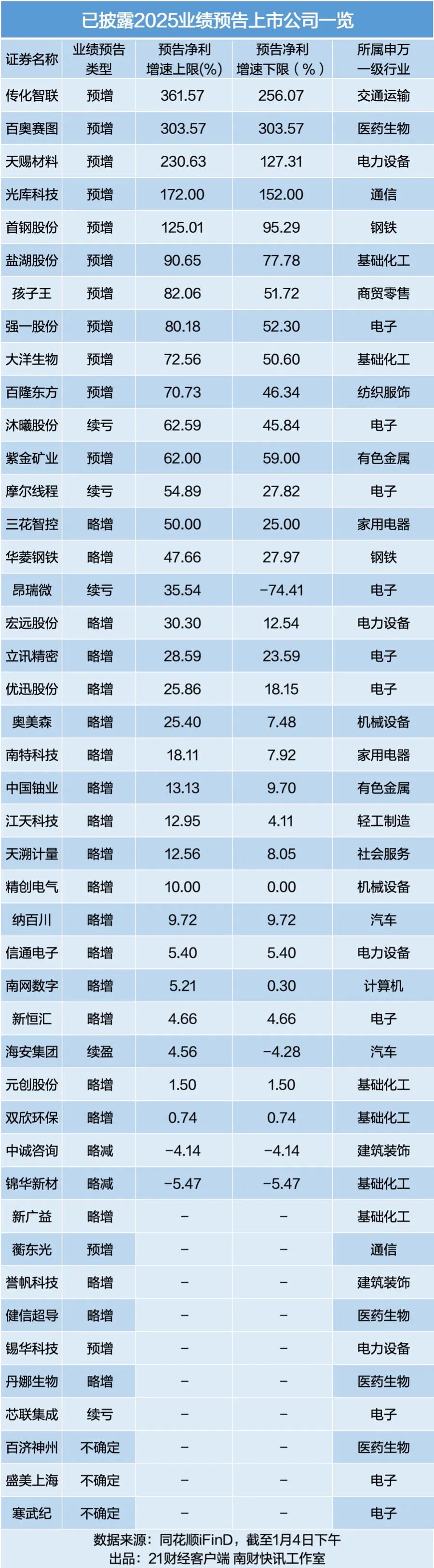
值得注意的是,传化智联(002010)(002010.SZ)以高达256.07%至361.57%的净利润预计增幅,暂列目前"预增王"。公司预计 2025年归母净利润为5.4亿至7亿元。公告显示,业绩大幅增长除因主营业务取得良好增长外,也受益于转让部分子公司股权确认 的投资收益及回购子公司股权提升持股比例等因素。 传统制造业在此轮业绩预告中表现尤为亮眼。钢铁行业方面,首钢股份(000959)(000959.SZ)预计2025年归母净利润为9.2亿元 至10.6亿元,同比增长95.29%至125.01%,增速上限在已披露公司中位居前列。公司表示,业绩增长得益于产品结构优化、高端 化发展及"极低成本"管理理念的贯彻。 同样属于钢铁板块的华菱钢铁(000932)(000932.SZ)在消化了补缴环保税及滞纳金约6.57亿元的情况下,依然预计净利润增长 27.97%至47.66%。对此,公司解释,主要得益于降本增效以及高端化、绿色化、智能化、精益化"四化转型等工作的开展。 以电子、医药生物为代表的高景气赛道则呈现批量报喜的态势。其中,电子行业的强一股份(688809.SH)预计净利润增长52.30% 至80.18%;医 ...


最高预增超360%!44家A股公司披露2025年度业绩预告
21世纪经济报道· 2026-01-05 12:52
记者丨 李益文 编辑丨叶映橙 随着年报披露窗口临近,A股上市公司2025年度业绩预告正密集出炉。21财经·南财快讯记者 据同花顺iFinD数据统计,截至1月4日下午, 已有44家A股上市公司披露了2025年业绩预告, 其中,业绩预喜(包括预增、略增、扭亏、续盈)的公司达35家,占比近八成。 从已披露的业绩预告看,各行业龙头企业基本面保持稳固。 消费电子制造龙头立讯精密 (002475.SZ)预计2025年实现归母净利润165.18亿元至171.86亿元,同比增长23.59%至 28.59%。 公司表示,将通过深化全球化战略与AI技术融合,构建更具弹性的业务矩阵。 热管理领域龙头三花智控(002050.SZ)预计净利润增长25%至50%,其汽车零部件业务在新 能源汽车热管理领域的领先布局持续贡献增长动能。矿业巨头紫金矿业(601899.SH)则受益 于主要矿产品产量提升及销售价格上涨,预计净利润增幅达59%至62%。 值得注意的是, 传化智联(002010.SZ)以高达256.07%至361.57%的净利润预计增幅,暂列 目前"预增王"。 公司预计2025年归母净利润为5.4亿至7亿元。公告显示,业绩大幅增长除 ...

财达证券每日市场观-20260105
Caida Securities· 2026-01-05 12:25
Market Overview - On December 31, 2025, the Shanghai and Shenzhen indices experienced mixed performance, with a total trading volume of CNY 2.07 trillion, a decrease of approximately CNY 90 billion from the previous trading day[1] - The market showed stability despite more stocks declining than rising, with notable gains in the aerospace, media, real estate, and non-ferrous metals sectors, while telecommunications, agriculture, and electronics faced declines[1] - The total trading volume for the year exceeded CNY 400 trillion, marking a year-on-year growth of over 60%, achieving a historical high[3] Sector Performance - The aerospace sector is rapidly regaining strength, with leading stocks reaching new highs and increasing trading volumes, indicating a sustained upward trend[1] - The non-ferrous metals sector is also performing steadily, supported by historical price increases in precious metals and a weak US dollar, suggesting a potential for long-term growth[1] - The top three sectors for net capital inflow on December 31 were aerospace equipment, military electronics, and advertising marketing, while the semiconductor, components, and photovoltaic equipment sectors saw the largest outflows[4] Regulatory Developments - The Ministry of Transport has initiated measures to promote the integration of public transportation data with enterprise data, aiming to enhance efficiency across various sectors, including logistics and green technology[5] - New regulations for green product certification have been introduced, covering 122 product categories and involving over 8,000 certified enterprises, marking a significant shift towards comprehensive regulatory oversight[7] Economic Indicators - The price of live pigs increased by 1.7% month-on-month in late December 2025, reflecting ongoing trends in agricultural pricing[8] - Natural gas consumption in November 2025 was reported at 36.28 billion cubic meters, a year-on-year increase of 5.1%, although total consumption for the first eleven months showed a slight decline of 0.1%[8] Investment Insights - The recent regulatory changes in fund sales fees aim to enhance investor returns by capping service fees for equity funds at 0.4% and for index and bond funds at 0.2%, promoting a shift towards long-term holding[12][14]

成长风格走强,指数涨近3%,成长ETF易方达(159259)全天净申购超8000万份
Sou Hu Cai Jing· 2026-01-05 12:11
Core Viewpoint - The market experienced a broad upward movement today, with technology sectors leading the gains, particularly in brain-computer interfaces, memory, and CRO concepts, which strengthened the growth style [1] Index Performance - The Guozheng Growth 100 Index rose by 2.9%, the Guozheng Free Cash Flow Index increased by 0.8%, and the Guozheng Value 100 Index saw a 0.5% rise, indicating a strong performance across growth-oriented indices [1] - Related ETFs received significant capital inflows, with the E Fund Growth ETF (159259) seeing a net subscription of over 80 million units throughout the day [1] Sector Focus - The Guozheng Growth 100 Index emphasizes stocks with prominent growth characteristics in the A-share market, aligning closely with the pulse of economic transformation [1] - Currently, over 70% of the index's weight is concentrated in the electronics, communications, and computer sectors, strategically positioning itself in the core areas of AI computing power [1] Investment Opportunity - The E Fund Growth ETF (159259) is the only product tracking the Guozheng Growth 100 Index, providing investors with an opportunity to capitalize on growth style investment prospects [1]

数据复盘丨传媒、医药生物等行业走强 118股获主力资金净流入超1亿元
Zheng Quan Shi Bao Wang· 2026-01-05 12:02
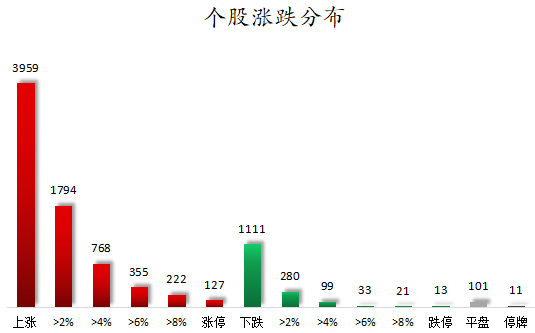
Market Overview - On January 5, 2026, the A-share market experienced a "good start," with major indices such as the Shanghai Composite Index, Shenzhen Component Index, ChiNext Index, and STAR Market Index all showing strong performance. The Shanghai Composite Index closed at 4023.42 points, up 1.38%, with a trading volume of 10,673 billion yuan [1] - The total trading volume for both Shanghai and Shenzhen markets reached 25,463.13 billion yuan, an increase of 5,010.9 billion yuan compared to the previous trading day [1] Sector Performance - The media, pharmaceutical, and other sectors showed strong gains, with notable stocks like Fenglong Co. achieving a seven-day consecutive limit-up [2][6] - Among the industry sectors, media, pharmaceuticals, insurance, electronics, computers, defense, non-ferrous metals, food and beverage, and precious metals had the highest gains. Conversely, sectors such as oil and petrochemicals, banking, and transportation saw declines [3] Individual Stock Performance - A total of 3,959 stocks rose, while 1,111 stocks fell, with 127 stocks hitting the daily limit-up and 13 stocks hitting the limit-down [3] - The top individual stocks with significant net inflows included Shenghong Technology with a net inflow of 2.007 billion yuan, followed by Tianji Co. and Dongfang Fortune with net inflows of 871 million yuan and 726 million yuan, respectively [9][11] Capital Flow - The net capital outflow from the main funds in the Shanghai and Shenzhen markets was 6.298 billion yuan, with the ChiNext seeing a net inflow of 1.497 billion yuan and the STAR Market experiencing a net outflow of 4.263 billion yuan [7] - Among the 31 primary industry sectors, 12 sectors saw net capital inflows, with the non-ferrous metals sector leading with a net inflow of 1.907 billion yuan [7] Institutional Activity - Institutional investors had a net selling of approximately 4.97 billion yuan, with BlueFocus being the top net buy stock at around 186 million yuan [16][18] - The stocks with the highest net selling included Aerospace Development, with a net outflow of 1.649 billion yuan, followed by Xinyi Sheng and Shunhao Co. [13][14]