
房地产

Search documents
兴业证券:哪些行业股价与人民币汇率相关性较强?
智通财经网· 2025-12-25 12:13
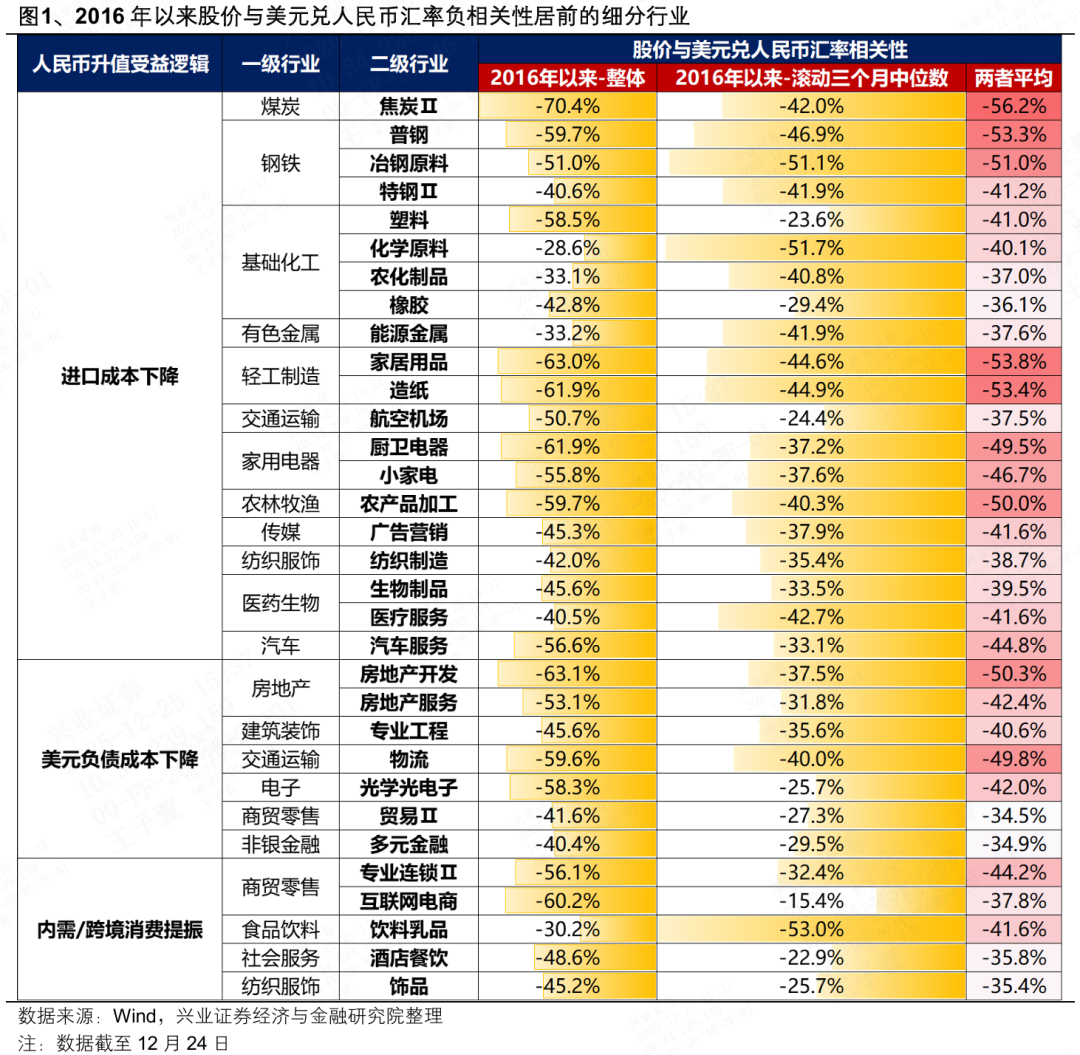
Core Viewpoint - The report from Industrial Securities highlights the negative correlation between stock prices and the USD/CNY exchange rate since 2016, indicating that a stronger RMB tends to drive stock prices higher across various sectors [1] Group 1: Industries Benefiting from RMB Appreciation - Industries with high reliance on imported raw materials benefit from RMB appreciation, leading to reduced import costs. Key sectors include coke, steel, certain chemicals (plastics, chemical raw materials, agricultural chemicals, rubber), energy metals, paper, airport operations, and agricultural product processing [1] - The construction and real estate sectors, which have high USD-denominated debt, see a decrease in financing costs due to RMB appreciation. This includes real estate development, real estate services, and specialized engineering [1] - The service and high-end consumption sectors, such as cross-border e-commerce, hotel and catering services, and jewelry, benefit from increased domestic demand and cross-border consumption driven by enhanced RMB purchasing power [1] Group 2: Correlation Data - The median negative correlation between stock prices and the USD/CNY exchange rate since 2016 shows significant figures for various sectors: - Coke: -70.4% overall, -42.0% rolling three months - Steel: -59.7% overall, -46.9% rolling three months - Basic chemicals: -58.5% overall, -23.6% rolling three months - Transportation (airports): -50.7% overall, -24.4% rolling three months - Real estate development: -63.1% overall, -37.5% rolling three months [2] Group 3: Impact on Financing Costs - Industries with high USD debt benefit from RMB appreciation, leading to lower financing costs. This includes logistics, optical electronics, trade, and diversified finance sectors [1] - Specific correlations include: - Logistics: -59.6% overall, -40.0% rolling three months - Optical electronics: -58.3% overall, -25.7% rolling three months - Trade: -41.6% overall, -27.3% rolling three months [2] Group 4: Domestic Demand and Cross-Border Consumption - The sectors benefiting from increased domestic demand and cross-border consumption include: - Food and beverage (dairy products): -30.2% overall, -53.0% rolling three months - Hospitality (hotels and restaurants): -48.6% overall, -22.9% rolling three months - Textiles (jewelry): -45.2% overall, -25.7% rolling three months [2]


专访邢自强:从投资于物到投资于人,持续撬动消费市场
2 1 Shi Ji Jing Ji Bao Dao· 2025-12-25 12:03
Core Insights - The future of China's economy relies on achieving a dual focus on "starry skies and vast seas" innovation and "daily necessities" improvement in living standards, emphasizing the need for a balanced approach to technological advancement and social welfare [1][2][3] Group 1: Economic Strategy - The strategy involves leveraging China's existing advantages in industrial chains, engineer dividends, and a large-scale market to foster innovation in cutting-edge technologies like 6G, quantum technology, and biomanufacturing [2][5] - The "dual-wheel drive" approach necessitates simultaneous progress in technological innovation and enhancing living standards to solidify the economic foundation [2][3] Group 2: Capital Market Role - The capital market must support both innovation and living standards by enhancing residents' consumption capacity and promoting a sustainable innovation ecosystem [6] - A robust capital market can help alleviate the low-price cycle by providing a stable return on investment, thus encouraging consumer spending [6][8] Group 3: Market Confidence Recovery - Since September 2024, market confidence has been restored due to a threefold awakening in policy, enterprise resilience, and funding dynamics [7][8] - Policy reforms aimed at addressing the low-price cycle have signaled a commitment to development alongside security, fostering a healthier market environment [7] Group 4: Structural Reforms - Key reforms during the "14th Five-Year Plan" include enhancing the national unified market and substantial social security reforms to improve consumer spending and reduce preventive savings [9][11] - The goal is to increase the share of resident consumption in GDP from under 40% to around 45% by 2030, creating a $10 trillion consumption market [9][12] Group 5: Fiscal Transformation - The shift from "investment in material" to "investment in people" is crucial for addressing structural issues of high savings and low consumption [11][13] - Strategies include increasing the proportion of state-owned capital allocated to social security funds and adjusting fiscal spending towards social services [13][14] Group 6: Real Estate Market Stabilization - To stabilize the real estate market, strategies include inventory reduction through government purchases of unsold properties and supporting key real estate firms facing difficulties [15][16] - Implementing interest subsidies on mortgage loans can significantly ease the financial burden on homebuyers, thereby boosting consumer confidence [16]

【投资风口】北京祭出重磅楼市新政;广州重磅扶持游戏电竞产业
第一财经· 2025-12-25 11:43
Group 1 - Beijing has introduced significant new policies to stabilize the real estate market, effective from December 24, 2025, aimed at activating market activity towards the end of the year [2] - Guangzhou has launched a substantial support initiative for the gaming and esports industry, with measures including million-level subsidies to stimulate sector growth [3]

风险月报 | 权益市场风险偏好温和修复,多维度指标分化持续缓和
中泰证券资管· 2025-12-25 11:32
Core Viewpoint - The overall market risk preference is showing a mild recovery, with the risk scoring system indicating a slight improvement in the stock market, while the bond market remains cautious due to weak economic data and credit risk concerns in the real estate sector [2][5]. Market Risk Assessment - The risk score for the CSI 300 index is 54.89, up from 52.77 last month, indicating a moderate recovery in market risk preference [2]. - The valuation of the CSI 300 has slightly increased to 61.54 from 60.68, remaining in a mid-high range over the past six months, with significant valuation differentiation across sectors [2]. - The market expectation score has decreased to 50.00 from 52.00, reflecting resilient external demand but a notable slowdown in internal demand [2]. Market Sentiment - Market sentiment has improved to 50.69 from 45.24, moving from a "depressed" to a "neutral" range, although sentiment indicators show significant differentiation [3]. - Margin financing scores have surged from historical lows to highs, indicating a recovery in sentiment, while public fund issuance remains stable at high levels [3]. Economic Indicators - Consumer Price Index (CPI) rose by 0.7%, the highest increase since March 2024, while core CPI increased by 1.2% [9]. - Industrial production value increased by 4.8%, with significant growth in equipment manufacturing and high-tech industries [9]. - Fixed asset investment decreased by 2.6% year-on-year, but excluding real estate development, it shows a growth of 0.8% [9]. Liquidity and Monetary Policy - The social financing scale increased by 8.5% year-on-year, with broad money (M2) growing by 8.0%, indicating a moderately loose monetary policy [11]. - The central bank has maintained a stable monetary policy, with the ten-year government bond yield around 1.85% and the thirty-year bond around 2.25%, reflecting a bear steepening trend in the bond market [11][12]. Investment Focus - In a structured market, sectors with high valuation and strong earnings certainty are emphasized, while those with high valuations but weak fundamentals are viewed with caution [3]. - The focus is on quality targets within a manageable risk range, prioritizing earnings realization and cash flow stability [3].

北京调减非京籍家庭购房社保或个税缴纳年限
Qi Lu Wan Bao· 2025-12-25 10:31
Core Viewpoint - The Beijing Municipal Commission of Housing and Urban-Rural Development, along with three other departments, has issued a notice to further optimize and adjust real estate policies to better meet the housing needs of residents, particularly focusing on easing purchase restrictions for non-local families and supporting multi-child households [1] Group 1: Policy Adjustments - The policy relaxes the purchasing conditions for non-local families, reducing the social security or individual income tax payment duration required for purchasing properties within the Fifth Ring Road from 3 years to 2 years [1] - For purchasing properties outside the Fifth Ring Road, the required payment duration is reduced from 2 years to 1 year for non-local families [1] Group 2: Support for Multi-Child Families - Multi-child families, specifically those with two or more children, are allowed to purchase an additional property within the Fifth Ring Road; local families can buy up to three properties, while non-local families with two years of continuous social security or tax payments can buy up to two properties [1]
三元股份剥离房地产资产:营业收入持续下滑 行业低谷期能否通过瘦身转型实现增长
Xin Lang Cai Jing· 2025-12-25 09:51
Core Viewpoint - San Yuan Co., Ltd. is divesting its 10% stake in Beijing San Yuan Dehong Real Estate Development Co., Ltd. to focus on its core business amid ongoing challenges in the dairy industry and declining revenues [1][2]. Group 1: Business Strategy and Financial Performance - The divestment of San Yuan Dehong is part of a broader strategy to shed unprofitable assets and concentrate on core operations, with the transaction valued at 26.85 million yuan [2]. - In the first three quarters of this year, San Yuan's net profit surged by 124.84% to 236 million yuan, attributed to the "slimming strategy" that alleviated the burden of loss-making non-core assets [6][7]. - Despite the profit increase, the company's revenue continues to decline, with a 10.06% drop to 4.871 billion yuan in the first three quarters, driven by a 13.15% decrease in liquid milk revenue and a 14.33% decrease in ice cream revenue [7][8]. Group 2: Market Challenges and Industry Context - The real estate market remains sluggish, impacting San Yuan Dehong's performance, which reported a revenue of 109 million yuan in 2024 and a net profit of 736,680 yuan, followed by a loss of 659,730 yuan in the first three quarters of 2025 [2][3]. - The dairy industry is facing significant pressure, with 63% of listed dairy companies reporting revenue declines and 52% experiencing drops in net profit, as raw milk prices have fallen nearly 30% since October 2021 [8][9]. - San Yuan's market share in Beijing remains strong, particularly in liquid milk, where it holds a 56.2% market share, but the overall revenue decline raises concerns about future growth [7][8].

中原地产:CVI结束5连跌企稳70点以上水平 料明年首季继续处于看好区
Zhi Tong Cai Jing· 2025-12-25 09:41
Core Viewpoint - The Central Valuation Index (CVI) has stabilized above 70 points after ending a five-week decline, indicating a positive outlook for the Hong Kong property market as banks maintain an optimistic stance on mortgage lending [1] Group 1: CVI and Market Trends - The latest CVI reported at 76.05 points, an increase of 1.75 points from last week, marking the end of a five-week decline [1] - The CVI has remained above 60 points for 12 consecutive weeks, suggesting continued upward momentum in Hong Kong property prices [1] - The current best lending rate has been lowered to a historical low, with expectations of further interest rate cuts in the U.S., which may lead to a decrease in mortgage rates in Hong Kong [1] Group 2: Future Outlook - The CVI is expected to remain in a positive zone in the first quarter of next year, supported by traditional seasonal demand during the Lunar New Year [1] - Following the government's full withdrawal of cooling measures by the end of February 2024, property transaction volumes are anticipated to rebound, contributing to a recovery in the CVI [1] - The CCL (Centaline Property Index) has shown signs of stabilization, moving between 144 and 148 points after previously dropping to a low of 143.02 points [1] Group 3: Historical Context and Adjustments - The CVI fell below 40 points in early June, indicating a bearish market phase, with property prices continuously adjusting downward [2] - The CVI began to rise again in September following a rate cut cycle, surpassing key thresholds of 40 and 50 points, coinciding with a stabilization in property prices [2] - By September, the CCL reported at 145.01 points, reflecting a 7.29% increase from the low of 135.16 points earlier in the year, indicating a recovery trend in property values [2]
讨论真问题,提供真价值 | 年度财经思想者揭晓人
Sou Hu Cai Jing· 2025-12-25 09:12
Core Insights - The article emphasizes the importance of rationality, professionalism, and courage in economic discussions, particularly in the context of the "Yi Cai Hao" platform and its annual recognition of outstanding thinkers in finance [1][2]. Group 1: Achievements and Impact - Over the past year, the "Qian V Plan" has produced over 700 in-depth articles and more than 1,500 videos, achieving over 60 million views [2]. - The "Da V Liu Shui Xi" live broadcast attracted 4.64 million viewers, while the previous year's "Annual Financial Thinker Ceremony" engaged 7.41 million participants, generating a total communication flow of 40 million [2]. Group 2: Economic Outlook - A survey of 180 economists and researchers indicates that over 60% expect China's GDP growth target for 2026 to be between 4.5% and 5.0%, reflecting a pragmatic balance between stability and progress [3]. - 88.2% of experts believe that significant advancements in 2026 will occur in "technological innovation and industrial upgrading," with a focus on artificial intelligence, robotics, and semiconductor localization as key strategic areas [3]. Group 3: Consumer Trends and Market Dynamics - Health and elderly care, along with cultural and experiential consumption, are viewed as the most promising new consumer engines, with approximately 70% agreement among experts [4]. - In the real estate sector, the focus has shifted from simple stimulus to urban renewal and improvement, indicating a transition from "housing for all" to "livable housing" [4]. Group 4: Global Economic Context - Experts anticipate that the Federal Reserve will gradually enter a rate-cutting phase in 2026, maintaining a neutral global liquidity environment, with the US dollar index expected to remain stable within a certain range [4]. - The article highlights the importance of understanding global variables to navigate domestic policy space and market fluctuations [4].
金雅福暴雷:70亿理财产品,拖垮500亿黄金巨头 || 深度
Sou Hu Cai Jing· 2025-12-25 09:03
Core Viewpoint - The collapse of Jinyafu, a company once valued at over 70 billion yuan in financial products, has led to significant financial losses for investors, with the company's actual control person, Huang Shikun, cashing out 145 million HKD from the Hong Kong stock market amid the crisis [2][4][28]. Group 1: Company Overview - Jinyafu, founded by Huang Shikun, was once a prominent player in the gold industry, achieving 56.12 billion yuan in revenue and ranking 437th on the "2025 China Enterprise 500" list [3][4]. - The company expanded from a small processing factory to a comprehensive gold industry giant, covering the entire supply chain, including manufacturing, retail, and investment management [5][10]. Group 2: Investment Products and Practices - Jinyafu offered various financial products promising annual returns of 8% to 14%, often exceeding 10%, through complex contracts that misrepresented their financial capabilities [12][16]. - The company utilized a model where investors were led to believe they were purchasing physical gold while actually engaging in contracts that relinquished their rights to the physical assets [17][20]. Group 3: Financial Mismanagement and Risks - A significant portion of the funds raised (approximately 35%-40%) was diverted into long-term real estate projects, which faced delays and liquidity issues, creating a mismatch between short-term investor expectations and long-term project timelines [23][27]. - As the international gold price rose, operational cash flow tightened, leading to overdue financial products as early as June 2023, indicating severe liquidity issues within the company [27][28]. Group 4: Leadership and Exit Strategies - Huang Shikun, who had previously built a successful career in hedge funds, was noted for his strategic timing in entering the gold market but ultimately faced challenges as the company's financial practices unraveled [9][11]. - Amid the financial crisis, Huang's associated companies liquidated significant stock holdings, raising 145 million HKD, suggesting a strategy to secure personal financial stability while investors faced losses [28][29].

博时市场点评12月25日:沪指继续上涨,军工板块活跃
Xin Lang Cai Jing· 2025-12-25 08:38
Market Overview - The Shanghai Composite Index recorded a seven-day consecutive rise, with a trading volume of 1.94 trillion yuan, indicating increased market activity [1][4][10] - The defense and military industry sector has shown strong performance, leading the market for two consecutive days [1][4] Monetary Policy - The People's Bank of China (PBOC) emphasized the need for continued implementation of a moderately loose monetary policy, with a focus on counter-cyclical and cross-cyclical adjustments to promote stable economic growth and reasonable price recovery [2][8] - The PBOC's new approach shifts from increasing the intensity of monetary policy control to leveraging the integrated effects of incremental and stock policies, utilizing various tools for enhanced monetary policy regulation [1][2][8] Real Estate Policy - Beijing has introduced new real estate policies effective from December 24, 2025, reducing the social security or tax payment duration for non-Beijing residents purchasing homes within the Fifth Ring Road from three years to two years, and from two years to one year for homes outside the Fifth Ring Road [2][3][9] - The policy also supports multi-child families, allowing them to purchase an additional property within the Fifth Ring Road [3][9] Foreign Investment - The National Development and Reform Commission and the Ministry of Commerce released the "Encouraged Foreign Investment Industry Catalog (2025 Edition)," effective from February 1, 2026, which adds 205 new items and modifies 303 items compared to the 2022 version [3][9] - The new catalog aims to attract foreign investment in advanced manufacturing, modern services, high-tech, and energy-saving sectors, particularly in the central and northeastern regions of China [3][9] Market Performance - As of December 25, 2025, the A-share market saw the Shanghai Composite Index close at 3959.62 points, up 0.47%, while the Shenzhen Component Index and the ChiNext Index also recorded gains [4][10] - The defense and military sector, along with light manufacturing and machinery equipment, led the gains among industry sectors, with increases of 2.91%, 1.59%, and 1.51% respectively [4][10]