
高端装备

Search documents
利好来了!“国家队”投向明确!四部门联合发布
凤凰网财经· 2026-01-12 13:37
Core Viewpoint - The article discusses the recent issuance of guidelines by four government departments in China aimed at strengthening the planning and investment direction of government investment funds, marking a significant step in defining the future of these funds, which are crucial for supporting emerging and future industries [2][3]. Group 1: Government Investment Fund Guidelines - The guidelines, titled "Work Method for Strengthening the Layout Planning and Investment Direction of Government Investment Funds (Trial)," were jointly released by the National Development and Reform Commission, Ministry of Finance, Ministry of Science and Technology, and Ministry of Industry and Information Technology [3]. - The guidelines focus on three main aspects: where to invest, how to invest, and who manages the funds, proposing 14 policy measures to optimize fund allocation [3]. - Funds are required to support major strategies and key areas, particularly in sectors where market resources are inadequately allocated, emphasizing early, small, long-term investments in hard technology [3][5]. Group 2: Investment Direction and Evaluation - The investment direction must align with national major plans and encourage industries listed in the national industrial catalog, avoiding investments in restricted or eliminated sectors [4]. - Local development and reform departments are tasked with creating lists of key investment areas to optimize fund allocation based on regional characteristics [5]. - The guidelines also clarify the roles of national and local funds, with national funds focusing on supporting the modernization of the industrial system and overcoming key technological challenges [6]. Group 3: Evaluation Management Method - The "Management Method for Evaluating Investment Direction of Government Investment Funds (Trial)" was also released, establishing a comprehensive evaluation system that combines quantitative and qualitative assessments [6]. - The evaluation includes three primary indicators: policy compliance (60% weight), optimization of productivity layout (30% weight), and policy execution capability (10% weight) [6][7]. - The evaluation aims to ensure that funds effectively support new productive forces, technological innovation, and the development of the digital economy, among other areas [8].


制造业高质量发展重点任务扎实推进
中汽协会数据· 2026-01-12 07:05
Core Viewpoint - The article emphasizes the significant progress in the digital transformation of the manufacturing industry in China, highlighting the government's strategic initiatives and the establishment of a comprehensive framework to support this transformation by 2025 [4][18]. Group 1: Digital Transformation Framework - The State Council issued a digital transformation action plan for the manufacturing industry, aiming for full coverage of digital upgrades in key industrial enterprises by 2027 and completion of a round of digital transformation by 2030 [4]. - A universal evaluation index system for the digital transformation of the manufacturing industry has been established, categorizing transformation levels into five grades (L1-L5) [6]. - A comprehensive information service platform for manufacturing digital transformation has been launched, providing assessment diagnostics, policy documents, and industry evaluations, with connectivity established across 15 provinces [9]. Group 2: Industry-Specific Policies - Implementation plans for digital transformation have been issued for 14 key industries, specifying transformation goals, typical scenarios, and solutions [12]. - The establishment of 62 digital transformation promotion centers has been initiated, covering 25 provinces and 14 key industries, focusing on specialized services [15]. Group 3: Progress and Achievements - As of December 31, 2025, 248,000 industrial enterprises have registered on the digital transformation platform, representing 47.1% of all industrial enterprises, with 89.6% of these enterprises having initiated digital upgrades [18]. - The penetration rate of digital production equipment among industrial enterprises reached 57.7% [18]. - Industrial technology renovation investments in 26 cities averaged a growth rate of 7.3%, exceeding the national average by 6.8 percentage points, with total investments surpassing 760 billion [21]. Group 4: Green and Intelligent Manufacturing - The average penetration rate of digital R&D design tools among industrial enterprises reached 86.7%, with the CNC rate for key production processes averaging 71.1% [23]. - The energy consumption per unit of industrial added value has decreased to 1.4 tons of standard coal per 10,000 yuan [23]. Group 5: Collaborative Innovation and New Models - The article highlights the establishment of 1,724 national-level technology innovation carriers and nearly 3,000 public service platforms, with an average R&D investment intensity of 4.64% within clusters [43]. - The integration of new technologies such as 5G, AI, and big data into manufacturing processes has led to the establishment of 238 leading and excellent smart factories [47][48]. Group 6: High-tech Industry Development - By 2025, national high-tech zones are expected to maintain a positive growth trend, with industrial output value reaching 27.4 trillion yuan, a year-on-year increase of 2.8% [72]. - High-tech zones have gathered 70% of national manufacturing innovation centers and 80% of key laboratories, contributing significantly to original innovations and high-tech industry clusters [76][78].

利好来了!刚刚,“国家队”投向明确!四部门联合发布
券商中国· 2026-01-12 06:10
Core Viewpoint - The article discusses the release of a significant document by four government departments in China, outlining guidelines for government investment funds, focusing on supporting emerging and future industries, and establishing a structured evaluation system for fund allocation [1][3][6]. Group 1: Government Investment Fund Guidelines - The document titled "Work Method" aims to systematically regulate the layout and investment direction of government investment funds for the first time at the national level [3]. - The guidelines emphasize the need for funds to support major strategies and key areas, particularly in sectors where market resource allocation is weak, promoting deep integration of technological and industrial innovation [6]. - Investment areas include emerging industries such as new-generation information technology, new energy, new materials, high-end equipment, and future industries like the metaverse, brain-computer interfaces, and generative artificial intelligence [1][9]. Group 2: Evaluation and Management of Fund Investments - The "Management Method" establishes a comprehensive evaluation system for fund investments, combining quantitative and qualitative assessments [7][9]. - Three primary indicators are set: policy compliance (60% weight), optimization of productivity layout (30% weight), and policy execution capability (10% weight) [9][11]. - The evaluation focuses on whether fund investments align with national strategic plans and encourage the development of new productive forces, including support for green development and the private economy [9][10].

2026新生代浙商传承主题沙龙在临平举行
Mei Ri Shang Bao· 2026-01-11 22:30
Group 1 - The core theme of the event is the transition of Zhejiang's private economy from the "first generation" to the "new second generation" of entrepreneurs, emphasizing the importance of inheritance and innovation for high-quality development [1] - The salon discussed key issues such as governance structure transformation during the generational handover of private enterprises and decision-making mechanism innovation led by the new generation [1] - Keywords related to technological innovation, such as "artificial intelligence," "new quality productivity," and "technological transformation," were highlighted during the discussions, along with the concept of "good governance" as a key to sustainable development [1] Group 2 - The nurturing of new-generation entrepreneurs is considered a strategic priority in Linping, with the implementation of the "Qinglan Relay Project" and a specific plan for the growth of high-quality new-generation entrepreneurs from 2025 to 2027 [2] - The Linping New Generation Entrepreneurs Association has gathered 203 member companies, including 12 listed companies and 7 from the Zhejiang 500 strong, showcasing the region's robust entrepreneurial ecosystem [2] - Linping has officially launched the New Generation Zhejiang Merchants Joint Innovation Service Center, attracting more entrepreneurs to settle in the area, with the China Youth Innovation Center set to open in 2026 [3] Group 3 - Linping is recognized as the youngest district in Zhejiang and a core area for intelligent manufacturing in Hangzhou, benefiting from its unique geographical advantages and a youthful population [3] - The region has established three major industrial platforms, resulting in the accumulation of 28 listed companies, 4 billion-level enterprises, and 40 national-level specialized "little giant" enterprises, with three trillion-level industrial clusters in high-end equipment, biomedicine, and fashion industries [3] - Linping aims to provide optimal services and environments to attract entrepreneurs, contributing to the high-quality development of Zhejiang's private economy [4]


投资逻辑转向个股深度挖掘 新质生产力成核心主线
Zhong Guo Zheng Quan Bao· 2026-01-11 20:49
Core Viewpoint - The investment strategies for the Beijing Stock Exchange (BSE) in 2026 are focusing on "new quality productivity" and "small and medium-sized growth stocks" as consensus themes among major brokerages [1][2]. Investment Logic Shift - The investment logic for the BSE is shifting from sector-wide increases to deep value exploration of individual stocks, with companies possessing core competitiveness expected to stand out [1]. - Major brokerages are identifying three main investment lines: "Wind Growth," "Joint Expansion," and "New Strong Inclusion," focusing on high-scarcity technology growth, mergers and acquisitions, and quality new stocks [2]. Focus on New Quality Productivity - "New quality productivity" is a central theme for brokerages looking towards 2026, supported by a solid industrial foundation, with 252 specialized "little giant" enterprises on the BSE, over 90% of which are classified as specialized and innovative [2]. - The BSE has established five major industrial clusters, including high-end equipment, information technology, new chemical materials, consumer services, and biomedicine, covering cutting-edge fields such as smart connected vehicles, hydrogen energy, and artificial intelligence [2]. Funding and Allocation Strategies - With policy encouragement, convertible bonds and refinancing tools are expected to become hotspots, providing efficient paths for R&D support for small and medium enterprises [3]. - A combination of top-down and bottom-up strategies is recommended, focusing on scarce companies in emerging industries and selecting potential enterprises based on financial metrics [3]. Market Dynamics - In 2025, up to 34 companies on the BSE are projected to see their stock prices double, indicating strong market elasticity, and the "spring rally" in 2026 is seen as a favorable investment opportunity [3]. - A positive cycle is forming in the BSE, characterized by the gathering of quality enterprises, improved liquidity, institutional empowerment, and performance realization, marking a transition from a focus on "small and beautiful" companies to "strong and enduring" development [3].
上海先进制造业转型文件出炉,引导企业投资五大新增长点
Di Yi Cai Jing· 2026-01-11 12:12
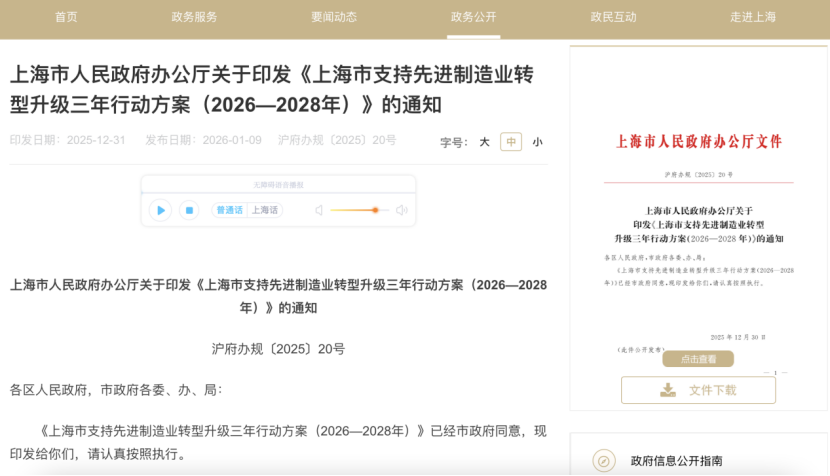
Core Insights - Shanghai aims to accelerate the transformation and upgrading of its advanced manufacturing industry over the next three years, targeting the establishment of 100 new manufacturing enterprises with an annual output value exceeding 1 billion yuan by 2028 [2] - The plan emphasizes the development of emerging sectors such as low-altitude economy, commercial aerospace, embodied intelligence, biomanufacturing, and smart terminals, positioning them as new growth points for the industry [2][3] Group 1: Advanced Manufacturing Transformation - The action plan outlines structural optimization and upgrading actions, including enhancing traditional industries and promoting the growth of key and emerging sectors [2] - Shanghai has established five national-level industrial clusters and four trillion-yuan industrial clusters, focusing on integrated circuits, biomedicine, new energy vehicles, large aircraft, and marine engineering equipment [2][3] Group 2: New Growth Areas - The plan identifies five new growth areas: low-altitude economy, commercial aerospace, embodied intelligence, biomanufacturing, and smart terminals, with a goal for these sectors to reach a scale of 1 trillion yuan by the end of the 14th Five-Year Plan [3] - Specific targets include achieving a scale of 100 billion yuan in the low-altitude economy and 500 billion yuan in embodied intelligence by 2027, with projections of 1 trillion yuan by 2030 for the latter [3][4] Group 3: Financial Support and Innovation - The plan includes financial incentives for companies increasing their R&D investments, with subsidies ranging from 200,000 to 1 million yuan based on the level of investment [5] - It also promotes the "AI + manufacturing" initiative, aiming for full coverage of intelligent applications in large enterprises by 2027 and increasing robot density to 600 units per 10,000 people by 2028 [5][6] Group 4: Industrial Ecosystem and Talent Development - The Shanghai Industrial Internet Association emphasizes the need for collaboration among government, industry, academia, and research to tackle challenges in the "AI + manufacturing" sector [6] - The initiative aims to build a comprehensive standard system for "AI + manufacturing" and enhance the cultivation of industrial intelligent talent [6]
重磅!沪发文扶持芯片业,攻坚装备与光刻胶
是说芯语· 2026-01-11 08:04
Core Viewpoint - The "Shanghai Action Plan for Supporting the Transformation and Upgrading of Advanced Manufacturing Industry (2026-2028)" emphasizes the importance of the integrated circuit industry, aiming to support enterprises in achieving breakthroughs across the entire industry chain and cultivating internationally competitive leading companies [1][2]. Summary by Sections 1. Main Goals - By 2028, the plan aims to add 100 manufacturing enterprises with an annual output value exceeding 1 billion yuan, totaling over 600, and to drive the addition of 500 large-scale industrial enterprises in the industry chain [3]. 2. Implementation of Structural Optimization and Upgrading Actions - **Optimization of Traditional Advantage Industries**: Support for petrochemical companies to shift towards new functional materials, and for steel and non-ferrous metal companies to strengthen specialty steel and expand light alloys. Financial support of up to 20 million yuan is available for qualifying projects [4]. - **Acceleration of Leading Industries**: Focus on integrated circuits, large aircraft, high-end equipment, and other key sectors to foster innovation and development [4]. - **Promotion of Key and Emerging Industries**: Development of new-generation electronic information, smart connected vehicles, and advanced materials, with encouragement for investment in emerging fields like commercial aerospace and humanoid robots [4]. 3. Implementation of Innovation and Core Technology Actions - **Release of Enterprise Innovation Vitality**: Financial incentives for companies increasing basic research investments, with subsidies ranging from 200,000 to 1 million yuan based on the amount invested [5]. - **Acceleration of Core Technology Research**: Support for enterprises focusing on cutting-edge technologies such as laser manufacturing and quantum technology [5]. 4. Implementation of Quality and Efficiency Enhancement Actions - **Promotion of Technological Transformation**: Financial support for fixed asset investment loans related to technological upgrades, with a maximum support of 20 million yuan [6]. - **Deepening Digital Transformation**: Initiatives to enhance AI applications in manufacturing, aiming for full coverage of smart factory applications by 2028 [6]. 5. Implementation of Resource and Element Support Actions - **Strengthening Talent Recruitment**: Support for enterprises in attracting high-level talent, with financial rewards for successful candidates [6]. - **Enhancing Financial Support**: Encouragement for financial institutions to offer favorable loan products for manufacturing enterprises, with interest subsidies of 0.8% to 1.3% [6]. 6. Implementation of Logistics and Cost Reduction Actions - **Logistics Support**: Development of industrial logistics facilities and integration with manufacturing [6]. - **Cost Reduction Initiatives**: Optimization of electricity capacity and support for reducing costs in integrated circuit waste disposal [6]. 7. Market Expansion and Service Optimization - **Market Development**: Establishment of platforms for supply chain connections and support for enterprises in expanding into diverse markets [6]. - **Service Optimization**: Coordination of services to address enterprise needs and ensure the effective implementation of supportive policies [6].

首批24家省级制造业中试平台名单发布
Xin Hua Ri Bao· 2026-01-10 21:14
Core Viewpoint - The establishment of 24 provincial-level manufacturing pilot platforms marks a significant advancement in the systematic construction of pilot platforms in the province, covering key industries such as semiconductors, biomedicine, new materials, high-end equipment, and new energy vehicles [1] Group 1: Manufacturing Pilot Platforms - The manufacturing pilot platforms focus on the provincial "1650" industrial system, providing services and solutions for new products in the trial production stage, acting as a crucial link between laboratory innovations and industrialization [1] - Starting in 2024, the Ministry of Industry and Information Technology and Jiangsu Province will initiate the cultivation and application process for manufacturing pilot platforms [1] - A guideline for the construction of manufacturing pilot platforms has been established, with over 400 platforms currently in cultivation, and 21 of them receiving key support from the Ministry of Industry and Information Technology [1] Group 2: Distribution of Platforms - The first batch of provincial-level manufacturing pilot platforms includes 6 cities, with Suzhou having the highest number at 8, followed by Changzhou with 5, Wuxi with 4, Nanjing with 3, Zhenjiang with 3, and Huai'an with 1 [1] - During the official operation of the provincial manufacturing pilot platforms, any significant changes such as name changes or structural adjustments must be reported to the local municipal industry and information bureau [1]
利好来了!上海重磅发布,事关商业航天、机器人……
Zheng Quan Shi Bao· 2026-01-10 08:38
Core Viewpoint - The Shanghai Municipal Government has released a three-year action plan (2026-2028) to support the transformation and upgrading of advanced manufacturing, focusing on structural optimization, innovation, and resource support. Group 1: Action Plan Overview - The action plan aims to add 100 manufacturing enterprises with an annual output value exceeding 1 billion yuan by 2028, totaling over 600 such enterprises, and to drive the addition of 500 large-scale industrial enterprises in the supply chain [2] - The plan emphasizes the development of new-generation electronic information, smart connected vehicles, high-end equipment, advanced materials, and green low-carbon industries [2][3] Group 2: Key Industry Focus - The action plan encourages investment in emerging fields such as low-altitude economy, commercial aerospace, embodied intelligence, biomanufacturing, and smart terminals, aiming to overcome bottlenecks in the industrial scale development of innovative products like eVTOLs, commercial rockets, and humanoid robots [1][2] - It supports integrated circuit companies to achieve breakthroughs across the entire industry chain, focusing on equipment, advanced processes, and materials [2] Group 3: Innovation and Research Support - The plan proposes financial incentives for companies increasing their basic research investments, with subsidies ranging from 200,000 to 1 million yuan based on the level of investment [4][5] - It encourages the establishment of research centers and collaboration with universities and research institutions to enhance technological innovation [5] Group 4: Digital and Intelligent Manufacturing - The action plan includes initiatives to promote AI in manufacturing, aiming for large enterprises to achieve full coverage of digital applications by 2027 and to increase robot density to 600 units per million people by 2028 [5][6] - It outlines a new round of smart factory initiatives, targeting a 70% digitalization level for smart manufacturing equipment by 2028 [5] Group 5: Green Transformation and Financial Support - The plan emphasizes green transformation, encouraging the development of low-carbon products and providing financial rewards for energy-saving upgrades [6] - It aims to create over 100 national-level green factories by 2028, with initial recognition receiving a one-time reward of 200,000 yuan [6] - Financial institutions are encouraged to offer lower-interest loans and customized insurance services for key technological equipment and new materials [6]

从会议现场奔赴工作一线 代表委员返岗即攻坚
Chang Jiang Ri Bao· 2026-01-10 01:04
Group 1 - Representatives and committee members are returning to their work immediately after the city’s two sessions, aiming to translate the spirit of the meetings into practical actions across various sectors such as project construction, technological innovation, urban renewal, and public services [1] - The Wuhan government emphasizes the cultivation and expansion of characteristic advantageous industrial clusters, with a focus on network security as a key guarantee for enterprises' digital transformation [2] - The design industry sees opportunities in urban renewal projects, with representatives actively engaging in discussions to align their work with government directives [3][4] Group 2 - The low-altitude economy is identified as a new industry with many standards still undefined, presenting a significant opportunity for development [4] - Companies are adjusting their research directions based on government reports, aiming to align macro-level strategies with micro-level operations [5] - A focus on high-end equipment industry development is highlighted, with companies increasing R&D investments to capture international market opportunities [6] Group 3 - The tourism sector is being prioritized, with representatives working on strategies to enhance the winter sports economy and create new consumer experiences [7] - The development of smart port technologies is underway, aiming to improve efficiency and safety in port operations [8][9] - Infrastructure projects are being closely monitored to ensure timely completion, which is crucial for enhancing local transportation networks and optimizing the business environment [10]