智能手机

Search documents
【盘前三分钟】9月26日ETF早知道
Sou Hu Cai Jing· 2025-09-26 01:35
Core Insights - The article highlights the ongoing strength of the AI narrative in the A-share market, with a focus on opportunities in the computing and AI application sectors, as indicated by the performance of the AI index which rose over 2% [3][4] - The Hong Kong stock market continues to show resilience, particularly in the internet sector, driven by liquidity easing and strong earnings from tech giants, with Xiaomi's new product launch being a significant event [4][5] Market Performance - The Shanghai Composite Index, Shenzhen Component Index, and ChiNext Index have respective P/E ratio percentiles of 95.97%, 85.4%, and 51.54%, indicating varying levels of market valuation [1] - The top three sectors for capital inflow include computing (1.195 billion), electric equipment (1.007 billion), and media (833 million), while the sectors with the highest outflows are electronics (-14.843 billion), machinery (-1.904 billion), and basic chemicals (-1.789 billion) [2][3] ETF Performance - The Big Data Industry ETF has shown a 19.79% increase over the past six months, while the AI-focused ETFs have also demonstrated significant growth, with the AI application ETF rising by 45.46% [3][4] - The article notes that the AI application and computing sectors are expected to continue driving innovation and growth in the industry, suggesting a favorable outlook for investments in these areas [4][5] Investment Recommendations - Analysts recommend focusing on the "AI main line" and the opportunities within the AI application and computing sectors, as these areas are projected to accelerate growth and innovation [4][5] - The article emphasizes the importance of monitoring the performance of ETFs related to AI and big data, as they are likely to benefit from the ongoing trends in the market [3][4]



Counterpoint Research:预计全球智能手机平均售价将从2025年的370美元升至2029年的412美元
智通财经网· 2025-09-26 01:33
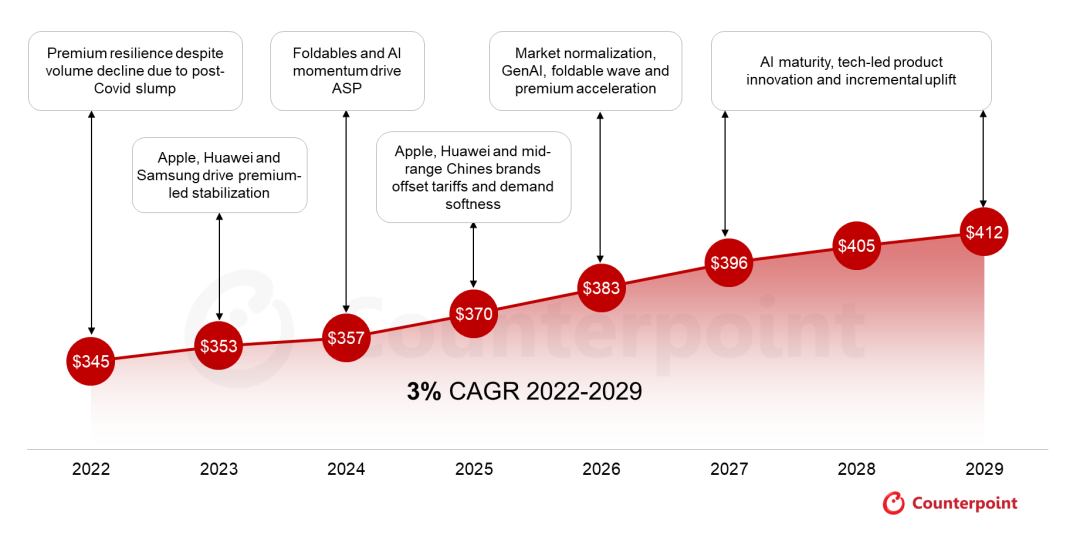
Core Insights - The global smartphone market's Average Selling Price (ASP) is projected to increase from $357 in 2024 to $370 in 2025, reaching $412 by 2029, with a CAGR of 3% driven by high-end trends and 5G adoption [1][4][10] - Smartphone shipments are expected to grow by 2.5% year-on-year in 2025, up from a previous forecast of 1.9%, but lower than the initial estimate of 4% due to price increases, supply chain adjustments, and macroeconomic pressures [1][4] - The combined effect of rising ASP and shipment growth is anticipated to drive smartphone revenue to increase by nearly 6% year-on-year in 2025, with a long-term revenue CAGR of 5% from 2025 to 2029, reaching $564 billion by 2029 [1][4] ASP Trends - North America's ASP is expected to rise by 7% year-on-year in 2025, driven by high-end models and ongoing promotions, with projections for ASP to reach $984 by 2026 [5][6] - In China, the ASP growth forecast for 2025 has been slightly revised down to 3.6%, influenced by Huawei, OPPO, and vivo, while Apple's ASP is expected to increase by about 2% [5][6] - India's ASP is projected to remain below $250 in 2025 but is expected to rise to $287 by 2029 due to the ongoing high-end trend [6] Brand Performance - Apple is expected to maintain its high-end market position, with ASP rising from $919 in 2025 to nearly $1,000 by 2029, despite a 9% year-on-year decline in Q1 2025 due to the introduction of the iPhone 16e [6][9] - Samsung's ASP is anticipated to remain stable, with flagship models impacting overall ASP but supported by foldable phones and GenAI integration for long-term growth [9] - Huawei is strengthening its ASP growth in China, driven by its Mate and Pura series, with expectations for overseas market expansion [9] Market Dynamics - The smartphone market is gradually normalizing after years of volatility due to pandemic demand fluctuations and supply chain challenges, with expectations for a more stable market environment by late 2025 to 2026 [4][10] - The introduction of GenAI smartphones is expected to increase the Bill of Materials (BoM) cost by $40-$60 per device, shifting ASP growth from cost-driven to value-driven as consumers are willing to pay a premium for AI-centric devices [9][10] - Foldable smartphones, although currently representing less than 2% of global shipments, are expected to influence consumer perceptions of high-end products, with Apple planning to launch its foldable model by the end of 2026 [10]

大摩:小米新款手机销量料强劲 汽车定制服务将成重要竞争优势
Ge Long Hui· 2025-09-26 01:25
Core Viewpoint - Morgan Stanley believes that the Xiaomi 17 series will see strong sales due to its quality and high cost-performance ratio, which will help accelerate Xiaomi's market share growth in the high-end smartphone sector [1] Group 1: Smartphone Business - Analysts, including Andy Meng, indicate that Xiaomi's strong sales in the Xiaomi 17 series will enhance its position in the high-end smartphone market [1] - The report emphasizes the importance of quality and cost-effectiveness in driving sales for the Xiaomi 17 series [1] Group 2: Electric Vehicle Business - Xiaomi has initiated a dedicated customization service in its electric vehicle business, which is expected to become a core competitive advantage [1] - Although the initial monthly production is only 40 vehicles, there is confidence that this service will scale as the utilization rate of the new electric vehicle factory increases [1] - The customization model is anticipated to be extended to most vehicle models, aiding Xiaomi in maintaining a steady flow of new orders [1] Group 3: Investment Rating - The report maintains an overweight rating for Xiaomi, reflecting confidence in its growth prospects in both the smartphone and electric vehicle sectors [1]
雷军:不少人有偏见,固执地认为小米没啥技术、就是组装厂
Guan Cha Zhe Wang· 2025-09-26 01:13
Core Insights - Xiaomi's chairman Lei Jun addressed the company's journey towards becoming a technology-driven firm, emphasizing the importance of self-developed chips and electric vehicles in the face of intense competition from giants like Apple, Samsung, and Huawei [1][11] - The company has faced skepticism regarding its technological capabilities, often being labeled merely as an assembly factory [1][11] Chip Development - Xiaomi launched its first flagship 3nm chip, the Xuanjie O1, marking a significant achievement in its chip development journey [4][10] - The company previously faced challenges with its chip division, particularly with the failure of its first chip, the Surge S1, which led to a temporary halt in SoC development [6][7] - The decision to re-enter the chip market was driven by the belief that self-developed chips are essential for success in the tech industry [8][10] Market Competition - The smartphone market is described as highly competitive, with six major players each holding an average market share of 15-16% in China [1][11] - Xiaomi aims to adopt a long-term strategy in the smartphone market, focusing on sustained growth rather than quick wins [19] Automotive Ventures - Xiaomi's entry into the automotive sector has been met with significant challenges, including public skepticism and competition from established players [22] - The company has emphasized the importance of collaboration within the automotive industry to foster a positive environment for growth [22] - Xiaomi's electric vehicle models, such as the SU7 and YU7, are seen as critical to its automotive strategy, with a focus on unique design rather than following competitors [20][22]
2025年Q2越南智能手机出货量中5G份额首次突破50%
Counterpoint Research· 2025-09-26 01:02
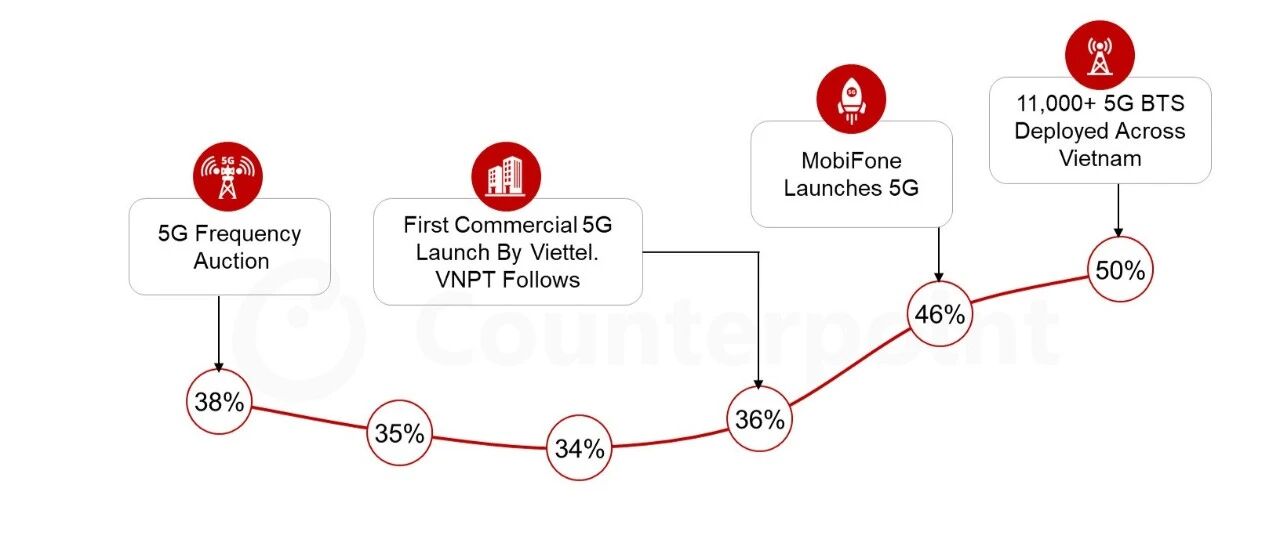
Core Insights - In Q2 2025, 5G smartphones in Vietnam achieved a significant milestone by surpassing 50% of the overall smartphone shipment volume, driven by collaborative efforts across the ecosystem to promote 5G adoption [4][5]. - Despite challenges in the market and macroeconomic uncertainties leading to a decline in overall smartphone shipments, the shipment volume of 5G smartphones in Vietnam still experienced a 13% year-on-year growth in Q2 2025, indicating strong consumer demand for 5G devices since the launch of 5G services [5][7]. - The average selling price (ASP) of 5G smartphones decreased by 12% year-on-year in Q2 2025, enhancing product affordability and accessibility for consumers [5]. Market Dynamics - Global OEMs played a dominant role in driving the growth of 5G smartphone shipments in Vietnam, with Apple and Samsung contributing a combined 73% of the 5G shipment volume in Q2 2025 [7][9]. - Apple emerged as the leading brand in Vietnam's 5G smartphone market, accounting for 40% of the total 5G smartphone shipments in Q2 2025, supported by discounts and promotions on both new and older iPhone models [9]. - Samsung ranked second, with 60% of its smartphone shipments in Vietnam being 5G models, and offered promotional incentives such as three months of free 5G data for users purchasing specific models [9][10]. Competitive Landscape - OPPO ranked third in 5G smartphone shipments, leveraging its Reno14 series, which supports 5G across its entire lineup [9]. - Chinese manufacturers like Xiaomi and vivo are actively expanding their 5G product lines, with Xiaomi launching the 5G-enabled Redmi Note 14 and vivo transitioning from 4G to 5G models [10]. - The introduction of more 5G models across various price segments is expected to further accelerate the adoption of 5G smartphones in Vietnam, with projections indicating that the share of 5G smartphones in overall shipments will exceed 50% by the end of 2025 [10].
2025年Q2拉美智能手机出货量在不利经济环境下仍同比增长4%
Counterpoint Research· 2025-09-26 01:02
Core Insights - The smartphone shipment volume in Latin America increased by 4% year-on-year in Q2 2025, supported by price competition and promotional activities despite a challenging economic environment [4][9] - The low base from the previous year also positively impacted the growth rate for this quarter [4] Market Performance - Seasonal factors contributed to a quarter-on-quarter increase in shipments, marking the second-largest sales season of the year in the region [6] - Mother's Day and Father's Day promotions significantly boosted demand in most Latin American countries, except Argentina [6] - Argentina, Chile, and Peru experienced notable growth, with Argentina's shipments doubling due to a low base last year [6] Competitive Landscape - Samsung maintained a leading market share of over 70% in Brazil and Mexico, despite the entry of several Chinese brands [6] - Motorola and Samsung continue to dominate the market, with new entrants facing challenges in brand recognition and capacity building [6] - Xiaomi achieved double-digit year-on-year growth in Q2 2025, solidifying its position in markets like Chile and Colombia [12] 5G Penetration - The 5G penetration rate in Latin America reached 42% in Q2 2025, with a year-on-year increase of 6% [9] - Local consumers prioritize affordability and features like camera quality and storage over 5G technology [6][9] - OPPO leads among Chinese brands in 5G market share, with Apple and Samsung also ranking in the top three [6] Brand Performance - Samsung's shipment volume grew by 8% year-on-year, aided by price reductions and extensive advertising [8][9] - Apple's shipment volume declined by 10% due to weak demand in Brazil and inventory adjustments from Q1 2025 [12] - Motorola's shipments continued to decline, particularly impacted by a nearly 64% drop in the Mexican market [12]
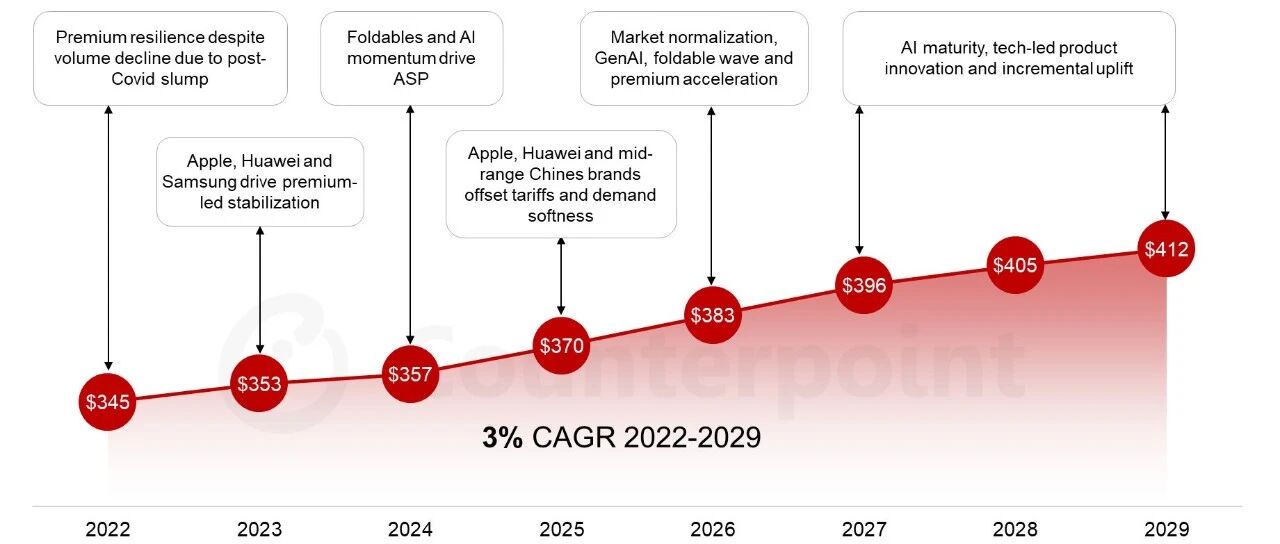
全球智能手机平均售价将从2025年的370美元升至2029年的412美元
Counterpoint Research· 2025-09-26 01:02
Core Viewpoint - The global smartphone average selling price (ASP) is projected to increase from $370 in 2025 to $412 in 2029, with a compound annual growth rate (CAGR) of 3% driven by high-end trends and the adoption of 5G technology [4][6][10]. Market Trends - The global smartphone market is expected to see a 2.5% year-on-year growth in shipments in 2025, an increase from the previous forecast of 1.9% [6]. - The ASP is anticipated to rise by 3.5% to $370 in 2025, influenced by price increases in North America and economic recovery in India and other Asia-Pacific regions [6][10]. - Smartphone revenue is projected to grow nearly 6% year-on-year in 2025, with a long-term CAGR of 5% from 2025 to 2029, reaching $564 billion by 2029 [10]. Regional Insights - In North America, the ASP is expected to grow by 7% year-on-year, while in China, it is projected to increase by 3.6%, primarily driven by high-end models [10][11]. - India’s ASP is expected to remain below $250 in 2025 but will gradually rise to $287 by 2029 due to the high-end trend [12]. Brand Performance - Apple is projected to maintain its position as a leader in high-end smartphone ASP, with an expected increase from $919 in 2025 to nearly $1000 by 2029 [10][12]. - Samsung's ASP is expected to remain stable, with flagship models impacting overall ASP but supported by foldable phones and GenAI integration [14]. - Huawei is strengthening its ASP growth in China, driven by its Mate and Pura series, as well as foldable phones [14]. Technology Impact - The introduction of GenAI smartphones is expected to increase the bill of materials (BoM) cost by $40-60 per device, initially raising prices but transitioning to value-driven ASP growth as AI features become more integrated [14][15]. - Foldable smartphones, although currently representing less than 2% of global shipments, are anticipated to elevate consumer perceptions of high-end products [15]. Conclusion - The global smartphone ASP outlook is optimistic, with stabilizing supply chains and diminishing tariff impacts, alongside the proliferation of high-end smartphones, GenAI, and foldable innovations driving gradual ASP increases [15].
雷军:和苹果的竞争漫长而痛苦 国产汽车都在进步 没必要在竞争上搞得很难看
Mei Ri Jing Ji Xin Wen· 2025-09-26 00:56
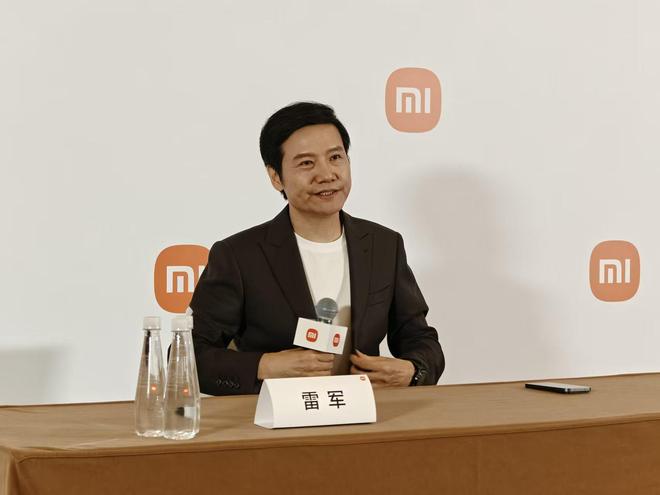
9月25日晚间,小米集团创始人雷军再次站上舞台,开启了他的第六次个人年度演讲。会后,雷军接受 了《每日经济新闻》等媒体的采访。雷军称,踩过坑后,小米已经开启了全面高端化的战略,汽车、手 机,甚至是路由器等电子产品都在向高端化迈进。 每经记者杨卉摄 汽车方面,雷军表示,感激新能源汽车行业所有先行者,并认为目前国产汽车都在进步,大家没必要在 竞争上搞得很难看。虽然小米交付汽车只有一年半的时间,也为国产汽车的高端化做出了贡献。但小米 汽车发布后成为全网被"黑"得最惨的品牌之一,希望汽车产业肃清风气。 手机方面,雷军称市场竞争的复杂度和难度远超过汽车,只能打"持久战"。经过几年摸索,小米形成了 自己的高端化的"方法论":科技引领、认知引领、审美引领。不过,眼下又遇到了新的问题——定制服 务。"如果5年后我们的定制服务(能被)很多高端客户喜欢的话,就基本做成了,能打平了。我都不想 要挣钱,如果可以不亏钱,就算非常成功了。"雷军称。 以下为经过不影响语义的调整的对话实录: 谈小米手机:通过改名,希望外界能够重新认识小米手机 提问:小米17这款产品,从16改名到17,引发了不少热议。同时您也提到要"全面对标iPhone"。 ...
对话雷军:和苹果的竞争漫长而痛苦 国产汽车都在进步,没必要在竞争上搞得很难看
Mei Ri Jing Ji Xin Wen· 2025-09-26 00:56
9月25日晚间,小米集团创始人雷军再次站上舞台,开启了他的第六次个人年度演讲。会后,雷军接受 了《每日经济新闻》等媒体的采访。雷军称,踩过坑后,小米已经开启了全面高端化的战略,汽车、手 机,甚至是路由器等电子产品都在向高端化迈进。 汽车方面,雷军表示,感激新能源汽车行业所有先行者,并认为目前国产汽车都在进步,大家没必要在 竞争上搞得很难看。虽然小米交付汽车只有一年半的时间,也为国产汽车的高端化做出了贡献。但小米 汽车发布后成为全网被"黑"得最惨的品牌之一,希望汽车产业肃清风气。 手机方面,雷军称市场竞争的复杂度和难度远超过汽车,只能打"持久战"。经过几年摸索,小米形成了 自己的高端化的"方法论":科技引领、认知引领、审美引领。不过,眼下又遇到了新的问题——定制服 务。"如果5年后我们的定制服务(能被)很多高端客户喜欢的话,就基本做成了,能打平了。我都不想 要挣钱,如果可以不亏钱,就算非常成功了。"雷军称。 以下为经过不影响语义的调整的对话实录: 谈小米手机:通过改名,希望外界能够重新认识小米手机 提问:小米17这款产品,从16改名到17,引发了不少热议。同时您也提到要"全面对标iPhone"。该如何 理解这句 ...
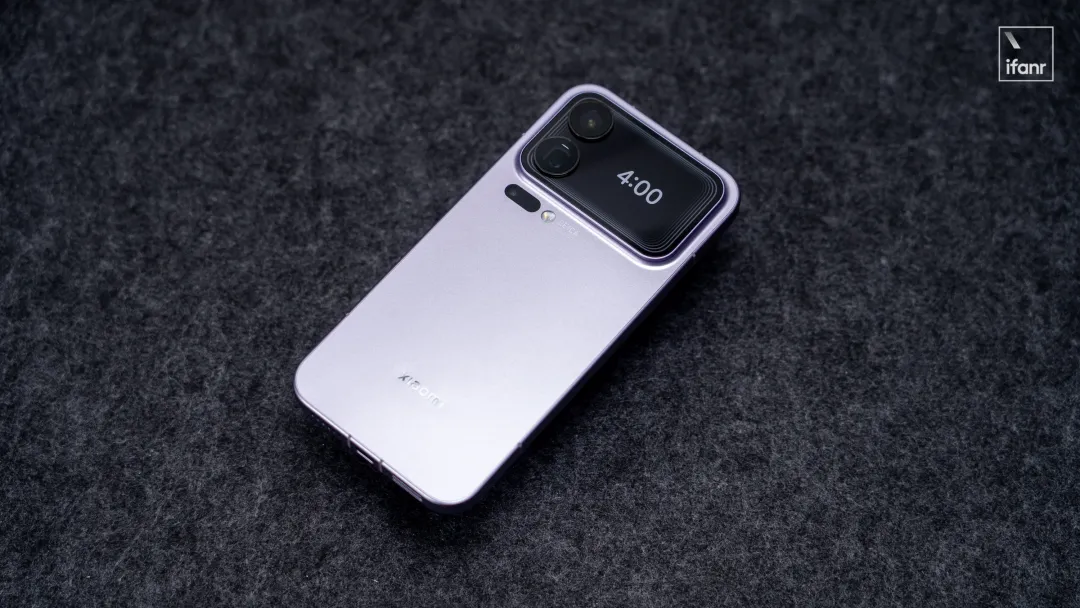
小米17Pro Max首发评测:米冲高,要退烧
Hu Xiu· 2025-09-26 00:54
Core Viewpoint - Xiaomi is shifting its strategy with the launch of the Xiaomi 17 Pro Max, aiming to appeal to a broader audience rather than just tech enthusiasts, marking a significant evolution in its flagship smartphone offerings [2][99][100]. Design and Features - The Xiaomi 17 Pro Max features a new design that moves away from the previous camera layout, incorporating a secondary display similar to the MIX Flip2, which enhances user experience [6][8]. - The phone's design aims to attract a wider customer base, including female users, reflecting a shift in target demographics [9][11][15]. - Compared to its predecessors, the Xiaomi 17 Pro Max has a more refined aesthetic with reduced curvature on the edges, enhancing its visual appeal [16]. Hardware and Performance - The device is powered by the fifth-generation Snapdragon 8 processor, which offers a 20% performance improvement over its predecessor [21]. - In benchmark tests, the Xiaomi 17 Pro Max achieved notable scores, indicating strong performance capabilities [22][23]. - The phone features a 6.9-inch display with a peak brightness of 3500 nits, significantly improving visibility in various lighting conditions [28]. Camera and Imaging - The Xiaomi 17 Pro Max boasts a 5000 MP camera system, with enhancements such as LOFIC technology that improves dynamic range and detail retention in high-contrast scenes [40][50]. - The introduction of a secondary display allows for improved selfie capabilities, positioning the device as a strong contender for users interested in high-quality front-facing photography [62][64]. Charging and Battery - The device supports 100W PPS public charging protocol, allowing for faster charging with compatible chargers, which is a growing trend in the industry [36][39]. - The Xiaomi 17 Pro Max is equipped with a large 7300 mAh battery, providing extended usage time [101]. Market Positioning - Xiaomi's strategy with the 17 Pro Max indicates a shift towards appealing to mainstream consumers rather than just tech enthusiasts, which could help the brand capture a larger market share [99][100]. - The pricing of the Xiaomi 17 Pro Max at 5999 yuan positions it competitively against other flagship devices, aiming to be an accessible option for a broader audience [103].