
养老等

Search documents
“十四五”期间,烟台全市改革呈现多点突破、全面发力
Qi Lu Wan Bao· 2025-12-26 02:09
Core Viewpoint - Yantai City is actively implementing comprehensive reforms during the "14th Five-Year Plan" period, aiming to enhance economic development and establish itself as a leading city in northern China with a GDP exceeding 1 trillion yuan [1][2]. Economic Development and Reform - Yantai's GDP has crossed three trillion yuan milestones, becoming the first prefecture-level city in northern China to exceed 1 trillion yuan in 2023 [2]. - The city has developed a modern industrial system, with 252 enterprises contributing nearly 70% of the industrial output value while representing less than 10% of the total number of industrial enterprises [2]. - Yantai has been recognized for its strategic emerging industries, with the establishment of several significant industrial clusters, including one valued at 300 billion yuan and another at 200 billion yuan [2]. Institutional and Market Reforms - The city has implemented significant reforms in state-owned enterprises, reducing the number from 19 to 12 and optimizing their operations [3]. - Yantai's state-owned enterprises are expected to see asset growth of 111%, revenue growth of 119%, and profit growth of 15% compared to the end of the "13th Five-Year Plan" [3]. Business Environment and Financial Reforms - Yantai has introduced over 600 innovative measures to improve the business environment, addressing more than 6,300 feedback requests from enterprises [4]. - The city has maintained its position as the top city in China for fiscal transparency for eight consecutive years [4]. Regional Development and Urban Planning - Yantai is advancing urban planning reforms, with significant projects underway to improve urban infrastructure and living conditions for nearly 500,000 households [5]. - The city has established 126 rural revitalization zones to support agricultural and rural development [6]. Green and Low-Carbon Development - Yantai has been recognized as a national pilot city for carbon peak initiatives and has made significant strides in clean energy development [7]. - The city has achieved air quality standards for eight consecutive years and has been awarded the International Garden City Gold Award [7]. Social Development and Public Services - Yantai has implemented reforms in education, healthcare, and social security, with a focus on improving employment support for key demographics [8]. - The city has achieved a 95% coverage rate for preschool education and has established a comprehensive elderly care service system [8]. Safety and Governance - Yantai has developed a robust social governance framework, receiving recognition as a model city for social governance modernization [9]. - The city has established a collaborative mechanism between government and judicial bodies to enhance legal and social stability [9]. Party Leadership and Reform Direction - Yantai emphasizes the integration of party leadership in all reform processes, ensuring alignment with national and provincial directives [11]. - The city is committed to continuous reform efforts, focusing on systemic integration and practical outcomes to support its development goals [12].
82.93%支出用于民生“真金白银”回应民生关切
Xin Lang Cai Jing· 2025-12-23 20:11
Core Insights - The article highlights the significant improvements in public welfare and living conditions in Yushu City, driven by substantial government investment in education, healthcare, and social services [2]. Group 1: Education - Since the beginning of the 14th Five-Year Plan, Yushu City's fiscal spending on public welfare has consistently exceeded 82.93%, focusing on effective implementation of welfare initiatives [2]. - The gross enrollment rate for preschool education has reached 91.5%, while the retention rate for compulsory education stands at 97.51%, and the gross enrollment rate for high school education is at 92.7% [2]. - A total of 356 million yuan has been invested in 39 projects for new construction, expansion, and renovation, alongside improvements in campus heating and food safety [2]. Group 2: Healthcare - The healthcare services have been upgraded and the medical network at the county, township, and village levels has been strengthened, consolidating the achievements in the prevention of major infectious and endemic diseases [2]. - The implementation of "legal health insurance" has been prioritized, ensuring comprehensive coverage of basic medical care, serious illness insurance, and medical assistance [2]. Group 3: Employment and Social Services - Employment initiatives have been effectively targeted, resulting in the creation of 304 new urban jobs and 1,908 instances of labor transfer from rural areas [2]. - The employment rate for college graduates remains stable at 92% [2]. - Various measures have been taken to enhance social services for the elderly and children, including renovations of service facilities and the operation of community meal service points [2].
三部门发文:加快推动个人消费贷款业务发展
Sou Hu Cai Jing· 2025-12-15 15:45
Core Viewpoint - The recent notice issued by the Ministry of Commerce, the People's Bank of China, and the Financial Regulatory Administration aims to strengthen the collaboration between commerce and finance to boost consumer spending and enhance financial support for consumption [1]. Group 1: Financial Support for Consumption - Local governments are encouraged to collaborate with financial institutions to develop specialized work plans and enhance communication mechanisms, thereby increasing financial supply in the consumption sector [1]. - Financial institutions are urged to partner with platforms and key merchants to improve payment services such as installment payments, credit cards, mobile banking, and digital RMB, catering to consumer upgrade demands [1]. - The notice emphasizes the need to expand the customer base while ensuring compliance and risk control, particularly targeting "long-tail" customers to enhance accessibility and convenience [1]. Group 2: Promotion of Consumption Policies - The notice calls for the utilization of both commerce and finance channels to promote existing financial support measures for consumption, encouraging enterprises and consumers to fully leverage policy benefits [1]. - Financial consumer rights protection is highlighted, guiding consumers towards rational borrowing and consumption [1]. Group 3: Focus on Key Consumption Areas - There is a push to enhance financial services for durable goods and digital products, aiming to unlock potential in product consumption upgrades [4]. - The notice encourages the development of financial products and services tailored to service consumption sectors such as home services, hospitality, entertainment, education, tourism, and elderly care [5]. - New consumption models, including green consumption and digital consumption, are to be supported through innovative financial services that align with local conditions [6]. Group 4: Integration of Financial Services - The integration of financing, settlement, and insurance services is encouraged to support new consumption scenarios and enhance the financial backing for various commercial activities [7]. - Financial institutions are urged to actively participate in local consumption promotion activities organized by business authorities [8].


21社论丨增强消费品供需适配性,促进扩内需稳增长
21世纪经济报道· 2025-11-27 02:34
Core Viewpoint - The article discusses the implementation plan aimed at enhancing the adaptability of supply and demand in consumer goods, with a focus on optimizing the supply structure and promoting high-quality development in consumption by 2027 and 2030 [1][2]. Group 1: Current Challenges in Consumer Goods Market - The fundamental issue in China's consumer goods market is the structural problem where the supply side has not timely responded to the trend of consumption upgrading [2]. - There is a significant need to improve the supply of high-quality, high-value-added products and brand premium capabilities, particularly in sectors like home appliances and new energy vehicles [2]. - Service consumption still has considerable room for upgrade, with restrictions in sectors such as education, healthcare, and elderly care limiting the supply of quality services [2]. Group 2: Key Tasks and Strategies - The plan outlines five areas with 19 key tasks to promote positive interaction between supply and consumption [2]. - Emphasis is placed on technological empowerment to drive industrial upgrades, focusing on sectors like automotive, home furnishings, and consumer electronics [3]. - The establishment of unified service standards and monitoring systems in service sectors is crucial for enhancing service quality and promoting brand protection [3]. Group 3: Market Activation and Channel Optimization - The plan calls for the continuous implementation of policies to expand market access and open up service sectors, addressing local protectionism and market segmentation [4]. - There is a need to enhance government investment structures to improve accessibility to quality supply, particularly in rural areas, to unleash rural consumption potential [4]. Group 4: Innovation and Supply Expansion - The article highlights the importance of scenario innovation and the integration of various business formats to expand supply space, promoting deep integration of culture, tourism, and technology with consumption [5]. - Support for the construction of international consumer center cities and the enhancement of consumer finance policies are essential for fostering a conducive environment for consumption [5].
粤港澳联合发布新一批二十七项“湾区标准”
Ren Min Ri Bao· 2025-10-14 23:16
Core Points - The Guangdong Provincial Market Supervision Administration, along with the Hong Kong and Macau authorities, announced a new batch of 27 "Bay Area Standards" on World Standards Day, October 14 [1] - The newly released standards cover various sectors including industry, business, and culture, with specific examples such as "green bond environmental benefit information disclosure indicators" and "home care health management services for the elderly" [1] - Aiming to support the upcoming 15th National Games and the Special Olympics in the Greater Bay Area, a standard for "general guidelines for volunteer services at large events" was introduced [1] - To date, a total of 262 "Bay Area Standards" have been jointly established by the three regions, encompassing fields like transportation, water conservancy, traditional Chinese medicine, green ecology, and elderly care services [1] - The formulation and promotion of these standards are expected to enhance regulatory alignment and mechanism connectivity in the Greater Bay Area, facilitating regional integration and contributing to the development of a world-class bay area and a world-class city cluster [1]
扩大服务消费从供需两端发力(权威发布)
Ren Min Ri Bao· 2025-09-17 22:22
Core Viewpoint - The Chinese government has introduced a series of policies aimed at expanding service consumption, which is seen as a crucial driver for economic growth and improving living standards. The measures focus on addressing barriers to service consumption development and enhancing the quality and variety of service offerings [1][2][3]. Group 1: Policy Measures - The policies emphasize a combination of improving people's livelihoods and promoting consumption, including initiatives for high-profile sports events, long-term care insurance, and early childhood education [1]. - The measures advocate for a dual approach of optimizing supply and stimulating demand, proposing pilot projects for new consumption models and enhancing consumer credit support [2]. - The government aims to balance external openness and internal deregulation, encouraging foreign investment in service sectors while reducing market entry barriers for domestic and foreign businesses [2]. Group 2: Market Performance - In the first half of the year, over 19 million foreign visitors entered China, marking a 30% increase year-on-year, with visa-free entries rising by 54% [3]. - The number of duty-free shops has tripled compared to the end of 2024, with a 248% increase in the number of people benefiting from duty refunds and a 98% rise in refund sales [3]. Group 3: Service Quality Enhancement - The government plans to enhance service supply quality by promoting innovation in service sectors, integrating various consumption formats, and increasing the availability of skilled service personnel [4]. - The Ministry of Culture and Tourism aims to improve tourism services and experiences through initiatives like the "Strong Foundation Renewal Action" for tourist attractions and promoting diverse tourism products [5]. Group 4: Financial Support - The People's Bank of China has established a 500 billion yuan fund to support service consumption and elderly care, with significant loan applications already submitted by financial institutions [5]. - As of July, the loan balance in key service consumption sectors reached 2.79 trillion yuan, reflecting a year-on-year growth of 5.3% [5].
激发经济发展内生动力和创新活力 国务院批准在10个地区开展要素市场化配置综合改革试点
Jin Rong Shi Bao· 2025-09-12 02:01
Core Viewpoint - The State Council has approved a pilot program for comprehensive reform of factor market-oriented allocation in 10 regions, aiming to enhance resource allocation efficiency and promote high-quality economic development [1][2]. Group 1: Pilot Regions and Characteristics - The 10 approved regions for the pilot program include Beijing Urban Sub-center, Jiangsu Su-Nan Key Cities, Zhejiang Hangzhou-Ningbo-Wenzhou, Anhui Hefei Metropolitan Area, Fujian Fuzhou-Xiamen-Quanzhou, Henan Zhengzhou, Hunan Chang-Zhu-Tan, Guangdong Greater Bay Area, Chongqing, and Sichuan Chengdu [2]. - These regions are characterized by strong economic growth and development foundations, making them representative for the reform [2]. Group 2: Reform Measures and Goals - The pilot program will focus on various reform measures tailored to local conditions, including stimulating technological innovation, promoting efficient land allocation, guiding human resource mobility, and enhancing capital service capabilities for the real economy [2][3]. - The program aims to improve factor coordination efficiency, explore new allocation methods, and foster new productive forces [3]. Group 3: Financial Support and Initiatives - The People's Bank of China is committed to supporting the pilot program by enhancing financial services and promoting green finance initiatives, including the issuance of a new green finance support project directory by 2025 [4][5]. - As of the second quarter of 2025, over 1.38 trillion yuan in carbon reduction loans have been issued, and green loan balances reached approximately 42.4 trillion yuan, indicating significant financial backing for green and innovative projects [5]. Group 4: Data Resource Utilization - The National Data Bureau plans to enhance the value of public data resources in the pilot regions, addressing issues such as data quality and circulation [7][8]. - The focus will be on developing data sharing and transaction mechanisms while ensuring data security, with specific tasks assigned to regions like Fuzhou-Xiamen-Quanzhou and the Greater Bay Area [8].
华夏时评:多样化提振消费,财政发力空间大
Hua Xia Shi Bao· 2025-08-15 13:10
Group 1 - The core viewpoint emphasizes that consumption is a crucial engine for economic growth and a key link in facilitating domestic circulation, highlighting the importance of fiscal measures in boosting consumption [2] - On August 12, the Ministry of Finance, in collaboration with other governmental bodies, released two new policies aimed at promoting consumption through interest subsidies on personal consumption loans and service industry loans [2] - The personal consumption loan interest subsidy covers various sectors including household vehicles, education, and healthcare, with a subsidy rate of 1% for a duration of one year [2][3] Group 2 - The service industry loan interest subsidy focuses on eight major consumption service sectors such as dining, health, and tourism, also offering a 1% subsidy for one year [2] - The Deputy Minister of Finance described these policies as a significant financial support to enhance consumer spending and improve service levels in the consumption sector, likening it to a "national subsidy" [3] - Recent fiscal policies have established a trend where fiscal measures are becoming the cornerstone for boosting consumption and ensuring livelihoods, indicating a need for increased fiscal spending and precision in targeting [4] Group 3 - The implementation of a childcare subsidy program starting January 1, 2025, will provide annual subsidies of 3,600 yuan per child for families with children under three years old, aiming for comprehensive coverage under the three-child policy [4] - A policy for free preschool education will be introduced in the fall semester of 2025, eliminating fees for public kindergarten for the final year, with a focus on increasing government investment [4] - A recent announcement regarding an increase in basic pension levels for retirees, effective January 1, 2025, will see an overall adjustment of 2% based on the average monthly pension of retirees in 2024 [5] Group 4 - The methods of fiscal intervention are becoming increasingly diverse and impactful, with a focus on ensuring that every penny of fiscal spending is directed to areas of greatest need [6] - The potential for fiscal measures to leverage and stimulate consumption remains significant, indicating a proactive approach to economic recovery [6]

这两项贴息政策,关系着你我的消费开支
Xin Hua She· 2025-08-14 03:31
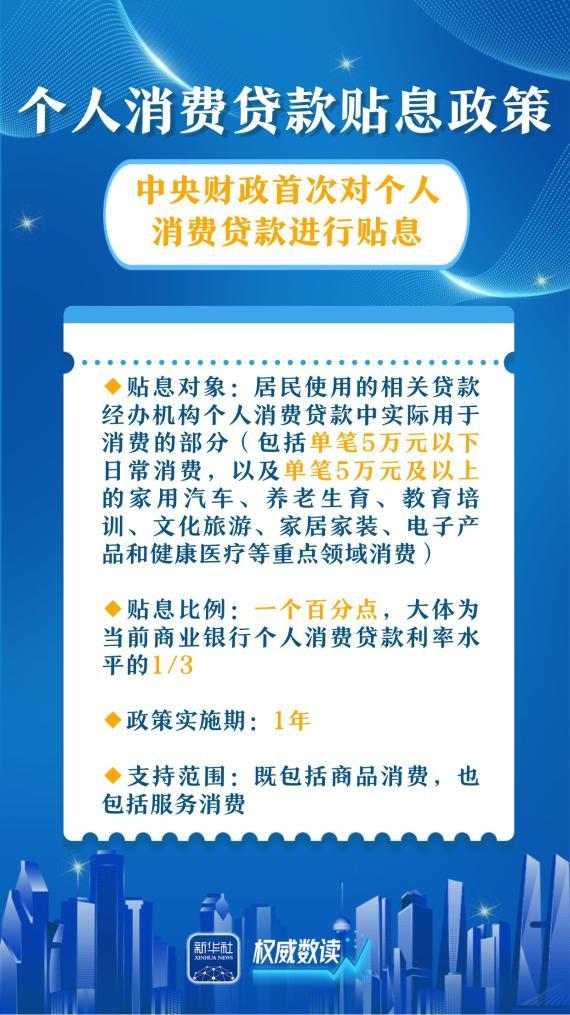
Core Viewpoint - The government has introduced two subsidy policies for personal consumption loans and service industry loans to stimulate consumption and support businesses, focusing on improving residents' living standards and enhancing service quality [1]. Personal Consumption Loan Subsidy Policy - The central government will provide interest subsidies for personal consumption loans, targeting loans used for various consumer expenditures, including daily expenses and significant purchases like cars and home renovations [2]. - The subsidy rate is set at 1%, approximately one-third of the current interest rate for personal consumption loans [2]. - The policy will be implemented for one year and covers both goods and service consumption [2]. Service Industry Loan Subsidy Policy - The subsidy targets bank loans issued to service industry businesses, focusing on eight key sectors such as dining, health, and tourism [3]. - Similar to the personal loan policy, the subsidy rate is also 1% and can be applied for one year [3]. - Each business can receive a maximum subsidy of 10,000 yuan for loans up to 1 million yuan [3]. Application Conditions for Personal Consumption Loan Subsidy - Individuals must have obtained a consumption loan from September this year and demonstrate actual consumption behavior [4]. - The maximum subsidy for a single loan is 500 yuan, with a cumulative maximum of 3,000 yuan for multiple loans [4]. Application Conditions for Service Industry Loan Subsidy - Businesses must utilize the loan funds for operational activities to qualify for the subsidy [5]. Loan Subsidy Processing for Personal Consumption - Borrowers need to authorize the lending institution to access transaction information for subsidy processing [9]. - The lending institution will deduct the subsidy amount from the interest payments, and borrowers will be notified through various channels [9]. Loan Subsidy Processing for Service Industry - Businesses follow standard credit procedures to apply for loans, and once the subsidy funds are received, the bank will refund the interest paid [11]. - Future interest payments will have the subsidy deducted directly by the bank [11]. Cost-Saving Examples - A consumer taking a 200,000 yuan loan for home renovation at a 3% interest rate could save 2,000 yuan in interest due to the subsidy [13]. - A restaurant receiving a 900,000 yuan loan can benefit from a total subsidy of 9,000 yuan, with the bank refunding part of the subsidy after receiving government funds [15]. Key Highlights of the "Double Subsidy" Policy - The policy aims for precise subsidies, greater support for consumption, broader coverage, efficient processing, and a focus on serving consumers and businesses [16].
项目进展顺利 承诺加速兑现 京口“十大民生实事”交出亮眼“期中答卷”
Zhen Jiang Ri Bao· 2025-08-05 23:36
Core Points - The article highlights the progress of the "Ten Major Livelihood Projects" in Jingkou District, which are aimed at improving the quality of life for residents by addressing key social needs [1][2][3] Group 1: Education and Child Services - Nine "Public Summer Care Service" classes have successfully opened, providing meaningful summer experiences for children [1] - Thirteen schools have completed electrical upgrades and air conditioning installations ahead of schedule [2] Group 2: Employment and Economic Support - The Human Resources Department has created nine temporary public welfare jobs and hosted seven job fairs, offering over 200 job positions [2] - Assistance has been provided to 415 individuals facing employment difficulties [2] Group 3: Health Services - The construction of the medical imaging diagnostic center is progressing well, with initiatives for free dental checks and cancer screenings for specific demographics [2][3] - Health lectures and consultations have reached over 3,300 individuals [2] Group 4: Elderly Care - A new 5,500 square meter elderly care facility is under construction, expected to add 160 beds [2] Group 5: Housing and Community Development - Projects aimed at improving community living conditions are underway, with specific street improvement plans being developed [2][3] Group 6: Infrastructure and Environmental Improvements - Road repairs and upgrades are being completed, including the restoration of damaged road surfaces [3] - Environmental initiatives, such as the improvement of water bodies and rural construction projects, have been successfully completed [3] Group 7: Public Safety - Flood prevention measures are being implemented, with ongoing work on the Yangtze River embankment [3]