家政等

Search documents
商务部、国家发改委等九部门发布重要行动通知
中国能源报· 2026-01-05 09:05
Core Viewpoint - The article emphasizes the implementation of green consumption initiatives to promote sustainable development and reduce carbon emissions across various sectors in China [1][2]. Group 1: Richening Green Product Supply - Encouragement for enterprises to expand the supply of green agricultural products, including organic and geographical indication products, and to establish dedicated sales areas for these products [2]. - Promotion of green home appliances and home decoration, urging the purchase of certified green products and the use of eco-friendly materials [3]. - Support for the consumption of new energy vehicles and the development of related markets, including second-hand cars and car-sharing services [3]. Group 2: Enhancing Green Service Consumption - Development of green dining services, urging restaurants to adopt standards that reduce waste and promote the use of biodegradable packaging [4]. - Promotion of green accommodation, encouraging hotels to use non-toxic and biodegradable cleaning products and to provide refillable toiletries [4]. - Encouragement of green housekeeping services that utilize eco-friendly cleaning products and innovative service models [4]. Group 3: Innovating Green Consumption Models - Promotion of green supply chains that prioritize eco-friendly products and practices throughout the supply chain [5]. - Establishment of a green consumption points system to incentivize consumers for purchasing green products and using low-carbon services [6]. - Encouragement of innovative sharing models, including shared transportation and resource-sharing platforms [6]. Group 4: Promoting Green Circular Recycling - Reduction of single-use plastic products through various initiatives, including the promotion of reusable shopping bags [7]. - Development of a comprehensive recycling system for waste products, including furniture and electronics, to enhance recycling efficiency [7]. - Support for the circulation of second-hand goods and the establishment of platforms for second-hand transactions [8]. Group 5: Optimizing Green Consumption Environment - Promotion of energy-efficient facilities and smart energy management systems to reduce energy consumption [9]. - Advocacy for green consumption awareness, encouraging consumers to adopt low-carbon lifestyles and make environmentally friendly choices [9]. - Strengthening public awareness campaigns to promote green consumption as part of national ecological and energy-saving initiatives [9]. Group 6: Strengthening Green Consumption Foundation - Encouragement for businesses to adopt green standards and certifications to foster a culture of sustainability [10]. - Participation in the formulation of international standards for green consumption to align with global practices [10]. Group 7: Increasing Policy Support - Strengthening policy integration and coordination among various departments to support green consumption initiatives [11]. - Encouragement for financial institutions to increase support for green consumption loans and innovative financial products [11].

【2026年两节工会送温暖行动·暖闻】送爱心 送法律 送宣讲
Xin Lang Cai Jing· 2026-01-04 20:04
Core Viewpoint - The event organized by the Qinhuangdao Municipal Federation of Trade Unions aims to provide support and legal guidance to workers in new employment forms, particularly in the service industry, enhancing their understanding of industry policies and legal rights [1] Group 1: Event Overview - The event took place at the square in front of the Qinhuangdao Shengjie Property Service Co., attracting a large number of workers [1] - It targeted six new employment sectors, including express delivery, cleaning, housekeeping, laundry, property management, and family services, benefiting 800 frontline workers [1] Group 2: Activities and Services Offered - The event included a special session on the spirit of the 20th Central Committee's Fourth Plenary Session, focusing on policies related to new employment and the service industry [1] - Legal consultation services were provided, with the legal service team explaining labor laws and offering on-site advice on issues such as labor contracts, wage protection, and work injury recognition [1] - Over 900 legal promotional materials, including handbooks and bags, were distributed during the event [1]
上海发文扩大服务消费:推动文博场馆延时开放,培育国际美食集聚区
Sou Hu Cai Jing· 2025-12-29 11:27
Core Viewpoint - Shanghai government has announced measures to enhance service consumption, focusing on high-quality supply, brand innovation, integrated consumption scenarios, and an optimized environment to stimulate growth in the service sector [1]. Group 1: Enhancing High-Quality Service Consumption Supply - The initiative aims to elevate cultural and tourism service levels by extending operating hours for museums and tourist attractions, encouraging innovative exhibition methods, and supporting the creation of high-quality cultural products [1][2]. - The sports service market will be invigorated through the development of event economies and the promotion of the "Shanghai Sports" brand, alongside enhancing public sports facilities [2]. - The education sector will see improved access for non-academic training institutions, with streamlined approval processes and the introduction of diverse learning products for the elderly [2]. - Health consumption will be internationalized, promoting specialized medical services and encouraging collaboration between medical institutions and insurance companies [2]. Group 2: Brand Innovation to Stimulate New Service Consumption Dynamics - There will be increased efforts in brand cultivation, including the establishment of mechanisms to discover new service brands and support for industry organizations in brand development [5]. - A robust standard support system will be developed for various service sectors, ensuring quality and service norms are met [6]. - The foundation for brand development will be strengthened through enhanced capabilities of industry organizations and the establishment of a professional talent pool [6]. Group 3: Creating Integrated Consumption Scenarios - The initiative promotes the creation of cross-sector integrated service consumption scenarios, such as "tourism+", "sports+", and "health+", encouraging collaboration among various service providers [7]. - Support for the "IP+" model will be provided to leverage cultural IPs for driving consumption, particularly in entertainment and digital sectors [7]. - The application of digital technologies like AR and VR will be encouraged to create immersive and sustainable service consumption experiences [7]. Group 4: Optimizing Environment to Stimulate New Service Consumption Growth - A service consumption credit system will be established, promoting credit evaluation and public disclosure of credit ratings for businesses [9]. - Financial institutions will be encouraged to enhance their customer evaluation and risk management systems, supported by third-party credit service providers [9].
消费利好!三部门,最新部署!深化商务和金融系统协作
Zheng Quan Shi Bao Wang· 2025-12-15 02:57
Core Viewpoint - The joint notice issued by the Ministry of Commerce, the People's Bank of China, and the Financial Regulatory Administration aims to strengthen the collaboration between commerce and finance to boost consumption significantly [1][2]. Group 1: Policy Measures - The notice outlines 11 policy measures across three main areas: enhancing collaboration between commerce and finance, increasing financial support for key consumption areas, and expanding cooperation among government, finance, and enterprises [2][4]. - It emphasizes the need for local departments to improve communication and collaboration, encouraging the establishment of mechanisms to address challenges in financial support for consumption [4][5]. Group 2: Financial Support for Consumption - Financial institutions are encouraged to focus on five key areas: upgrading product consumption, expanding service consumption, fostering new consumption types, innovating diverse consumption scenarios, and supporting consumption assistance [2][7]. - Specific measures include enhancing financial services for durable goods and digital products, improving loan policies for personal consumption, and supporting cross-border trade financing [7][8]. Group 3: Government-Finance-Enterprise Cooperation - The notice promotes joint consumption activities organized by local commerce departments and financial institutions, aiming to reach more businesses and consumers [11]. - It encourages the sharing of information and resources between local departments and financial institutions to facilitate precise service delivery and enhance credit construction in the consumption sector [12].
更大力度提振消费,三部门推出11条措施
Di Yi Cai Jing· 2025-12-14 08:34
鼓励有条件的地方运用数字人民币智能合约红包提升促消费政策实施质效。 12月14日,据商务部网站,商务部、中国人民银行、金融监管总局联合印发《关于加强商务和金融协同 更大力度提振消费的通知》(以下简称《通知》)。《通知》提出3方面11条政策措施: 一是深化商务和金融系统协作。推动地方有关部门加强沟通交流和分工协作,鼓励有条件的地方健全沟 通合作机制,强化财政资金、信贷资金与社会资本等合力,细化落实具体实施细则,共同打好政策"组 合拳"。 二是加大消费重点领域金融支持。鼓励金融机构围绕升级商品消费、扩大服务消费、培育新型消费、创 新多元化消费场景、助力消费帮扶五大重点领域,优化金融产品服务,推动供需两端强化对接,提高对 商品和服务消费的适配性,因地制宜推动新型消费发展,支持消费新业态新模式新场景建设,落实落细 各项金融支持举措。 三是扩大政金企对接合作。鼓励发挥"政金企"扩消费合力,开展多层次、多渠道、多样化的促消费活动 和信息共享,做好精准对接服务,用足用好相关政策红利,更好满足相关经营主体和消费者需求。 一、深化商务和金融系统协作 (一)完善协作机制。地方商务主管部门与金融管理部门加强沟通交流和分工协作,结合 ...
加强商务和金融协同 更大力度提振消费 三部门发布通知
Xin Jing Bao· 2025-12-14 08:23
Core Viewpoint - The Ministry of Commerce, the People's Bank of China, and the Financial Regulatory Administration have issued a notification to enhance collaboration between commerce and finance, aiming to boost consumption through increased financial support in key areas [1][2]. Group 1: Strengthening Collaboration - Local commerce departments and financial management authorities are encouraged to improve communication and establish coordination mechanisms to address challenges in financial support for consumption [1]. - Financial institutions are urged to develop specific implementation guidelines and conduct special actions to support consumption based on existing policies [1][2]. Group 2: Financial Support for Key Consumption Areas - There is a focus on upgrading consumer goods, particularly durable goods and digital products, by enhancing financial services and facilitating consumer financing options [3]. - The notification emphasizes the need to expand service consumption by innovating financial products tailored to sectors like hospitality, education, and healthcare [4]. Group 3: Promoting New Consumption Models - The initiative encourages the development of new consumption types, including green and digital consumption, by providing diverse financial services [5]. - Financial institutions are advised to collaborate with e-commerce platforms to create business models that cater to online consumer behavior [5]. Group 4: Enhancing Government-Finance-Enterprise Cooperation - Financial institutions are encouraged to participate in local consumption promotion activities, offering tailored financial products and services to reach more consumers [7]. - There is a call for improved information sharing between local commerce departments and financial institutions to facilitate precise financing services [8]. Group 5: Publicity and Consumer Guidance - The notification highlights the importance of promoting existing financial support policies to both enterprises and consumers, ensuring they can effectively utilize these benefits [8]. - It also stresses the need for consumer protection and guidance on responsible borrowing and consumption practices [8].
三部门十一条措施,更大力度提振消费!
Wind万得· 2025-12-14 08:08
Core Viewpoint - The recent Central Economic Work Conference emphasizes the need for financial institutions to enhance support for expanding domestic demand, leading to the issuance of a notification aimed at boosting consumption through coordinated efforts between commerce and finance [2][3]. Group 1: Strengthening Collaboration Between Commerce and Finance - Local commerce departments and financial management authorities are encouraged to improve communication and establish coordination mechanisms to address challenges in implementing financial support for consumption [3][4]. - Financial institutions are urged to align their resources and develop specific implementation guidelines to support consumption expansion, following existing policy frameworks [4][5]. - Local authorities are encouraged to utilize existing funding channels to promote consumption activities, leveraging digital currency and various financial instruments to enhance policy effectiveness [4][6]. Group 2: Increasing Financial Support for Key Consumption Areas - Financial services for durable goods and digital products are to be enhanced, with a focus on installment payments and credit services to meet consumer upgrade demands [5][6]. - A comprehensive policy support system for service consumption is to be established, promoting innovation in financial products tailored to sectors like hospitality, education, and tourism [6][7]. - New consumption models, including green and digital consumption, are to be explored, with financial institutions encouraged to collaborate with e-commerce platforms to develop suitable business models [7][8]. Group 3: Expanding Government-Financial-Enterprise Cooperation - Financial institutions are encouraged to participate in local consumption promotion activities, offering tailored products and services to reach a broader consumer base [9][10]. - Information sharing mechanisms are to be established to facilitate better alignment between financial institutions and local commerce departments, enhancing the precision of financial services [9][10]. - Promotion of consumer rights and rational borrowing practices is emphasized, alongside the need for regular updates on the progress of financial support for consumption [10][11].

50城将入围消费新试点 首发经济、国潮IP、夜间消费成发力重点
Zheng Quan Shi Bao Wang· 2025-09-30 11:06
Core Points - The Ministry of Finance and the Ministry of Commerce issued a notification on September 30 to launch pilot projects for new consumption formats, models, and scenarios in approximately 50 cities across the country, with a funding support of up to 400 million yuan per city based on city size [1][2] Funding Support - The central government will provide tiered financial support based on city size: 400 million yuan for super-large cities, 300 million yuan for large cities, and 200 million yuan for other cities, with funds distributed in two batches [2][3] Focus Areas for Innovation - The policy emphasizes supply-side innovation to enhance the consumption market through three main dimensions: 1. Establishing a comprehensive service system for new product launches, including the creation of launch centers and platforms for various sectors [3] 2. Promoting diverse service consumption scenarios, including the development of cultural, health, and entertainment consumption areas, and enhancing night-time economy [3][4] 3. Supporting collaborations between quality consumption resources and well-known intellectual properties (IPs) to create innovative consumption experiences [4] Economic Impact - The pilot projects aim to stimulate employment and drive industry innovation by focusing on new consumption formats and enhancing service sectors such as retail, hospitality, and cultural entertainment, thereby creating more job opportunities [5] Evaluation Criteria - Cities interested in applying for the pilot program will be evaluated based on their market construction, business environment, and potential for consumption market development, with strict regulations on the use of funds to prevent misuse [7]
19项措施扩大服务消费!9部门重磅发文
21世纪经济报道· 2025-09-16 09:28
Core Viewpoint - The article emphasizes the importance of service consumption in improving people's livelihoods and driving economic transformation, outlining measures to boost consumption and expand domestic demand [4]. Group 1: Measures to Promote Service Consumption - The government has proposed 19 measures across five areas to enhance service consumption, including launching "Service Consumption Season" activities and supporting collaborations between quality consumption resources and well-known IPs [5][6]. - There is a focus on extending operating hours for popular cultural and tourist venues and optimizing reservation methods to encourage more visitors [5][6]. Group 2: Enhancing Quality Service Supply - The initiative aims to expand high-level opening of the service industry, particularly in sectors like telecommunications, healthcare, and education, to attract foreign investment [5][6]. - It encourages the development of cultural and artistic projects, enhancing the supply of cultural products and services through various venues [5][6]. Group 3: Stimulating New Service Consumption - The plan includes attracting more foreign visitors by optimizing visa policies and promoting China's cultural resources, such as cuisine and traditional medicine [6][7]. - There is an emphasis on expanding digital service consumption and encouraging e-commerce platforms to innovate in online and offline integration [6][7]. Group 4: Financial Support for Service Consumption - The government will utilize various funding channels to support the construction of service facilities in culture, tourism, and sports [7][8]. - There is a focus on increasing credit support for service consumption sectors, encouraging financial institutions to develop tailored financial products [7][8]. Group 5: Statistical Monitoring and Implementation - The article highlights the need to optimize service consumption statistics and innovate monitoring methods using big data to reflect regional consumption development accurately [8]. - Various departments are tasked with ensuring the implementation of these policies to better meet the diverse service consumption needs of the public [8].

我国一刻钟便民生活圈已服务1.18亿居民,这些业态排名前三
Di Yi Cai Jing· 2025-09-10 08:56
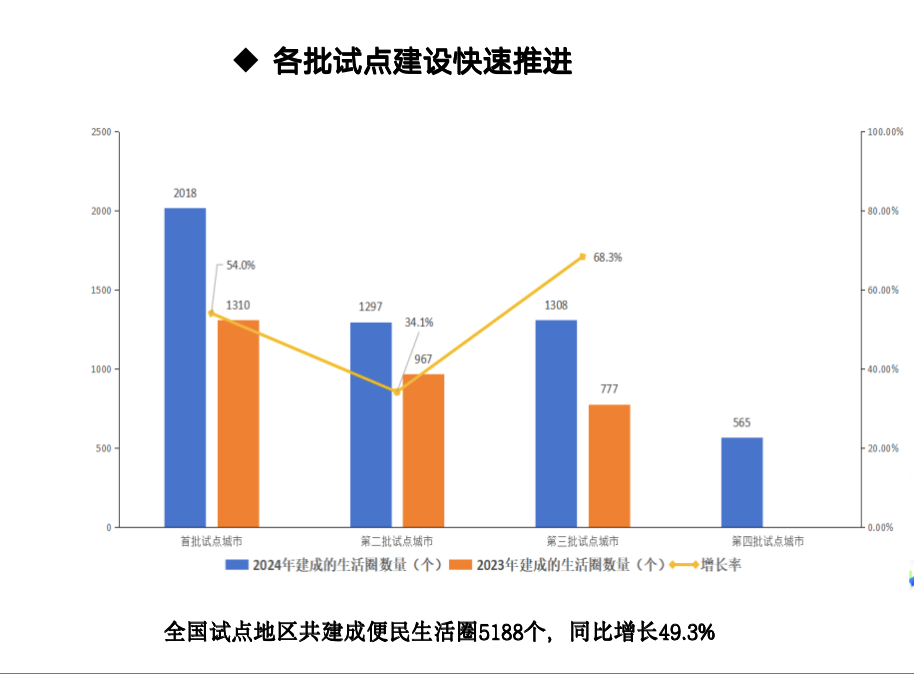
Core Insights - The development of convenient living circles in China is accelerating, with 5,188 circles established by the end of 2024, serving 118 million residents [1][4] - The report highlights that basic service categories dominate the living circles, accounting for 86%, while quality enhancement categories make up 14% [4] - Employment growth has been significantly driven by the establishment of these living circles, creating 7.324 million jobs, a year-on-year increase of 44.9% [4] Group 1 - By the end of 2024, 210 pilot areas in China will have established 5,188 convenient living circles, covering 79% of cities above the prefecture level and 13,600 communities [1] - The overall resident satisfaction rate exceeds 93%, indicating a positive reception of the living circles [1] - The number of community commercial centers has increased to 8,039, a year-on-year increase of 4,044 centers, with an average of 1.6 centers per living circle [4] Group 2 - The report suggests extending the living circles from key cities to eligible county towns, aiming for full coverage in urban and county communities within 2-3 years [5] - The focus should shift from merely meeting basic needs to providing higher quality, more personalized, and precise services, particularly catering to the needs of the elderly and children [5] - The number of communities utilizing smart service platforms has reached 7,250, reflecting a year-on-year growth of 4,044, with a smart coverage rate of 53.2% [4]