
精炼石油产品制造

Search documents
上月PPI环比涨幅扩大
Zhong Guo Hua Gong Bao· 2026-01-13 02:51
Core Viewpoint - The Producer Price Index (PPI) in December 2025 showed a year-on-year decline of 1.9%, with a narrowing decrease compared to the previous month, while a month-on-month increase of 0.2% was observed, indicating a mixed trend in industrial prices driven by supply-demand dynamics and external factors [1]. Group 1: PPI Trends - The year-on-year PPI decline of 1.9% reflects a narrowing of 0.3 percentage points from the previous month [1]. - The month-on-month PPI increased by 0.2%, which is an expansion of 0.1 percentage points compared to the prior month [1]. Group 2: Price Influences - Improvement in supply-demand structure led to price increases in certain sectors, such as a 1.0% rise in lithium-ion battery manufacturing prices for three consecutive months [1]. - Seasonal demand increases contributed to price rises in gas production and supply (1.2%) and electricity and heat production and supply (1.0%) [1]. - Input factors caused a divergence in prices for non-ferrous metals and oil-related industries, with international crude oil prices leading to declines of 2.3% in domestic oil extraction and 0.9% in refined oil product manufacturing [1]. Group 3: Policy Impact and Sector Performance - Continuous effectiveness of macro policies has resulted in positive price changes in certain industries, with the construction of a unified national market contributing to a narrowing of year-on-year price declines [1]. - The growth of new productive forces has led to price increases in related sectors, including a 9.0% rise in biomass liquid fuel prices, 5.5% in graphite and carbon product manufacturing, 2.4% in integrated circuit finished products, and 0.9% in waste resource recycling [1]. - The effective release of consumer potential has also driven year-on-year price increases in relevant industries [1].
扩内需促消费政策显效2025年物价呈温和回升态势
Shang Hai Zheng Quan Bao· 2026-01-09 18:38
Core Viewpoint - The expansion of domestic demand and consumption policies is showing effectiveness, leading to a moderate recovery in prices and improved supply-demand relationships in key industries [2][6][7]. Group 1: CPI and PPI Trends - In December 2025, the Consumer Price Index (CPI) increased by 0.8% year-on-year, marking the highest level since March 2023, with food prices significantly contributing to this rise [2][3]. - The Producer Price Index (PPI) decreased by 1.9% year-on-year in December, but the decline was narrower than in November, indicating positive changes in certain industries due to improved market competition [4][6]. - The core CPI, excluding food and energy, rose by 1.2% year-on-year, maintaining a growth rate above 1% for four consecutive months, reflecting stable demand recovery [3][6]. Group 2: Industry-Specific Insights - Prices in the coal mining, lithium-ion battery manufacturing, and photovoltaic equipment sectors showed reduced declines, indicating a positive trend in market competition and production capacity management [4][5]. - The price of lithium-ion batteries and cement manufacturing increased by 1.0% and 0.5% month-on-month, respectively, demonstrating a recovery in these key industries [4][5]. - The prices of external storage devices and bio-liquid fuels rose by 15.3% and 9.0% year-on-year, respectively, driven by the growth of new productive forces [5]. Group 3: Future Outlook - Experts predict that with continued policy support for domestic demand and consumption, the CPI is expected to show a steady upward trend in 2026, with food prices returning to a reasonable fluctuation range [6][7]. - The overall economic operation is expected to improve, with demand gradually recovering and supply-side structural optimization continuing [7].

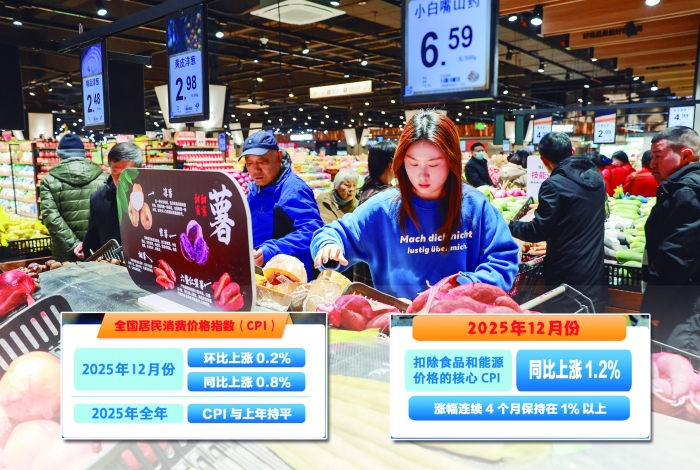
最新CPI数据出炉!环比由降转涨
新华网财经· 2026-01-09 07:49
Group 1 - The core viewpoint of the article indicates that the CPI has turned from a decline to an increase, with a year-on-year rise of 0.8% in December 2025, reflecting a gradual improvement in supply-demand relationships and effective governance in key industries [2][4] - The CPI for the entire year of 2025 remained flat compared to the previous year, while the PPI decreased by 2.6%. Experts anticipate that with the implementation of policies aimed at boosting domestic demand, the price levels are expected to maintain a stable and moderate trend [2] - Food prices significantly contributed to the CPI increase, with food prices rising by 1.1% year-on-year, and specific categories like fresh vegetables and fruits seeing increases of 18.2% and 4.4%, respectively [4][5] Group 2 - The core CPI, excluding food and energy, rose by 1.2% year-on-year, maintaining a growth rate above 1% for four consecutive months, indicating a stable recovery in demand [5][6] - The PPI showed a year-on-year decline of 1.9% in December, but the rate of decline narrowed by 0.3 percentage points compared to November, suggesting positive changes in certain industries due to effective macro policies [8] - Prices in key sectors such as lithium-ion battery manufacturing and photovoltaic equipment have shown signs of recovery, with lithium-ion battery prices increasing by 1.0% month-on-month, indicating a positive trend in the industry [8][9]

2025年12月份CPI同比上涨0.8%!
Zheng Quan Ri Bao Wang· 2026-01-09 03:12
Group 1 - The core consumer price index (CPI) increased by 0.2% month-on-month and 0.8% year-on-year, with core CPI (excluding food and energy) rising by 1.2% year-on-year, indicating a recovery in consumer demand driven by policies to boost consumption and the upcoming New Year holiday [1][2][3] - Food prices rose by 1.1% year-on-year, with significant increases in fresh vegetables (18.2%) and fresh fruits (4.4%), contributing to the overall CPI increase [3][2] - Energy prices decreased by 3.8% year-on-year, with gasoline prices dropping by 8.4%, while the overall CPI was positively impacted by a 0.3% rise in food prices [3][2] Group 2 - The producer price index (PPI) increased by 0.2% month-on-month, marking the third consecutive month of growth, with a narrowing year-on-year decline of 1.9% [4][5] - Key industries such as coal mining and lithium-ion battery manufacturing saw price increases due to improved supply-demand dynamics and ongoing capacity management policies [4][6] - The prices of non-ferrous metals rose significantly due to international price increases, while oil-related industries experienced price declines due to falling crude oil prices [4][6]
解读:12月份CPI同比涨幅继续扩大,PPI同比降幅收窄
Guo Jia Tong Ji Ju· 2026-01-09 01:57
Group 1: CPI Analysis - The Consumer Price Index (CPI) increased by 0.2% month-on-month and 0.8% year-on-year, with the core CPI rising by 1.2% year-on-year, indicating a recovery in consumer demand as the New Year approaches [1][2][3] - The month-on-month increase in CPI was primarily driven by rising prices of industrial consumer goods, excluding energy, which rose by 0.6%, contributing approximately 0.16 percentage points to the CPI increase [2] - Food prices rose by 1.1% year-on-year, with significant increases in fresh vegetables (18.2%) and fresh fruits (4.4%), contributing approximately 0.17 percentage points to the year-on-year CPI increase [3] Group 2: PPI Analysis - The Producer Price Index (PPI) rose by 0.2% month-on-month, marking the third consecutive month of increase, with the growth rate expanding by 0.1 percentage points compared to the previous month [4] - The month-on-month PPI increase was supported by improved supply-demand dynamics, with notable price increases in coal mining (1.3%) and lithium-ion battery manufacturing (1.0%) [4] - Year-on-year, the PPI decreased by 1.9%, but the decline rate narrowed by 0.3 percentage points, reflecting positive price changes in certain industries due to ongoing macroeconomic policies [5]
中国PPI环比连续两个月上涨
Zhong Guo Xin Wen Wang· 2025-12-10 07:58
Group 1 - In November, China's Producer Price Index (PPI) increased by 0.1% month-on-month, marking the second consecutive month of growth [1] - Seasonal demand in certain domestic industries, particularly coal and gas, contributed to the price increase, with coal mining and washing prices rising by 4.1% and gas production and supply prices increasing by 0.7% [1] - The PPI year-on-year decreased by 2.2%, with the decline rate widening by 0.1 percentage points compared to the previous month, influenced by a high comparison base from the previous year [1] Group 2 - The reduction in year-on-year price declines for certain industries indicates the effectiveness of measures against "involution" competition, with coal mining and washing, photovoltaic equipment manufacturing, and lithium-ion battery manufacturing seeing narrowed declines [2] - Emerging industries are driving price increases, with external storage devices and components prices rising by 13.9% year-on-year, graphite and carbon product manufacturing prices increasing by 3.8%, and integrated circuit manufacturing prices up by 1.7% [2]
国家统计局解读:10月份CPI由降转涨 PPI降幅收窄
Di Yi Cai Jing· 2025-11-09 01:52
Group 1: CPI Analysis - The Consumer Price Index (CPI) increased by 0.2% month-on-month and 0.2% year-on-year, with the core CPI (excluding food and energy) rising by 1.2%, marking the sixth consecutive month of growth [1][2][3] - Service prices shifted from a decline of 0.3% to an increase of 0.2%, driven by strong travel demand during the National Day and Mid-Autumn Festival, with hotel accommodation, flight tickets, and tourism prices rising by 8.6%, 4.5%, and 2.5% respectively [2][3] - Food prices increased by 0.3%, contrasting with a seasonal decline of 0.1%, with significant price rises in fresh vegetables, lamb, fresh fruits, and seafood ranging from 0.5% to 4.3% [2][3] Group 2: PPI Analysis - The Producer Price Index (PPI) saw a month-on-month increase of 0.1%, marking the first rise of the year, while the year-on-year decline narrowed to 2.1%, a reduction of 0.2 percentage points from the previous month [1][4][5] - Key industries such as coal mining and photovoltaic equipment manufacturing experienced price increases, with coal mining prices rising by 1.6% and photovoltaic equipment prices by 0.6% [4][5] - The year-on-year decline in PPI was influenced by improved supply-demand dynamics and ongoing capacity governance in key sectors, leading to a narrowing of price declines in industries like coal mining and battery manufacturing [5]
9月份CPI环比上涨0.1% 消费市场运行总体平稳
Ren Min Ri Bao Hai Wai Ban· 2025-10-20 06:13
Group 1: Consumer Price Index (CPI) Insights - In September, the Consumer Price Index (CPI) increased by 0.1% month-on-month but decreased by 0.3% year-on-year, with the core CPI (excluding food and energy) rising by 1.0%, marking the fifth consecutive month of growth [1][2] - Food prices rose by 0.7% month-on-month, contributing approximately 0.13 percentage points to the CPI increase, while clothing prices increased by 0.8% due to seasonal changes [1] - Service prices declined by 0.3%, with significant drops in airfare, hotel accommodation, and tourism prices, collectively impacting the CPI by approximately 0.17 percentage points [1] Group 2: Producer Price Index (PPI) Insights - The Producer Price Index (PPI) remained flat month-on-month and decreased by 2.3% year-on-year, with the decline narrowing by 0.6 percentage points compared to the previous month [2][3] - The PPI's year-on-year decline was influenced by a lower comparison base from the previous year and the positive effects of macroeconomic policies, leading to price stabilization in certain industries [3] - Improvements in supply-demand structures and the impact of international oil price fluctuations contributed to the PPI trends, with coal processing prices rising by 3.8% month-on-month [2][3]
前三季度核心CPI持续回升,PPI降幅有所收窄
Guo Jia Tong Ji Ju· 2025-10-20 02:18
Group 1: Consumer Price Trends - Consumer prices remained stable in the first three quarters, with CPI decreasing by 0.1% year-on-year, consistent with the first half and the first quarter [2] - Core CPI, excluding food and energy, has shown a continuous recovery since March, rising to 1% in September, the highest in nearly 19 months [4] - Food prices saw a year-on-year decline of 1.8%, with fresh vegetable prices averaging a drop of 7.9% and pork prices shifting from an increase of 3.8% in the first half to a decrease of 2.9% in the first three quarters [2] Group 2: Energy Price Trends - Energy prices decreased by 3.3% year-on-year in the first three quarters, with gasoline prices dropping by 7.3% due to international oil price fluctuations [3] Group 3: Producer Price Trends - PPI decreased by 2.8% year-on-year in the first three quarters, with a narrowing decline of 0.3 percentage points in the third quarter compared to the second quarter [5] - The domestic market's competitive order has improved, leading to a recovery in prices for certain industries, such as coal processing and black metal smelting, which saw a reduction in year-on-year price declines [5] Group 4: External Influences on Prices - International oil prices have generally trended downward, impacting domestic oil-related industry prices, with a 9.9% decline in the oil and gas extraction industry [6] - Conversely, international non-ferrous metal prices have risen, leading to a 5.6% year-on-year increase in domestic non-ferrous metal smelting and rolling industries [6] Group 5: High-Tech Industry Developments - The development of high-tech industries and effective macro policies have driven price increases in certain sectors, such as integrated circuit packaging and testing, which rose by 3.0% year-on-year [7] - Upgraded consumer demand has also contributed to price increases in sectors like arts and crafts manufacturing, which saw a 12.7% rise [7]
消费市场运行总体平稳
Sou Hu Cai Jing· 2025-10-20 01:16
Group 1 - The consumer price index (CPI) increased by 0.1% month-on-month in September, while year-on-year it decreased by 0.3%, with the core CPI (excluding food and energy) rising by 1.0%, marking the fifth consecutive month of growth [1][2] - Food prices rose by 0.7% month-on-month, contributing approximately 0.13 percentage points to the CPI increase, while clothing prices increased by 0.8% due to seasonal changes [1] - The producer price index (PPI) remained flat month-on-month and decreased by 2.3% year-on-year, with the decline narrowing by 0.6 percentage points compared to the previous month [2][3] Group 2 - The year-on-year decline in CPI of 0.3% was primarily influenced by a negative carryover effect of approximately 0.8 percentage points, while new price changes contributed about 0.5 percentage points [2] - The PPI's month-on-month stability is attributed to improved supply-demand dynamics in certain industries, with coal processing prices rising by 3.8% and coal mining prices increasing by 2.5% [2][3] - The narrowing year-on-year decline in PPI is a result of ongoing macroeconomic policy effects, with some industries experiencing positive price changes due to market competition and structural upgrades [3]