信息传输

Search documents
10月份国民经济运行基本平稳 稳中有进态势持续
Guo Jia Tong Ji Ju· 2025-11-14 02:01
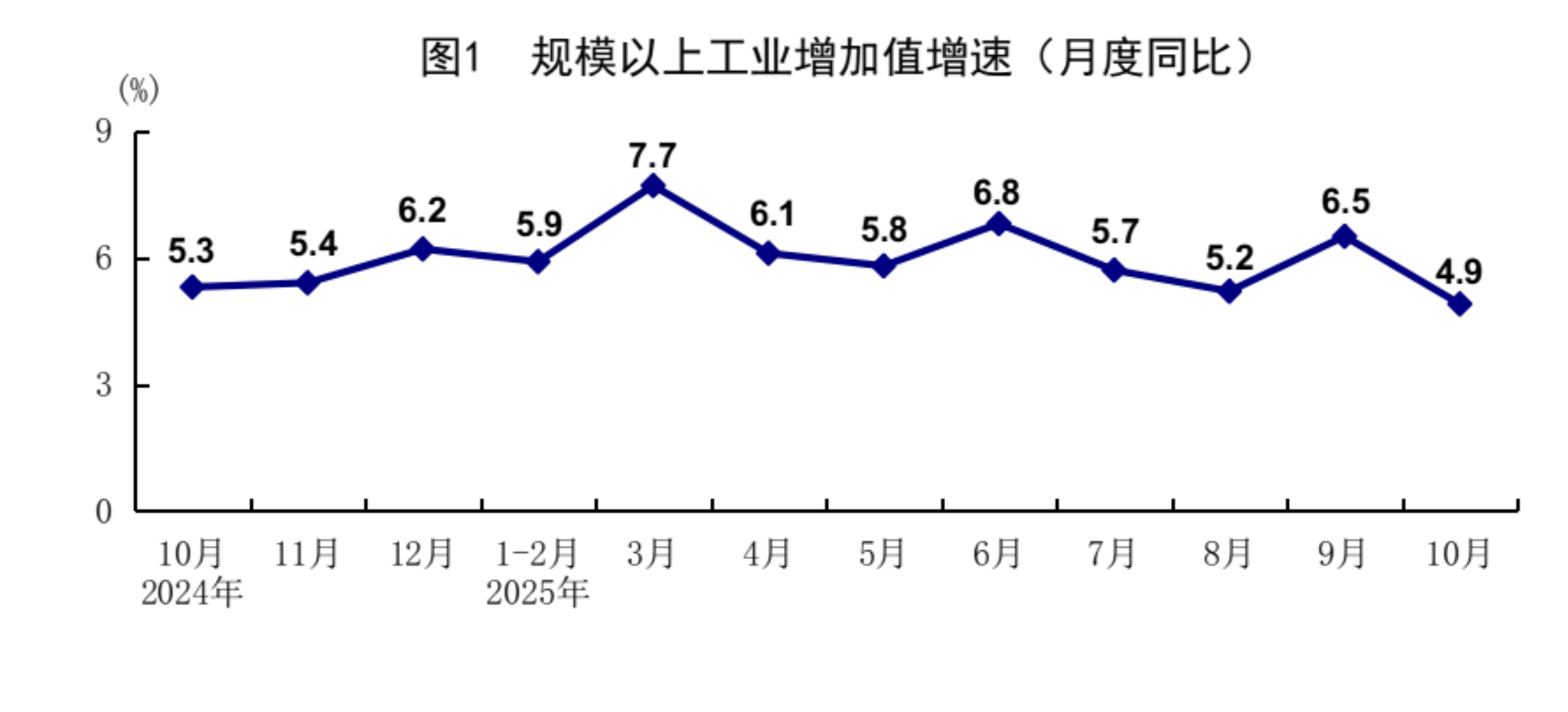
(2025年11月14日) 国家统计局 10月份,在以习近平同志为核心的党中央坚强领导下,各地区各部门认真贯彻落实党中央、国务院决策部署,坚持稳中求进工作总基调,加力稳就业、稳企 业、稳市场、稳预期,纵深推进全国统一大市场建设,积极畅通国内国际双循环,生产供给基本平稳,就业总体稳定,物价有所改善,新动能培育壮大,国 民经济保持总体平稳、稳中有进发展态势。 一、工业生产持续增长,装备制造业和高技术制造业增势较好 10月份,全国规模以上工业增加值同比增长4.9%,环比增长0.17%。分三大门类看,采矿业增加值同比增长4.5%,制造业增长4.9%,电力、热力、燃气及水 生产和供应业增长5.4%。装备制造业增加值同比增长8.0%,高技术制造业增加值增长7.2%,分别快于全部规模以上工业增加值3.1和2.3个百分点。分经济类 型看,国有控股企业增加值同比增长6.7%;股份制企业增长5.2%,外商及港澳台投资企业增长4.0%;私营企业增长2.1%。分产品看,3D打印设备、新能源 汽车、工业机器人产品产量同比分别增长30.8%、19.3%、17.9%。1-10月份,全国规模以上工业增加值同比增长6.1%。10月份,制造业采 ...

创业板前三季度营收净利均两位数增长,创业50ETF(159682)盘中交投活跃、成交额超2亿元,机构:看好科技成长景气主线
2 1 Shi Ji Jing Ji Bao Dao· 2025-11-10 05:12
Core Viewpoint - The ChiNext 50 ETF (159682) has experienced a decline of over 2% as of the morning close on November 10, with a trading volume exceeding 200 million yuan, indicating significant market activity [1] Group 1: ETF Performance - The ChiNext 50 ETF tracks the ChiNext 50 Index, with industry allocations including manufacturing, information transmission, software, and technology services [1] - Key weighted stocks in the index include CATL, Dongfang Wealth, Xinyisheng, Zhongji Xuchuang, Shenghong Technology, Huichuan Technology, Sunshine Power, and Tianfu Communication [1] - The ETF also includes off-market connecting funds: Connect A (017949) and Connect C (017950) [1] Group 2: Earnings Reports - As of October 31, 2023, 1,388 companies listed on the ChiNext have reported a total revenue of 3.25 trillion yuan for the first three quarters, reflecting a year-on-year growth of 10.69% [1] - The net profit for these companies reached 244.66 billion yuan, with a year-on-year increase of 18.69%, indicating an acceleration in growth compared to the first half of the year [1] Group 3: Market Outlook - According to Industrial Securities, positive factors from the quarterly reports are expected to catalyze a favorable outlook for the technology growth sector [1] - The market's risk appetite is anticipated to rise as the most significant overseas disturbances may be subsiding, coinciding with a phase of positive catalysts from domestic quarterly report validations [1] - Expectations of a potential interest rate cut by the Federal Reserve may further strengthen this trend [1]






华联期货周报:制造业PMI弱于季节性年底美联储降息生变-20251109
Hua Lian Qi Huo· 2025-11-09 10:36
Report Industry Investment Rating No relevant content provided. Core View of the Report - In October 2025, the national consumer price index (CPI) increased by 0.2% year-on-year, with food prices down 2.9% and non-food prices up 0.9%. The average CPI from January to October decreased by 0.1% compared to the same period last year [4]. - The national producer price index (PPI) for industrial products decreased by 2.1% year-on-year in October 2025, with the decline narrowing by 0.2 percentage points from the previous month, and the month-on-month change turned from flat to an increase of 0.1%. The average PPI from January to October decreased by 2.7% compared to the same period last year, and the purchase price of industrial producers decreased by 3.2% [4]. - China's gold reserves at the end of October 2025 were 74.09 million ounces, an increase of 300,000 ounces from the end of August, showing a continuous increase for 12 months. The scale of foreign exchange reserves at the end of October was US$3.3433 trillion, an increase of US$470 million from the end of September, with a growth rate of 0.14% [4]. - From January to September 2025, the total profit of industrial enterprises above designated size reached 5.3732 trillion yuan, a year-on-year increase of 3.2%. The operating income was 102.08 trillion yuan, a year-on-year increase of 2.4% [5]. - In October 2025, the manufacturing PMI was 49%, a significant decrease of 0.8 percentage points from the previous month, indicating a seasonal decline in the manufacturing prosperity level. The non-manufacturing business activity index was 50.1%, an increase of 0.1 percentage points from the previous month, rising to the expansion range [5]. Summary by Relevant Catalogs National Economic Accounting - The GDP quarterly year-on-year growth rates from Q2 2023 to Q3 2025 were 6.5%, 5%, 5.3%, 5.3%, 4.7%, 4.6%, 5.4%, 5.4%, 5.2%, and 4.8% respectively. Different industries showed varying growth trends during this period [7]. - The contributions of different industries to the GDP growth rate also changed over time. For example, the contribution of the primary industry, secondary industry, and tertiary industry to the constant-price GDP year-on-year growth rate and the pull effect on GDP showed different trends from 2013 to 2025 [13]. Industry - The year-on-year growth rates of added value in different industries showed fluctuations. For example, the coal mining and washing industry, oil and gas extraction industry, and other industries had different growth rates from August 2024 to September 2025 [22]. - The output of major industrial products also showed different trends. For example, the output of crude oil, coal, steel, and other products changed from September 2024 to September 2025 [24]. - In September 2025, China's total social electricity consumption was 888.6 billion kilowatt-hours, a year-on-year increase of 4.5%. The electricity consumption of different industries also showed different growth trends [31]. - From January to September 2025, the total profit of industrial enterprises above designated size reached 5.3732 trillion yuan, a year-on-year increase of 3.2%. Different industries had different profit growth rates, with some industries showing growth and others showing decline [5][35]. - As of the end of September 2025, the finished product inventory of industrial enterprises above designated size was 6.71 trillion yuan, a year-on-year increase of 2.8%. The inventory turnover days were 20.2 days, an increase of 0.2 days compared to the same period last year [5]. Price Index - In October 2025, the CPI increased by 0.2% year-on-year, with food prices having a significant impact on the CPI decline. Different CPI sub-items showed different year-on-year and month-on-month changes [4][49]. - The PPI for industrial products decreased by 2.1% year-on-year in October 2025, with the decline narrowing. Different industries' PPI also showed different trends, with production materials prices generally declining more than living materials prices [56]. - The purchase price of industrial producers also showed different trends, with some categories such as fuel and power showing a decline, while others such as non-ferrous metal materials and wires showing an increase [60].
梅雁吉祥投资成立新公司,含物联网业务
Sou Hu Cai Jing· 2025-11-06 02:25
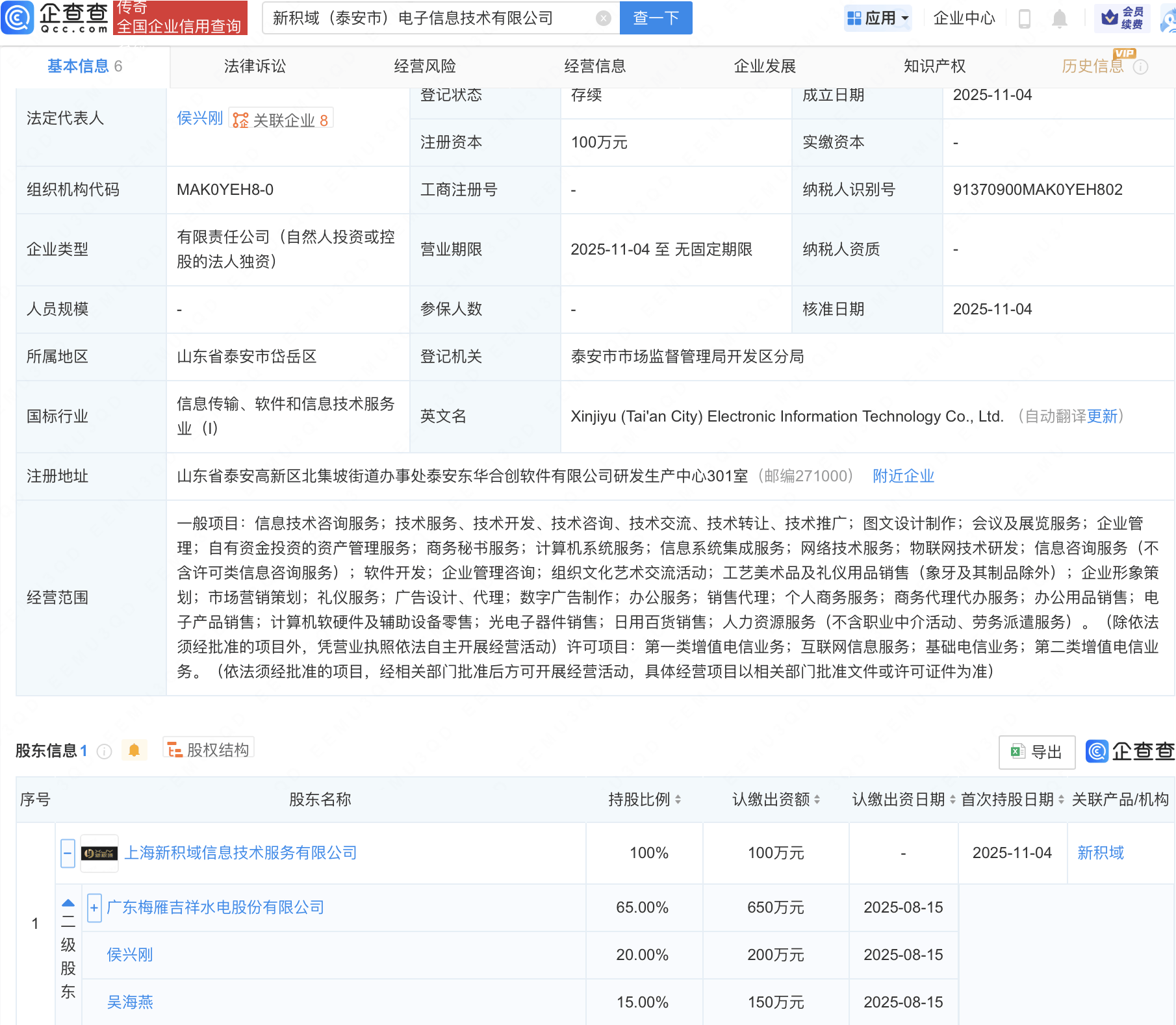
Core Insights - A new company, Xinjiyu (Tai'an City) Electronic Information Technology Co., Ltd., has been established, with a focus on computer system services, information system integration, network technology services, and IoT technology research and development [1] Company Information - The legal representative of the company is Hou Xinggang, and it is fully owned by Shanghai Xinjiyu Information Technology Service Co., Ltd., a subsidiary of Meiyan Jixiang (600868) [1] - The registered capital of the company is 1 million yuan [2] - The company is located in Tai'an, Shandong Province, and is classified under the national standard industry of information transmission, software, and information technology services [2] Business Scope - The business scope includes information technology consulting services, technical services, software development, enterprise management consulting, and various other services related to computer systems and technology [2]

保持稳中向好,今年第三季度中国企业信用指数为161.66
Xin Jing Bao· 2025-11-04 09:45
Core Insights - The corporate credit index in China for Q3 2025 is reported at 161.66, indicating a stable and improving credit level overall [1] - The index decreased by 0.63 points from Q2 but is still 0.85 points higher than Q1, reflecting a resilient credit environment despite external pressures [1] - In September, the corporate credit index was 162.29, showing a slight decline of 0.31 points from August, yet the number of companies listed in the operational anomaly directory decreased [1] Regional Analysis - The top five provinces in terms of credit index for Q3 are Anhui, Beijing, Chongqing, Tianjin, and Shaanxi, with most regions showing slight fluctuations [1] - In September, the leading provinces shifted slightly to Anhui, Chongqing, Shaanxi, Beijing, and Zhejiang, with Guangdong showing a significant increase in its index ranking [1] Industry Analysis - The top five industries by credit index in Q3 are leasing and business services, accommodation and catering, manufacturing, information transmission, software and IT services, and culture, sports, and entertainment [2] - Notably, the agriculture, forestry, animal husbandry, and fishery sectors, as well as the mining industry, saw significant increases in their credit indices compared to Q2 [2] - In September, the leading industries were finance, electricity, heat, gas, and water production and supply, education, water conservancy, environment and public facilities management, and manufacturing [2]
地区经济发展韧性进一步彰显
Jing Ji Ri Bao· 2025-11-04 01:04
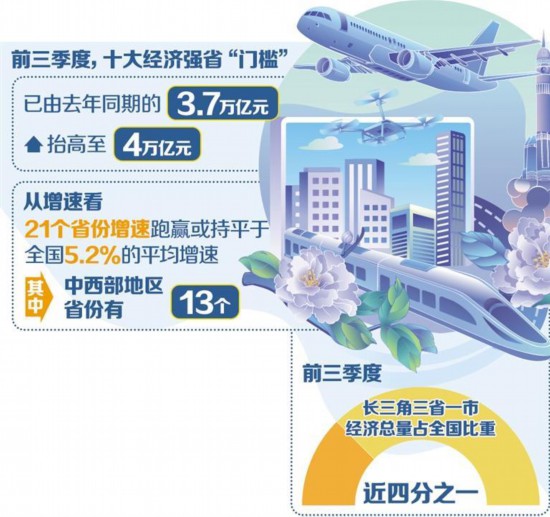
Economic Overview - The economic performance report for the first three quarters has been released, showing resilience and progress despite external pressures and internal challenges [2] - 21 provinces have achieved growth rates that either exceed or match the national average of 5.2%, indicating strengthened economic resilience [3] Economic Scale - Guangdong and Jiangsu have both surpassed the 10 trillion yuan mark in GDP, reaching 10,517.698 billion yuan and 10,281.1 billion yuan respectively [2] - The threshold for the top ten economic provinces has increased from 3.7 trillion yuan to 4 trillion yuan compared to the same period last year [2] Growth Rates - Tibet leads with a growth rate of 7.1%, while Gansu has maintained a growth rate above the national average for 15 consecutive quarters at 6.1% [3] - The Yangtze River Delta region has shown strong economic performance, with a total economic output exceeding 25 trillion yuan, accounting for nearly one-quarter of the national total [3] Foreign Trade - The foreign trade data for the first three quarters reflects resilience, with Guangdong, Jiangsu, Zhejiang, Shanghai, and Shandong contributing over 80% to the national import and export growth [4] - Zhejiang's foreign trade reached historical highs, with total import and export values surpassing 4 trillion yuan [4] Domestic Demand - The implementation of proactive macro policies has effectively stabilized the economy, with significant growth in consumer spending observed in provinces like Hainan and Henan [5] - Hainan's retail sales grew by 8.6%, while Henan's retail sales increased by 6.2%, showcasing strong consumer demand [5] Innovation and New Industries - Technological innovation is becoming a key driver of high-quality development, with significant growth in high-tech manufacturing in regions like Shanghai and Jiangsu [6] - In the central and western regions, industries such as strategic emerging industries in Henan and high-tech manufacturing in Hubei have shown remarkable growth rates [6] Service Sector Development - The modern service industry is accelerating, with significant growth in information technology services in Beijing and research and development revenues in Hunan [7] - The film and television production industry in Henan has seen a dramatic increase in revenue, growing by 107.8% due to the rapid development of the micro-short drama industry [7] Future Outlook - Despite the complex external environment, provinces are actively planning for the fourth quarter to ensure the achievement of annual economic goals [7] - Guangdong and Shanghai have outlined strategies to enhance economic operations and contribute to national economic stability [7]
前三季度十大经济强省“门槛”跃上4万亿元台阶 地区经济发展韧性进一步彰显
Jing Ji Ri Bao· 2025-11-04 00:05
Core Insights - China's economy has shown resilience and progress despite external pressures and internal challenges, with 21 provinces achieving growth rates that either surpassed or matched the national average of 5.2% [1][3] Economic Performance - The top ten provinces by economic output are Guangdong, Jiangsu, Shandong, Zhejiang, Sichuan, Henan, Hubei, Fujian, Shanghai, and Hunan, with Guangdong and Jiangsu both exceeding 10 trillion yuan in GDP [2] - The economic threshold for the top ten provinces has increased from 3.7 trillion yuan to 4 trillion yuan compared to the previous year [2] Growth Rates - 21 provinces have growth rates that either exceed or match the national average, with Tibet leading at 7.1% growth [3] - Gansu has maintained a growth rate above the national average for 15 consecutive quarters, while Hubei's growth rate is 6% [3] Trade Performance - External trade data reflects resilience, with Guangdong, Jiangsu, Zhejiang, Shanghai, and Shandong contributing over 80% to national import and export growth, with Zhejiang achieving historical highs in trade values [4] Demand and Consumption - The implementation of proactive macro policies has effectively stabilized economic operations, with notable growth in retail sales in provinces like Hainan and Henan [5] - Hainan's retail sales grew by 8.6%, while Henan's retail sales increased by 6.2% [5] Innovation and New Growth Drivers - There is a significant focus on technological innovation, with high-tech manufacturing in regions like Shanghai and Jiangsu showing substantial growth [7] - In the central and western regions, industries such as strategic emerging industries in Henan and high-tech manufacturing in Hubei have also seen impressive growth rates [7] Future Outlook - Various provinces are actively planning for the fourth quarter to ensure the achievement of annual economic goals, with Guangdong and Shanghai emphasizing the need for effective policy implementation and economic management [8]
长三角三季报暗藏玄机:浙江5城“霸榜”增速榜,江苏为何失落?
2 1 Shi Ji Jing Ji Bao Dao· 2025-11-03 13:08
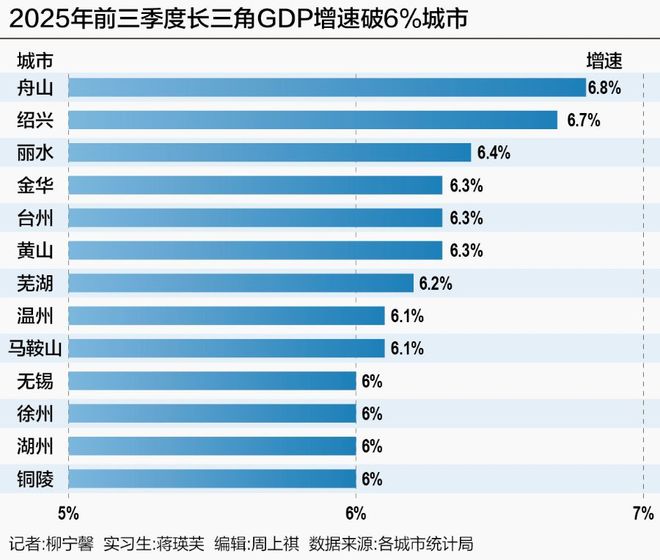
Economic Overview - The Yangtze River Delta (YRD) accounts for approximately 25% of China's GDP, with a total GDP of 251,797.17 billion yuan in the first three quarters of this year [1][5] - Among the 41 cities in the YRD, 28 cities outpaced the national average GDP growth rate of 5.2%, with 13 cities exceeding 6% [1][5] Economic Growth by Region - Zhejiang led the YRD with a GDP growth rate of 5.7%, followed by Shanghai, Jiangsu, and Anhui at 5.5%, 5.4%, and 5.4% respectively [5] - Jiangsu had the highest GDP total at 102,811 billion yuan, followed by Zhejiang at 68,495 billion yuan, Shanghai at 40,721.17 billion yuan, and Anhui at 39,770 billion yuan [6] Industrial Development - Advanced manufacturing is a key support for Jiangsu's economy, with significant contributions from high-tech manufacturing and digital core product manufacturing, both maintaining double-digit growth [4][12] - In Shanghai, the AI and integrated circuit sectors saw double-digit growth in output value, while Jiangsu's high-tech manufacturing increased by 27.8% [4][12] Consumption Trends - The consumption market in the YRD is steadily recovering, with policies like "old for new" driving sales in appliances, automobiles, and electronics [14] - Jiangsu's sports events, such as "Su Chao," have significantly boosted local consumption, with a 13% increase in sports service revenue [14][15] City-Specific Insights - Among the 13 cities with GDP growth exceeding 6%, all top five are from Zhejiang, indicating a strong manufacturing base and rapid advancement in traditional industries [6][7] - Shanghai's service sector, particularly information services, contributed significantly to its economic growth, with the tertiary industry accounting for 79.1% of its GDP [10][12] Future Directions - The YRD is focusing on enhancing traditional industries through digital transformation and innovation, with policies promoting smart factory development [8][12] - There is a strong emphasis on integrating consumption scenarios with digital economy advancements, particularly in Zhejiang, which is leveraging its e-commerce and digital payment systems [15][16]
云从科技:战略投资进入银发经济赛道,元生智能居家养老看护设备在各大电商平台有售
Cai Jing Wang· 2025-11-03 03:57
Core Insights - The company focuses on providing efficient human-machine collaboration operating systems and AI solutions, targeting G-end and B-end clients in sectors like smart finance, smart governance, and smart mobility [1] - The company has also ventured into consumer-oriented smart products through its ecosystem partners, including a stake in a subsidiary that developed the "Zhongxun AI Mouse" and strategic investments in elder care technology [1] - The company is closely monitoring the potential of the personal consumer market and plans to enter the C-end market when its technology and ecosystem are sufficiently mature [1] Financial Performance - For the period from January to September 2025, the company achieved a revenue of 355 million yuan, representing a year-on-year growth of 56.81% [1] - The company reported a net loss of 310 million yuan during the same period [1]

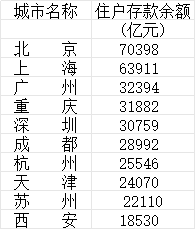
34城住户存款超万亿,住户存款10强城市都有谁
Di Yi Cai Jing· 2025-10-31 11:50
Core Insights - As of the end of 2024, 34 cities in China have household deposits exceeding 1 trillion yuan, with the top ten cities being Beijing, Shanghai, Guangzhou, Chongqing, Shenzhen, Chengdu, Hangzhou, Tianjin, Suzhou, and Xi'an. The first nine cities have household deposits exceeding 2 trillion yuan [1][3]. Group 1: Household Deposit Balances - The top three cities for household deposit balances are Beijing (over 7 trillion yuan), Shanghai (over 6.39 trillion yuan), and Guangzhou (over 3 trillion yuan) [3]. - The household deposit balance in Beijing is 22,110 billion yuan, while Shanghai has 70,398 billion yuan, Guangzhou has 63,911 billion yuan, and other cities follow with varying amounts [2][3]. Group 2: Per Capita Deposits - Among the 34 cities with household deposits over 1 trillion yuan, 14 cities have per capita deposits exceeding 160,000 yuan, with Beijing, Shanghai, and Hangzhou surpassing 200,000 yuan [4]. - The per capita household deposits in Beijing, Shanghai, and Hangzhou are 322,000 yuan, 258,000 yuan, and 202,000 yuan, respectively [4]. Group 3: Economic Insights - Hangzhou has capitalized on the development of the internet industry, expanding from consumer internet to industrial internet and artificial intelligence, contributing to its economic growth [4]. - In 2024, Hangzhou's digital economy core industry added value reached 630.5 billion yuan, a year-on-year increase of 7.1%, accounting for 28.8% of the city's GDP [4].