医疗

Search documents
城市副中心正迈入市场导向的高质量发展新阶段
Xin Jing Bao· 2026-01-25 22:59
"十五五"期间,副中心建设发展将有哪些大变化?1月25日,北京市第十六届人民代表大会第四次会议 审议了关于北京市2025年国民经济和社会发展计划执行情况与2026年国民经济和社会发展计划(草案) 的报告(以下简称《计划报告》)。 北京市经济社会发展研究院改革开放所副研究员刘沛罡表示,规划建设北京城市副中心,是党中央着眼 京津冀协同发展作出的重大战略部署,承载着疏解非首都功能、推动区域协调发展的重要使命。当前, 城市副中心正在从政府主导的规划建设阶段,迈入市场导向的高质量发展新阶段。 "改革让家门口的好机会变多了" "十四五"期间,副中心已引入20家市级优质教育资源,2024年义务教育均衡发展指数居全市第一。随着 中国人民大学通州校区全面投用,清华大学金融发展与人才培养基地、北京服装学院通州校区等高校陆 续建成,副中心的教育资源会进一步提质升级。医疗方面,已有北大人民医院、友谊医院、安贞医院等 知名医院相继落地,首儿所通州院区预计于2027年投用。 刘沛罡表示,试点获批以来,北京市迅速行动,对照国务院批复的试点任务逐项细化分解,紧紧围绕副 中心功能定位,坚持问题导向,聚焦技术、土地、人才、数据、资本、绿色等重点 ...
民生向暖幸福满格
Xin Lang Cai Jing· 2026-01-25 20:19
Core Viewpoint - The news emphasizes the commitment of Qinghai province to improving people's livelihoods through various initiatives and projects, focusing on enhancing the quality of life and ensuring social welfare for its residents [1][3]. Group 1: Employment and Economic Support - Qinghai has established 35 labor market stations, with an average of over 40,000 job seekers per month, enhancing employment services [2]. - The province's fiscal spending on social welfare reached 78.3% of total expenditures in 2025, ensuring basic livelihood support [3]. - The implementation of various policies, including minimum wage increases and student nutrition programs, has positively impacted employment and income levels [3][7]. Group 2: Healthcare and Social Services - Qinghai has included 531 types of Tibetan and Mongolian medicine in its medical insurance coverage, reducing healthcare costs for residents [4]. - The province has built national and provincial medical centers, with 323 inter-institutional test result recognition projects, improving healthcare accessibility [6]. - Social security measures have been enhanced, including adjustments to pensions and subsidies for low-income households [7]. Group 3: Infrastructure and Community Development - Significant improvements have been made in community infrastructure, such as the renovation of old residential areas and the construction of convenient bridges [5][6]. - The "Happy Village" project has been implemented, benefiting 2.7 million households by improving living conditions [6]. - Qinghai has launched 150 rural construction projects, focusing on enhancing the quality of life for farmers and herders [6]. Group 4: Consumer Engagement and Economic Growth - The "Hui Gou Cheng Dong" New Year market event was organized to stimulate local consumption, featuring various local products and interactive experiences [8]. - Qinghai has implemented policies to boost consumer spending, including a 16.9 billion yuan subsidy program that generated 186.3 billion yuan in consumption [9]. - The province aims to maintain continuous improvement in living standards, focusing on the needs and expectations of its residents [9].
银河基金—— 告别“炒概念” AI悄然重塑医药、传媒、能源估值逻辑
Zheng Quan Shi Bao· 2026-01-25 17:00
尽管所处赛道不同,但在人工智能这一关键变量上,医药基金经理方伟、周期基金经理金烨、新能源基 金经理李一帆、传媒基金经理卢轶乔以及科技基金经理高鹏形成了高度一致的看法:AI正成为影响行 业效率提升与估值逻辑重构的重要背景因素。 从应用端的商业化推进,到产业链层面的需求外溢,再到企业盈利模型与投资节奏的重新审视,AI已 不再只是单一板块的主题概念,而是以更为底层的方式,逐步嵌入多个行业的投资决策框架之中。 从独立概念到通用工具 近日,银河基金的医药、周期、新能源、传媒和科技等领域的五位基金经理集中发声,围绕各自关注的 投资方向分享了最新观点。 卢轶乔观察到,AI正在实质性改变内容生产与分发效率。随着大模型能力提升和大厂生态打通,AI开 始具备商业化落地条件,广告分发和内容生成更容易成为最先受益的环节。在这一过程中,AI并不是 独立的投资主线,而是推动传媒行业效率跃迁、打开新增市场空间的关键工具。 在医药领域,方伟同样强调,AI并未构成一个脱离原有产业逻辑的新赛道。相反,其核心价值体现在 对既有医疗企业经营结构的重塑之中。无论是研发效率提升,还是费用率与利润率中枢的变化,最终都 会反映到企业的财务模型和长期估值假设 ...
114.96%!2025成渝地区双城经济圈重大项目建设交“答卷”
Xin Lang Cai Jing· 2026-01-25 15:08
Core Viewpoint - The construction of the Chengdu-Chongqing economic circle is progressing well, with 181 major projects completing a total investment of 296.144 billion yuan, achieving an annual investment completion rate of 114.96% [2] Group 1: Infrastructure Network - Modern infrastructure projects completed an investment of 136.586 billion yuan, with an annual investment completion rate of 104.77% [3] - Key transportation projects include the successful completion of the Yuwan High-speed Railway tunnel and the opening of the highway from Hechuan to Bicheng to Jiangjin, significantly improving travel efficiency [3] - Energy and water resource projects have also advanced, including the completion of the Hami-Chongqing ±800 kV UHVDC project and the full water supply of the Western Water Resource Allocation Project, benefiting nearly ten million people [3] Group 2: Modern Industrial System - Modern industrial projects achieved an investment of 62.624 billion yuan, with an annual investment completion rate of 143.68% [4] - Significant advancements in advanced manufacturing include the trial operation of a 6-inch IGBT power semiconductor production line and the completion of the main plant for the fiberglass and high-performance composite materials base [4] - The new energy sector is thriving, with the completion of a lightweight chassis for smart connected vehicles and the acceleration of lithium battery separator production, filling a regional capacity gap [4] Group 3: Technological Innovation and Open Cooperation - Investment in technology innovation and open projects reached 17.271 billion yuan, with an annual investment completion rate of 125.43% [5] - The construction of innovation platforms is progressing, including the establishment of the Zhangjiang Laboratory in Chongqing and advancements in neutron technology for scientific applications [5] - The Western Land-Sea New Corridor is being developed, with key logistics nodes like the Chongqing South Comprehensive Logistics Park taking shape [5] Group 4: Ecology, Consumption, and Livelihood - Projects focused on ecology, consumption, and livelihood completed an investment of 79.663 billion yuan, with an annual investment completion rate of 114.01% [6] - Ecological restoration projects, such as the Longxi River ecological restoration, have achieved stable water quality standards [7] - The transformation of the Jiefangbei-Chaotianmen area has enhanced its appeal as an international consumption destination, while healthcare facilities are being improved to better serve the community [7]


挖掘经济潜能系列一:纵深推进全国统一大市场建设的方向、举措、效果推演
East Money Securities· 2026-01-25 13:30
Group 1: National Unified Market Construction - The construction of a national unified market has been elevated to a core economic strategy, emphasizing the need to eliminate market barriers and facilitate economic circulation[8] - The central economic work conference in 2025 highlighted the importance of deepening the construction of a unified market, marking a transition from framework establishment to systematic implementation[9] - The construction process has seen significant progress, with improvements in property rights protection, market access, fair competition, and social credit systems[9] Group 2: Key Areas and Policies - The modern service industry is expected to be a crucial driver in the unified market construction, with coastal regions likely to be the first to pilot reforms[1] - Tax incentives and government subsidies have been adjusted, primarily affecting key industries such as electronics, automotive, and pharmaceuticals, which may accelerate industry restructuring[1] - The establishment of a unified market will require reforms in the fiscal and tax systems, as well as optimization of local performance evaluation systems[1] Group 3: Economic Impact and Participation - The participation of different provinces in the unified market varies significantly, with coastal provinces showing higher engagement levels[1] - The share of external factors in total inputs is over 50% for resource-related and some high-tech manufacturing industries, indicating smoother domestic flow of factors[14] - Service industries show lower external factor input ratios, with public administration, accommodation, and comprehensive technical services at 7.23%, 11.54%, and 11.99% respectively, suggesting potential bottlenecks in factor circulation[14]
2026年,北京要干这些民生大事
Xin Jing Bao· 2026-01-25 04:31
Group 1: Employment and Skills Development - In 2026, Beijing aims to create no less than 280,000 new urban jobs, with a focus on providing at least 100,000 job opportunities for college graduates, targeting a graduate employment rate of no less than 95% [2] - The city will implement a skills training initiative, including enrolling unemployed youth and migrant workers in vocational schools, with relaxed age restrictions for admissions [2] - Standardization of the gig economy market will be promoted, along with exploring mechanisms for gig workers' accident insurance [2] Group 2: Social Services and Infrastructure - Beijing plans to add 5,000 family elderly care beds and establish 20 regional elderly service centers, focusing on areas with a high number of elderly individuals [3] - The city will enhance public services by adding 10,000 middle school places and improving educational infrastructure, alongside reforms in school management and teacher allocation [4] - In healthcare, the city will renovate hospitals and construct new medical facilities, aiming for an 80% coverage rate of community medical groups [4] Group 3: Safety and Disaster Management - Beijing will implement 40 urban and rural water supply enhancement projects, aiming for 66% of rural populations to have access to large-scale water services [5] - The city will establish high-standard automatic weather stations and develop AI models for disaster weather forecasting [5] - In food safety, local regulations will be developed, and a digital platform for food safety standards will be constructed [6]
AI应用的“妖风”还能吹多久?
投中网· 2026-01-24 07:36
Core Viewpoint - The article discusses the volatility and potential of AI application stocks, highlighting the recent surge and subsequent decline in their prices, emphasizing the need for logical investment rather than speculative trading [4][5][7]. Group 1: AI Application Market Dynamics - The AI application market experienced a significant surge starting January 9, driven by the IPO of MiniMax, which saw a price increase of over 90%, boosting market confidence in AI commercialization [5]. - Following the initial excitement, many AI application companies issued announcements clarifying their limited revenue from AI, leading to a sharp price correction in the sector [7]. - The article suggests that while the AI application sector is currently volatile, it has the potential to create long-term value if investors can identify companies with genuine business models and revenue streams [9]. Group 2: GEO Model in Advertising - The article introduces the GEO (Generative Engine Optimization) model, which allows users to input specific demands and receive optimized product recommendations directly from AI, streamlining the purchasing process [11]. - The GEO market is projected to grow significantly, with estimates of $2.9 billion in China and $11.2 billion globally by 2025, and reaching $24 billion and $100.7 billion by 2030 respectively [13]. - GEO is seen as a transformative force in marketing, shifting the power dynamics towards platforms that can leverage AI models effectively, similar to how Google and Baidu dominated the SEO era [16][17]. Group 3: AI in Healthcare - The AI healthcare sector has shown strong performance, with companies like Hongbo Medicine and Dian Diagnostics seeing stock increases of over 50% year-to-date [28]. - Government policies are increasingly supportive of AI in healthcare, with initiatives aimed at integrating AI into high-end medical equipment and remote healthcare applications [30]. - The article notes that AI healthcare applications are moving from concept to clinical use, with companies like Tempus AI reporting an 83% revenue growth, indicating a positive trend for domestic firms in the sector [31]. Group 4: AI in Financial Technology - The financial technology sector has also seen a rise, with the Financial Technology ETF increasing by over 14% since the beginning of 2026 [46]. - AI is expected to enhance the capabilities of internet financial companies by improving customer engagement and operational efficiency through advanced tools [48]. - However, the article cautions that while AI can improve operational efficiency, it may not fundamentally change the poor business models of many financial IT companies, which face challenges such as high customization costs and fragmented market share [49].

今年“百展千企 沪连全球”海外展会推荐名单扩容50% 上海外贸企业提前集结出海亮相
Jie Fang Ri Bao· 2026-01-24 01:36
Group 1 - Shanghai Tongxin Trading Co., Ltd. is preparing to participate in the Paris Textile and Fabric Exhibition from February 2 to 4, with support from the Shanghai International Exhibition (Group) Co., Ltd. providing booth fee subsidies and organizing pre-exhibition meetings for 56 participating companies [1] - The Shanghai Municipal Commission of Commerce announced that in the first quarter of this year, 424 companies will participate in 136 overseas exhibitions through a dual-track model of government-led and market-driven organization [2] - The "Hundred Exhibitions, Thousand Enterprises" initiative aims to organize 5,725 enterprises for 1,149 overseas exhibitions in 2025, with a focus on both traditional markets in Europe and the U.S. and emerging markets [2] Group 2 - The recommended list of overseas exhibitions for 2026 has been expanded to 305 events, a 50% increase from the previous year, covering key export industries and regions [3] - The number of overseas exhibitions organized by the Shanghai International Exhibition Group is set to increase from 159 in 2025 to 219 in 2026, representing a 38% growth [5] - The focus for 2026 will include emerging markets in the Middle East, Central and Eastern Europe, and Africa, with new sectors such as energy storage and biomedicine being emphasized [5]
1月23日创业板医疗(970082)指数涨1.62%,成份股华兰股份(301093)领涨
Sou Hu Cai Jing· 2026-01-23 10:52
创业板医疗(970082)指数十大成份股详情如下: 证券之星消息,1月23日,创业板医疗(970082)指数报收于4022.47点,涨1.62%,成交210.38亿元, 换手率2.5%。当日该指数成份股中,上涨的有46家,华兰股份以12.8%的涨幅领涨,下跌的有3家,新 产业以0.99%的跌幅领跌。 资金流向方面,创业板医疗(970082)指数成份股当日主力资金净流入合计10.42亿元,游资资金净流 出合计3729.45万元,散户资金净流出合计10.05亿元。成份股资金流向详情见下表: 以上内容为证券之星据公开信息整理,由AI算法生成(网信算备310104345710301240019号),不构成 投资建议。 ...

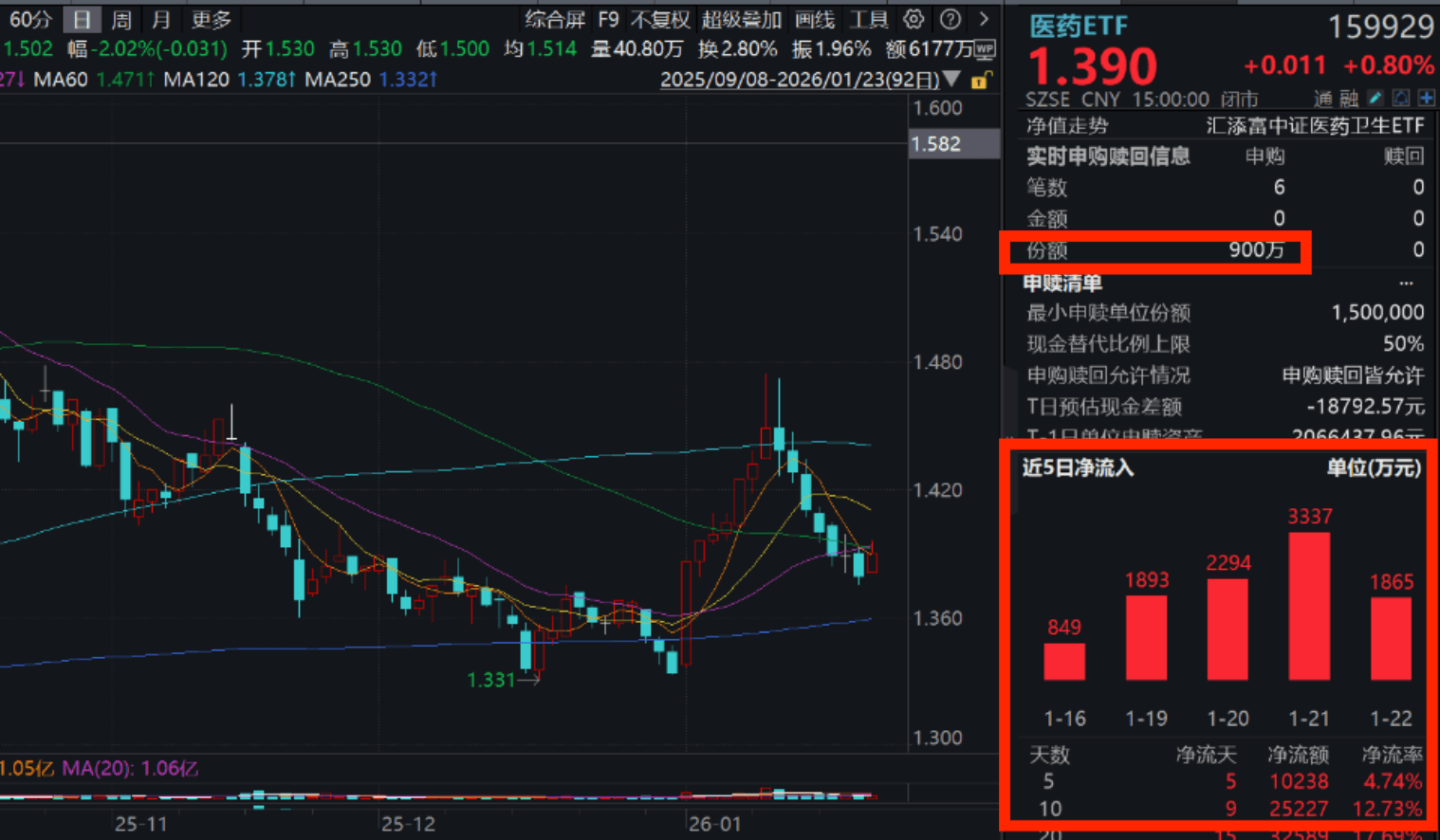
医药果然反弹!医药ETF(159929)收涨近1%,近5日狂揽超1亿元!关注创新、出海、困境反转脉冲三大产业演绎脉络!
Sou Hu Cai Jing· 2026-01-23 07:43
Core Viewpoint - The pharmaceutical sector is experiencing a rebound, with the pharmaceutical ETF (159929) rising by 0.8% and a total trading volume exceeding 86 million yuan, indicating strong investor interest and capital inflow [1]. Group 1: Market Performance - The pharmaceutical ETF (159929) has seen a capital inflow of over 320 million yuan in the last 20 days, with 15 of those days showing increased funding [1]. - The latest financing balance has surged to over 75 million yuan, reflecting continued leverage in the market [1]. - Major stocks within the ETF, such as Mindray Medical and United Imaging, have shown positive performance, with several stocks rising over 1% [4]. Group 2: Sector Analysis - The report highlights a shift in focus within the pharmaceutical sector towards innovative fields such as AI healthcare and medical robotics, moving away from previously strong areas like brain-computer interfaces [3]. - The CRO (Contract Research Organization) sector has also shown some performance, driven by market sentiment and expectations of turning points in the industry [3]. - The top three investment directions identified for 2026 include BD 2.0, small nucleic acids, and supply chain (CXO and upstream), emphasizing the importance of innovation and international expansion [5]. Group 3: Company Highlights - Key companies in the ETF include WuXi AppTec, with an estimated weight of 10.77%, and Hengrui Medicine, with a weight of 9.41%, both of which are significant players in the pharmaceutical industry [2]. - Tempus AI reported a revenue of approximately 1.27 billion USD for 2025, marking an 83% year-on-year growth, showcasing the commercial viability of AI in healthcare [6]. - NVIDIA and Eli Lilly announced a partnership to establish an AI innovation lab, investing up to 1 billion USD over five years to address challenges in drug discovery and development [5].