
电气机械

Search documents
稳中向好态势延续 全年增速预计5.5%
Zhong Guo Zheng Quan Bao· 2025-08-04 21:06
Core Viewpoint - The mechanical industry in China is experiencing stable growth in the first half of 2025, with positive economic indicators and resilience in foreign trade, expected to continue this trend in the second half of the year with a projected annual growth rate of around 5.5% [1][6]. Economic Indicators - The number of large-scale enterprises in the mechanical industry reached 136,000 by the end of June, an increase of 6,000 year-on-year, accounting for 26.2% of the national industrial total, up 0.4 percentage points from the previous year [1]. - Total assets in the mechanical industry amounted to 40.4 trillion yuan, a year-on-year increase of 6.6%, representing 22% of the national industrial total, up 0.3 percentage points from the previous year [1]. - The added value of large-scale enterprises in the mechanical industry grew by 9% year-on-year, outperforming the national industrial and manufacturing growth rates by 2.6 and 2 percentage points, respectively [1]. Sector Performance - All five major sectors of the mechanical industry reported year-on-year growth in added value, with the automotive and electrical machinery sectors leading with growth rates of 11.3% and 12.2%, respectively [2]. - In the automotive sector, production and sales reached 15.62 million and 15.65 million units, reflecting year-on-year growth of 12.5% and 11.4% [2]. - The electrical machinery sector saw significant production increases, with generator output rising by 60.5% and solar cell production increasing by 18.2% [2]. Innovation and New Energy - The mechanical industry is focusing on technological innovation and green development, with new energy vehicles (NEVs) showing rapid growth, with production and sales reaching 6.968 million and 6.937 million units, respectively, up 41.4% and 40.3% year-on-year [3]. - The production of wind power units increased by over 70%, contributing significantly to the new energy system [3]. Foreign Trade - The total import and export value of the mechanical industry reached $597.6 billion, a year-on-year increase of 7.1%, with exports growing by 12.4% to $465.94 billion [4]. - The trade surplus was $334.28 billion, up 23.3% year-on-year, accounting for 57.1% of the national trade surplus [4]. Challenges and Future Outlook - Despite the positive trends, the mechanical industry faces challenges such as cautious foreign orders and market demand fluctuations, with 66% of enterprises reporting insufficient orders [4]. - The Ministry of Industry and Information Technology is set to issue growth stabilization plans for the mechanical, automotive, and electrical equipment sectors to enhance supply capabilities and optimize the industry environment [5]. - The long-term support conditions for the mechanical industry remain strong, with expectations for continued stable growth in the second half of the year [6].
机械工业规上企业利润增长9.4% 战略性新兴产业贡献超八成
Zheng Quan Shi Bao Wang· 2025-08-04 09:16
8月4日,中国机械工业联合会召开2025年上半年机械工业经济运行情况发布会。今年上半年,机械工业 规模以上企业增加值同比增长9.0%。实现营业收入15.3万亿元,同比增长7.8%;实现利润总额7912.1亿 元,同比增长9.4%,增速比全国工业高11.2个百分点。 中国机械工业联合会副会长、新闻发言人罗俊杰透露,工信部即将印发机械、汽车、电力装备等行业稳 增长工作方案,为机械工业发展注入强劲动力,推动其实现质的有效提升和量的合理增长,助力行业延 续稳中向好的发展态势。 机械工业规模以上企业利润增长9.4% 上半年,机械工业主要经济指标较快增长,为实现全年目标打下了良好基础。罗俊杰介绍,上半年,机 械工业规模以上企业增加值同比增长9.0%,增速高于全国工业和制造业2.6和2个百分点,为稳定经济大 盘、提振工业经济发挥积极作用。 机械工业主要涉及的五个国民经济行业大类增加值均实现同比增长。数据显示,汽车和电气机械行业实 现两位数增长,增速分别为11.3%和12.2%,引领机械工业的增长;通用设备、专用设备和仪器仪表行 业增速分别为8.3%、3.8%和7.6%。 在存量政策与新一轮"两新"政策加力扩围叠加效应下,国 ...
多领域上半年“成绩单”出炉 利好积聚经济“跃动”内生动力强劲
Yang Shi Wang· 2025-08-04 08:55
记者8月4日从中国机械工业联合会获悉,2025年上半年,我国机械工业经济运行稳中向好,产品产销平 稳增长,对外贸易展现韧性,创新活力加快释放,新质生产力积极发展,产业升级和高质量发展成效显 著。 2025年上半年,机械工业产业支柱地位稳固提升。截至6月末,机械工业规模以上企业数量达13.6万 家,较上年同期增加0.6万家,占全国工业的26.2%。 此外,上半年,机械工业规模以上企业增加值同比增长9.0%,增速高于全国工业和制造业2.6和2个百分 点,为稳定经济大盘、提振工业经济发挥积极作用。 不仅如此,机械工业主要涉及的5个国民经济行业大类增加值均实现同比增长。其中,汽车和电气机械 行业实现两位数增长,增速分别为11.3%和12.2%。通用设备、专用设备和仪器仪表行业增速分别为 8.3%、3.8%和7.6%。 罗俊杰表示,近期,工业和信息化部即将印发机械、汽车、电力装备等行业稳增长工作方案。着力提升 优质供给能力,优化行业发展环境,推动行业实现质的有效提升和量的合理增长。综合判断,预计下半 年,机械工业经济运行将延续稳中向好的总体态势,全年主要经济指标增速在5.5%左右,对外贸易保 持基本稳定。 国家税务总局 ...
多领域上半年“成绩单”出炉,活力澎湃!利好积聚经济“跃动”内生动力强劲
Yang Shi Wang· 2025-08-04 08:11
央视网消息:记者8月4日从中国机械工业联合会获悉,2025年上半年,我国机械工业经济运行稳中向好,产品产销平稳增长,对外贸易展现韧 性,创新活力加快释放,新质生产力积极发展,产业升级和高质量发展成效显著。 2025年上半年,机械工业加速推进新型工业化和产业转型升级,创新活力加快释放,新动能、新优势继续壮大,高质量发展取得积极成效。 在新兴产业方面,战略性新兴产业对机械工业发展的带动作用继续增强。上半年,新能源装备、节能环保装备、高端装备制造等相关产业营业 收入和利润总额增速均明显高于机械工业总体水平。 2025年上半年,机械工业产业支柱地位稳固提升。截至6月末,机械工业规模以上企业数量达13.6万家,较上年同期增加0.6万家,占全国工业 的26.2%。 此外,上半年,机械工业规模以上企业增加值同比增长9.0%,增速高于全国工业和制造业2.6和2个百分点,为稳定经济大盘、提振工业经济发 挥积极作用。 不仅如此,机械工业主要涉及的5个国民经济行业大类增加值均实现同比增长。其中,汽车和电气机械行业实现两位数增长,增速分别为 11.3%和12.2%。通用设备、专用设备和仪器仪表行业增速分别为8.3%、3.8%和7.6 ...

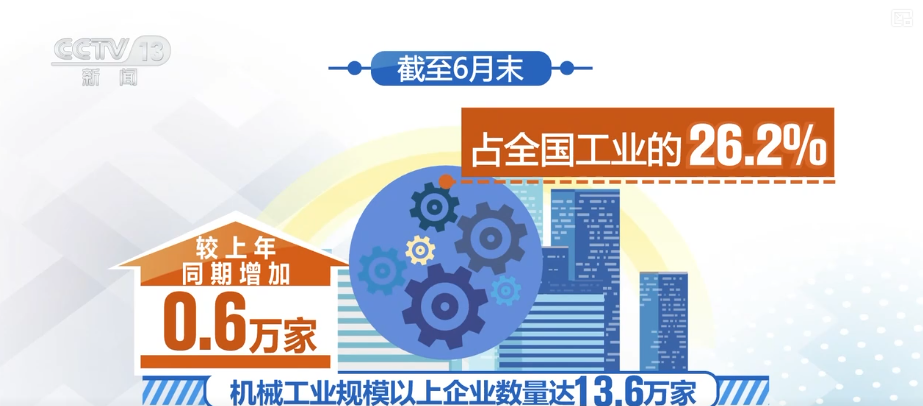
今年上半年机械工业增加值同比增长9% 产业支柱地位稳固提升
news flash· 2025-08-04 08:11
Core Viewpoint - The mechanical industry in China has shown stable growth in the first half of the year, with significant contributions to economic stability and industrial development [1] Group 1: Economic Performance - The number of large-scale enterprises in the mechanical industry reached 136,000 by the end of June, an increase of 6,000 compared to the same period last year, accounting for 26.2% of the national industrial total [1] - The added value of large-scale mechanical enterprises grew by 9.0% year-on-year, surpassing the national industrial and manufacturing growth rates by 2.6 and 2 percentage points respectively [1] Group 2: Sector Growth - All five major categories of the national economy related to the mechanical industry achieved year-on-year growth in added value [1] - The automotive and electrical machinery sectors experienced double-digit growth rates of 11.3% and 12.2% respectively, while general equipment, specialized equipment, and instruments and meters grew by 8.3%, 3.8%, and 7.6% respectively [1] Group 3: Market Demand - The domestic market demand improved due to the combined effects of existing policies and the new round of "two new" policies, leading to better overall production and sales conditions in the mechanical industry compared to the previous year [1] - Among the 122 key monitored products, 84 products saw year-on-year production growth, representing 68.9% of the total, an increase of 7.4 percentage points from the previous year [1]
机械工业上半年利润增长9.4%,战新产业带动作用增强
Di Yi Cai Jing Zi Xun· 2025-08-04 03:13
Core Viewpoint - The mechanical industry in China showed stable growth in the first half of the year, with key economic indicators such as value-added output, revenue, and profit all experiencing positive year-on-year growth, despite facing challenges like insufficient effective demand and external trade pressures [1][2][6]. Economic Performance - In the first half of the year, the value-added output of large-scale mechanical enterprises grew by 9.0% year-on-year, with total revenue reaching 15.3 trillion yuan, a 7.8% increase [1][2]. - Total profit amounted to 791.21 billion yuan, reflecting a 9.4% year-on-year growth, which is 11.2 percentage points higher than the national industrial average [1][2]. - The operating profit margin was 5.2%, slightly above the national industrial average [2]. Sector Growth - The automotive and electrical machinery sectors led the growth with increases of 11.3% and 12.2%, respectively, while general equipment, specialized equipment, and instruments also saw growth rates of 8.3%, 3.8%, and 7.6% [2]. - Among 122 monitored products, 84 saw year-on-year production increases, representing 68.9% of the total, which is an improvement of 7.4 percentage points from the previous year [2]. Strategic Emerging Industries - Strategic emerging industries continue to drive growth in the mechanical sector, with revenue and profit growth rates for these industries exceeding the overall mechanical industry by 1.3 and 5.4 percentage points, respectively [3]. Challenges and Risks - Over 60% of enterprises reported insufficient orders, with challenges including market fluctuations, insufficient effective demand, and pressure from external trade [5][6]. - The impact of U.S. tariff policies has led to increased caution among foreign buyers, resulting in a slowdown in order growth, particularly in sectors like petrochemical machinery and agricultural machinery [6]. - The price index for mechanical products has been declining, with a consistent drop of around 2% year-on-year for 29 consecutive months, further compressing profit margins [6]. Future Outlook - The mechanical industry is expected to maintain a stable growth trajectory in the second half of the year, with a projected annual growth rate of around 5.5% for major economic indicators [1][7]. - Continued emphasis on technological innovation, industrial upgrading, and the cultivation of new productive forces is anticipated to enhance the resilience and safety of the supply chain [7].

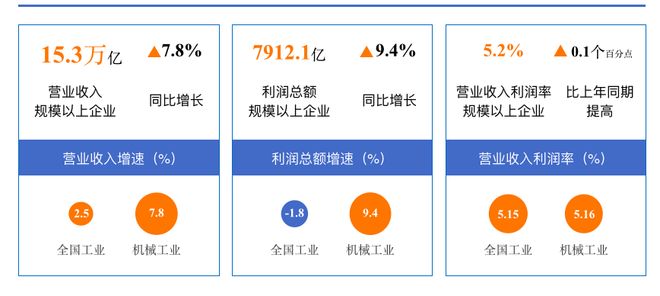
今年上半年机械工业规模以上企业增加值同比增长9.0%
Zheng Quan Shi Bao Wang· 2025-08-04 02:20
人民财讯8月4日电,8月4日,中国机械工业联合会发布的数据显示,2025年上半年,机械工业规模以上 企业增加值同比增长9.0%,增速高于全国工业和制造业2.6和2个百分点。其中,汽车和电气机械行业增 速分别为11.3%和12.2%,引领机械工业增长。 ...
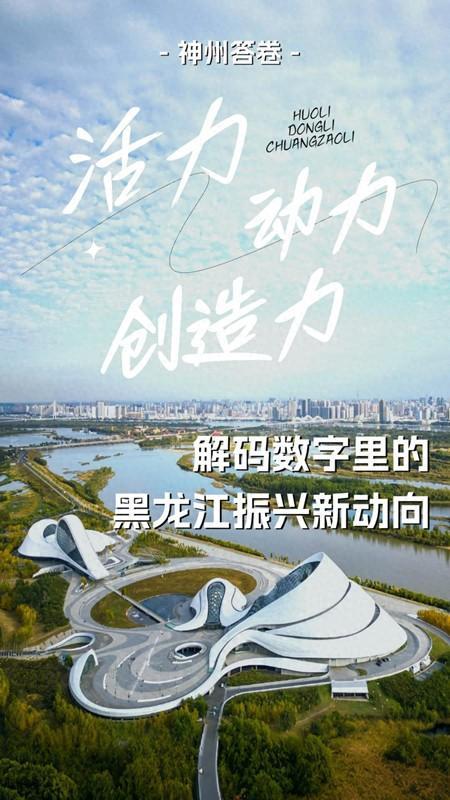
神州答卷|活力、动力、创造力——解码数字里的黑龙江振兴新动向
Xin Hua Wang· 2025-08-02 03:53
Economic Growth and Tourism - Heilongjiang Province received 135 million domestic and international tourists in the first half of the year, a year-on-year increase of 13.8%, with total tourism spending reaching 193.37 billion yuan, up 25.8% [4][6] - The integration of culture and tourism has led to a significant enhancement in consumer spending, showcasing a deep fusion and innovation within the tourism industry [4][8] - The province's tourism market is thriving, with events like the Harbin International Beer Festival attracting large crowds and boosting local consumption [8][10] Digital Economy and Industrial Upgrade - Heilongjiang is focusing on transforming traditional industries through digitalization, with manufacturing moving towards high-end, intelligent, and green production [12][14] - The province has seen a 5.2% year-on-year increase in industrial added value, with a remarkable 65.5% rise in manufacturing technology investment [12][14] - The introduction of smart manufacturing and AI technologies is becoming a core driver for industrial innovation and economic growth [14][15] Agricultural Innovation and Food Security - Heilongjiang is enhancing agricultural productivity through technological innovations, with a focus on high-quality grain production [19][21] - The province's agricultural output value reached 104.42 billion yuan in the first half of the year, reflecting a 3.8% year-on-year growth [21] - Investments in seed industry innovation and modern agricultural practices are being prioritized to ensure sustainable development and food security [21][23] International Trade and Economic Cooperation - The province is actively participating in international trade, with a total import and export value of 160.12 billion yuan in the first half of the year, marking a historical high [26] - The 34th Harbin International Economic and Trade Fair attracted over 1,500 enterprises from 38 countries, showcasing advancements in technology and innovation [26][27] - Heilongjiang is leveraging its geographical position to enhance its role in the Belt and Road Initiative, promoting high-level openness and cooperation [23][27]
热点思考 | 反内卷:为何需关注地方政府?(申万宏观·赵伟团队)
赵伟宏观探索· 2025-08-01 16:03
Group 1 - The current "anti-involution" differs from previous instances by focusing more on regulating local government behavior, emphasizing the need for a unified government action standard [2][11][90] - The shift from "Five Unifications and One Abolition" to "Five Unifications and One Opening" highlights the importance of local government behavior regulation and external openness [11][12][90] - The current round of "involution" is driven by local governments' deep involvement, characterized by creating policy gaps, blindly launching projects, and setting market barriers [2][16][90] Group 2 - Local governments are facing pressure to find growth drivers due to the downturn in the real estate cycle, with national commodity housing sales area down 39.7% and real estate investment down 27.3% from 2021 to 2024 [4][29][92] - The reliance on land finance has decreased, leading local governments to seek growth in high-tax industries, with manufacturing and wholesale retail accounting for 32% and 14% of total tax revenue in 2021 [4][37][92] - The principle of "production-based taxation" in the VAT system encourages local governments to promote manufacturing clusters [42][92] Group 3 - The average investment growth rate in manufacturing exceeded 10% in 16 provinces from 2022 to 2023, with the top five provinces averaging over 20% [52][53][92] - There is a significant overlap in industrial planning among local governments, particularly in sectors like pharmaceuticals, new materials, artificial intelligence, and new energy, leading to repeated construction and overcapacity [57][94] - Local governments are competing through tax incentives and subsidies, resulting in significant differences in manufacturing tax burdens across provinces, with a national average of 17.4% in 2023 [70][94] Group 4 - The central government is likely to implement targeted reforms to address local government "involution," including regulating investment attraction behaviors and promoting a healthy investment environment [79][94] - Short-term measures may include cleaning up illegal policy incentives, while long-term strategies could involve changing government functions and promoting efficient resource allocation nationwide [79][94]
宁波122家A股上市公司总市值达1.36万亿元
Zhong Zheng Wang· 2025-08-01 12:19
Group 1 - As of July 31, 2025, there are 122 A-share listed companies in Ningbo with a total market capitalization of 1.36 trillion yuan [1] - The top ten companies by market capitalization include Ningbo Bank, Bull Group, Top Group, Ningbo Port, Deye Shares, Youngor, Dongfang Cable, Samsung Medical, Joyson Electronics, and Shuanglin Shares [1] - Among the 122 A-share listed companies, 100 are in the manufacturing sector, accounting for 81.97% of the total [1] Group 2 - The distribution of companies by industry shows 5 in construction (4.10%), 4 in transportation, storage, and postal services (3.28%), and 3 each in leasing and business services and wholesale and retail (2.46% each) [1] - The remaining 7 companies are spread across five major industries, including electricity, heat, gas, and water production and supply, real estate, and information transmission, software, and IT services [1] - By exchange, there are 68 companies on the Shanghai Stock Exchange (63 on the main board and 5 on the Sci-Tech Innovation Board), 50 on the Shenzhen Stock Exchange (17 on the main board and 33 on the Growth Enterprise Market), and 4 on the Beijing Stock Exchange [1] Group 3 - The top three regions by the number of A-share listed companies are Yinzhou District (27 companies), Beilun District (19 companies), and Yuyao City (17 companies) [2]