
科技创新

Search documents
中央明确北京、上海国际科创中心扩围
Di Yi Cai Jing Zi Xun· 2025-12-14 12:31
Core Insights - The construction of three major international technology innovation centers in China, namely Beijing, Shanghai, and the Guangdong-Hong Kong-Macao Greater Bay Area, is increasingly significant in the country's technology innovation landscape [2][3] Group 1: Development and Achievements - The central government has made significant progress in establishing these innovation centers since the 18th National Congress, aiming to accelerate the formation of original innovation sources in China [2] - According to the 2025 Global Innovation Index released by WIPO, the Shenzhen-Hong Kong-Guangzhou cluster has surpassed the Tokyo-Yokohama cluster to rank first globally, with Beijing and the Shanghai-Suzhou cluster ranking fourth and fifth, respectively [3] - Beijing's original innovation capability has strengthened, with basic research funding accounting for over 16% of its total R&D expenditure [3] Group 2: Regional Collaboration and Innovation - The collaborative innovation effects among major city clusters have improved, with the Beijing-Tianjin-Hebei region showing continuous strengthening in collaborative innovation development [4] - The Yangtze River Delta's innovation community is accelerating its formation, and the Guangdong-Hong Kong-Macao Greater Bay Area maintains strong innovation development momentum [4] Group 3: Rankings and Investment - Beijing ranks second nationally in comprehensive technology innovation level, with R&D expenditure intensity reaching 6.73%, the highest in the country [5] - Shanghai has risen to first place in comprehensive ranking, with R&D expenditure intensity ranking second, and leading in technology international income per unit GDP and labor productivity [5] Group 4: Future Directions and Strategies - The Beijing International Technology Innovation Center aims to establish a basic framework this year, focusing on enhancing the technology innovation source function and integrating technology with industrial innovation [6] - Shanghai's strategy emphasizes deepening systemic reforms and focusing on high-risk, high-value basic research, particularly in integrated circuits, biomedicine, and artificial intelligence [6][7] - The Guangdong-Hong Kong-Macao Greater Bay Area is working to leverage its unique advantages to build a tighter innovation community and optimize the regional technology innovation layout [7]


中央明确北京、上海国际科创中心扩围
第一财经· 2025-12-14 12:22
Core Viewpoint - The article emphasizes the growing significance of three major international science and technology innovation centers in China: Beijing, Shanghai, and the Guangdong-Hong Kong-Macao Greater Bay Area, which are positioned as strategic hubs for original innovation and technological advancement in the country [3][5]. Group 1: Progress and Rankings - The three international innovation centers have seen significant progress, with their comprehensive indices rising in global rankings, placing them among the top 10 global technology innovation clusters [5]. - According to the 2025 Global Innovation Index by the World Intellectual Property Organization (WIPO), the Shenzhen-Hong Kong-Guangzhou cluster has surpassed the Tokyo-Yokohama cluster to become the top cluster, with Beijing ranked fourth and the Shanghai-Suzhou cluster fifth [6]. - Beijing's original innovation capacity has strengthened, with basic research funding accounting for over 16% of its total R&D expenditure [6]. Group 2: Regional Innovation Dynamics - The collaborative innovation effects among major city clusters have improved, with the Beijing-Tianjin-Hebei region enhancing its collaborative innovation development, and the Yangtze River Delta forming a technology innovation community [6][9]. - Beijing ranks second nationally in comprehensive technology innovation level, maintaining the top position in the innovation environment, while Shanghai has risen to first place in overall ranking [7]. Group 3: Future Directions and Initiatives - The article outlines future initiatives for the three innovation centers, including the establishment of a basic framework for the Beijing International Science and Technology Innovation Center and the deepening of integration between technological and industrial innovation [9][10]. - Shanghai aims to focus on high-risk, high-value basic research and enhance the strategic agility of its technological layout through systemic reforms [10]. - The Guangdong-Hong Kong-Macao Greater Bay Area is set to leverage its unique "one country, two systems" advantage to strengthen its innovation community and optimize its technological innovation spatial layout [10].

西南证券首席经济学家叶凡:2026年中国经济回稳向好趋势有望延续
Zheng Quan Ri Bao· 2025-12-14 12:05
Core Viewpoint - The Central Economic Work Conference held on December 10-11 outlines clear policy directions and development signals for 2026, emphasizing the need for coordinated policy efforts and opportunities for industrial innovation [1]. Group 1: Policy Coordination and Economic Outlook - The conference highlights the importance of systematic and forward-looking policy layouts, shifting the focus from "promoting stability through progress" to "enhancing quality and efficiency" [2]. - Key tasks for 2026 include boosting consumption, which remains a priority, and addressing the "strong supply and weak demand" issue, indicating that these challenges can be resolved through efforts [2]. - The expected GDP growth rate for 2026 is around 4.9%, with nominal GDP growth projected to rebound to approximately 4.2% [3]. Group 2: Fiscal and Monetary Policy - The conference reiterates the need for a more proactive fiscal policy, maintaining necessary fiscal deficits and optimizing expenditure structures [3]. - Monetary policy will continue to adopt a supportive stance, with flexible tools like reserve requirement ratio cuts and interest rate reductions to ensure ample liquidity [3]. Group 3: Innovation and Domestic Demand - The focus on "domestic demand as the main driver" encompasses both consumption and investment needs, with an emphasis on optimizing supply to stimulate demand [4]. - The conference prioritizes innovation-driven growth, with plans to develop "artificial intelligence+" and establish international science and technology innovation centers [4][5]. - Financial innovation will support technological advancements, ensuring a positive cycle between technology, industry, and finance [5].

为国担当、勇为尖兵,在挑大梁作贡献上展现新作为!上海市委常委会扩大会议传达中央经济工作会议精神
Di Yi Cai Jing· 2025-12-12 13:49
上海市委常委会今天(12月12日)下午举行扩大会议,传达中央经济工作会议精神。市委书记陈吉宁主 持会议并强调,要深入学习贯彻习近平总书记在中央经济工作会议上的重要讲话精神,准确把握、深刻 领会党中央对国内外经济形势的科学判断、对明年工作的总体要求和重点任务,为国担当、勇为尖兵, 在挑大梁作贡献上展现新作为,在推进中国式现代化中充分发挥龙头带动和示范引领作用,确保"十五 五"开好局、起好步。 会议指出,要把学习贯彻中央经济工作会议精神和习近平总书记考察上海重要讲话精神紧密结合起来, 以当好"施工队长"的强烈自觉和有力行动,深入抓好中央决策部署的贯彻落实。要充分释放内需潜力, 高质量推进"两重"项目建设。围绕投资于人,扩大有效投资,激发民间投资活力,加强人力资源开发, 加大对服务业优质高效发展的引导和支持。落实提振消费专项行动,推动文旅商体展深度融合。深入推 进"五个中心"建设,紧扣建设上海(长三角)国际科技创新中心,携手苏浙皖打造世界级科技创新策源 地,更好以科技创新引领产业升级,加快培育壮大新动能。持续强化"四大功能",加强对跨境和离岸金 融、全球供应链管理、企业走出去综合服务、全球大宗商品交易等重点功能布局 ...
创新“以点带面”:三大国际科创中心领航,激活企业创新活力
Bei Ke Cai Jing· 2025-12-12 07:15
Group 1 - The core viewpoint emphasizes the need for "innovation-driven development" and the establishment of international technology innovation centers in Beijing, Shanghai, and the Guangdong-Hong Kong-Macao Greater Bay Area [1][2] - The meeting reinforces the strategic importance of these regions in fostering high-quality development, enhancing global innovation cooperation, and addressing critical technological challenges [1][2][3] - The focus is on creating a complete and vibrant innovation ecosystem that integrates top universities, strong manufacturing bases, active venture capital, diverse application scenarios, and efficient result transformation mechanisms [3][4] Group 2 - The three international innovation centers have distinct roles: Beijing focuses on basic research and national strategic technology tasks, Shanghai emphasizes the integration of technology and industry, while the Greater Bay Area promotes cross-border innovation cooperation [3][4] - To avoid homogenization of competition among these regions, it is crucial to adopt differentiated development paths and establish collaborative mechanisms for resource sharing and mutual recognition of achievements [4][5] - Companies are identified as key players in driving innovation, but they face challenges such as resource misallocation, insufficient intellectual property protection, and barriers in the transformation of scientific achievements [5][6] Group 3 - Proposed solutions to enhance the innovation capacity of companies include improving innovation incentive mechanisms, building collaborative innovation platforms, and strengthening comprehensive intellectual property protection [6][8] - New emerging fields of intellectual property face unique challenges, including ambiguous boundaries, shortened life cycles, and strong interdisciplinary integration, complicating rights definition and protection [8][9] - The legal framework for intellectual property is lagging behind emerging technologies, necessitating gradual solutions to enhance corporate innovation vitality [9]
全球媒体聚焦 | 外媒:中国正以高效举措优化经济发展
Sou Hu Cai Jing· 2025-12-12 02:16
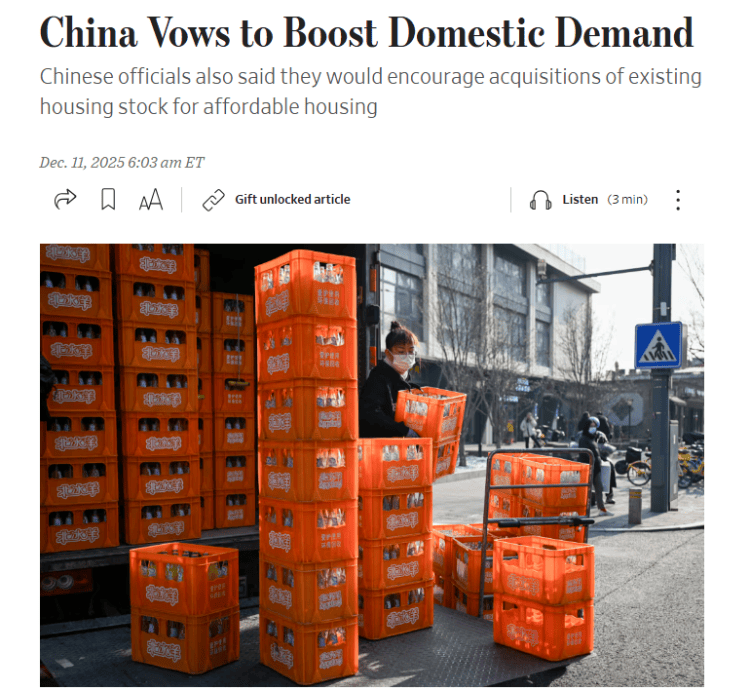
中央经济工作会议明确提出,"坚持内需主导,建设强大国内市场"是明年经济工作的重点任务之一。 路透社在报道中关注到,中国将深入实施提振消费专项行动,制定实施城乡居民增收计划。报道指出,服 务消费在中国拥有巨大发展潜力,相关举措将有效激活这一潜力。报道援引经济分析师克里斯托弗·贝多的 观点认为,政府将采取更多措施支持家庭消费,进而持续提升国内市场的活力。 2025年12月10日至11日,在北京召开,为2026年中国经济工作指明了方向。多家外媒认为,会议传递出的 明确信号不仅展现了中国应对复杂外部环境不确定性的坚定决心,还强调了推动高质量发展的长期战略目 标。 加强内需驱动,激发消费潜力 《华尔街日报》则提到,中国将清理消费领域的"不合理限制"措施,这将有助于提振内需,改善民生,并 进一步推动国内经济的稳定发展。 政策着眼未来 △《华尔街日报》网站截图 彭博社分析认为,会议明确透露出2026年将持续推出相关经济促进政策,始终坚持稳中求进的工作总基 调,这一信号凸显中国将坚定保障经济长期增长目标。 报道同时提及,中国经济在2025年展现出惊人韧性,尤其是在面对美国关税壁垒时,中国通过积极开拓多 元化出口市场,进一步印 ...
“评价准”破解科创企业融资难
Jing Ji Ri Bao· 2025-12-11 21:37
Core Viewpoint - The People's Bank of China, along with various Shanghai financial and governmental bodies, has initiated the "Shanghai Science and Technology Credit Points Loan" program to encourage financial institutions in Shanghai to use "Shanghai Science and Technology Points" as a key criterion for evaluating the innovation capabilities of enterprises, thereby facilitating loans to local companies under manageable risk conditions [1]. Group 1: Evaluation of Innovation Enterprises - The current consensus in the industry is to shift the evaluation of science and technology enterprises from a historical perspective ("looking at the past") to a forward-looking approach ("looking at the future") [1]. - Financial institutions are increasingly focusing on the growth potential and development capabilities of enterprises, such as patent status, product layout, and the qualifications of founding teams, rather than solely on historical financial performance [1]. Group 2: Implementation of the Innovation Points System - The "Innovation Points System" provides a structured approach to defining specific indicators for evaluating future potential, including weightings, data standards, and application scenarios [2]. - The system was piloted in 13 national high-tech zones in 2020, with further developments leading to the release of the "Innovation Points System Work Guidelines (National Trial Version)" in August 2024 and an upgraded version in October 2025 [2]. Group 3: Financial Institutions' Role - The "Innovation Points System Work Guidelines (Version 2.0)" consists of 9 quantitative indicators and 3 bonus indicators, structured into 4 primary indicators and 12 secondary indicators, allowing financial institutions to better identify and evaluate technology-oriented enterprises [3]. - Financial institutions are encouraged to adapt the application of the "Innovation Points System" to their regional characteristics and the specific realities of enterprises, linking it with other supportive policies to enhance the effectiveness of financial support for innovation [3].
市发展和改革委员会党组书记、主任王洋:未来五年要确保现代化大武汉建设取得决定性进展
Chang Jiang Ri Bao· 2025-12-10 08:06
Core Viewpoint - The article outlines the strategic plan for Wuhan's development over the next five years, emphasizing the goal of establishing "five centers" and advancing towards a modernized Wuhan as part of the city's 15th Five-Year Plan [1][2]. Group 1: Development Goals - The 15th Five-Year Plan aims to ensure significant progress in building "five centers" and modernizing Wuhan, which serves as the main line of work and a guiding mission for the city [2][4]. - The goal system is designed to align with the times, local conditions, and practical progress, acting as a comprehensive roadmap for Wuhan's development over the next five years [3][4]. Group 2: Key Development Areas - The plan identifies seven key areas for economic and social development, including economic growth, legal system advancement, cultural tourism, social equity, and ecological harmony [3][4]. - The focus is on optimizing industrial structure, enhancing open hub functions, integrating culture, commerce, tourism, and achieving carbon peak targets, which are essential for high-quality development [4]. Group 3: Achievements During the 14th Five-Year Plan - Wuhan's GDP has consistently increased, surpassing 2 trillion yuan, ranking among the top ten cities in China and first in Central China [6]. - The city has made significant strides in innovation, establishing a nationally influential technology innovation center and achieving breakthroughs in various scientific fields [6][7]. - Reforms in key sectors have led to a more vibrant market environment, with a notable increase in the share of the private economy [7]. Group 4: Future Development Focus - The city aims to achieve a GDP exceeding 3 trillion yuan by 2030, with a focus on economic growth driven by consumer spending and effective investment [8][9]. - The plan emphasizes the need for a modern industrial system, integrating traditional industries with emerging sectors and fostering innovation [8][9]. - Urban renewal initiatives will focus on improving existing infrastructure and enhancing community living standards, promoting a comprehensive approach to urban development [9].
城市融、科创燃、平台优!广东“十五五”如何建“最好湾区”
Nan Fang Du Shi Bao· 2025-12-09 03:17
Core Viewpoint - The Guangdong Province is committed to enhancing the development of the Guangdong-Hong Kong-Macao Greater Bay Area, aiming to create a vibrant and internationally competitive first-class bay area and world-class city cluster, as outlined in the recently published 15th Five-Year Plan proposal [1] Group 1: Transportation Infrastructure - The Greater Bay Area has accelerated transportation construction, with over 3,000 kilometers of rail transit established, making it a leading city cluster in the country [2] - The completion of the Shenzhen-Zhongshan Bridge has reduced travel time from 2 hours to 30 minutes, enhancing connectivity [2] - Daily travel volume between Guangzhou and other cities in the Bay Area is projected to reach 3.2 million by 2024, indicating a significant increase in intercity commuting [2][3] Group 2: Innovation and Technology - The Greater Bay Area is enhancing collaborative innovation, with 32 joint laboratories established in key sectors such as artificial intelligence and biomanufacturing [4] - Guangdong has allocated 460 million yuan in research funding for cross-border projects, facilitating the establishment of a "research community" in the region [4] - Several Hong Kong and Macao universities are expanding into the Bay Area, contributing to a growing pool of talent and research capabilities [4] Group 3: Economic Development Platforms - The four major cooperation platforms (Hengqin, Qianhai, Nansha, and He Tao) are becoming key engines for development, with significant contributions to local GDP and attracting international financial institutions [5][6] - The "Cross-border Wealth Management Connect" business has surpassed 120 billion yuan, indicating robust financial integration [6] - Guangdong plans to enhance the role of these platforms in facilitating major policies and reforms, further promoting cross-regional economic cooperation [6]
定调!重磅会议召开!
Jin Rong Shi Bao· 2025-12-08 13:35
Core Viewpoint - The Central Political Bureau of the Communist Party of China has set the tone for economic work in 2026, emphasizing "seeking progress while maintaining stability" and "improving quality and efficiency" as key principles for the upcoming economic strategy [1] Economic Performance - The macroeconomic resilience has exceeded market expectations, with high-tech manufacturing leading growth [2] - The total economic output is projected to reach approximately 140 trillion yuan this year [2] - The focus for 2026 will be on achieving qualitative improvements and reasonable quantitative growth while ensuring social stability and a good start to the 14th Five-Year Plan [2] Macroeconomic Policy - The meeting highlighted the continuation of a more proactive fiscal policy and moderately loose monetary policy, aiming to enhance macroeconomic governance effectiveness [3] - The fiscal deficit rate is expected to remain around 4%, with local government special bond issuance potentially increasing from 4.4 trillion yuan in 2025 to about 5 trillion yuan [3] - Monetary policy will seek a dynamic balance among multiple objectives, including stable growth and risk prevention [3] Domestic Market Development - The strategy emphasizes the need to build a strong domestic market to counter external uncertainties and enhance economic resilience [6] - Experts suggest that a consumption-oriented policy framework should be established, alongside reforms in income distribution and effective investment expansion [6] Innovation and Infrastructure - The focus on innovation and industrial development remains critical, with support for leading enterprises to form innovation alliances for national technological challenges [6] - There will be increased policy support for "new infrastructure" development, including communication networks and modern energy systems [6][7] Market Environment - A unified national market is essential for supporting technological innovation, with recommendations for optimizing institutional rules and protecting property rights [7] - Addressing "involution" competition is necessary to establish a healthy market order that promotes quality and fair pricing [7]