
海运

Search documents
【财经分析】加沙停火第一阶段协议生效后 红海国际航运何时恢复?
Xin Hua Cai Jing· 2025-10-24 10:29
Core Points - The recent ceasefire agreement between Hamas and Israel has increased the possibility of safe passage through the Red Sea, but conditions for international shipping to return are not yet mature [1][4] - The shipping industry has experienced significant fluctuations in freight rates due to the ongoing crisis, with rates peaking at over three times the normal levels before gradually declining [2][3] - Egypt has faced a substantial loss in revenue from the Suez Canal, amounting to approximately $9 billion over the past two years due to the crisis [2] Shipping Industry Impact - The Red Sea crisis has forced most container ships and some oil and bulk carriers to reroute around the Cape of Good Hope, leading to increased fuel costs and lower turnaround efficiency for shipping companies [3] - The return of international shipping to the Red Sea is contingent upon several conditions, including the effective implementation of the ceasefire agreement and improved security in the region [4][6] - Analysts predict that even if the ceasefire holds, shipping companies may need to wait several months for guarantees against further attacks before considering a return to the Red Sea [6][7] Future Outlook - The likelihood of restoring the Red Sea shipping route before the Chinese New Year in 2026 is considered low, with some experts suggesting that a more realistic timeline could extend to the October 2026 Golden Week [6][7] - Major shipping alliances may opt for a phased return to the Red Sea to avoid congestion at ports, as vessels from different routes could arrive simultaneously [7]
交运行业2025年四季度投资策略:岁暮回暖,超越季律
Changjiang Securities· 2025-10-24 05:27
Group 1: Logistics - The logistics industry is expected to undergo a paradigm shift towards high-quality development, driven by policy changes and the "anti-involution" movement, which aims to ensure the rights of delivery personnel and improve profitability [4][24][30] - The logistics sector is entering a new phase of overseas expansion, with companies like Jitu Express and Jiayou International transitioning from initial stages to more advanced operations, focusing on management and capacity exports [4][8][35] Group 2: Aviation - The aviation industry is poised for recovery, benefiting from a resurgence in business travel demand since September, leading to improved revenue and cost dynamics [9][51] - The supply side is tightening, with low aircraft deliveries expected in 2025 and high capacity utilization rates, indicating a potential for revenue and cost resonance in the industry [9][51] Group 3: Shipping - The shipping sector is influenced by both seasonal and non-seasonal factors, with a focus on oil transportation due to OPEC+ production adjustments and the expected positive impact of new projects in the dry bulk segment [10][20] - The container shipping market is facing tariff disruptions, but demand is anticipated to rise due to proposed measures from the 301 investigation, which may boost feeder vessel demand [10][20] Group 4: Highways - Highway companies are regaining attractiveness in terms of valuation and dividend yield, with a focus on low valuation and high dividend characteristics [11][20] - The widening gap between highway company dividend yields and ten-year government bond yields suggests a return to a high cost-performance ratio for these assets [11][20]





山西开辟铁路35吨宽体集装箱铁海联运“一箱到底”新通道
Zhong Guo Xin Wen Wang· 2025-10-22 07:19
Core Viewpoint - Shanxi has successfully opened a new "one box to the end" rail-sea intermodal transport channel for 35-ton wide-body containers, enhancing logistics efficiency and reducing costs [1][3]. Group 1: Logistics and Transportation - The first train, J80112, departed from the Datong Railway Logistics Center, carrying 98 wide-body containers with a total weight of 3,136 tons of industrial non-stick coal [1][3]. - The 35-ton wide-body containers are advantageous due to their strong loading capacity, low logistics costs, and wide adaptability for transporting bulk goods like coal and minerals [3]. - The new intermodal transport method reduces logistics costs by 13% and nearly eliminates cargo damage, which previously stood at 5‰ [3][4]. Group 2: Operational Efficiency - The new system allows for seamless integration of rail, port, and shipping data, simplifying the logistics process for shippers who now only need to coordinate with the railway department [4]. - The initiative is expected to operate three dedicated trains per month, aiming to ship nearly 1,000 wide-body containers by the end of the year, thereby improving service to downstream enterprises [4].

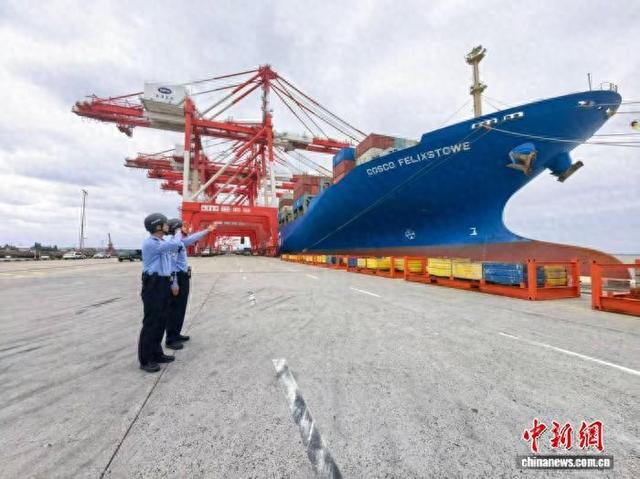
“中远费力克斯托”轮入境带来南太平洋国家进博会展品 上海边检部门开启“绿色通道”
Zhong Guo Xin Wen Wang· 2025-10-21 07:19
Core Points - The "Zhongyuan Felix" container ship has arrived at Shanghai's Waigaoqiao Port carrying exhibits for the 8th China International Import Expo (CIIE) [1][3] - The CIIE serves as a strategic platform connecting China with the world, providing opportunities for businesses to observe China's openness and market potential [3][4] Shipping and Logistics - The "Zhongyuan Felix" ship departed from Auckland, New Zealand, on September 20, transporting various specialty products including dairy, natural mineral water, coconut oil, and handcrafted items [1][3] - A specialized guarantee plan was implemented for the transportation of sensitive products like dairy, utilizing advanced temperature-controlled storage and transport equipment to ensure optimal conditions during transit [3] Customs and Inspection - Shanghai's border inspection authorities have established a "green channel" for the efficient and safe entry of CIIE exhibits, facilitating the entire process from transportation to customs clearance [3][4] - Eight convenience measures have been introduced by Shanghai's border inspection authorities to enhance customs clearance for the CIIE, including dedicated inspection channels and a hotline service [4]

今年前三季度“钱凯-上海”海运航线运载进出口货物15.4万吨
Xin Hua Cai Jing· 2025-10-20 16:26
Core Insights - The "QianKai-Shanghai" maritime route has facilitated significant growth in trade between Shanghai and Peru, with imports and exports reaching 134.2 billion RMB in the first three quarters of this year, marking a substantial increase of 56.9% compared to the same period last year [1]. Group 1: Trade Volume and Value - In the first three quarters of this year, Shanghai Customs supervised a total of 15.4 million tons of goods and a value of 39.7 billion RMB through the "QianKai-Shanghai" maritime route [1]. - In the first half of this year, the same route accounted for 7.8 million tons of goods and a value of 17.2 billion RMB, indicating a rapid acceleration in trade activity [1]. Group 2: Economic Significance - The "QianKai-Shanghai" maritime route is emerging as a new bridge for economic and trade exchanges between China and Peru, enhancing bilateral trade relations [1]. - The first batch of maritime exhibition items from Peru, including 764 handcrafted items such as alpaca dolls and ceramic cows, arrived at Shanghai Yangshan Port for the upcoming China International Import Expo [1].
绿色金融联合研究(五):集运碳成本更新:基于2024年排放数据的影响重估
Guo Tai Jun An Qi Huo· 2025-10-20 08:05
◼ 海运业首个履约年度碳账单约 24 亿欧元 2024 年,海运业在 EU ETS 覆盖范围内的经核查排放量为 0.9 亿吨,海运业首个履约年度的碳账单约 为 24 亿欧元。预计 2025 年海运业碳账单或达到 42 亿欧元;2026 年,EU ETS 对海运业温室气体覆盖范围 进一步扩展至甲烷和一氧化二氮,估算其对应的碳成本可能升至 62 亿欧元。 ◼ 集运碳成本对运费的影响权重日渐增加 二 〇 二 五 年 度 2025 年 10 月 20 日 集运碳成本更新:基于 2024 年排放数据的影 响重估——绿色金融联合研究(五) 唐惠珽 投资咨询从业资格号:Z0021216 tanghuiting@gtht.com 郑玉洁 投资咨询从业资格号:Z0021502 zhengyujie@gtht.com 报告导读: ◼ EU ETS 影响全球 13%的船舶、49%的集装箱运力 2024 年,实际受 EU ETS 管制的船舶数量约占全球船舶总量的 13%,其碳排放约占全球船舶碳排放总 量的 17%。近五成的全球集装箱运力在 EU ETS 的管辖范围内。 基于 THETIS-MRV 公布的 2024 年最新排放数据,本 ...
交运周专题:航空四要素同改善,海运迎来超季节性攻势
Changjiang Securities· 2025-10-19 23:30
Investment Rating - The report maintains a "Positive" investment rating for the transportation industry [8] Core Insights - The travel chain is experiencing a recovery in demand, with ticket prices showing a positive trend and a clear inflection point in revenue [2][5] - The shipping sector is witnessing a seasonal surge in freight rates due to peak season and geopolitical factors [6] - The logistics sector is seeing a year-on-year increase in unit prices for major express delivery companies, with a second round of price hikes initiated [6] Summary by Sections Aviation - Demand recovery is evident, with business travel gradually increasing since September, leading to improved revenue margins. The industry is expected to benefit from a tightening supply side and lower fuel costs, resulting in a resonance of income and costs [5][17] - The introduction of new aircraft is expected to remain slow in 2025, with engine maintenance squeezing capacity. The industry is projected to reach historical highs in capacity utilization [5][17] Shipping - Oil shipping rates are on the rise, with the average VLCC-TCE increasing by 8.7% to $86,000 per day. Geopolitical events and OPEC+ production increases are expected to support the oil shipping market [6][22] - The SCFI index for foreign trade shipping has risen by 12.9% to 1,310 points, driven by increased demand and tariff adjustments [6][22] - The BDI index for bulk shipping has increased by 6.9% to 2,069 points, supported by stable overseas mining shipments [6][22] Logistics - The express delivery sector is seeing a year-on-year increase in unit prices, with a second round of price hikes underway. The overall performance of the sector is expected to improve in Q4 and next year [6][36] - The average daily collection volume for postal express services has decreased by 0.7% year-on-year, indicating seasonal effects and price adjustments [6][36]



回眸“十四五”|海洋强国:“蓝色引擎”迸发活力
Jing Ji Ri Bao· 2025-10-19 01:10
Core Viewpoint - The ocean is becoming a significant force for stable growth and a new engine for economic development in China, with a focus on marine economic development and ecological protection during the "14th Five-Year Plan" period [2][3]. Economic Growth and Development - China's marine GDP surpassed 10 trillion yuan, reaching 10.5 trillion yuan, a 34% increase from the end of the "13th Five-Year Plan," accounting for 7.8% of the national GDP [1]. - The first self-operated ultra-deepwater gas field, "Deep Sea No. 1," has been fully operational since June 25, marking a key step in large-scale deep-sea oil and gas development [3]. - Marine oil and gas resources are expected to contribute over 70% of the domestic crude oil increment in 2024, with marine crude oil and natural gas production projected to grow by 4.7% and 8.7%, respectively [3]. Emerging Marine Industries - New emerging marine industries, such as marine engineering equipment, seawater desalination, marine medicine, and offshore wind power, are becoming new economic growth points [4]. - The market share of marine engineering equipment is expected to exceed 50% globally in 2024, with seawater desalination projects exceeding 2.9 million tons per day [4]. Technological Innovation - Technological innovation is identified as the primary driving force for marine economic development during the "14th Five-Year Plan" [6]. - The establishment of the national marine comprehensive test site in Hainan aims to support deep-sea scientific research and technological innovation [5]. - The marine technology innovation index is projected to reach 135.2 in 2024, reflecting a 2.6% increase from the previous year [7]. Environmental Protection and Sustainable Development - High-level protection is essential for sustainable marine economic development, with significant efforts made in coastal restoration and marine ecological system improvement [9]. - China has signed blue economy cooperation agreements with over 50 countries, promoting practical cooperation projects that contribute to local poverty alleviation [9]. Future Outlook - The marine economy is expected to continue growing, with a focus on cultivating new productive forces and building a modern marine industry system [10]. - The total import and export volume of marine transportation is projected to grow by 1.9% in 2024, with trade with countries along the "Belt and Road" increasing by 6.3% [10].
美国征收“入港费”也让日本忧虑
日经中文网· 2025-10-19 00:33
Core Viewpoint - The U.S. government is delaying the implementation of port fees for foreign-built car carriers from October to December, which may act as a hidden tariff on automobiles for Japanese shipping companies and manufacturers [2][4]. Group 1: Port Fee Details - The U.S. will charge a port fee of $46 per net ton for foreign-built car carriers, with the actual collection starting on December 10 [4][6]. - The fee is based on the "net tonnage" of the car carrier, which for large vessels carrying 7,000 to 7,500 cars is approximately 22,000 to 23,000 tons, resulting in fees exceeding $1 million [4][6]. - The fee structure has changed multiple times, initially proposed at $150 per vehicle, then adjusted to $14 per net ton, and finally set at $46 per net ton [5][6]. Group 2: Impact on Japanese Shipping Companies - Japanese shipping companies, including Nippon Yusen, Mitsui O.S.K. Lines, and Kawasaki Kisen Kaisha, hold a 40% share of the global car carrier market, making them significantly affected by the new fees [7][8]. - Nippon Yusen operates 127 car carriers, with about 30% of their cargo related to the U.S. market, indicating a substantial impact on their operations [7]. - The company is currently negotiating with automobile manufacturers on how to share the burden of the new port fees [9]. Group 3: Broader Trade Implications - The U.S. port fee is part of a broader strategy to counteract perceived unfair support for the Chinese shipbuilding industry, which accounts for 50% of global shipbuilding capacity [11]. - The fee structure was initially aimed at ships built in China but has since expanded to include all foreign vessels, indicating a wider impact on international trade dynamics [11][13]. - China has responded with its own measures, including a special port fee on U.S. vessels and sanctions against U.S. companies linked to investigations into Chinese shipbuilding practices [13].
揭秘涨停丨拟收购半导体资产,超过4亿元资金封涨停
Zheng Quan Shi Bao Wang· 2025-10-17 11:28
Core Insights - The A-share market saw a total of 44 stocks hitting the daily limit up, with a closing limit-up rate of 68.75% after excluding 7 ST stocks [1] Group 1: Semiconductor Sector - Huaten Technology had the highest limit-up order volume, with 340,400 hands, and announced plans to acquire 100% of Huayi Microelectronics for over 4.41 billion yuan [2] Group 2: Local Stocks in Fujian - The Fujian Marine Economy Industry Cooperation Innovation Development Conference signed 50 major marine economy projects with a total investment of 99.15 billion yuan [3] - Stocks such as Haixia Innovation, Pingtan Development, and Haitong Development saw limit-up, benefiting from local economic initiatives [4] Group 3: Coal Industry - Dayou Energy and Antai Group both hit the limit up, with Dayou Energy focusing on coal mining and processing, while Antai Group leverages local coal resources for its coking business [6] Group 4: Pharmaceutical Sector - Huabang Health and Chenxin Pharmaceutical both achieved limit-up, with Huabang Health being a leader in dermatological drugs and Chenxin focusing on innovative drug development [7] Group 5: Institutional Buying Trends - Tianji Shares saw over 200 million yuan in net buying from institutions, with East信和平 and Pingtan Development also among the top net buying stocks [8]
